
The Strategic Business Credit Building Program: A Roadmap to 0% Interest Capital
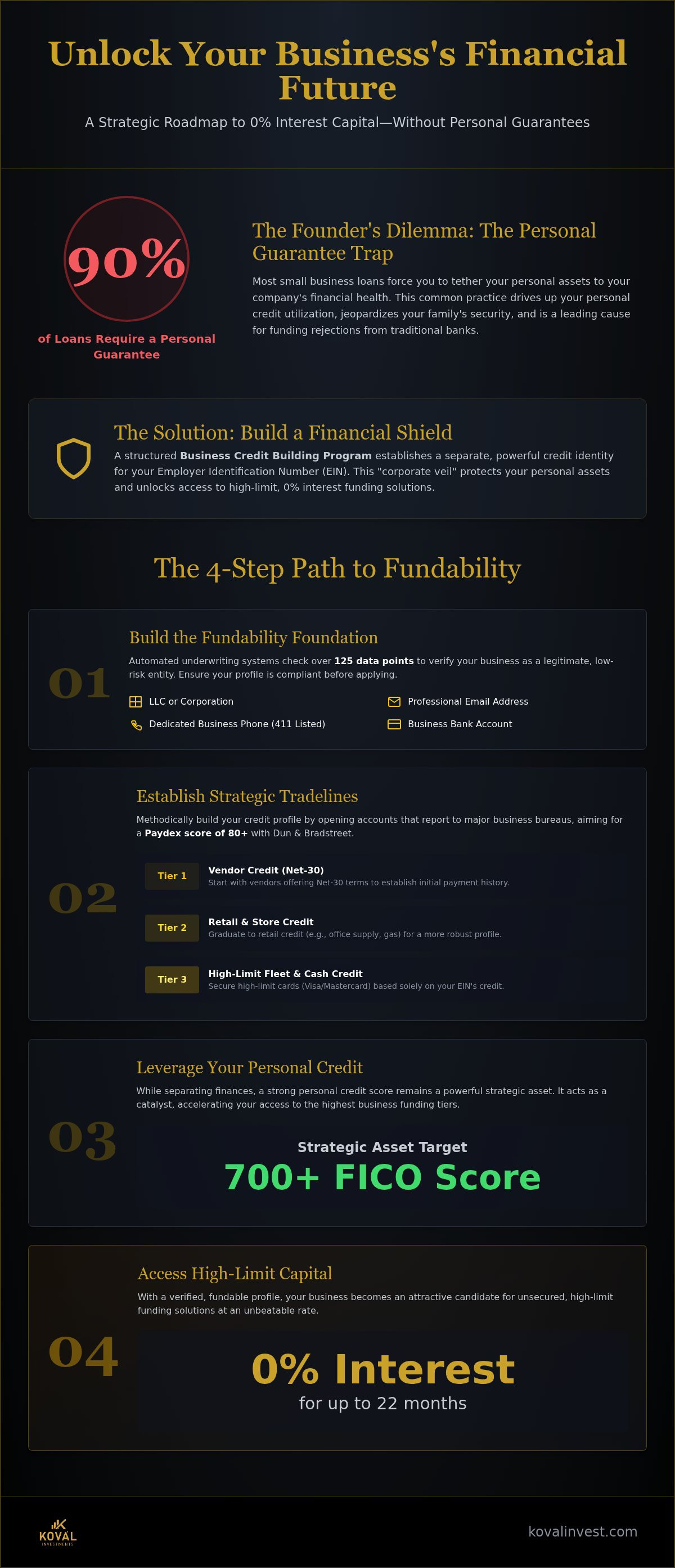
Over 90% of small business loans require a personal guarantee, effectively tethering your personal financial health to your company's every move. It is a common trap where business expenses drive up personal credit utilization, leading to bank rejections and a lower personal score. You likely started your company to build a legacy, not to see your personal financial stability compromised by operational costs. This frustration is understandable, especially when traditional lenders make the path to capital feel like an uphill battle.
A structured business credit building program offers a strategic way out of this cycle. By focusing on a fundability foundation, you can separate your personal and professional credit files to unlock high-limit, 0% interest funding solutions. This article provides a roadmap to building a fundable EIN profile that stands on its own. We will examine how to navigate business credit bureaus, establish strategic tradelines, and position your company to access 0% interest capital without the weight of personal liability.
Key Takeaways
- Establish a distinct financial identity for your EIN to protect your personal assets and lower your individual credit utilization.
- Learn how to satisfy the 125+ fundability data points that institutional lenders use to evaluate your business risk and approval odds.
- Discover the tiered strategy for reporting tradelines, moving methodically from Net-30 vendors to high-limit retail credit.
- Utilize a structured business credit building program to qualify for 0% interest funding solutions that provide strategic capital for up to 22 months.
- Understand why maintaining a 700+ personal FICO score is a strategic asset that accelerates your access to the highest business credit limits.
What is a Business Credit Building Program and Why Does Your EIN Need One?
A business credit building program is a systematic framework designed to establish a verified credit identity for your Business Tax ID (EIN) that exists entirely independent of your Social Security Number. While many owners hope credit will simply grow as they pay bills, organic growth is often too slow and inconsistent to satisfy modern lenders. A managed program ensures that every vendor you use and every account you open reports to the major bureaus. It's the difference between waiting for recognition and actively constructing a financial reputation that commands respect from institutional banks.
In 2026, this proactive approach is essential. Lenders have shifted toward sophisticated AI-driven algorithms to vet applicants, looking at over 125 specific data points before a human ever sees the file. If your business lacks a clear, separate history, these algorithms often default to a rejection or trigger a heavy reliance on your personal score. By building a robust profile, you maintain the "corporate veil," ensuring that your business liabilities don't bleed into your personal life or lower your individual credit score.
The Core Objectives of Credit Building
The primary goal is to generate a strong Paydex score with Dun & Bradstreet, which acts as the "FICO score" for the corporate world. Understanding What is a Business Credit Report? is fundamental here; these reports aggregate your payment history with vendors to prove you can handle "Trade Credit." A managed strategy focuses on three pillars:
- Credit Scoring: Establishing a Paydex score of 80 or higher through consistent reporting.
- Cash Flow Management: Utilizing vendor terms to bridge the gap between expenses and revenue.
- Institutional Fundability: Meeting the internal criteria banks use to approve high-limit funding.
Successfully building this history improves your operational cash flow and makes your company an attractive candidate for unsecured funding solutions that don't require collateral.
Separating Personal and Business Liability
Mixing finances is a significant risk. High personal credit utilization due to business costs is a leading reason for SBA loan rejections. When your personal cards are maxed out with inventory or marketing spend, your debt-to-income ratio makes you look high-risk to traditional banks. There is also a psychological benefit to a business-only financial ecosystem; it provides clarity and reduces the stress of personal financial exposure. The EIN credit profile is the primary asset for capital procurement. By focusing on this asset, you create a scalable foundation that supports long term growth without compromising your family's financial security.
The Fundability Foundation: Preparing Your Business for Approval
Before you apply for a cent of capital, you must ensure your business looks "fundable" to automated underwriting systems. Banks use more than 125 data points to verify that your business is a legitimate, low-risk entity. If a single detail, like a mismatched address or an unofficial email, doesn't align, the system may auto-decline your application. A professional business credit building program starts by auditing these data points to ensure your profile is bulletproof before you ever hit "submit" on an application.
Operating as a sole proprietorship is a major red flag for high-limit lenders. To be taken seriously, an LLC or Corporation is non-negotiable. This legal separation creates the entity that will hold the credit. Beyond the legal filing, your digital footprint must be consistent. This includes a dedicated business phone number listed with 411 and a domain-based email address rather than a generic personal account. These small details signal to lenders that you're a professional operator rather than a hobbyist.
Lenders also look at your North American Industry Classification System (NAICS) code. Some industries, like real estate or high-volume retail, are flagged as "High Risk." Choosing a code that accurately reflects your business while avoiding unnecessary high-risk designations is a critical part of the foundation. If you're unsure where your current profile stands, a fundability audit can identify gaps before they lead to rejections.
Structural Compliance for Lenders
Lenders verify your business bank account to confirm "Time in Business." This account serves as the heartbeat of your financial operations; without it, you can't prove revenue or operational stability. Additionally, your physical address matters. While virtual offices can work if set up correctly, using a commercial space or a verified business address is often preferred over a residential one. Avoid using P.O. Boxes, as they're often filtered out by fraud detection software during the initial vetting phase.
The EIN Credit Bureaus
You aren't just dealing with one bureau. Dun & Bradstreet is the primary gatekeeper, issuing the D-U-N-S number and the Paydex score. However, lenders also pull from Experian Commercial and Equifax Business. These reports are more complex than personal ones. Many banks also utilize the FICO SBSS score, which ranges from 0 to 300. This score is a major factor in SBA loan approvals and bank lines of credit. Following a guide on how to Build Business Credit in 6 Steps can help you stay organized as you tackle these different bureaus and ensure your business credit building program remains on track.
Strategic Tradelines: Scaling Your Credit Profile Methodically
Establishing a robust EIN profile requires more than just paying a few bills. It involves a tiered approach where each level of credit unlocks the next. Within a structured business credit building program, you move through four distinct phases of tradeline acquisition to ensure your profile is deep enough for high-limit approvals. This methodical progression prevents you from applying for advanced credit too early, which often results in hard inquiries without approvals.
Net-30 Vendor Strategy
Tier 1 focuses on Net-30 vendors. These companies, such as Uline or Quill, provide essential supplies and report your payment behavior to the bureaus. It's a foundational Strategy to Get Credit while conserving your operational cash flow. To advance to the next tier, you typically need at least five reporting tradelines. A common "early payment" hack involves paying your invoices by day 10 rather than day 29. Since the Paydex score heavily weights how early you pay, this practice can push your score into the elite 80+ range much faster than standard on-time payments.
Once Tier 1 is established, you move to Tier 2, which consists of retail credit. These are store-branded cards from retailers like Amazon or Home Depot that often don't require a personal guarantee once your EIN history is verified. Tier 3 introduces fleet and fuel cards. These are highly valuable because they generate frequent, recurring reporting activity, which demonstrates consistent debt management to the bureaus. Finally, Tier 4 represents unsecured revolving credit. This is the ultimate gateway to the 0% interest funding solutions that drive rapid business scaling.
Monitoring and Maintenance
A successful profile isn't just built; it's maintained. You must use professional monitoring tools to track your scores in real-time and ensure that every vendor you use is actually reporting. Inaccuracies are common in the commercial credit world, and they can stall your progress for months if left unaddressed. This is where the intersection of growth and mastering business credit repair services becomes vital. Regularly disputing errors and verifying data accuracy ensures that your file remains pristine as you move toward Tier 4. This methodical oversight prevents setbacks and keeps your capital procurement goals on schedule.
The Role of Personal Credit Restoration in Business Scaling
Many entrepreneurs are told they can build massive credit limits without ever touching their personal financial files. This is often a half-truth. While a business credit building program creates a separate identity for your EIN, your personal FICO score remains a vital catalyst for high-growth funding. For 0% interest solutions with high limits, lenders frequently look at the owner's personal profile as a secondary assurance. A score of 700 or higher serves as an accelerant; it allows you to bypass manual reviews and secure larger amounts of capital than a standalone EIN profile might achieve in its early stages.
At Koval Investments, we utilize a success-based philosophy for credit restoration. This means our goals are directly aligned with yours; we don't succeed unless your profile reaches the benchmarks required for funding. This approach removes the red flags that trigger automated rejections, such as thin files or past delinquencies. By optimizing both your personal and professional profiles simultaneously, you create a dual-track advantage that most competitors ignore. It's a pragmatic way to ensure you're ready for capital when the right opportunity arises.
Optimizing the Personal Profile for SBA Loans
Lenders are particularly wary of "zombies," which are old, unverified collections that suddenly reappear on your report. These can be fatal when seeking SBA loan assistance. Beyond removing errors, you must manage your personal credit utilization. Keeping your personal balances below 30% demonstrates credit capacity. It shows lenders you have the discipline to handle debt, even if your business is currently in a growth phase. This discipline is a key metric in the AI-driven vetting processes used by major banks in 2026.
Disputing Business Credit Errors
Errors on commercial reports are surprisingly common. These range from incorrect NAICS industry codes to outdated physical addresses that don't match your bank records. Unlike consumer credit, business bureaus don't have the same strict federal oversight, making the bureaucracy harder to navigate alone. A professional service can manage these disputes, ensuring your reports are accurate and your interest rates remain as low as possible. Clean reports lead to higher funding limits and better terms across the board. If you're ready to align your profiles for maximum capital access, you can start your credit optimization today through our success-based model.
From Credit Profile to Capital: Leveraging the Koval 0% Funding Solution
The culmination of a successful business credit building program isn't just a high score; it's the ability to procure capital on your own terms. Once your EIN profile is robust and your fundability foundation is secure, you can leverage the Koval 0% Interest Funding Solution. This strategy allows businesses to access significant capital for a period of 12 to 21 months without accruing interest. Unlike traditional marketplace solutions that offer random products, this is a targeted approach designed to maximize your borrowing power through "Credit Card Stacking."
By securing multiple high-limit business lines simultaneously, you can aggregate enough capital to fund major initiatives. Whether you're looking to acquire a competitor, restock inventory for a peak season, or scale a proven marketing campaign, 0% capital acts as a powerful lever for growth. This isn't a one-time transaction but a strategic component of your financial ecosystem. It allows you to use the bank's money to generate revenue while keeping your own cash reserves liquid for emergencies or other investments.
The 0% Interest Funding Roadmap
To qualify for these solutions, your business must meet specific benchmarks regarding profile depth and personal credit alignment. If you've followed the methodical steps of our business credit building program, you're likely already positioned for success. For a deeper dive into the mechanics of these accounts, you should consult our Ultimate Guide to 0% Interest Business Funding. Maintaining this 0% status requires a proactive approach, including strategic balance transfers and refinancing as introductory periods conclude. We work alongside our clients to ensure these transitions are seamless, preserving your cash flow and protecting your profile's integrity.
Strategic Advisory and Exit Planning
A strong credit profile does more than just provide cash; it increases the overall valuation of your company. When the time comes for an exit, institutional buyers and M&A advisors conduct deep due diligence on your EIN credit history. A business that stands on its own financially is far more attractive than one dependent on the owner's personal guarantee. It suggests operational maturity and financial stability, which can lead to higher multiples during a sale.
Building credit is a prerequisite for any serious acquisition strategy. If you plan to grow through mergers or eventually sell your firm, your EIN profile is a primary asset that buyers will scrutinize. By integrating credit building into your long-term strategic planning, you're not just solving today's cash flow needs; you're building a more valuable, salable entity. This collaborative effort ensures that your business is as fundable as it is functional, providing a steady hand as you move through complex financial landscapes.
Mastering Your Financial Future with Strategic Capital
Establishing a robust financial identity for your business is a deliberate process that requires precision and a long-term view. By prioritizing a structured business credit building program, you move beyond the limitations of personal guarantees and unlock access to high-limit, 0% interest capital. This transformation protects your personal assets while positioning your company as a fundable entity ready for acquisition or rapid scaling.
You've seen that fundability is about more than just scores; it's about structural compliance and strategic tradeline acquisition. Aligning your personal and professional profiles through success-based restoration ensures that no red flags stand between you and your growth objectives. This dual-track approach provides the steady foundation needed to navigate complex financial landscapes with confidence.
At Koval Investments, we act as your strategic partner to navigate these complexities with no upfront risk. We provide the expertise needed for credit optimization, 0% interest funding solutions, and professional advisory for business valuations. Secure Your 0% Interest Funding with Koval Investments today and build the foundation your legacy deserves. Your path to interest-free capital is ready when you are.
Frequently Asked Questions
How long does a business credit building program take to show results?
A structured business credit building program typically shows tangible results within 4 to 6 months. This timeline accounts for the time it takes for vendors to report your initial payments to bureaus like Dun & Bradstreet or Experian. While some accounts report within 30 days, building a deep enough profile for high-limit funding requires consistent behavior across multiple reporting cycles to establish a reliable score.
Can I build business credit with a bad personal credit score?
Yes, you can establish an EIN credit identity regardless of your personal score. Business credit bureaus track your company's payment history independently. However, accessing high-limit 0% interest solutions often requires a personal guarantee. If your score is low, our success-based credit repair services can help optimize your personal profile in tandem with your business growth to unlock better capital terms and higher limits.
Do I need a D-U-N-S number to start building business credit?
A D-U-N-S number is essential for establishing a profile with Dun & Bradstreet, which is the primary bureau for commercial credit. It acts as a unique identifier for your business entity. Without it, you cannot generate a Paydex score, which is a key metric lenders use to evaluate your risk. Obtaining this number is one of the first steps in any professional credit strategy.
What are the best tradelines for a new business in 2026?
In 2026, the most effective starting points are Tier 1 Net-30 vendors that report to all major bureaus. Companies like Uline, Quill, and Grainger remain reliable options for new entities. These accounts allow you to build a reporting history without a personal guarantee. As your profile matures, you should transition to fleet cards and retail accounts to demonstrate more complex debt management to creditors.
Is a business credit building program tax-deductible?
Professional consulting fees associated with financial restructuring and capital procurement are generally considered necessary business expenses. Since a business credit building program is designed to facilitate growth and operational efficiency, it typically qualifies as a deductible cost. You should always consult with a qualified tax professional to confirm how these services apply to your specific entity and your current annual tax filing requirements.
How does business credit affect my ability to get an SBA loan?
Business credit is a primary factor because the SBA uses the FICO SBSS score to pre-screen applications. This score aggregates data from your business and personal reports to assess risk. A strong commercial history demonstrates that your company is a stable, independent entity. Improving this score through a managed program increases your approval odds and can streamline the documentation process for various SBA loan products.
What is the difference between a business credit score and a personal credit score?
Personal scores are tied to your Social Security Number and range from 300 to 850, focusing on your individual debt habits. Business scores are linked to your EIN and often use a 0 to 100 scale, such as the Paydex score. While personal credit focuses on utilization and length of history, business credit is more heavily weighted toward your speed of payment to vendors and suppliers.
Can I get 0% interest funding if my business is less than a year old?
Yes, startup entities can qualify for 0% interest funding solutions if they have a strong fundability foundation. Lenders often look at the owner's personal credit score of 700 or higher as a secondary factor for young businesses. By building a reporting history early, even a new business can access stacking strategies to secure the capital needed for inventory, marketing, or other essential scaling costs.