
Why I Was Denied for a Bluevine Loan: Common Reasons and Strategic Solutions
Receiving an "Adverse Action" notice from Bluevine is not a final verdict on your company's potential. It is actually a diagnostic signal that your credit profile is currently unoptimized for their specific automated algorithms. It's incredibly frustrating to reach for working capital to scale your operations only to be met with a vague rejection letter. You likely feel that your credit score is a permanent barrier to growth, or you're confused about why your monthly revenue wasn't enough to clear the bar.
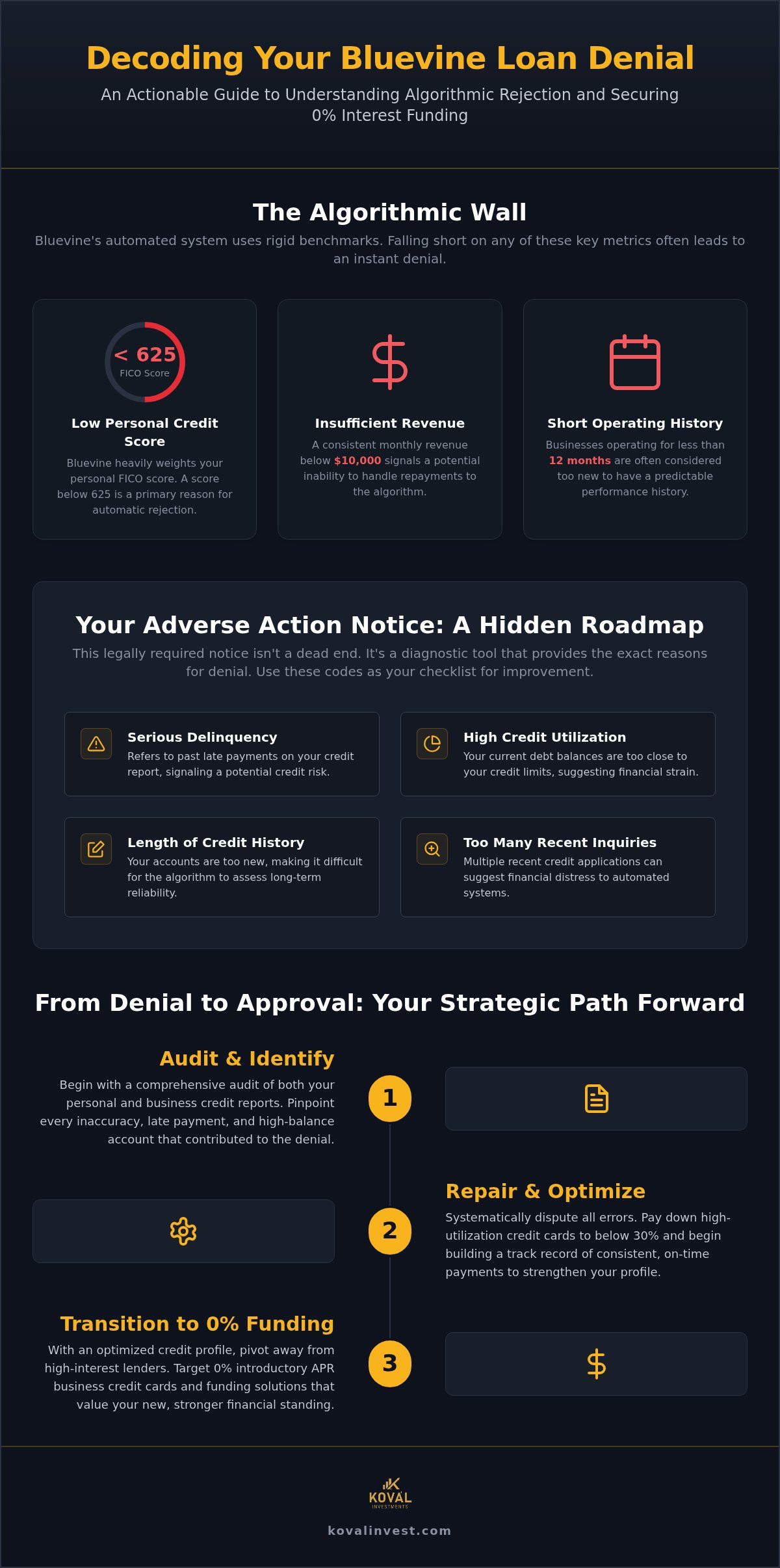
This guide will help you understand exactly why I was denied for a Bluevine loan by examining common pitfalls like FICO scores below 625 or having less than 12 months of operating history. Beyond just identifying the problem, you will discover the exact steps to optimize your profile for 0% interest funding alternatives that often provide better strategic value. We will explore a clear path to restoring your business and personal credit, ensuring you have the necessary tools to secure capital and maintain your business momentum.
Key Takeaways
- Identify the specific algorithmic triggers, such as a FICO score below 625 or insufficient business age, to understand exactly why I was denied for a Bluevine loan.
- Decode the technical language in your Adverse Action notice to transform vague denial reasons into a clear, actionable checklist for profile improvement.
- Master a strategic two-step process for auditing and repairing both personal and business credit to eliminate the most common barriers to capital.
- Discover how to transition from high-interest debt models to a 0% interest funding solution through strategic credit stacking and profile optimization.
- Learn to navigate industry-specific restrictions and NAICS code flags that often disqualify otherwise healthy businesses from traditional fintech lending.
Common Reasons Why Bluevine Denies Business Loan Applications
Understanding the logic behind a fintech rejection is the first step toward securing capital. Bluevine uses a sophisticated automated underwriting system that prioritizes speed; however, this often leads to rigid decisions that don't account for your business's full story. If you're asking why I was denied for a Bluevine loan, the answer usually lies in a specific set of algorithmic benchmarks regarding your personal credit, operational history, and revenue stability. These automated filters are designed to mitigate risk, but they can be navigated with the right strategic adjustments.
Credit Score and History Thresholds
While you're applying for a business product, Bluevine heavily weights your personal FICO score as a proxy for what lenders call "Character." They typically require a minimum score of 625. If your score falls below this floor, or if you've had multiple hard inquiries recently, the system may flag you as a high-risk borrower. These inquiries suggest a frequent search for capital, which can negatively impact your assessment. Utilizing professional business credit repair services can help you clean up these discrepancies and build a more robust profile before your next application. Improving your personal score doesn't just help with Bluevine; it serves as a bridge to much higher funding limits and more favorable terms across the board.
Revenue and Cash Flow Requirements
Capacity is another critical pillar in the underwriting process. Bluevine generally looks for a minimum of $10,000 in monthly revenue to qualify for a line of credit. It isn't just about the total amount; it's about consistency. Their system analyzes your business bank account data to identify "lumpy" cash flow patterns. Even if you have high annual revenue, significant gaps between deposits can trigger a denial because the algorithm perceives a risk in your ability to make regular payments. They want to see a steady stream of income that suggests your business can comfortably handle the debt service without straining operational expenses.
Beyond financial metrics, your business must be a corporation or LLC and have at least 12 months of operating history for a line of credit. Certain industries, such as gambling or high-risk financial services, are often excluded entirely. For those seeking larger amounts through their referral network, such as loans backed by the Small Business Administration (SBA), the requirements become even more stringent. Knowing these boundaries allows you to pivot toward more flexible 0% interest funding solutions that prioritize your growth potential over rigid, automated checkboxes.
Decoding Your Adverse Action Notice: What Bluevine Is Really Saying
An Adverse Action notice is a formal document required by the Equal Credit Opportunity Act (ECOA) whenever a lender denies your application. While it often feels like a door closing, this notice is actually a precise diagnostic tool that reveals the internal logic of the lender's decision. If you've been searching for answers as to why I was denied for a Bluevine loan, this letter provides the specific data points their algorithm flagged. You have a legal right to this information, and importantly, you have a 60-day window from the date of the notice to request a free copy of the credit report used to make the decision.
The notice will typically include specific denial codes that pinpoint the failure points in your application. "Serious Delinquency" refers to past late payments that suggest a credit risk, while "Proportion of Balances to Limits" indicates that your current credit utilization is too high. "Length of Credit History" is another frequent code, suggesting that your accounts haven't been active long enough to prove long-term reliability. Instead of viewing these as a final verdict, use them as a strategic roadmap to optimize your profile for future capital access.
Identifying Credit Report Inaccuracies
Automated lenders like Bluevine are highly sensitive to data quality. Because their systems lack human underwriters to interpret context, even small errors on a report can lead to an immediate rejection. Common issues include duplicate accounts, incorrect balances, or outdated public records that should have been removed. If your Adverse Action notice mentions factors that don't align with your records, disputing business credit report errors should be your immediate priority. Correcting these inaccuracies is often the fastest way to restore your eligibility for funding.
Understanding "Capacity" and Debt-to-Income Ratios
Capacity measures your business's ability to take on and repay new debt without defaulting. A major barrier here is the presence of existing Uniform Commercial Code (UCC) filings, which act as liens against your business assets. Furthermore, lenders are wary of "stacking," which is the practice of holding multiple active loans simultaneously. Stacking often triggers an automatic denial because it suggests a high risk of cash flow insolvency. Consolidating these debts can improve your capacity and help you meet SBA 7(a) loan requirements if you decide to pursue government-backed options. If you're unsure how to restructure your current obligations, Koval Investments can help you evaluate your debt-to-income ratio to ensure you're positioned for success.
The Hidden Barriers: Industry Restrictions and Business Age
Fintech underwriting is often a "black box" that prioritizes rigid data points over your company's actual potential. You might have strong revenue and a solid credit score but still find yourself asking why I was denied for a Bluevine loan. Often, the answer isn't found in your bank balance; it's in the way your business is structured or classified. Bluevine, like many online lenders, uses North American Industry Classification System (NAICS) codes to instantly filter out sectors they deem high-risk. If your business falls into categories like gambling, adult entertainment, or specific high-risk financial services, you'll likely face an automatic rejection regardless of your profitability.
Business maturity is another hurdle that often catches entrepreneurs off guard. According to current standards as of August 2026, Bluevine requires a minimum of 12 months in business for their line of credit products. For term loans offered through their partner network, this requirement often extends to 24 months. If you apply even a few weeks before hitting these specific milestones, the automated system won't see your growth trajectory; it'll only see a failure to meet the age requirement. This creates a barrier for newer companies that need capital to reach that one-year mark.
NAICS Code Optimization
Your business classification on Experian or Dun & Bradstreet (D&B) acts as your digital identity in the eyes of an algorithm. A simple clerical error during your initial business registration can lead to an "accidental" industry denial. For instance, a marketing firm mislabeled as a "financial services" entity might be flagged as high-risk by mistake. It's vital to audit your current business profile and ensure your NAICS code accurately reflects your daily operations. Updating this information with the major credit bureaus can resolve these hidden barriers and clear the path for a successful re-application.
Business Maturity and Entity Structure
Lenders distinguish between the time you've been "in business" and the time since your legal incorporation. If you operated as a freelancer for years but only incorporated as an LLC six months ago, most fintech algorithms will only recognize those six months. Sole proprietorships also face higher scrutiny because they lack the legal separation and perceived stability of a Corporation or LLC. Building a "fundable" entity requires a clean legal structure and a documented history of corporate existence from the day of filing.
If your industry is permanently on a restricted list for online lenders, don't lose hope. Traditional fintech might not be the right fit, but SBA loan assistance can provide a more flexible path. Government-backed programs often have broader industry acceptance and use more nuanced underwriting processes than automated platforms, allowing you to secure the capital needed to scale.
Strategic Steps to Fix Your Credit and Re-Apply for Funding
A rejection letter isn't the end of your growth journey; it's a prompt to rebuild a more resilient financial profile. If you've been searching for answers as to why I was denied for a Bluevine loan, the most effective response is a methodical restoration of your creditworthiness. This process begins with a dual-layer audit. You must examine both your personal FICO reports and your business credit profiles at Experian and Dun & Bradstreet to identify the exact data points that triggered the automated denial. Understanding the "why" allows you to stop guessing and start fixing the specific failure points.
Once you've identified the discrepancies, follow these strategic steps to restore your fundability:
- Aggressive Disputes: Target every inaccuracy, from duplicate accounts to outdated public records, with formal disputes to the bureaus.
- Utilization Optimization: Lower your credit utilization by paying down high-interest revolving accounts. Lenders view high balances as a sign of financial strain.
- Strategic Tradelines: Establish new trade credit accounts with vendors that report to all major business bureaus to build a positive payment history.
- Strategic Partnership: Align with experts who specialize in alternative business funding solutions to bridge the gap while your credit recovers.
Rapid Credit Restoration Techniques
Traditional credit repair can be a slow, opaque process. Instead, we advocate for a success-based approach where you focus on tangible results rather than monthly fees. This method identifies "low-hanging fruit" like misreported balances or incorrect inquiry counts that can be corrected to provide a score boost in as little as 30 days. Professional consulting ensures that your disputes are legally sound and persistent, preventing bureaus from dismissing your claims as frivolous. This targeted intervention transforms your profile from a "decline" into a "strong candidate" for future capital without the financial risk of traditional repair models.
Building a Stronger Credit Profile for 2026
Fundability in 2026 requires more than just a high score; it requires a diversified credit mix. Lenders want to see that you can manage various types of debt, including term loans, lines of credit, and trade credit. Consistency across your SOS filing, tax returns, and credit reports is the foundation of digital fundability. If your business address or name varies slightly between documents, automated underwriting systems may flag your application for potential fraud or instability. If you're ready to move beyond automated rejections, you can schedule a strategic consultation with Koval Investments to begin your profile optimization today.
Beyond Bluevine: Transitioning to 0% Interest Funding Solutions
While a rejection from a major fintech lender feels like a setback, it often serves as a necessary pivot point toward more sophisticated capital structures. If you've spent weeks wondering why I was denied for a Bluevine loan, it's time to look beyond the rigid constraints of traditional online lines of credit. Even with Bluevine's starting APR of 7.8%, the cost of capital can still weigh heavily on your margins. In contrast, 0% interest business funding provides a strategic window to scale operations, invest in inventory, or fund marketing campaigns without the immediate burden of interest payments. This interest-free capital is accessible through a process known as strategic credit stacking, where multiple business credit lines are combined to provide a significant pool of working capital.
Qualifying for these solutions requires a high degree of profile optimization that automated lenders often ignore. While Bluevine's algorithms focus on a narrow set of criteria, our approach looks at the broader picture of your business's fundability. By repairing the specific data points that led to your initial denial, you can unlock access to capital that traditional banks and fintech platforms frequently miss. This isn't just about getting an approval; it's about securing the most efficient capital possible to maximize your return on investment. If you're asking why I was denied for a Bluevine loan, the answer is often that your profile wasn't yet tuned for the elite requirements of 0% interest funding, which we can help you address.
The Koval Investments Advantage
At Koval Investments, we operate as a seasoned strategic partner rather than a distant service provider. Our collaborative venture model is built on a success-based philosophy; we only succeed when you successfully secure the funding your business needs. This alignment of interests ensures that our guidance is always pragmatic and focused on tangible value. We bridge the gap between a "denied" notice and a fully funded account by providing expert oversight on credit restoration and strategic growth. Our team understands the nuances of mergers, acquisitions, and operational efficiency, allowing us to position your business as a prime candidate for high-limit, interest-free capital.
Next Steps: From Rejection to ROI
The path from a loan denial to rapid expansion starts with a professional audit of your current financial standing. We don't just tell you what went wrong; we create a customized roadmap for capital procurement that addresses every algorithmic trigger in your credit report. This methodical approach replaces the uncertainty of automated applications with a steady, logical plan for success. You don't have to navigate complex financial landscapes alone. Ready to secure the capital your business deserves? Explore our 0% Interest Funding Solutions today.
Transform Your Capital Strategy
A Bluevine denial isn't a dead end; it's a signal to refine your financial profile for more efficient capital. By decoding your Adverse Action notice and addressing the specific algorithmic triggers, you can move from uncertainty to strategic growth. Whether the issue was a FICO score below 625 or a simple industry classification error, these barriers are entirely fixable with a methodical approach to credit restoration and entity optimization.
Understanding why I was denied for a Bluevine loan is the first step toward securing the funding your business deserves. At Koval Investments, we bring over 6 years of expertise in capital procurement to help you navigate these challenges. We specialize in 0% interest funding and professional credit restoration to ensure your business remains fundable and resilient. Our success-based philosophy means there's no financial risk to you; we only win when you successfully secure the capital you need.
Don't let a temporary setback stall your momentum. It's time to transition from high-interest debt to strategic, interest-free capital. Secure Your 0% Interest Business Funding with Koval Investments today. We look forward to partnering with you on your journey to rapid expansion and long-term success.
Frequently Asked Questions
How long do I have to wait to re-apply for a Bluevine loan after being denied?
You typically need to wait 90 days before re-applying for a Bluevine line of credit. This window allows you enough time to make substantive changes to your revenue or credit profile. If you apply sooner than this period, the automated underwriting system may issue a repeat denial without a full review of your new data. We recommend using this time to optimize your business credit profile to ensure a higher probability of approval on your next attempt.
Can I get a Bluevine loan with a 600 credit score?
No, you generally cannot qualify for a Bluevine loan with a 600 credit score as their current minimum requirement is a personal FICO of 625. Their automated system uses this score as a primary filter to assess risk. If your score falls below this threshold, your application will likely be rejected regardless of your business revenue. For owners in this position, we suggest focusing on professional credit restoration to bridge the gap to eligibility.
Does a Bluevine denial affect my credit score?
A denial from Bluevine doesn't directly lower your credit score; however, the hard inquiry performed during the application process might. Each hard pull typically results in a small, temporary dip in your FICO score. The Adverse Action notice itself is a private communication between the lender and the applicant. It is never reported to the credit bureaus as a negative event, so it won't impact your ability to seek capital from other sources.
What is the most common reason for Bluevine line of credit denials?
The most common reasons for rejection include a personal FICO score below 625 or monthly revenue that fails to meet the $10,000 floor. If you're wondering why I was denied for a Bluevine loan, it often comes down to these two rigid algorithmic requirements. Inconsistent cash flow patterns can also trigger a denial because the system views "lumpy" deposits as a risk to your capacity for regular debt service and operational stability.
How can I fix my credit if Bluevine says my history is too short?
You can address a short credit history by establishing new tradelines with vendors that report to all major business credit bureaus. Adding three to five net-30 accounts can build a positive payment history relatively quickly. Ensuring your business is properly incorporated as an LLC or Corporation also helps separate your professional identity from your personal history. This methodical approach builds the fundability that automated lenders look for when evaluating why I was denied for a Bluevine loan.
Are there alternatives to Bluevine for businesses in high-risk industries?
Yes, businesses in industries flagged as high-risk can often find capital through SBA loans or 0% interest strategic funding solutions. While Bluevine uses rigid NAICS code filters, government-backed programs and private strategic funding models often employ more nuanced underwriting. These alternatives focus on your overall business health and growth potential rather than just your industry classification. We help clients navigate these complex landscapes to find capital that traditional fintech platforms frequently miss.
Does Bluevine require a personal guarantee even if I have good business credit?
Yes, Bluevine typically requires a personal guarantee for their business funding products even if you have established business credit. This legal agreement ensures that the business owner is personally responsible for the debt if the company cannot repay it. Most fintech lenders use this requirement to mitigate the risk of lending to small businesses. Even with a strong corporate structure, you should expect to see this as a standard condition for most online lines of credit.
What documents should I have ready to prove my revenue after a denial?
You should have three to six months of business bank statements, your most recent business tax returns, and a current year-to-date Profit and Loss statement ready. These documents provide the objective data needed to verify your revenue consistency after a denial. Lenders use this information to look for steady deposit patterns and sufficient cash reserves. Having these files organized allows for a more thorough manual review if you decide to pursue alternative funding paths.