
2026 DSCR Loan Guide for Real Estate Investors
What if your personal tax returns weren't the gatekeeper to your next five rental properties? Many seasoned investors reach a point where their debt-to-income ratio or complex tax filings make traditional lenders hesitate, regardless of how profitable a deal looks on paper. You've likely felt the frustration of hitting a ceiling with conventional lending limits while interest rates on standard investment loans remain elevated. This is where DSCR loans for real estate investors become a vital strategic tool; they shift the focus from your personal paycheck to the property's actual performance.
In this 2026 guide, you'll learn how to secure financing based on property cash flow to rapidly expand your holdings under an LLC. We'll explore the current market landscape where rates for qualified borrowers typically range from 6.0% to 8.0% and explain why a DSCR ratio of 1.25 is your ticket to the best terms. We will also detail how to close loans faster and use strategic financing to protect your liquidity. By the end of this article, you'll have a clear roadmap to building a scalable portfolio without the friction of traditional underwriting.
Key Takeaways
- Understand how to bypass personal debt-to-income limits by qualifying for financing based solely on a property's income-generating potential.
- Learn why DSCR loans for real estate investors require specific ratio benchmarks, such as 1.25x, to unlock the most competitive 2026 interest rates.
- Discover the long-term financial impact of your credit score on loan-to-value ratios and how to optimize your profile for maximum leverage.
- Explore the "Capital Stack" strategy, which combines specialized real estate funding with 0% interest solutions to preserve your liquidity during value-add renovations.
- Identify the benefits of working with a strategic advisor to navigate complex financial landscapes and scale your portfolio efficiently under an LLC.
What is a DSCR Loan and Why Does it Matter for Investors?
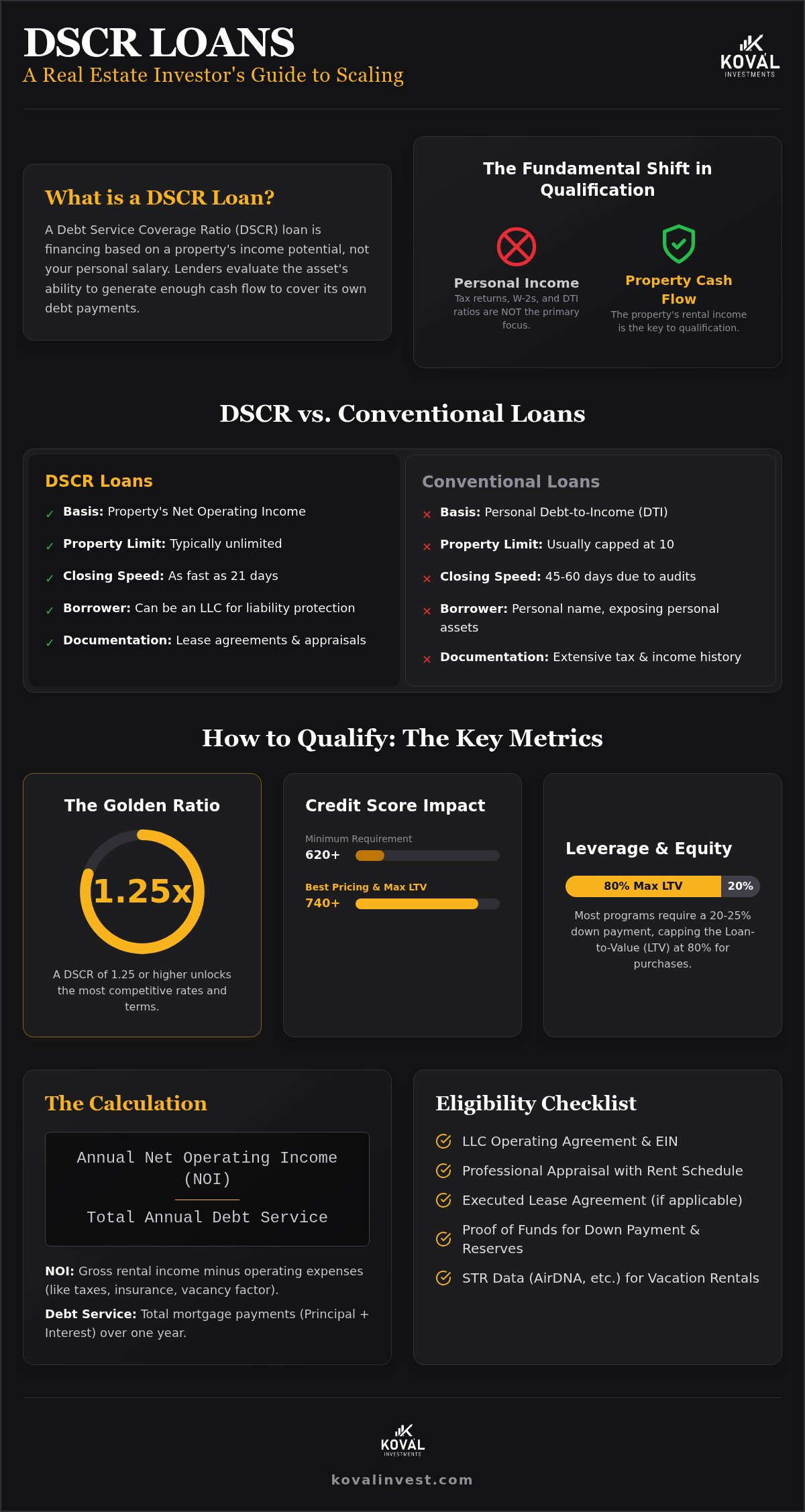
A Debt Service Coverage Ratio (DSCR) loan is a financing solution where the lender evaluates the property's ability to generate enough rental income to cover its debt obligations. Unlike traditional mortgages that scrutinize your personal salary or debt-to-income (DTI) ratio, DSCR loans for real estate investors focus on the asset's performance. This shift is fundamental for those who've hit the "DTI wall" where personal income can no longer support additional conventional financing. In 2026, these Non-Qualified Mortgage (Non-QM) products have become the standard for professional scaling because they prioritize the business logic of an investment over the borrower's personal financial history.
Investors choose these products because they offer a path around the rigid documentation requirements of big banks. You don't need to provide years of tax returns or proof of a 9-to-5 job. This accessibility leads to several key advantages:
- No employment verification or W-2 requirements.
- No personal tax returns needed for qualification.
- Significantly faster closing times compared to government-backed loans.
- Ability to purchase or refinance multiple properties simultaneously.
The Core Mechanics of Investor Cash Flow Financing
Lenders view a property as a standalone business. If the rental income exceeds the mortgage payment, taxes, and insurance, the deal makes sense. This perspective allows you to borrow under an LLC or corporate entity, which provides essential liability protection. Because the lender isn't limited by your personal income cap, DSCR becomes the primary tool for "unlimited" portfolio growth. You can keep adding properties as long as each one meets the minimum cash flow requirements, allowing your portfolio to grow at the pace of the market rather than the pace of your personal raises.
DSCR vs. Conventional Mortgages: A Quick Comparison
Conventional loans often come with a hard ceiling, usually capping an investor at ten financed properties. DSCR loans for real estate investors remove this hurdle. While traditional banks might take 45 to 60 days to close due to rigorous income audits, DSCR lenders often close in 21 days or less. The documentation is straightforward; instead of hundreds of pages of personal financial history, the primary focus is the lease agreement and a professional appraisal that includes a rent schedule. In competitive 2026 markets, this speed is often the difference between winning a bid and losing it.
How to Calculate and Qualify for a DSCR Loan in 2026
Qualification for DSCR loans for real estate investors hinges on a simple but precise mathematical relationship. Lenders use a standard formula: Annual Net Operating Income (NOI) divided by Total Debt Service. Understanding The Debt Service Coverage Ratio is vital because this number determines your interest rate and down payment requirements. While a 1.20x to 1.25x ratio typically unlocks the most competitive 2026 rates, some aggressive programs accept ratios as low as 0.75x if the borrower has significant experience or higher cash reserves.
Lenders verify income through a 1007 Rent Schedule, which is a professional appraiser's opinion of market rent. For vacation rentals, many 2026 programs now accept AirDNA data or historical 12-month statements to prove cash flow. Minimum requirements generally include a FICO score of 620, though a score of 740 or higher is usually necessary to secure the best pricing. Expect to provide a down payment of 20% to 25%, as maximum loan-to-value (LTV) ratios typically cap at 80% for purchases.
Step-by-Step Calculation for Rental Properties
To find your ratio, you must first calculate the full monthly debt obligation, known as PITIA. This includes the Principal, Interest, Taxes, Insurance, and any Association dues. A DSCR ratio of 1.0 marks the break-even point where the property’s gross rental income exactly covers the total monthly debt obligations. Short-term rentals (STRs) are treated with more scrutiny than long-term leases; lenders often apply a higher vacancy factor to STR projections to account for seasonal fluctuations in income.
Documentation and Eligibility Checklist
Because these are business-purpose loans, you'll need to provide entity documents such as your LLC Operating Agreement and EIN. Lenders also require a 1007 Appraisal to confirm the property's income potential matches the local market. Liquidity is the final pillar of eligibility. Most 2026 lenders require you to prove you have 3 to 12 months of PITIA in liquid reserves after closing to ensure you can handle unexpected vacancies. Exploring real estate investment funding options early in your search ensures you're ready to move when a high-performing property hits the market.
The Credit Score Factor: Why Your Financial Profile Still Matters
Your credit score acts as the lever that determines the total weight of your debt. While the property's cash flow qualifies the deal, your FICO score dictates the interest rate and the required down payment. In the 2026 lending environment, a score below 680 often triggers a "pricing hit," which can increase your interest rate by 0.5% to 1.0%. This might seem minor at first glance, but the math tells a different story. On a $500,000 loan, a 1% rate hike adds approximately $340 to your monthly payment, totaling over $122,000 in additional interest over a 30-year term. For many, this difference alone can turn a cash-flowing asset into a break-even liability.
Many DSCR loans for real estate investors also tie their maximum loan-to-value (LTV) ratios to credit tiers. An investor with a 740 score might secure an 80% LTV, while someone at 660 might be capped at 70% or 75%. This requires you to bring significantly more cash to the closing table, which limits your ability to acquire multiple properties. Common errors, such as incorrectly reported late payments or outdated balances, frequently plague investor credit reports and create unnecessary friction during the underwriting process.
Optimizing Your Score for Prime DSCR Rates
Lenders typically view credit in 20-point tiers. Moving from a 719 to a 721 can result in a measurable shift in your "points" or closing costs. Managing your credit utilization is the fastest way to influence these tiers. If your personal lines of credit are tapped out for property renovations, your score will drop, even if your payment history is perfect. Utilizing professional business credit repair services allows you to strategically dispute inaccuracies and optimize your profile before the lender pulls your file. This proactive approach ensures you're positioned for the lowest possible down payment requirements.
Koval’s Success-Based Approach to Financial Profiles
We treat your credit profile as a strategic asset rather than a static number. Our goal is to align your personal financial health with your long-term growth objectives. This is particularly vital when seeking SBA loan assistance for mixed-use properties, where the requirements are often more stringent than standard residential DSCR products. By preparing your file before it reaches the lender, we remove the "credit friction" that often stalls high-value deals. This "insider" advantage allows you to move with confidence, knowing your profile is optimized to capture the best possible market terms.
Strategic Scaling: Leveraging DSCR with 0% Interest Funding
Scaling a portfolio effectively requires a shift in perspective. You shouldn't view a mortgage as your only source of capital. Instead, think in terms of a "Capital Stack" where different layers of funding work in tandem to protect your personal liquidity. While DSCR loans for real estate investors provide the long-term debt foundation, they often require a significant cash commitment up front. By layering in working capital or unsecured lines, you can keep your cash reserves intact for emergency repairs or the next down payment. This method significantly boosts your Internal Rate of Return (IRR) because you're using less of your own money to control a high-value asset.
Combining these tools allows for rapid portfolio acquisition. In a competitive 2026 market, having immediate access to capital means you can close deals while others are still waiting for traditional bank approvals. This strategy is particularly effective for value-add projects where the initial purchase is just the beginning of the investment. By reducing your out-of-pocket costs at the start, you ensure that your capital is always working at its highest potential capacity.
The 0% Interest Advantage for Real Estate
A common hurdle in 2026 is the 20% to 25% down payment requirement for prime DSCR rates. You can bridge this gap by applying 0% interest business funding to your acquisition strategy. These unsecured lines of credit are also ideal for "soft costs" such as inspections, legal fees, and initial property stabilization. Utilizing zero-interest capital significantly lowers your weighted average cost of capital, which directly enhances a property's year-one cash-on-cash return. This strategy turns a standard renovation project into a high-velocity growth engine without depleting your primary bank accounts.
Scaling Beyond the First Five Properties
Once your portfolio grows, managing individual loans becomes administratively heavy. Transitioning to portfolio lending allows you to cross-collateralize assets, often unlocking better terms and higher total loan amounts. During this phase, maintaining momentum is critical. Using alternative business funding solutions ensures you have the working capital needed to pounce on off-market opportunities without waiting for a refinance to close. Strategic planning ensures that your capital procurement stays ahead of your acquisition pipeline, allowing you to scale with professional precision.
If you're ready to optimize your capital stack and accelerate your growth, consult with Koval Investments to explore our integrated funding solutions.
Securing Your Real Estate Capital with Koval Investments
Choosing a financing partner is a decision that dictates the trajectory of your growth. While "loan factories" focus on churning through high-volume transactions, serious investors require a boutique advisory approach. Koval Investments operates on a success-based, win-win philosophy. We don't just provide a product; we provide a collaborative strategy that minimizes your financial risk. Our expertise spans the entire lifecycle of an investment, offering everything from funding for real estate investors to specialized business valuations. We treat your success as our own. This is the insider advantage.
Professional scaling requires looking beyond the next closing. We integrate M&A consulting into our advisory services to help you view your portfolio as a sellable business entity. This preparation for a future exit ensures that when the time comes to sell, you aren't just selling titles and deeds. You're selling a high-performing, optimized operation with a documented track record of success. This long-term perspective is why we prioritize the quality of our relationships over the quantity of our transactions. It works because our goals remain perfectly aligned with yours.
Your Strategic Partner in Capital Procurement
We build customized funding roadmaps that align with your 5-year expansion goals. This isn't just about DSCR loans for real estate investors; it's about the total capital stack. If your plans include owner-occupied or mixed-use projects, we facilitate access to SBA loans to diversify your leverage. Having a single point of contact for credit restoration, strategic funding, and valuation creates a seamless experience. It removes the friction of managing multiple distant service providers who don't understand your overarching objectives. You get clarity, momentum, and accountability in one place.
Get Started: Assessing Your Portfolio's Potential
The first step toward rapid expansion is an initial consultation to determine your capital readiness. We analyze your current holdings and credit profile to identify the optimal mix of DSCR loans for real estate investors and 0% interest products. This proactive audit ensures you're positioned to capture the best market terms before you even find your next property. By fixing credit friction early, you ensure your 2026 acquisition pipeline remains clear and well-funded. Partner with Koval Investments to secure your next investment property and experience a partnership built on tangible results and shared success.
Mastering Your Capital Strategy for 2026 and Beyond
The real estate market in 2026 demands a sophisticated approach to capital procurement. By shifting your focus from personal income to property cash flow, you can bypass traditional lending hurdles and maintain your acquisition momentum. We've explored how DSCR loans for real estate investors serve as the foundation for this growth, especially when paired with strategic credit optimization and alternative funding sources. This integrated method doesn't just secure a single property; it builds a resilient, scalable business model that protects your personal liquidity.
Success in this landscape requires more than just a mortgage. It requires a partner who understands the nuances of your long-term expansion plan. Koval Investments offers a success-based philosophy for credit restoration, specialized 0% interest funding solutions, and expert strategic business advisory to ensure your portfolio is primed for maximum return. Whether you're acquiring your first multi-family unit or preparing an entire portfolio for a strategic exit, the right capital stack is your most powerful tool. Secure your real estate investment funding with Koval Investments today and start building the portfolio your ambitions deserve. Your next high-performing asset is within reach with the right strategic support.
Frequently Asked Questions
What is the minimum credit score for a DSCR loan in 2026?
The technical minimum credit score for a DSCR loan in 2026 is often 620, though most lenders prefer a score of 660 or higher. Achieving a score of 740 is typically necessary to unlock the most competitive pricing and maximum leverage tiers. If your current score falls below these benchmarks, utilizing strategic credit restoration can help you bridge the gap and secure much more favorable loan terms for your next acquisition.
Can I get a DSCR loan for a short-term rental or Airbnb?
You can absolutely use DSCR loans for short-term rentals or Airbnb properties. Lenders in 2026 frequently utilize specialized data from platforms like AirDNA or review the property's historical 12-month rental income to verify cash flow potential. This flexibility makes these loans ideal for vacation rental investors who need financing based on the property's actual performance rather than traditional long-term lease agreements. It's a vital tool for those scaling in high-demand tourism markets.
Do DSCR loans require a 20% down payment?
Most DSCR loans for real estate investors require a down payment of 20% to 25%, representing an 80% to 75% loan-to-value ratio. While some aggressive programs may offer slightly higher leverage, a 25% down payment is the industry standard to secure the best interest rates. Investors often supplement this requirement by utilizing alternative funding sources to preserve their primary cash reserves during the acquisition and ensure they have capital for future deals.
Can I use an LLC to close on a DSCR loan?
Closing in the name of an LLC or corporate entity is not only allowed but often encouraged by DSCR lenders. This structure provides essential liability protection and allows you to keep your personal and business finances separate. Borrowing through an entity is a fundamental strategy for professional investors looking to scale their portfolios beyond the limits of individual conventional mortgage caps while maintaining a clean personal financial profile for future growth.
How do DSCR interest rates compare to traditional investment mortgages?
Interest rates for DSCR loans for real estate investors typically trade at a premium of 0.5% to 1.5% above conventional investment property mortgage rates. In mid-2026, qualified borrowers generally see rates between 6.0% and 8.0% depending on their FICO score and loan-to-value ratio. While the cost of capital is slightly higher, the benefits of faster closing times and no personal income verification often outweigh the interest rate difference for active real estate professionals.
What happens if my property's DSCR ratio is below 1.0?
If your property's ratio falls below 1.0, it means the rental income doesn't fully cover the debt obligation, which may disqualify you from standard programs. However, some specialized lenders offer "No Ratio" products or accept ratios as low as 0.75 for experienced investors with high credit scores. In these cases, expect to provide a larger down payment or show significant liquid reserves to mitigate the lender's risk and ensure the deal remains viable.
Is a personal guarantee required for a DSCR loan?
A personal guarantee is standard for most DSCR loans, even when the property is held within an LLC. This ensures that the borrower remains accountable for the debt, although the lender's primary focus remains on the property's cash flow. While non-recourse options exist in the commercial space, they typically require much higher loan amounts and significantly more equity than standard residential products. This guarantee is a common part of the collaborative risk-sharing between lender and investor.
Can I use a DSCR loan to refinance an existing investment property?
You can use a DSCR loan to refinance an existing investment property, including cash-out options to fund new acquisitions. Most lenders allow a maximum loan-to-value ratio of 70% to 75% for cash-out refinances in 2026. This is a strategic way to pull equity from a performing asset to supplement your capital stack for future value-add projects or portfolio expansion without the need for traditional income documentation or personal tax returns.