
Financial Due Diligence: 2026 Investor Guide
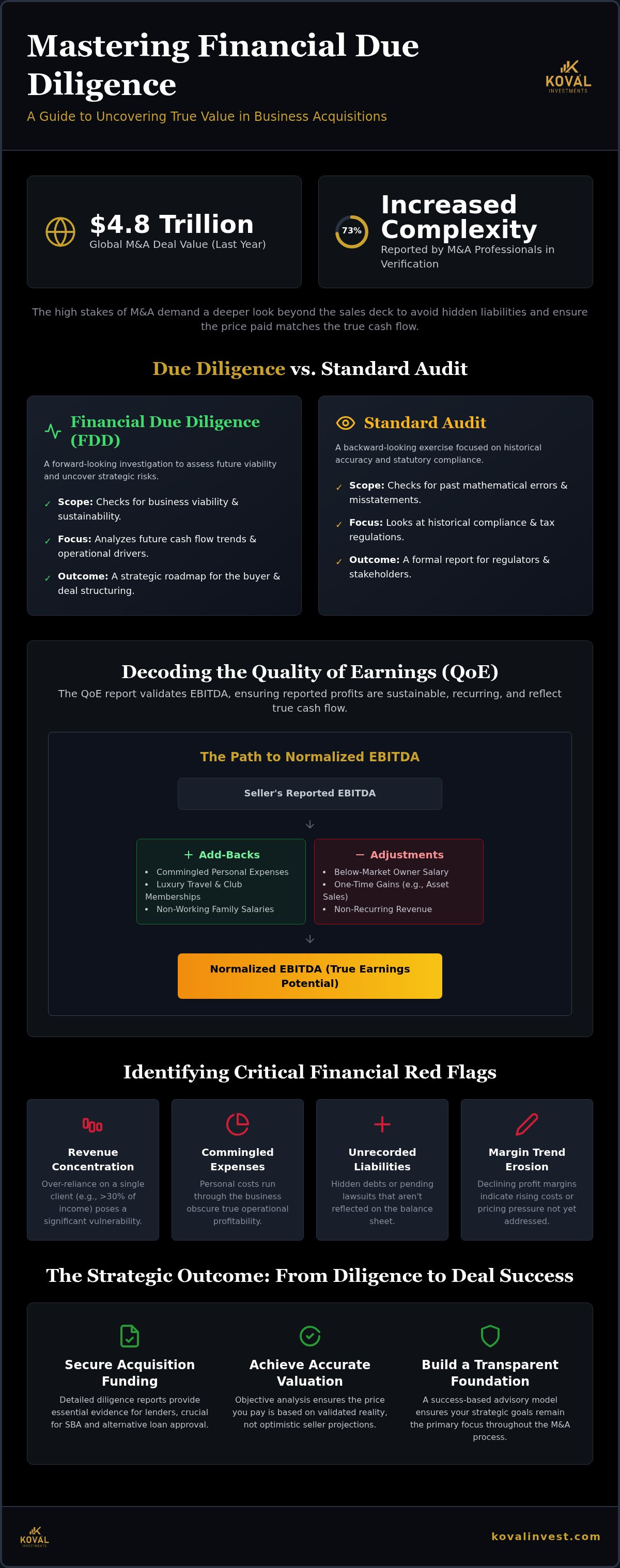
With global M&A deal values hitting $4.8 trillion last year, it's clear the market is moving fast, yet 73% of professionals report that the verification process is becoming significantly more complex. You've likely felt this pressure yourself. It's common to worry that hidden liabilities or inflated EBITDA figures might be lurking beneath a polished sales deck. When you're performing financial due diligence for business acquisition, the stakes go beyond just "checking the boxes"; it's about ensuring the price you pay matches the reality of the cash flow.
We understand that uncertainty about true profitability can stall your momentum and even jeopardize your ability to secure SBA or alternative funding. This guide provides a clear roadmap to master the financial validation process. You'll learn how to uncover hidden risks, validate true earnings through Quality of Earnings analysis, and align your findings with lender requirements. We'll explore the critical intersection of business valuation and strategic planning to ensure your 2026 acquisition is built on a foundation of transparency and tangible value.
Key Takeaways
- Learn why a standard tax audit is insufficient and how a targeted investigation validates the accuracy of a company's financial records.
- Master the art of identifying "add-backs" to adjust EBITDA and reveal the true earnings potential of a target business.
- Uncover critical red flags such as commingled personal expenses and unrecorded liabilities during your financial due diligence for business acquisition.
- Understand how detailed diligence reports serve as essential evidence for lenders when approving SBA loans and alternative funding.
- Discover how a success-based advisory model ensures your strategic goals remain the primary focus throughout the entire M&A process.
What is Financial Due Diligence for Business Acquisition?
Financial due diligence for business acquisition is much more than a routine check of a company's bank statements. It is a comprehensive, investigative process designed to validate the accuracy of a target company’s financial records and operational health. While a broad search for What is Due Diligence? provides a general framework, the financial component focuses specifically on the "Quality of Earnings" (QofE). This analysis confirms that the profits reported by the seller are sustainable, recurring, and free from accounting distortions. Typically, this process begins immediately after a Letter of Intent (LOI) is signed, providing a window of time where the buyer can verify every claim before the deal is finalized.
The Difference Between FDD and a Standard Audit
Many first-time buyers assume that a standard tax audit provides enough protection. This is a dangerous misconception. Audits are backward-looking exercises focused on statutory compliance and historical accuracy. They verify that the math was correct in the past, but they don't tell you if the business will remain profitable tomorrow. Financial due diligence is a forward-looking tool that examines the sustainability of those earnings. It looks beyond the balance sheet to understand operational drivers, such as customer concentration and vendor dependencies. Ultimately, FDD serves as a strategic tool for risk mitigation and deal structuring.
- Scope: Audits check for errors; FDD checks for business viability.
- Focus: Audits look at compliance; FDD looks at cash flow trends.
- Outcome: Audits result in a report for regulators; FDD results in a roadmap for the buyer.
Why Buyers Often Overlook Critical Financial Gaps
The excitement of a potential deal often leads to what industry insiders call "deal fever." This emotional bias clouds judgment and causes buyers to overlook subtle warning signs in the data. Relying solely on the seller’s self-reported P&L statements is a significant risk because these documents are often prepared to show the business in the best possible light. They might include non-recurring gains or fail to account for upcoming capital expenditures. Maintaining objectivity during this phase is difficult without an outside perspective. Professional business valuation services act as a neutral anchor, ensuring that the price you pay is based on validated reality rather than optimistic projections. By stepping back and analyzing the data through a professional lens, you protect your capital and ensure the acquisition actually meets your long-term strategic goals.
Evaluating Quality of Earnings (QofE) and EBITDA
EBITDA stands as the universal metric for assessing a company's value. It represents core operational profitability by stripping away the noise of interest rates, tax jurisdictions, and non-cash accounting entries. While EBITDA provides the baseline, the Quality of Earnings (QofE) report is what truly validates it. This report is the centerpiece of Due Diligence in an M&A Transaction, ensuring that the numbers you see on a P&L reflect the actual cash flow you'll inherit. During financial due diligence for business acquisition, you must look beyond the bottom line to understand how those earnings are generated.
One critical area involves "add-backs." Small business owners often run personal expenses through the company, such as luxury travel, club memberships, or salaries for family members who don't work in the business. Identifying these allows you to add those costs back to the profit, showing the true earnings potential. However, you also need to analyze risks like revenue concentration. If 30% of a company's income comes from a single client, the business is vulnerable. We also look at margin trends to see if profits are growing or if they're being squeezed by rising operational costs that the seller hasn't yet addressed. A professional business valuation provides the objective data needed to move from investigation to a firm offer.
Normalizing Earnings for a Clear Valuation
Normalizing earnings involves removing one-time gains or losses that won't repeat under your ownership. If the seller won a large legal settlement or sold a piece of real estate, those funds shouldn't be included in the valuation. You must also adjust for owner compensation. If the current owner takes a below-market salary to inflate profits, you'll need to deduct a fair market wage for a replacement manager. This process creates a "normalized" EBITDA that reflects the reality of the 2026 market, allowing for a fair and defensible purchase price.
Working Capital Requirements Post-Acquisition
Working capital is the fuel that keeps a business running day-to-day. It's often the most contested part of an M&A deal because it determines how much cash must stay in the business at closing. We calculate the "peg," which is the average working capital the business needed over the last twelve months. You don't want to take over a company only to realize it's starved for cash. Aligning your diligence with working capital funding solutions ensures you have the liquidity needed to maintain operations from the very first day of ownership.
Identifying Financial Red Flags in SMB Acquisitions
Identifying red flags is the most critical phase of financial due diligence for business acquisition. This is where the "as-is" reality of the business often clashes with the seller's pitch. Our goal is to peel back the layers of the financial statements to find what isn't being said. We look for inconsistencies that suggest the reported profits might not be sustainable under new ownership.
Commingled funds are a frequent discovery in the SMB space. Owners often treat their company like a personal piggy bank, burying family travel, luxury vehicles, or household bills within the general ledger. We meticulously separate these personal lifestyle choices from legitimate business operations. If you don't, you risk paying a valuation multiple on the owner's vacation. Similarly, we hunt for unrecorded liabilities. These include "off-balance-sheet" debts like verbal vendor guarantees or pending litigation that hasn't hit the books yet. Tax compliance is another non-negotiable area. We verify that sales tax, payroll tax, and federal filings are current. In many jurisdictions, successor liability means you inherit the seller's tax debt the moment the deal closes. Finally, we scrutinize aging accounts receivable. If a significant portion of the ledger is over 90 days old, it's likely bad debt. Sellers frequently count these as current assets, but they often represent uncollectible income that should be written off.
The Risk of Owner-Dependency
A business that cannot function without the owner's daily involvement is a fragile investment. If the current owner holds all the key client relationships or is the only person capable of managing technical operations, the cash flow is at risk the moment they exit. We spot this by analyzing payroll records; a lack of mid-level management salaries often signals that the owner is wearing too many hats. We also look for owner-only expense approvals or specialized knowledge that isn't documented. When this "key man" risk is present, we adjust the business valuation to account for the cost of hiring a replacement manager or the potential revenue dip during the transition.
Hidden Capital Expenditure (CapEx) Needs
We compare the physical condition of equipment and facilities against their book value. If machinery is nearing the end of its useful life but hasn't been replaced, the business is suffering from deferred maintenance. This is a strategic red flag. CapEx neglect can artificially inflate short-term EBITDA by avoiding necessary reinvestment, making the business look more profitable than it actually is. You'll likely face these upgrade costs shortly after closing, which directly impacts your day-one liquidity and long-term ROI. By identifying these hidden costs early, we ensure you aren't surprised by a massive repair bill in your first six months of ownership.
Aligning Due Diligence with Acquisition Funding
Lenders are essentially your silent partners in any deal. They won't cut a check based on a seller's word alone. They rely on your financial due diligence for business acquisition to verify that the cash flow is sufficient to cover the debt. A comprehensive report doesn't just satisfy their curiosity; it justifies the loan amount by proving the business's ability to generate steady income. When your report is thorough, it builds the lender's confidence, which is often the difference between a deal that closes and one that falls through.
The Debt-Service Coverage Ratio (DSCR) is the primary metric lenders use to measure this capacity. By using the normalized EBITDA figures we've already validated, lenders calculate whether the business can cover its annual debt payments with a comfortable margin. Most lenders look for a DSCR of 1.25 or higher. A strong report showing consistent, non-volatile earnings can even give you the leverage to negotiate more favorable interest rates, as it significantly reduces the bank's perceived risk profile.
Securing SBA 7(a) and 504 Funding
When you're seeking SBA loan assistance, the level of scrutiny intensifies. The SBA requires a deep dive into three years of federal tax returns, year-to-date interim statements, and detailed aging reports. Choosing between an SBA 7(a) vs. 504 loan depends largely on your FDD findings. A 7(a) loan is often better for general business acquisitions and working capital, while the 504 is ideal if the deal includes significant real estate or heavy equipment. Beyond the business's health, the SBA also scrutinizes your personal credit profile, making credit health a prerequisite for approval.
Bridging the Gap with 0% Interest Funding
The costs of professional diligence can be a hurdle before you even own the business. This is where 0% interest business funding becomes a strategic asset. These unsecured lines of credit can cover FDD fees or help with the down payment, preserving your liquid cash for day-one operations. Managing the post-acquisition transition often involves unexpected costs. Accessing 0% capital provides a safety net during those first critical months. At Koval Investments, we act as your partner to optimize your funding strategy by repairing and positioning your credit before you apply, ensuring you qualify for the maximum limits available.
The Koval Approach: Strategic Advisory and M&A Consulting
At Koval Investments, we view the acquisition process as a collaborative journey rather than a series of disconnected transactions. Our mergers and acquisitions consulting is built on a success-based philosophy, meaning our goals are perfectly aligned with your successful closing. We don't just provide static reports; we act as a steady hand through the complexities of financial due diligence for business acquisition. From the initial professional valuation to final capital procurement, our focus remains on securing a win-win outcome that minimizes your financial risk while maximizing the potential for post-acquisition growth.
Our methodology bridges the gap between high-level financial strategy and the day-to-day realities of business ownership. We provide strategic planning that looks past the closing date, helping you prepare for market impact and operational scalability from day one. By positioning ourselves as a partner rather than a distant service provider, we ensure that every piece of data we uncover serves your long-term ambitions.
Why a Strategic Partner Beats a Standard Accountant
A standard accountant is trained to count the numbers, but a strategic partner is trained to value the opportunity. While compliance is necessary, it doesn't account for market positioning or future scalability. We integrate specialized services like credit repair directly into our acquisition strategy. By optimizing your credit profile early in the process, we help you access higher funding limits and more favorable terms for SBA or alternative loans. In the 2026 SMB landscape, this boutique approach provides the agility and insider knowledge that large, detached institutional firms often lack.
- Holistic Analysis: We look beyond the balance sheet to assess operational drivers and market sustainability.
- Funding Optimization: We align your financial validation with a clear path to capital procurement.
- Risk Alignment: Our success-based model ensures we're as invested in the quality of the deal as you are.
Next Steps: Moving from Diligence to Closing
Once the due diligence phase concludes, the findings become your primary leverage at the negotiating table. If the investigation uncovers deferred maintenance or inflated earnings, we use that concrete data to justify a renegotiation of the purchase price. We also help you finalize a deal structure that protects your cash flow. This often involves negotiating earn-outs, where a portion of the price is contingent on future performance, or utilizing seller notes to reduce your immediate capital outlay. Structuring the deal correctly is just as vital as finding the right business.
The transition from investor to owner requires a clear roadmap and a partner who understands the stakes. If you're ready to move forward with confidence, schedule a consultation with Koval Investments today to start your acquisition journey. We provide the strategic planning and financial expertise needed to turn a potential deal into a successful, profitable reality.
Securing Your Future Through Strategic Validation
Mastering the financial due diligence for business acquisition is the difference between a high-risk gamble and a calculated strategic move. By validating the Quality of Earnings and uncovering hidden liabilities like owner-dependency or deferred maintenance, you ensure the purchase price reflects the true value of the asset. This thoroughness doesn't just protect your investment; it creates the evidence-based narrative that lenders require to approve your capital requests with confidence.
Our success-based consulting model ensures we're as committed to your results as you are. Whether you need specialized 0% interest funding solutions to cover transition costs or expert SBA loan assistance to navigate complex federal requirements, we provide the steady hand needed in the 2026 market. We bridge the gap between high-level financial strategy and the practicalities of business ownership, ensuring your new venture is positioned for immediate stability and long-term growth.
You've done the hard work of finding the right opportunity. Now, it's time to ensure that opportunity is built on a foundation of transparency and tangible value. Secure your acquisition capital with Koval Investments today. We're ready to help you move from investigation to successful ownership.
Frequently Asked Questions
What is the most important document in financial due diligence?
The Quality of Earnings (QofE) report is arguably the most critical document. It provides a detailed analysis of a company's historical earnings to determine how much of that profit is sustainable and recurring. While tax returns and balance sheets are necessary, the QofE report strips away non-recurring items and accounting anomalies. This ensures that your financial due diligence for business acquisition is based on the actual cash flow you'll inherit.
How long does the financial due diligence process typically take?
The process typically takes between one and three months to complete. According to 2026 industry data, over half of deal professionals report that review timelines have been prolonged due to increased regulatory complexity and heightened scrutiny on labor documentation. The duration depends on the target company’s size and the organization of their records. Starting early after the Letter of Intent is signed helps keep the acquisition on track for closing.
Can I perform financial due diligence myself to save costs?
While you can review basic records yourself, it's rarely recommended for a professional-grade acquisition. Emotional bias or "deal fever" often leads individual buyers to overlook subtle red flags like owner-dependency or aging accounts receivable. Professional advisors provide the objectivity needed to validate EBITDA and identify unrecorded liabilities. This expertise often pays for itself by uncovering discrepancies that lead to a lower, more accurate purchase price during final negotiations.
What is a "Quality of Earnings" report and do I need one?
A Quality of Earnings (QofE) report is a deep-dive analysis that validates the sustainability of a target company’s profits. You'll likely need one if you intend to secure institutional funding or SBA loans. It focuses on identifying "add-backs" and non-recurring expenses that standard financial statements might hide. This report ensures your financial due diligence for business acquisition accurately reflects the business's ability to generate cash flow under your new ownership.
How does due diligence affect the final purchase price of a business?
Findings from the due diligence phase are your primary tools for price negotiation. If the process reveals deferred maintenance, customer concentration issues, or inflated margins, you have the data needed to justify a lower purchase price. It can also shift the deal structure from all-cash at close to a more protected arrangement involving earn-outs or seller notes. This ensures the final price aligns with the business's validated performance.
What happens if I find financial discrepancies during due diligence?
Discovering discrepancies gives you several strategic options. You might choose to renegotiate the purchase price to account for the new risks, or you could walk away from the deal entirely if the red flags are too severe. In many cases, buyers use these findings to restructure the deal, making a portion of the payment contingent on the business meeting specific performance milestones. This approach protects your capital and ensures a win-win outcome.
Does a clean tax return guarantee a healthy business?
A clean tax return confirms compliance with the IRS, but it doesn't guarantee a healthy or sustainable business. Tax returns are designed to minimize taxable income, while your goal is to understand true operational profitability. They often fail to show operational risks like key-man dependency or shifting market trends. Relying solely on tax filings without a comprehensive financial review is a significant risk that could lead to overpaying for an acquisition.
How do lenders use due diligence reports for SBA loan approval?
Lenders use these reports to verify the business's Debt-Service Coverage Ratio (DSCR). They need documented proof that the company generates enough cash flow to cover the loan payments with a safe margin. A thorough due diligence report provides the transparency lenders require to justify the loan amount and approve the funding. In 2026, a professional report is often a non-negotiable prerequisite for obtaining SBA 7(a) or 504 loan approval.