Fix and Flip Financing: The Strategic Investor’s Guide to Capital in 2026
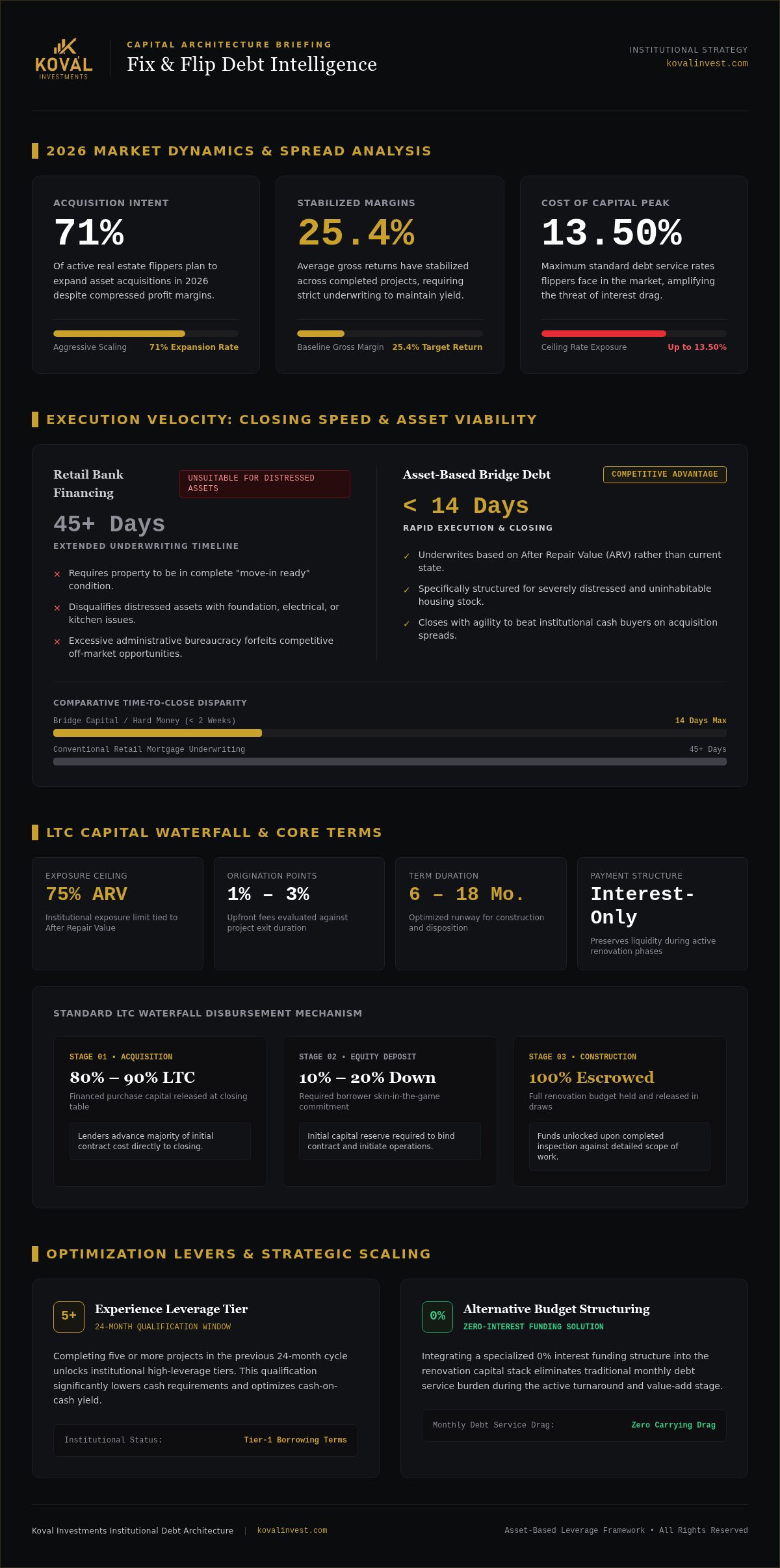
Did you know that 71% of active real estate flippers plan to increase their acquisitions in 2026 despite the most challenging margin environment in nearly two decades? It's a striking statistic that highlights a growing divide in the market. While average gross returns have recently stabilized at 25.4%, many investors still struggle with interest rates that can reach 13.50% and slow closing speeds that cost them lucrative deals. Securing the right fix and flip financing is no longer just about getting a loan. It's about engineering a capital stack that protects your bottom line.
We recognize that high debt costs and rigid credit requirements can feel like an anchor on your portfolio's growth. You want to move quickly and maximize your leverage without sacrificing your net profit to monthly interest drag. This guide will help you master the complexities of real estate leverage and show you how to optimize your financial profile for the best possible terms. We'll examine how to unlock high LTC ratios, use strategic credit positioning to lower your rates, and implement 0% interest solutions to fund your renovation budgets. You'll gain a clear roadmap to faster capital and a lower total cost of debt.
Key Takeaways
- Understand why speed is the ultimate currency in real estate and how bridge debt outperforms traditional mortgages for distressed assets.
- Learn the critical difference between LTC and LTV ratios to maximize your leverage while maintaining sustainable monthly cash flow.
- Discover how to optimize your credit profile to unlock the most competitive rates for fix and flip financing, even with high existing debt utilization.
- Master the construction draw process by establishing a precise scope of work that ensures capital is released exactly when your project needs it.
- Explore how to integrate a 0% interest funding solution into your strategy to fund renovations without the burden of traditional debt service.
What is Fix and Flip Financing and Why Speed Matters
Fix and flip financing serves as a specialized short-term bridge debt designed specifically for the acquisition and renovation of distressed real estate assets. Unlike traditional financing, which focuses on the long-term stability of a primary residence, these loans provide the immediate capital needed to purchase a property, complete necessary improvements, and sell it for a profit. It's the engine that powers the residential transition market, allowing investors to revitalize aging housing stock that would otherwise remain uninhabitable.
Traditional mortgages are fundamentally unsuitable for this type of work. Retail banks typically require a property to be in "move-in ready" condition to satisfy underwriting standards; they often reject houses with significant foundation issues, outdated electrical systems, or missing kitchens. Even if a property qualifies, the bureaucracy of a traditional bank can extend closing timelines to 45 days or more. In a competitive market, this delay is a deal-killer. Sellers often prioritize cash or private capital offers that can close in under two weeks, making speed a critical component of your competitive advantage.
The concept of opportunity cost is central to your success as a flipper. Every day a property sits on the market because you're waiting for a loan officer's approval is a day you're losing potential profit to a more agile competitor. Efficient capital allows you to secure under-market deals before they reach the general public, ensuring your margins remain healthy even as market conditions shift.
The Role of Asset-Based Lending
In this specialized financial sector, lenders prioritize the property’s intrinsic value over the borrower’s personal income. This approach is known as asset-based hard money loans, where the underlying real estate serves as the primary collateral. The most critical metric here isn't the current purchase price, but the After Repair Value (ARV). This figure represents the estimated worth of the property once all renovations are finished. While this focus on the asset provides flexibility, liquidity remains a hurdle. Most lenders still require the investor to have enough cash for a down payment and an initial construction reserve to initiate the project.
Bridge Loans vs. Hard Money
While people often use the terms interchangeably, subtle differences exist. Hard money acts as the "first responder" of capital; it's fast, high-leverage, and ideal for the initial purchase of a derelict property. Bridge loans often serve as a transitionary tool, helping an investor move from the purchase phase into long-term financing if they decide to keep the property as a rental. These products typically carry term lengths ranging from 6 to 18 months. This window provides enough time to complete the renovation and execute an exit strategy, whether that involves a retail sale or a refinance into a permanent debt structure.
Evaluating Fix and Flip Loan Terms and Leverage
Success in fix and flip financing depends on understanding how leverage interacts with your total cost of capital. Lenders use two primary metrics to size a loan: Loan-to-Cost (LTC) and Loan-to-Value (LTV). LTC measures the loan amount against the actual purchase price and renovation budget, while LTV is usually tied to the After-Repair Value (ARV). Most institutional programs cap their exposure at 75% of the ARV to protect against market fluctuations. Understanding these fix and flip loan options is essential for maintaining a healthy margin.
Interest-only payments are the industry standard for these short-term instruments. Because you aren't paying down the principal during the renovation phase, your monthly carrying costs remain manageable. This preserves cash flow for unexpected site issues or material price spikes. You should also evaluate "points," or origination fees, which typically range from 1% to 3% of the total loan amount. While a lower interest rate is attractive, high points can erode your total ROI if you plan to exit the project quickly.
Understanding the LTC Waterfall
The LTC waterfall describes how capital is disbursed throughout the project lifecycle. Most lenders fund between 80% and 90% of the purchase price at closing. The remaining 10% to 20% represents your skin in the game. However, many competitive programs provide 100% of the renovation funding, which is held in escrow and released through draws. Experienced flippers who have completed five or more projects in the last 24 months often access higher leverage tiers, reducing their initial cash requirement and increasing their cash-on-cash return. For those looking to optimize their capital stack, exploring specialized real estate investment funding can help align these terms with your specific portfolio goals.
Closing Costs and Hidden Fees
Beyond interest and points, several administrative costs can impact your bottom line. You'll need to budget for appraisals, legal processing, and draw inspection fees, which generally cost between $200 and $400 per visit. It's also vital to identify any prepayment penalties. In a fast-moving market, you want the flexibility to sell the property as soon as it's ready without being penalized for paying off a 12-month loan in half the time. Always use a checklist to compare term sheets, focusing on the total cost of debt rather than just the headline interest rate. For high-volume investors, prioritizing non-recourse debt is a strategic move that separates personal assets from project-specific liabilities.
Optimizing Your Financial Profile for Lower Rates
Securing the most competitive fix and flip financing isn't just about the property's potential; it's about the borrower's financial narrative. Lenders view your credit score as a proxy for risk management. For active real estate investors, credit reports often become "noisy" due to high credit utilization on existing projects. When you carry renovation expenses on personal lines of credit, your score can drop significantly, even if your equity remains high. Utilizing professional business credit repair services allows you to restructure this debt and present a cleaner profile to underwriters.
A "clean" financial profile does more than just lower your interest rate; it dramatically speeds up the underwriting process. When a lender can verify your liquidity and creditworthiness without wading through dozens of disputed items or unexplained late payments, they can issue a commitment letter in days rather than weeks. In a market where the best deals are won by the fastest capital, your credit score is a strategic tool for project acquisition.
The ROI of Credit Restoration
The financial impact of a credit score increase is quantifiable. In the current market, an investor with a 640 FICO score might face interest rates of 11% or higher, while an investor with a 740 score can often unlock rates below 9%. On a $300,000 loan, this 2% delta represents thousands of dollars in annual interest savings. Disputing inaccuracies and removing outdated negative marks can also unlock higher funding limits, providing the leverage needed for larger, more profitable assets. It's also worth noting that if you eventually pivot toward long-term debt, such as seeking SBA loan assistance for a mixed-use property, you'll need to meet even stricter credit benchmarks.
Building a Business Credit Identity
Long-term scaling requires a clear separation between personal and project-based debt. Establishing a formal business credit identity ensures that your fix-and-flip activities don't negatively impact your personal borrowing power. This corporate transparency builds lender confidence by demonstrating that you treat your investments as a professional enterprise rather than a hobby. Lenders are more likely to offer favorable terms to investors who present a cohesive strategic plan and a documented history of managing the construction loan draw process effectively. This methodical approach to your financial identity creates a foundation for sustainable portfolio growth and reliable capital procurement.
Managing the Draw Process and Construction Capital
Efficient management of construction capital is what separates profitable flippers from those who struggle with project delays. When you secure fix and flip financing, the renovation portion of your loan is typically held in escrow and released in stages. This process begins during underwriting with the establishment of a detailed Scope of Work (SOW). The SOW serves as a contractual agreement between you and the lender, defining exactly what work must be completed to trigger a fund release.
The draw cycle follows a logical four-step progression. First, you and your contractor execute the SOW. Second, you reach specific project milestones, such as completing the "dry-in" phase or finishing the interior paint. Third, you request a draw, which initiates a third-party inspection to verify the work. Finally, the lender issues a reimbursement for the completed phase. This cycle repeats until the project is finished, ensuring that the lender’s capital is always backed by tangible improvements to the asset.
Avoiding the Construction Cash Crunch
One of the most common pitfalls in fix and flip financing is the "cash gap." Because most lenders operate on a reimbursement model, you must have the liquidity to pay for labor and materials before you can request a draw. It's vital to maintain a liquidity reserve of at least 10% to 15% of your total rehab budget to cover these upfront costs. If your capital is currently deployed in other assets, utilizing alternative business funding solutions can provide the necessary gap coverage to keep your contractors on-site and your timeline intact.
The Inspector-Lender Relationship
Draw inspectors act as the eyes and ears of the lender. To ensure a 100% payout on your draw requests, keep your project site organized and ensure all work matches the SOW exactly. If you deviate from the plan without prior approval, the inspector may withhold funds, causing a significant bottleneck. While some lenders use third-party management firms, others handle draws in-house, which can often lead to faster funding speeds. If you're ready to scale your operations with a partner who understands these operational nuances, apply for real estate investment funding to get started on your next acquisition.
Strategic Scaling: Beyond the Single Flip
Scaling a real estate enterprise requires a shift from viewing each project as a standalone transaction to managing a continuous pipeline of assets. While traditional fix and flip financing provides the necessary foundation for acquisition, the most successful operators look for ways to optimize their capital stack and reduce the total cost of debt. Moving beyond a "one-deal-at-a-time" mentality allows you to build a resilient business that attracts institutional partners and higher-tier funding opportunities. This strategic evolution is where your choice of a financial partner becomes a defining factor in your long-term ROI.
Koval Investments acts as a strategic partner in this journey, offering more than just a capital source. We focus on your overall business health, helping you transition from a property flipper to a sophisticated portfolio manager. By aligning your capital procurement with a clear growth roadmap, you can ensure that every project contributes to a larger objective of wealth preservation and operational efficiency.
Leveraging 0% APR for Renovations
One of the most effective ways to protect your margins is to decouple your renovation costs from high-interest debt. Utilizing a 0% Interest Funding Solution allows you to fund your rehab budget without the 8.5% to 13.5% interest drag typically associated with hard money. When you use unsecured 0% interest lines for materials and labor, every dollar saved in interest is a dollar added directly to your net profit. Qualification for these specialized lines often depends on the credit optimization strategies discussed earlier, making a clean financial profile a direct contributor to your project's bottom line. This approach provides the liquidity needed to manage multiple projects simultaneously without over-leveraging your primary fix and flip financing.
Business Valuation and Long-term Growth
Treating your flipping activity as a formal business entity increases your "fundability" in the eyes of institutional lenders. We provide funding for real estate investors that emphasizes corporate transparency and professional strategic planning. As your volume increases, understanding your business valuation becomes essential, especially if you intend to exit the business or bring on equity partners. A well-structured business with a documented track record of success is worth significantly more than the sum of its individual properties. We encourage a consultation to align your capital procurement with these long-term wealth goals, ensuring your financial structure supports a portfolio rather than just a job. This methodical approach builds the credibility needed to secure lower rates and higher leverage as you scale.
Mastering the Path to Sustainable Portfolio Growth
Mastering fix and flip financing is a journey that moves from individual property acquisition to systematic portfolio growth. By prioritizing speed and understanding the nuances of the construction draw process, you protect your margins from common operational bottlenecks. We've explored how optimizing your financial profile and leveraging 0% interest funding solutions can significantly reduce your total cost of debt, allowing you to scale your business with confidence. This methodical approach to capital ensures that you're building a resilient enterprise rather than just managing a series of isolated jobs.
At Koval Investments, we're a steady hand in complex financial landscapes. We provide expert credit repair to unlock prime real estate rates and comprehensive strategic planning to ensure your capital procurement aligns with your long-term wealth goals. Our success-based philosophy means we're as invested in your progress as you are; we focus on creating win-win scenarios where your growth is our primary metric for success. This collaborative stance allows us to navigate challenges alongside you as a trusted mentor and strategic advisor.
Secure your strategic fix-and-flip funding with Koval Investments today to begin engineering a more profitable and sustainable future. Your next successful exit is just one strategic decision away, and we're ready to help you navigate the path forward with quiet confidence and expertise.
Frequently Asked Questions
What is the minimum credit score for fix and flip financing?
Most institutional lenders require a minimum FICO score between 620 and 660. However, scores above 700 or 740 unlock the most competitive rates and higher leverage for fix and flip financing. Koval Investments provides specialized credit repair services to help investors move from standard tiers to prime rates. This financial restructuring is a prerequisite for optimizing your total cost of capital and securing the most favorable terms for your project.
Can I get a fix and flip loan with no experience?
Yes, you can secure funding as a first-time investor, though terms are usually stricter. New flippers might face lower Loan-to-Cost (LTC) limits, often capped at 75% to 80%, compared to 90% for seasoned pros. Lenders will focus more heavily on your liquidity and the property's After-Repair Value (ARV). Partnering with an experienced contractor or mentor can also increase a lender's confidence in your ability to execute the project successfully.
How much of a down payment do I need for a fix and flip loan?
Typically, you'll need a down payment of 10% to 20% of the property's purchase price. While some programs offer 100% renovation funding, the acquisition phase almost always requires the investor to have skin in the game. Your experience level and credit score largely determine this percentage. Higher-volume operators with a proven track record can often negotiate lower down payment requirements to maximize their cash-on-cash returns and project liquidity.
How long does it take to get funded for a fix and flip project?
Private money and hard money lenders can fund a project in as little as 5 to 15 business days. This speed is a primary advantage over traditional retail banks, which often take 45 days or more to close. Rapid access to capital allows you to secure distressed assets before competitors can react. The timeline usually depends on the speed of the appraisal and the clarity of your renovation scope of work.
Is a fix and flip loan better than a HELOC for renovations?
Dedicated bridge loans are generally better for scaling because they're asset-based, business-purpose instruments that don't rely solely on your personal home equity. HELOCs can offer lower interest rates, but they put your primary residence at risk and often have lower limits than a dedicated real estate investment loan. Additionally, specialized investment financing provides specific structures for renovation draws, which helps maintain a clear business accounting trail and protects your personal credit profile.
What property types are eligible for fix and flip financing?
Most programs cover non-owner-occupied residential properties, including single-family homes, townhouses, and 2-4 unit multi-family buildings. Some specialized lenders also fund larger multi-family complexes or mixed-use assets. Properties must generally be distressed or in need of renovation to qualify for bridge debt. Lenders typically exclude primary residences or properties that don't have a clear path to a value-add exit through a retail sale or a long-term refinance.
Can I use 0% interest business funding for real estate flips?
You can use a 0% interest funding solution to cover renovation costs, materials, and labor. While the acquisition of the property is usually handled through fix and flip financing, unsecured 0% APR business lines act as a secret weapon to eliminate interest drag on your rehab budget. This strategy preserves your profit margins by replacing expensive hard money draws with interest-free capital during the construction phase.
What happens if I cannot finish the flip before the loan term ends?
If a project runs past its term, most lenders offer loan extensions, typically for a fee ranging from 1% to 2% of the loan balance. It's vital to communicate with your lender as soon as you anticipate a delay. Lenders prefer a successful exit over a default, so they're usually willing to work with investors who have a clear plan for completion. Maintaining a contingency reserve helps manage these unexpected carrying costs.