
How Credit Score Impact on Business Loans Defines Your Growth in 2026
What if the difference between your business scaling to new heights and stalling in 2026 isn't your revenue, but a three-digit number you rarely check? Understanding the credit score impact on business loans is the single most important step you can take toward securing your company's future. You've likely felt the sting of high interest rates eating into your profits or the frustration of being turned away by traditional banks that require a FICO score of 680 or higher. It's confusing when personal and business credit reporting overlap, leaving you unsure of where you stand.
We believe that capital should be a tool for progress, not a source of stress. You'll discover how your credit profile dictates your access to capital and learn strategic ways to optimize your score for premium funding. This guide provides a clear look at how to qualify for 0% interest solutions and SBA funding, ensuring you have the steady hand needed to navigate a complex financial environment. We'll show you how to transform your credit from a hurdle into a strategic advantage that lowers your cost of capital and supports your long-term objectives.
Key Takeaways
- Understand why lenders in 2026 are shifting their focus from simple revenue to comprehensive credit risk profiles to determine your business's scalability.
- Identify which credit tier your business currently occupies and how reaching the "Premium Tier" of 740 or higher unlocks the most competitive prime rates.
- Learn the mechanics of the personal guarantee and why your personal financial history remains a critical factor in securing business-level capital.
- Discover the direct credit score impact on business loans and follow a step-by-step framework to repair inaccuracies and optimize your debt utilization.
- Explore how a strategic credit profile serves as the primary tool for unlocking 0% interest funding solutions for your working capital needs.
The Strategic Role of Credit Scores in Business Capital Procurement
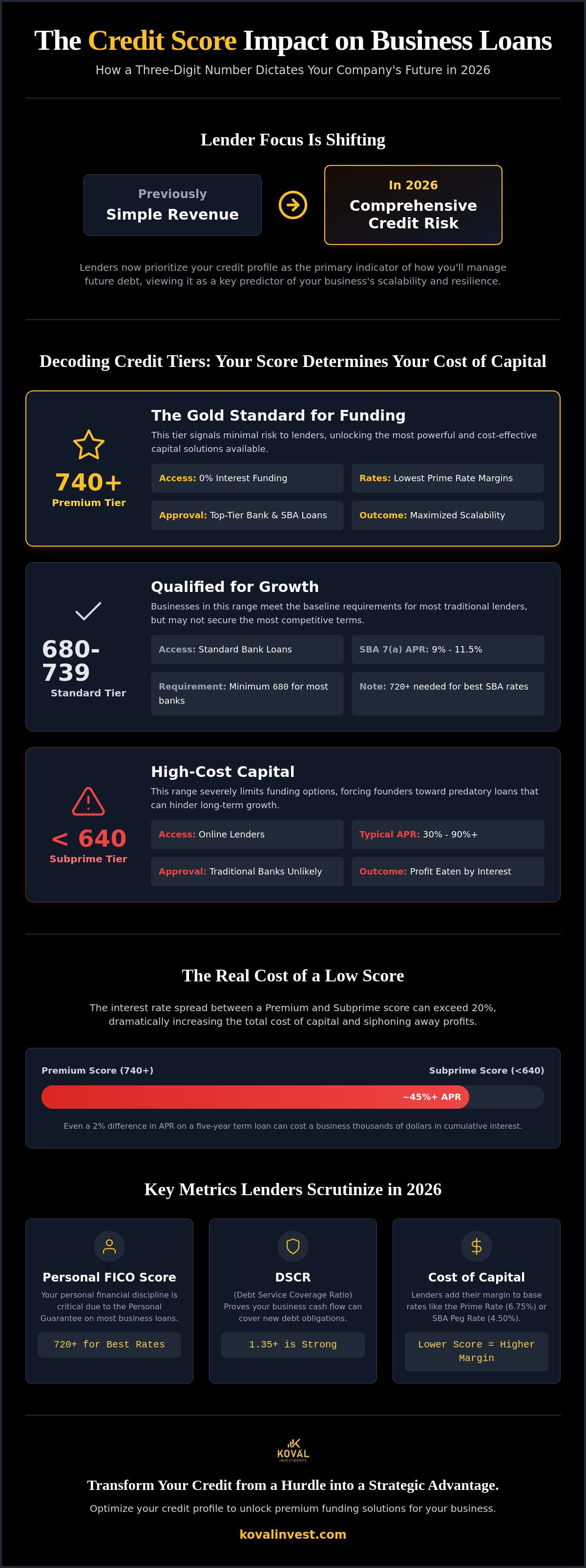
To understand your company's potential, you must first understand the metrics lenders use to evaluate it. What is a credit score? At its core, it's a risk-assessment tool that summarizes your financial reliability into a single, actionable figure. In 2026, the credit score impact on business loans has evolved. While revenue remains a critical factor, lenders now prioritize your credit profile as the primary indicator of how you'll manage future debt obligations. This profile directly influences your business valuation. A company with high-tier credit standing is viewed as a lower-risk investment, suggesting stable and predictable cash flow that attracts better partnership opportunities.
The Gatekeeper of Growth
Credit scores act as a filter, determining which financial doors open and which remain closed. This score represents the fundamental credit score impact on business loans, serving as the primary barrier between standard operations and aggressive expansion. If you're seeking SBA loan assistance, for instance, a personal FICO score of 680 is often the baseline for traditional banks. This number dictates your "cost of capital." A lower score forces you into higher-interest alternative loans, where APRs can reach 45% or more, significantly limiting your ability to reinvest in your company. By viewing your credit as a strategic business asset rather than a personal hurdle, you align your financial health with your long-term growth objectives.
Lender Expectations in the 2026 Market
Today's lenders are moving beyond surface-level balance sheets. They utilize global cash flow analysis, which scrutinizes both your business revenue and your personal household obligations. With the Prime Rate holding steady at 6.75% in June 2026, lenders are particularly focused on your Debt Service Coverage Ratio (DSCR). A ratio of 1.35 or higher is considered strong, but your credit score remains the lens through which this data is interpreted. Lenders use these profiles to predict business resilience during economic shifts, favoring founders who demonstrate long-term financial discipline.
With the SBA Optional Peg Rate at 4.50% for the second quarter of 2026, the competition for fixed-rate funding is high. Lenders now look for scores of 720 or higher to offer the most competitive variable rates, which currently range from 9% to 11.5% APR for SBA 7(a) loans. This shift toward holistic evaluation means your credit health is the deciding factor in whether you qualify for the most favorable terms available. It's not just about getting approved; it's about qualifying for capital that supports, rather than hinders, your company's scalability.
Decoding Credit Tiers: How Scores Influence Interest Rates and Terms
Your credit score isn't just a number; it's a pricing mechanism. Lenders use the 300 to 850 FICO range to bucket risk, and your placement dictates your company's profitability. Moving beyond the strategic role of credit, we must examine how specific numerical ranges translate into financial outcomes. The credit score impact on business loans is most visible when lenders sort applicants into distinct tiers. These tiers determine whether you're offered a growth-enabling tool or a high-interest burden.
- The Premium Tier (740+): This is the gold standard for business owners. It provides access to 0% interest funding solutions and the lowest margins above the Prime Rate, which currently sits at 6.75%.
- The Standard Tier (680-739): Most traditional banks and SBA lenders operate here. While you'll qualify for standard bank loans, you may need a score of 720 or higher to secure the most competitive SBA 7(a) variable rates, currently ranging from 9% to 11.5% APR.
- The Subprime Tier (Below 640): This range often forces founders toward online lenders where APRs commonly range from 30% to 90% or more. At this level, traditional bank approval is rare, as most require at least a 680.
The Real Cost of a Low Score
The interest rate spread between a 620 and 740 score often exceeds 20%, shifting a borrower from prime bank rates to high-cost alternative capital. Even a seemingly small 2% difference in APR on a five-year term loan can cost a business thousands of dollars in cumulative interest, siphoning away cash that should be used for payroll or inventory. Subprime funding, particularly merchant cash advances, often traps businesses in debt cycles where daily or weekly revenue is sacrificed just to service the high-cost debt. If you find yourself in this tier, utilizing professional Credit Repair Services is often the most effective way to pivot toward more sustainable capital.
Qualifying for Premium Funding Tiers
Reaching the 740+ threshold does more than lower your rates; it expands your funding limits and secures longer repayment terms. These favorable conditions reduce the monthly pressure on your cash flow, allowing for more aggressive strategic planning. It's essential to understand the credit score needed for a business loan across different lender types to set realistic goals. To ensure your company is positioned for the best possible terms, you should also follow a how to qualify for SBA loan checklist. This methodical approach ensures that when you apply for capital, you're doing so from a position of strength rather than necessity.
The Personal Guarantee: Why Personal Credit Matters for Business Loans
Many founders believe that forming an LLC or a corporation creates an impenetrable wall between their personal finances and their business obligations. In reality, lenders view the owner's financial behavior as a direct proxy for the company's future performance. This is why understanding the credit score requirements for a business loan involves a deep dive into your personal FICO report. For most small business loans, especially for newer enterprises, a personal guarantee is a standard requirement. This legal commitment means you're personally responsible for the debt if the business cannot meet its obligations.
Bridging the Gap Between Personal and Corporate
Lenders often apply the "alter ego" doctrine during the underwriting process. They assume that if you manage your personal debts with precision, you'll apply that same discipline to your corporate capital. Conversely, common personal credit errors, such as high utilization on personal cards used for business expenses, can sink an application even if the company's revenue is strong. The credit score impact on business loans is magnified when your personal debt-to-income ratio is high, as it suggests you might be overextended. To protect your borrowing power, it's vital to keep personal and business expenses separate, even though this decoupling is a gradual process.
The Role of an SBA Loan Consultant
When your credit profile is "on the bubble," typically in the 640 to 670 range, the path to approval becomes narrow. This is where a professional SBA loan consultant provides significant value. These advisors help you navigate the complexities of personal guarantee requirements by presenting your financial narrative in a way that aligns with lender expectations. They bridge the communication gap between you and the underwriter, explaining one-time credit events or highlighting mitigating factors like a strong Debt Service Coverage Ratio (DSCR). Professional representation ensures that minor credit blemishes don't automatically result in a denial.
Building business credit independently is the long-term solution to reducing personal risk. By establishing tradelines with vendors who report to bureaus like Dun & Bradstreet, you begin to create a standalone credit identity for your entity. While this transition allows your business to eventually secure funding without a personal guarantee, the journey always begins with the foundation of a healthy personal score. Strategic growth in 2026 requires you to manage both profiles with equal intentionality, ensuring that your personal history supports, rather than hinders, your corporate ambitions.
Actionable Steps to Repair and Optimize Your Credit Profile
Optimizing your financial profile is a methodical process that requires precision and persistence. While previous sections established the tiers of funding, moving your score into a higher bracket involves specific, tactical adjustments. The credit score impact on business loans is often dictated by the clarity and accuracy of your reporting. By treating your credit as a strategic asset, you can actively reduce your cost of capital and increase your borrowing capacity for 2026.
- Step 1: Audit and Dispute. Obtain a comprehensive report from all three major bureaus. Look for inaccuracies in payment history, incorrect credit limits, or accounts that don't belong to you. Disputing these errors is the fastest way to see an immediate score adjustment.
- Step 2: Strategic Debt Paydown. Focus on lowering your revolving credit utilization. Lenders prefer to see utilization below 30%, but for premium funding, aim for under 10%. This demonstrates that you don't rely on credit for daily survival.
- Step 3: Diversify Your Credit Mix. A robust profile includes a blend of revolving accounts and installment loans. This variety proves to underwriters that you can manage different types of financial obligations simultaneously.
- Step 4: Manage Hard Inquiries. During a funding search, multiple applications can trigger hard inquiries that temporarily lower your score. Coordinate your applications within a short window to minimize the cumulative impact on your profile.
Restoring a damaged profile is not an overnight event. In the 2026 market, most restoration timelines range from three to six months, depending on the complexity of the errors and the amount of debt being restructured. Patience and a logical progression are your best tools during this phase.
Professional Credit Repair Services
DIY credit repair often fails to meet the rigorous demands of business capital procurement. Business owners frequently encounter complex reporting errors that require sophisticated intervention. Investing in professional Credit Repair Services provides a tactical advantage by identifying hidden discrepancies that automated systems often miss. The ROI of this investment is realized the moment you qualify for a prime-rate loan instead of a high-interest alternative, potentially saving your company tens of thousands in interest expenses.
Maintaining an Optimal Profile
Keeping your profile "funding ready" requires consistent vigilance. Establish a monthly checklist to monitor for new inquiries, changes in utilization, and reporting updates. We operate on a success-based philosophy, emphasizing that a strong score is only valuable if it remains stable through your expansion phases. By staying proactive, you ensure that when a strategic opportunity arises, your credit profile supports an immediate and favorable response from lenders. This steady hand in managing your finances is what defines a resilient and scalable business.
Leveraging an Optimized Credit Profile for 0% Interest Funding
The ultimate goal of credit optimization is to eliminate the cost of borrowing entirely. While we've analyzed the credit score impact on business loans in terms of general approval, its most significant influence is on the interest rate itself. Reaching a score of 700 or higher doesn't just lower your rates; it unlocks access to 0% interest business funding solutions. This specialized capital allows you to scale without the immediate burden of interest payments, providing a clear runway for aggressive growth in 2026.
Interest-free working capital serves as a powerful strategic lever. By utilizing these funds, you can preserve your company's equity while avoiding the 9% to 45% APR ranges common with other lenders. This approach creates a win-win scenario where your business expansion is funded by prime-tier credit rather than high-cost debt. It's a methodical way to ensure that your revenue goes toward your bottom line instead of servicing interest expenses. When your profile is optimized, you transition from being a seeker of capital to a strategic allocator of it.
The 0% Interest Strategy
Founders often use interest-free capital for high-ROI activities like inventory procurement, targeted marketing campaigns, or key hires. Because this funding is typically unsecured, it doesn't require you to pledge business assets or real estate as collateral, significantly reducing your operational risk. Koval Investments facilitates access to these specialized sources by aligning your optimized credit profile with lenders that prioritize high-tier borrowers. This strategy provides the flexibility of a credit line with the cost-efficiency of cash, allowing you to move quickly when market opportunities arise.
Your Next Steps to Capital Access
The path from a challenged credit history to 0% interest funding is a logical progression that requires a steady hand. It begins with professional restoration to remove inaccuracies and continues through strategic optimization of your utilization and debt mix. This journey ensures your business remains funding-ready at all times, regardless of economic shifts. We believe in a collaborative approach where we act as your strategic partner, navigating the complexities of the financial landscape alongside you.
Your credit score is the foundation of your company's scalability. By taking intentional steps to repair and optimize your profile today, you're securing the interest-free capital you'll need for tomorrow's expansion. If you're ready to transform your credit into a strategic asset, we invite you to reach out for a consultation. Let's work together to define your growth and secure the premium funding your business deserves.
Securing Your Financial Future Through Strategic Credit Optimization
Your credit profile is the primary lever for business scalability in 2026. We've explored how the credit score impact on business loans dictates everything from your interest rates to your access to interest-free capital. By shifting from a reactive stance to a proactive strategy, you position your company to thrive in a competitive market. It's about more than just numbers; it's about the freedom to reinvest in your vision without the weight of high-cost debt.
Founded in 2018, Koval Investments serves as a seasoned strategic partner in complex financial landscapes. We offer specialized 0% interest funding solutions and expert SBA loan assistance to help you navigate the path to premium capital. Our team provides the steady hand needed to bridge the gap between where you are and where you want to be. Optimize your credit and secure 0% interest funding today with Koval Investments. The journey toward sustainable growth is within your reach, and we're ready to help you navigate every step of the process with confidence.
Frequently Asked Questions
Does a business loan affect my personal credit score?
Yes, a business loan can affect your personal credit score if the lender requires a personal guarantee or reports your payment history to consumer credit bureaus. Most traditional banks and SBA lenders conduct a hard inquiry on your personal report during the application phase, which causes a temporary dip. If your business fails to make payments, the delinquency will likely appear on your personal profile, impacting your future borrowing capacity.
What is the minimum credit score for an SBA loan in 2026?
SBA lenders generally require a minimum personal FICO score between 640 and 680 in 2026. While some flexible lenders might accept a score of 650, securing the most competitive rates on SBA 7(a) loans often requires a score of 720 or higher. This specific credit score impact on business loans ensures that the most favorable terms, such as variable rates between 9% and 11.5%, are reserved for low-risk borrowers.
Can I get a business loan with a 500 credit score?
Yes, you can obtain a business loan with a 500 credit score, but your choices are typically restricted to alternative and online lenders. These lenders prioritize business revenue over credit history, often requiring strong monthly cash flow to offset the risk. However, be prepared for significantly higher costs, as APRs for borrowers with scores below 600 can range from 30% to 90% or more, depending on the lender's risk assessment.
How long does it take for credit repair to impact my loan eligibility?
It generally takes three to six months for professional credit repair to significantly impact your loan eligibility. This timeline allows for the identification and dispute of inaccuracies, as well as the time required for credit bureaus to update your records. During this period, focusing on strategic debt paydown can further improve your utilization ratios, making your profile more attractive to lenders who prioritize high-tier credit standing for premium funding.
Why did my business loan get denied even with a good credit score?
Approval depends on several critical factors beyond your credit score, including your Debt Service Coverage Ratio (DSCR) and global cash flow. Lenders in 2026 typically require a DSCR of at least 1.25, with 1.35 or higher considered strong. If your business revenue doesn't sufficiently cover your existing debt obligations and the new loan payment, a lender may deny your application regardless of how high your personal or business credit scores are.
How do I separate my personal credit from my business credit?
Separation begins with formalizing your business entity and obtaining a federal Employer Identification Number (EIN). Once established, you should open a dedicated business bank account and apply for tradelines with vendors who report specifically to business credit bureaus like Dun & Bradstreet. This process allows you to build a standalone credit identity, eventually reducing the credit score impact on business loans by qualifying for capital without relying solely on your personal history.
What is a personal guarantee in business lending?
A personal guarantee is a legal agreement where a business owner assumes personal liability for a company's debt. If the business defaults on the loan, the lender has the right to pursue the owner's personal assets, such as savings or real estate, to recover the funds. This requirement is standard for most small business loans because it provides lenders with an additional layer of security, especially for newer or smaller enterprises.
How much does credit repair cost for a business owner?
Costs vary based on the complexity of your credit profile and the specific errors that need to be addressed. Professional services involve a thorough audit of your reports followed by targeted disputes and optimization strategies. Rather than viewing this as a simple expense, it's more accurate to see it as a strategic investment that enables access to lower interest rates and premium funding solutions, ultimately saving your business significant capital over time.