
How to Build Business Credit: Strategic 2026 Guide
A 2026 survey revealed that over 76% of small business owners are now bypassing traditional banks for capital, marking a record shift in how companies fund their growth. Many entrepreneurs still find themselves trapped in a cycle of high personal credit utilization, essentially acting as the primary lender for their own firms. If you're researching how to establish business credit for the first time, you're likely tired of seeing your personal score dip because of essential corporate expenses. It's a common frustration to feel the weight of personal liability for every debt when you should be building a separate financial identity for your brand.
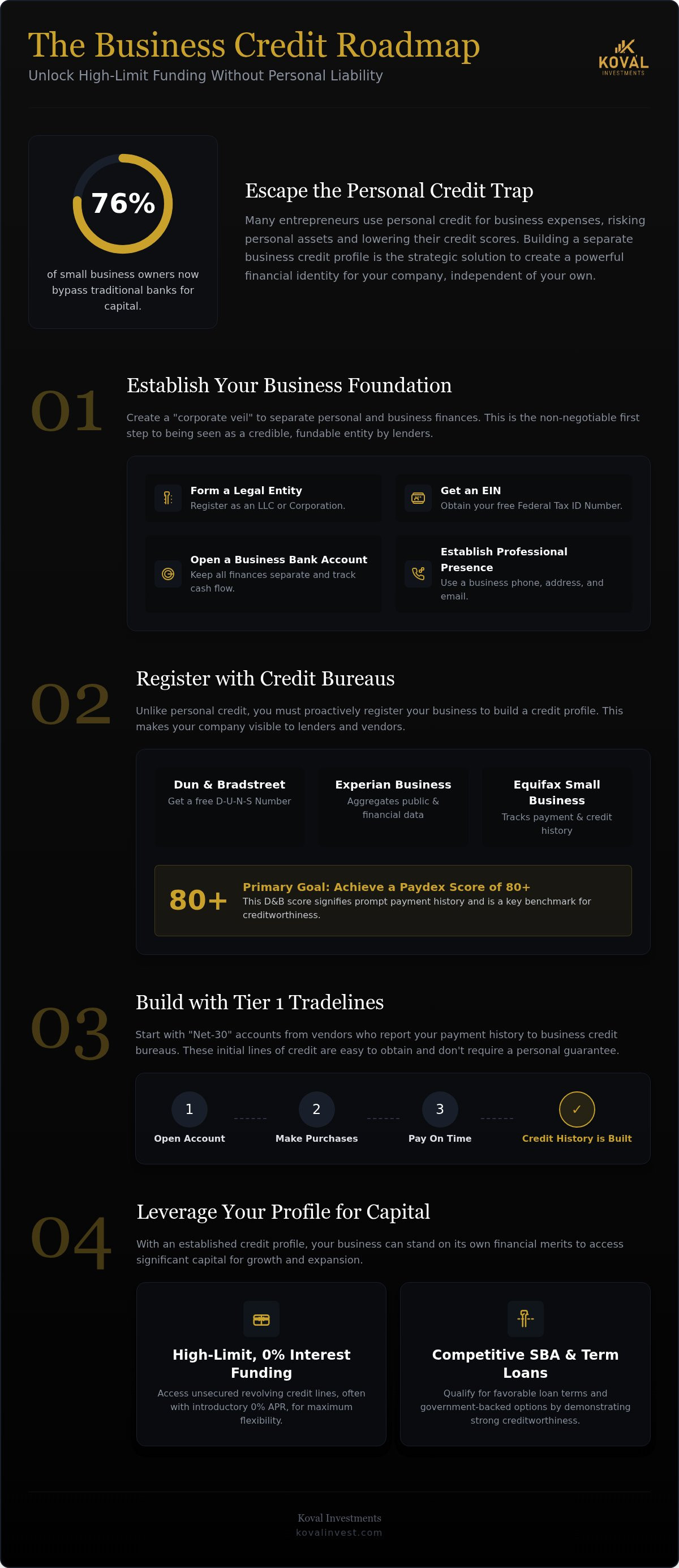
This guide provides a strategic roadmap to building a powerful business credit profile from scratch. You'll learn the exact steps to separate your personal and business finances, allowing you to unlock high-limit, 0% interest funding solutions. We will detail the methodical process of securing Tier 1 vendor lines and navigating bureau reporting requirements to ensure your company qualifies for significant capital. By following this framework, you'll position your business to stand on its own financial merits and access the strategic capital necessary for long-term expansion without the typical hurdles of institutional lending.
Key Takeaways
- Learn why establishing a separate legal entity is the essential first step to protecting personal assets and creating a professional corporate veil.
- Discover how to establish business credit for the first time by securing a free D-U-N-S number and registering with the major reporting bureaus.
- Identify specific Tier 1 Net-30 vendors that report your payment history without requiring a personal guarantee or social security number.
- Implement a hybrid credit strategy that optimizes both personal and business scores to access high-limit, unsecured revolving credit.
- Transition your established profile into tangible capital, including 0% interest funding solutions and competitive SBA loan options.
The Foundation: Creating a Separate Legal and Financial Identity
Building a wall between your personal life and your business isn't just about legal protection; it's the bedrock of your financial future. This separation is known as the "corporate veil." When you're learning how to establish business credit for the first time, this veil ensures that lenders view your company as its own entity. Without it, your personal credit utilization remains high, and your personal assets stay at risk. Establishing this boundary is the first step for anyone wondering how to establish business credit for the first time effectively.
A sole proprietorship creates a significant bottleneck for growth. Because there's no legal distinction between the owner and the business, lenders often default to your personal credit score and history. To break this cycle, you must obtain a Federal Tax ID, also known as an Employer Identification Number (EIN). This nine-digit number acts as your business’s Social Security Number, allowing you to build business credit reports that are entirely independent of your personal profile.
Forming Your Business Entity Correctly
Choosing a formal structure like an LLC or a Corporation is non-negotiable. These structures provide the legal framework required for building corporate credit. You must ensure your business name is identical on every document, from your Secretary of State filing to your utility bills. Lenders use automated systems to verify your existence through state records. Any discrepancy in your name or address can trigger a manual review or an immediate denial. The filing with the Secretary of State is often the first place a lender looks to confirm your business is in good standing.
Professional Presence and Compliance
Credibility markers act as silent signals to underwriters. Listing your business in the 411 directory might seem dated, but many automated underwriting systems still use these databases to verify that a business is legitimate. Similarly, using a personal email address like a Gmail or Yahoo account suggests a lack of permanence. A dedicated business domain and a professional email address are small investments that yield high trust. You don't want a simple email choice to be the reason a high-limit application gets rejected.
Finally, you must open a dedicated business bank account. This account serves as the primary record of your company's cash flow. Lenders often require several months of bank statements to verify revenue before extending high-limit lines of credit. Keeping your business finances in a separate bucket proves you're serious about maintaining a professional financial identity and allows you to track your growth accurately.
Registering with Major Business Credit Bureaus
Once you've secured your legal foundation, the next phase in learning how to establish business credit for the first time is visibility. Unlike personal credit where bureaus track you via your Social Security Number, business credit requires proactive registration with three major entities: Dun & Bradstreet (D&B), Experian Business, and Equifax Small Business. Each bureau weights data differently, and they don't always share information. Your industry classification, determined by your NAICS or SIC code, is another critical factor. These codes tell a lender exactly what your risk level is based on your sector. If you choose a high-risk code like "Real Estate Investment," you might face stricter underwriting than a "Management Consulting" firm. It's vital to select a code that accurately reflects your operations while remaining favorable to lenders.
The Dun & Bradstreet (D&B) Registration Process
Registering for a D-U-N-S Number is the entry point for most corporate credit builders. You can apply for this number for free on the D&B website. While the process typically takes up to 30 business days, D&B often pushes "expedited" packages that cost hundreds of dollars. These are usually unnecessary if you aren't in an immediate rush to apply for a loan. Once registered, your primary goal is to build your Paydex score. The Paydex score is a dollar-weighted indicator of your payment performance that ranges from 1 to 100, where a score of 80 or higher signifies that your business pays its bills on time.
Experian and Equifax Small Business Profiles
Experian and Equifax operate differently than D&B because they often aggregate data from public records, bank accounts, and existing trade lines to create a "ghost" profile before you even apply for credit. You should search their databases to ensure a profile hasn't already been started with incorrect or outdated data. A little-known factor in these scores is the age of your business bank account. Lenders view a long-standing account as a sign of stability and operational health.
If you're following the how to establish business credit guidelines provided by the SBA, you know that data congruence is key. Your address, phone number, and legal name must match exactly across all three bureaus to avoid being flagged by automated fraud detection systems. If you find that your personal credit history is currently creating friction in this process, credit repair services can help clear the path for your business profile to grow independently.
Building Your Profile with Tier 1 Tradelines and Net-30 Accounts
After registering your business with the bureaus, your profile is a blank slate. To fill it with positive data, you must engage with Tier 1 vendors. These companies offer "Net-30" accounts, which serve as the training wheels for your corporate credit. A Net-30 account allows you to purchase supplies today and pay the full invoice within 30 days. When you're learning how to establish business credit for the first time, these accounts are your most accessible tools because they typically don't require a personal guarantee or a hard pull on your personal credit. Your goal is to establish a "Buy-Pay-Repeat" cycle. By purchasing small items and paying the invoice immediately, you force the bureaus to recognize your business as a reliable borrower within 60 to 90 days.
It's vital to never carry a balance on these accounts. Unlike personal credit where carrying a small balance can sometimes be neutral, business trade credit is purely about performance. A single late payment or a revolving balance on a Net-30 account can stall your progress before it truly begins. You want your reports to show a consistent history of fulfilled obligations, not outstanding debt.
Selecting Your First Strategic Vendors
- Uline: A staple for shipping and industrial supplies that consistently reports to Dun & Bradstreet.
- Quill: Excellent for office supplies and cleaning products; they generally require a small initial purchase before extending terms.
- Grainger: A reliable source for industrial equipment that helps diversify your tradeline types and reports to multiple bureaus.
Before spending a dollar, always confirm that a vendor still reports to at least one of the major bureaus. In 2026, most businesses need between three and five active tradelines to generate an initial credit score. Without this minimum threshold, your profile will remain "unscored," making it difficult to move toward higher-limit revolving credit.
Managing Trade Credit for Maximum Impact
The "early payment" hack is the fastest way to a high Paydex score. While the terms are Net-30, paying your invoice 10 to 15 days before the due date often triggers a higher score than paying on the actual deadline. D&B's algorithm rewards businesses that demonstrate superior liquidity. You should monitor your business credit reports monthly to ensure these vendors are actually reporting your activity. If a vendor stops reporting, they're no longer serving your strategic goal, and it's time to find a replacement. Don't fall into the trap of applying for ten accounts at once; a steady, methodical approach is more persuasive to future lenders than a sudden burst of activity.
Strategic Optimization: Repairing and Improving Your Credit Profile
While the core objective of learning how to establish business credit for the first time is to build a standalone profile, the reality of high-tier funding often involves a "Hybrid" model. Lenders for high-limit corporate cards and unsecured lines of credit frequently look at the owner's personal FICO score alongside the business Paydex or Intelliscore. This is especially true when seeking 0% interest introductory periods. If your personal credit utilization is spiked due to business overhead, it signals a liquidity risk to underwriters. Strategic optimization requires balancing both profiles to ensure neither one drags down the other's eligibility. This balance is a critical, yet often overlooked, part of how to establish business credit for the first time with the goal of long-term scalability.
Disputing Inaccuracies and Errors
Business credit reports are notorious for containing clerical errors that can silently sabotage your funding chances. Common issues include incorrect physical addresses, outdated tax liens that have already been satisfied, or duplicate profiles for the same EIN. Dun & Bradstreet and Experian have distinct processes for corrections; D&B typically requires using their iUpdate portal, while Experian may require a formal written dispute supported by legal documentation. Utilizing professional business credit repair services allows founders to focus on operations while experts handle the bureaucratic friction of bureau communications. Correcting these errors is a foundational part of mastering business credit repair services to ensure your data is congruent and lender-ready.
Preparing for High-Tier Lending
Reaching the highest levels of capital access requires more than just a few Net-30 accounts. A personal FICO score of 700 or higher is generally the threshold for unlocking 0% interest business credit cards with limits exceeding $50,000. This personal strength is also vital when seeking SBA loan assistance, where the lender evaluates the "total credit character" of the borrower. Before you apply for expansion capital, you must manage your debt-to-income ratio and ensure your personal reports are clean. This dual-optimization strategy creates a win-win scenario where your business can leverage interest-free capital while protecting your personal financial health.
If you're ready to move beyond basic tradelines and want to optimize your profile for maximum funding, consider our professional credit repair services to accelerate your path to capital.
Leveraging Your Credit for 0% Interest Funding and SBA Loans
The final phase of your journey focuses on converting your established profile into tangible liquid capital. Once you have mastered how to establish business credit for the first time by building a foundation of Tier 1 tradelines, you can transition into high-limit revolving credit. These unsecured lines of credit are the lifeblood of a growing company, providing the flexibility to manage cash flow without the constraints of fixed repayment schedules. A strong credit profile significantly lowers the cost of alternative business funding solutions, as lenders view your demonstrated history of reliability as a justification for lower risk premiums. This transition marks the point where your business moves from merely existing to strategically expanding.
The 0% Interest Funding Strategy
One of the most effective ways to fuel rapid growth is through business credit cards that offer 0% APR introductory periods. In 2026, these periods typically range from 12 to 21 months, allowing you to utilize interest-free capital for inventory, marketing, or equipment. A major advantage of these corporate accounts is that most do not report to your personal credit bureaus. This keeps your personal debt-to-income (DTI) ratio low, protecting your personal financial health while you scale your operations. To maximize this opportunity, you should follow the ultimate guide to 0% interest business funding in 2026 to ensure you are selecting the right banking partners for your specific industry.
Partnering for Capital Procurement
Securing high-limit funding is a methodical process that benefits from professional oversight. While many founders understand how to establish business credit for the first time, they often struggle with the nuances of lender-specific underwriting requirements. Koval Investments acts as a strategic partner in this landscape, utilizing a success-based philosophy to align our objectives with your growth. We help you navigate the complexities of procurement, whether you are seeking immediate working capital or long-term SBA loan assistance.
A well-planned capital strategy moves you through a logical progression. You start with 0% interest revolving lines to build momentum and eventually graduate to larger, long-term debt instruments like SBA 7(a) or 504 loans for major acquisitions or real estate investments. By working with an expert team, you can significantly compress the timeline between registration and your first major funding round. It's time to review your current credit profile, identify any remaining gaps, and prepare your business to access the capital it deserves. Our collaborative approach ensures that you have a steady hand guiding you through every financial milestone.
Scaling Your Business with a Strategic Financial Identity
Mastering the process of how to establish business credit for the first time is more than a clerical task; it's a strategic move toward financial independence. By formalizing your legal entity and building a history with Tier 1 vendors, you create a profile that commands respect from major lenders. This foundation allows you to stop relying on personal assets and start leveraging the power of corporate credit to fuel your expansion. Success in the current financial landscape requires a methodical approach to credit repair and profile optimization to ensure you're always lender-ready.
Koval Investments provides the expertise needed to bridge the gap between building credit and securing actual capital. We specialize in success-based credit optimization and offer strategic guidance for SBA loan approval. Whether you need working capital or want to Secure Your 0% Interest Funding Solution Today, our team is ready to help you access high-limit capital with 0% introductory rates. Your business's potential is no longer limited by your personal credit score. Take the next step toward a collaborative partnership and unlock the funding your company deserves.
Frequently Asked Questions
How long does it take to establish business credit for the first time?
It typically takes between 60 and 90 days to generate an initial score when you are learning how to establish business credit for the first time. This timeframe allows your first Tier 1 vendors to report your payment history to bureaus like Dun & Bradstreet. While your profile begins forming immediately after registration; lenders usually look for at least three months of consistent activity before they consider your score stable enough for significant funding.
Can I build business credit without using my personal Social Security Number?
You can build a credit profile using only your Employer Identification Number (EIN) without linking your personal Social Security Number. Many Tier 1 vendors and some corporate credit cards offer "EIN-only" applications that don't require a personal guarantee. This separation is essential for protecting your personal financial health; however, keep in mind that high-limit 0% interest funding often utilizes a hybrid approach where your personal score acts as a secondary verification.
What is the best way to get a business credit score fast?
The fastest method to generate a score is to open three to five Net-30 accounts with vendors that report to the major bureaus immediately. By making purchases and paying the invoices at least ten days before the due date, you trigger positive data points quickly. This "early payment" strategy is highly effective for raising your Paydex score, as the algorithm rewards businesses that demonstrate superior liquidity and proactive debt management.
Do I need a personal guarantee to establish business credit?
A personal guarantee isn't strictly necessary for Tier 1 vendor accounts, but it's often required for high-limit revolving credit and SBA loans. Many business owners choose to provide a guarantee initially to unlock 0% interest capital more quickly. As your business profile matures and shows significant revenue, you can often request the removal of personal liability or apply for "corporate-only" lines that rely solely on your business's financial performance.
Which credit bureaus do business lenders check most often?
Lenders primarily check Dun & Bradstreet, Experian Business, and Equifax Small Business. While D&B is the most common for trade credit, many traditional banks and fintech lenders prefer Experian’s Intelliscore for revolving lines. Because each bureau pulls from different data sources, you must ensure your business information is congruent across all three. Inconsistencies in your address or phone number can lead to automatic denials during the underwriting process.
What is a good business credit score for a new company?
For a new company, a Paydex score of 80 or higher is considered excellent. This score indicates that your business pays its bills on time, which is the baseline requirement for most competitive funding. On the Experian Intelliscore scale, a score above 75 suggests low risk. Maintaining these levels is vital when you are navigating how to establish business credit for the first time with the goal of securing interest-free capital.
How many tradelines do I need to get 0% interest business funding?
Most lenders look for a minimum of five to ten reported tradelines before approving high-limit 0% interest funding. These lines should show a mix of Net-30 accounts and smaller revolving cards. Having a diverse profile proves you can manage different types of debt responsibly. If you currently have fewer lines, focusing on adding two to three new reporting vendors can significantly improve your eligibility for unsecured corporate credit within a few months.
Is it possible to establish business credit with a new LLC?
It's entirely possible and highly recommended to start building credit with a brand-new LLC. Establishing your EIN and professional credibility markers immediately after formation prevents the common mistake of mixing personal and business expenses. By starting early, you allow your business bank account to age; this is a secret factor many lenders use to determine the stability and reliability of a new enterprise during the funding phase.