
How to Get an SBA Loan with Bad Credit: A 2026 Strategic Guide
A credit score in the 500s or low 600s is often viewed as a permanent "no" from federal lenders, but the reality of 2026 SBA lending is far more nuanced. You likely feel the weight of high interest rates on alternative loans and the fear that a single rejection letter will stall your business growth. It's exhausting to navigate complex financial requirements when you're already focused on daily operations. We understand that a less-than-perfect credit history doesn't always reflect your current business potential.
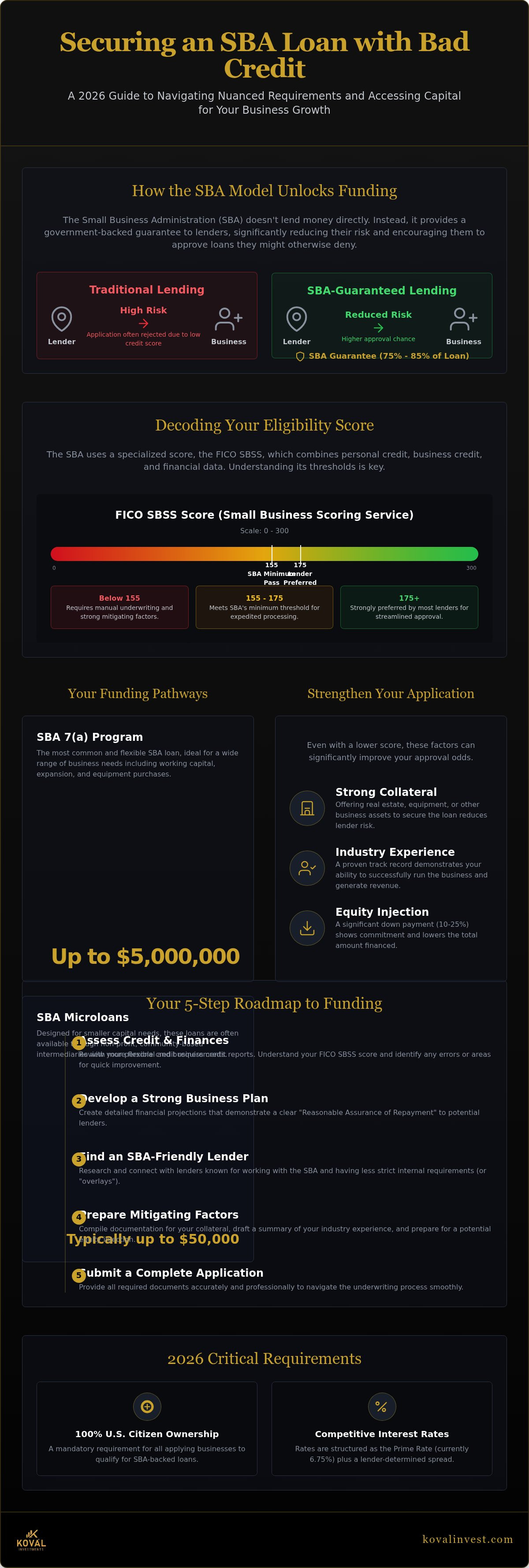
This guide explains exactly how to get an SBA loan with bad credit by leveraging specific pathways like SBA Microloans or the 7(a) program. You'll discover how to navigate the FICO SBSS score, which typically requires a minimum of 155 to 165 for approval. We also address critical 2026 updates, including the requirement that businesses be 100% owned by U.S. citizens to qualify. By the end of this article, you'll have a clear roadmap to secure funding at competitive rates, such as the current Prime Rate of 6.75% plus a lender spread, while simultaneously restoring your credit profile. We'll show you how to move from financial uncertainty to a successful, capital-backed expansion.
Key Takeaways
- Understand how the SBA’s role as a guarantor provides lenders the security needed to approve files that fall below traditional credit thresholds.
- Learn to navigate the FICO SBSS scoring system and how it combines your personal and business history into a single, critical eligibility metric.
- Identify why SBA Microloans and the 7(a) program remain viable options for business owners who need to secure up to $5,000,000 in capital.
- Discover the exact five-step roadmap on how to get an SBA loan with bad credit by integrating strategic credit restoration with your funding application.
- See how professional SBA loan assistance and bridge funding solutions can stabilize your cash flow while you work toward long-term government-backed financing.
Understanding the SBA Loan Landscape for Business Owners with Bad Credit
Many entrepreneurs believe a credit score below 640 is an absolute barrier to government funding. This misconception often leads business owners to settle for predatory, high-interest alternative loans that stifle growth and drain working capital. Understanding how to get an SBA loan with bad credit begins with a clear view of the lending structure. The Small Business Administration (SBA) does not typically issue the funds directly. They serve as a guarantor, providing a safety net that encourages private lenders to extend credit to businesses that don't meet traditional banking criteria.
In the 2026 lending environment, the focus has shifted toward inclusive capital access. While traditional banks might see a low credit score as an immediate red flag, the SBA encourages a more holistic view. They prioritize the long-term viability of the business over historical credit setbacks. This approach allows for a "win-win" scenario where the government supports economic growth and the business owner gains access to affordable capital.
The Role of the SBA Guaranty
The SBA provides a guaranty that covers 75% to 85% of the loan amount, depending on the specific program and loan size. This means if a business faces a default, the government reimburses the lender for the guaranteed portion. This significantly lowers the bank's risk profile. However, it's important to distinguish between SBA requirements and bank "overlays." An overlay is a stricter internal policy a bank adds on top of the SBA’s rules. While one bank might require a 680 score, another SBA-friendly lender might be comfortable with a 620 if other factors are strong. Finding a lender whose internal policies align with your current financial standing is a critical part of the strategy.
Why the SBA Does Not Set a Hard Minimum Score
The SBA focuses on the "totality of the circumstances" rather than a single numerical threshold. Their primary requirement is the "Reasonable Assurance of Repayment." This rule mandates that a lender must perform a thorough analysis to ensure the business can generate enough cash flow to service the debt. While many lenders prefer a score of 680 or higher, 2026 data shows that approvals are increasingly common for scores in the mid-600s when revenue is stable. Underwriting now favors established businesses with strong revenue, even if the owner's personal credit history has some blemishes. Lenders look for mitigating factors to offset a low score, such as:
- Collateral: Real estate or equipment that can secure the loan.
- Industry Experience: A proven track record of managing similar businesses.
- Equity Injection: A larger down payment to reduce the lender's exposure.
By demonstrating a clear path to profitability and a solid management team, you can successfully navigate the application process. This strategic approach is the foundation of how to get an SBA loan with bad credit while positioning your company for long-term expansion.
Decoding SBA Credit Score Requirements: FICO SBSS and Beyond
While many borrowers focus solely on their personal FICO score, the SBA utilizes a more complex metric for loans under $500,000. This is the FICO Small Business Scoring Service (SBSS) score. Understanding this specific number is a vital part of learning how to get an SBA loan with bad credit. Unlike personal scores that range from 300 to 850, the SBSS operates on a scale of 0 to 300. It doesn't just track how you handle personal credit cards; it aggregates your personal credit history, your business credit report, and your company's financial data into one distilled number.
The SBA currently sets a minimum "pass" threshold of 155 to 165 for the 7(a) small loan program. However, many traditional lenders require a score of 175 or higher before they feel comfortable moving forward. If you fall below this mark, your application won't benefit from expedited processing, and you'll face much more rigorous manual underwriting. Exploring various SBA loan programs can help you identify which specific path fits your current SBSS profile and business needs.
The Mechanics of the FICO SBSS Score
The weighting of the SBSS score is proprietary, but it heavily emphasizes your personal credit behavior alongside your business's payment history. For newer businesses, the personal side carries more weight. For established firms, the financial health of the entity takes center stage. To optimize this score, you should focus on a few key areas. First, maintain a low personal credit utilization ratio. Second, ensure all business trade lines are reported to agencies like Dun & Bradstreet. Third, demonstrate consistent profitability on your tax returns. Finally, correct any inaccuracies in both personal and business credit reports to ensure the data is precise.
Personal Credit as a Proxy for Business Character
Lenders view personal credit as a window into your professional integrity. Derogatory marks like recent bankruptcies, tax liens, or foreclosures are often interpreted as character risks rather than just financial setbacks. If your record includes these, you'll likely need to complete SBA Form 912, the Statement of Personal History. This document allows you to provide context for past financial challenges. This transparency is essential when figuring out how to get an SBA loan with bad credit, as it builds trust with the underwriter. When addressing these mishaps, stay objective; state the cause of the issue, how it was resolved, and why it won't happen again. If you're concerned about how your history might impact your eligibility, our SBA loan assistance can help you develop a strategic approach to present your file in the best possible light.
SBA Microloans and Alternative Funding: The Best Paths for Low Credit Scores
While the 7(a) program is the SBA's flagship product, it often carries the strictest credit requirements. If your score is currently below 620, you should look toward programs designed specifically for underserved markets. Learning how to get a business loan with bad credit involves understanding that different government-backed structures have different risk tolerances. For instance, the SBA 504 program is excellent for real estate but generally requires a minimum score of 680. In contrast, the Microloan program and certain alternative business funding solutions provide much more flexibility for founders in the rebuilding phase.
The 2026 lending landscape continues to favor domestic growth, and these smaller-scale programs are the engine for that progress. By choosing the right entry point, you can secure the capital you need today while positioning your business for larger traditional loans in the future. This strategic selection is the most reliable method of how to get an SBA loan with bad credit without facing constant rejections from institutional banks.
The SBA Microloan: A Gateway to Capital
The SBA Microloan program provides up to $50,000 to help small businesses start and expand. These loans aren't issued by banks; they're managed by non-profit, community-based intermediaries, including Community Development Financial Institutions (CDFIs). Because these lenders focus on community economic development rather than just profit, they're often the most accessible path for those wondering how to get an SBA loan with bad credit. A unique feature of this program is the requirement for technical assistance. Lenders provide business training and management coaching to ensure you can handle the debt responsibly. Successfully repaying a Microloan is a powerful way to build the business credit history needed to qualify for a larger 7(a) loan later.
Leveraging 0% Interest Funding as a Strategic Bridge
Sometimes the time required for an SBA approval doesn't align with your immediate operational needs. This is where 0% interest business funding serves as a strategic bridge. This solution provides unsecured capital that can be used for inventory, marketing, or equipment while you work through the credit restoration process. By utilizing a "capital stack" strategy, you combine these 0% interest lines with a Microloan to cover both short-term gaps and long-term growth. This collaborative approach allows you to maintain momentum without being forced into high-interest, predatory debt cycles that further damage your financial standing. We view this as a proactive way to maintain cash flow while your long-term SBA application moves through the federal pipeline.
5 Strategic Steps to Secure SBA Funding Despite a Low Credit Score
Securing government-backed capital requires more than just a filled-out application; it demands a tactical approach to your financial narrative. If you're wondering how to get an SBA loan with bad credit, you must look beyond the score and focus on the data behind it. Lenders in 2026 are increasingly willing to partner with resilient founders who demonstrate a clear plan for capital deployment and debt service. By following these five steps, you can shift the lender's focus from your past setbacks to your future potential.
- Step 1: Conduct a deep-dive audit. Pull your reports from all three major bureaus for both your personal and business profiles. Look for mismatched addresses, closed accounts marked as open, or settled debts still showing a balance.
- Step 2: Resolve inaccuracies. Utilize professional business credit repair services to dispute and remove errors. This is often the fastest way to see a meaningful score increase before an underwriter reviews your file.
- Step 3: Prioritize cash flow. Build a robust business plan that demonstrates a Debt Service Coverage Ratio (DSCR) of at least 1.25. This proves you generate $1.25 for every $1.00 of debt payment, which provides the "reasonable assurance of repayment" lenders require.
- Step 4: Offer mitigation. If your score is a weak point, strengthen the file with tangible collateral or a co-signer with a higher credit profile. This reduces the lender's risk and can bridge the gap for a "soft" credit score.
- Step 5: Seek expert guidance. Partner with an SBA loan consultant who understands which specific banks have an appetite for your industry and credit profile. This prevents you from wasting time on lenders with strict internal "overlays."
Audit and Optimize Your Credit Profile
Disputable items on a credit report act as friction in the SBA approval process. Removing a single erroneous late payment can sometimes boost a score by 30 points or more, which is far more efficient than waiting years for old, legitimate debt to fall off the record. It's vital to distinguish between credit repair and credit building. Credit repair focuses on the integrity of your historical data, while credit building involves strategically adding new, positive trade lines to your profile. Both are necessary when learning how to get an SBA loan with bad credit, but repair usually offers the most immediate results for an active application.
Strengthening the Rest of Your Application
A high DSCR is often the most powerful offset for a low FICO score. If your business is highly profitable, lenders may overlook personal credit hiccups, provided you include a well-crafted Letter of Explanation. This letter should be objective; it should detail the circumstances of past issues and provide evidence that those conditions no longer exist. Additionally, obtaining a professional business valuation can help prove your loan-to-value (LTV) ratios are favorable, making the deal more attractive to conservative bank committees. If you're ready to begin this process, our Credit Repair Services can help you clean up your reports while you finalize your funding strategy.
Navigating the SBA Application with Koval Investments: Your Path to Capital
The journey to securing federal capital is often more about strategic presentation than just a numerical score. While the previous sections outlined the mechanics of how to get an SBA loan with bad credit, the actual execution requires an insider's perspective to move from application to closing. Automated marketplaces and generic lending tools often fail business owners with complex histories. These algorithms don't understand the context of a temporary setback or the strength of a recovering revenue stream. At Koval Investments, we provide high-level SBA loan assistance that translates your company's potential into a language that federal underwriters respect. We operate on a success-based philosophy, ensuring that our interests are perfectly aligned with your ultimate funding goals.
Our collaborative approach treats you as a partner, not just a transaction. We understand that a less-than-perfect credit history is a challenge to be solved, not a reason for dismissal. By integrating our credit repair services with our capital procurement strategies, we create a streamlined path that addresses the root causes of rejection while simultaneously building your case for approval. This dual-focus strategy ensures you aren't just applying for a loan; you're optimizing your entire financial profile for long-term stability and growth.
The Insider Advantage: Why Expertise Matters
Navigating the 2026 lending landscape involves more than just finding a bank. It requires identifying specific lenders whose internal "overlays" are compatible with your unique credit profile. We leverage an extensive network of SBA-friendly institutions that prioritize cash flow and operational experience over static credit thresholds. Our strategic planning services polish your application to meet current standards, ensuring that every derogatory mark is addressed with a factual, results-oriented explanation. This human-led advisory process removes the mystery from the application and replaces it with a predictable, methodical path to approval. We focus on the "win-win" nature of our engagements, positioning your business as a low-risk, high-reward opportunity for the right lender.
Ready to Secure Your Business Future?
The path to capital involves a specific three-stage process: Repair, Prepare, and Procure. We begin by identifying and disputing inaccuracies in your credit reports to give you the best possible starting point. Next, we help you prepare a professional package that highlights your company’s debt service coverage and market position. Finally, we procure the funding through our network of strategic partners. This integrated model is the most effective answer to how to get an SBA loan with bad credit in today’s economy.
2026 is the year to scale your operations and capture market share. Past credit setbacks shouldn't dictate your company's future potential. We invite you to experience a partnership built on integrity, expertise, and a shared commitment to your success. Schedule your strategic funding consultation with Koval Investments today and discover how we can help you navigate the complexities of the SBA landscape with confidence.
Empowering Your Business Growth Through Strategic Funding
Accessing government-backed capital in 2026 requires a shift from viewing credit as a static number to seeing it as a manageable asset. We've explored the pathways to approval, from understanding the FICO SBSS threshold of 155 to leveraging non-profit Microloan intermediaries. You now have the tactical steps necessary to audit your profile and present a cash-flow-heavy application that offsets historical credit challenges. Mastering how to get an SBA loan with bad credit is ultimately about alignment, persistence, and specialized expertise.
Koval Investments stands as your strategic partner, offering a success-based engagement model that prioritizes your results. Our comprehensive credit restoration expertise and national access to 0% interest funding solutions provide the bridge you need while navigating the SBA process. We move beyond automated marketplaces to provide personalized, high-level advisory that mirrors a professional consultation.
Your business potential isn't defined by your past. With the right strategy and a committed partner, you can secure the funding required to scale your operations and achieve long-term success.
Frequently Asked Questions
What is the absolute minimum credit score for an SBA 7(a) loan in 2026?
There is no official government-mandated minimum credit score, but most lenders require a personal score of at least 650. For the SBA 7(a) small loan program, a FICO SBSS score of 155 to 165 is the standard threshold for automated approval. If your score falls below these levels, you'll need to demonstrate exceptional cash flow or provide significant collateral to satisfy the lender’s internal risk overlays.
Can I get an SBA loan with a recent bankruptcy on my credit report?
You can secure funding with a past bankruptcy, provided it has been fully discharged for at least two to three years. Lenders will carefully review the circumstances surrounding the filing through your Statement of Personal History. You must demonstrate that the financial instability was due to an isolated event rather than a pattern of poor management. Showing a consistent history of on-time payments since the discharge is essential for approval.
How does the SBA FICO SBSS score differ from my personal credit score?
Your personal FICO score focuses exclusively on your individual credit behavior, while the FICO SBSS score aggregates personal data, business credit reports, and company financial statements. The SBSS scale ranges from 0 to 300 and is used to predict the likelihood of business default. Understanding this distinction is vital when learning how to get an SBA loan with bad credit, as a strong business history can sometimes offset personal credit blemishes.
Will a co-signer help me get an SBA loan if my credit is bad?
A co-signer with a strong credit profile can significantly improve your chances of approval by reducing the lender's overall risk. The SBA allows for "guarantors" who provide additional security for the loan. This individual must be willing to undergo the same financial scrutiny as the primary applicant. Their presence on the application can bridge the gap if your personal score doesn't meet a specific bank’s internal minimum requirements.
How long does it take to repair credit for an SBA loan application?
The timeline for credit restoration typically ranges from 30 to 90 days for disputing and removing inaccuracies. While correcting errors provides a relatively fast boost, building a new positive history through strategic trade lines can take six months or longer. We recommend starting the credit repair process as early as possible to ensure your profile is optimized before the final underwriting phase of your SBA application begins.
What are the best SBA programs for startups with low credit scores?
The SBA Microloan program is the most accessible option for startups with lower credit scores. These loans are managed by community-based non-profit lenders who prioritize business viability and community impact over traditional credit metrics. For larger amounts, the 7(a) program remains an option if the startup has a robust business plan and a significant equity injection. These programs provide the foundational capital needed to scale while building business credit.
Does the SBA require collateral if I have a low credit score?
The SBA requires lenders to follow specific collateral policies, and a low credit score often makes this requirement more stringent. For loans over $50,000, lenders must generally secure as much collateral as is available, up to the loan amount. Using tangible assets like real estate or equipment can provide the necessary security to offset the perceived risk of a lower credit score, making your application much more competitive.
Can I use 0% interest funding while waiting for SBA approval?
You can absolutely utilize 0% interest business funding as a strategic bridge while your SBA application is in process. This unsecured capital allows you to maintain operational momentum and cover immediate expenses like inventory or marketing. By using this "capital stack" approach, you avoid high-interest alternative debt while waiting for the longer-term, lower-rate SBA funding to close. This creates a flexible financial cushion during the transition period.