
How to Get Business Funding with Bad Credit: A 2026 Strategic Guide
What if your current credit score isn't a permanent barrier but actually the starting line for a more sophisticated capital strategy? Many business owners feel trapped by high-interest debt and the sting of frequent bank denials when their scores don't meet the traditional 680 threshold. It's frustrating to watch capital costs eat into your margins while you're trying to scale. However, learning how to get business funding with bad credit is about more than just finding a lender who says yes; it's about engineering a profile that commands the best possible terms.
We understand the confusion that often arises when personal and business credit impacts collide. Our approach focuses on a logical transition from expensive, short-term fixes to sustainable, low-cost solutions. In this guide, you'll discover the methodical steps required to restore your credit profile and position your company for SBA loan eligibility or 0% interest business funding. We'll break down the 2026 landscape, including updated debt service coverage ratio requirements, so you can stop reacting to financial hurdles and start executing a clear plan for growth.
Key Takeaways
- Learn how to conduct a multi-bureau deep dive to isolate factual inaccuracies and outdated industry codes that hinder your capital access.
- Discover the strategic steps of how to get business funding with bad credit by engineering a diverse credit mix and lowering utilization ratios.
- Prepare your profile for 0% interest funding and SBA 7(a) eligibility by meeting 2026 FICO SBSS thresholds and removing excessive inquiries.
- Understand why a success-based advisory model provides a more reliable path to sustainable capital than traditional DIY credit repair methods.
The Reality of Business Funding with Bad Credit: Restoration vs. Acceptance
In the current 2026 financial environment, "bad credit" isn't just a number; it's a structural barrier to growth. While the prime rate has settled at 6.75%, the lowest since late 2022, lenders remain highly selective. For most entrepreneurs, understanding your credit score is the first step in realizing that a personal FICO below 680 often triggers automatic denials for traditional capital. Settling for high-interest alternative loans seems like a temporary solution, but the opportunity cost is immense. Every dollar spent on excessive interest is a dollar taken away from your marketing budget, payroll, or equipment upgrades. Business credit restoration is the systematic removal of inaccuracies to meet lender-grade standards.
The Hidden Dangers of "Bad Credit" Loans
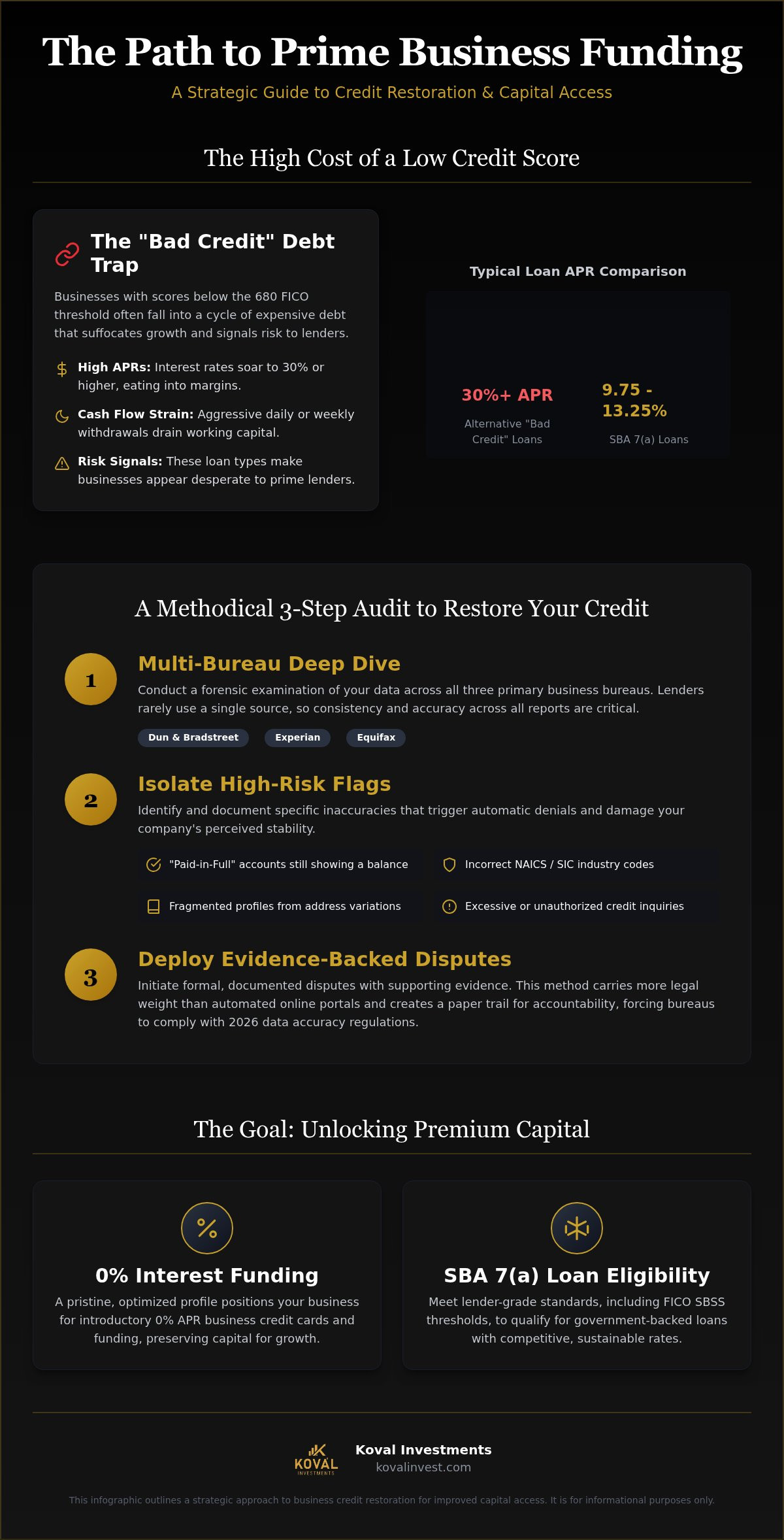
Many SMBs fall into a "debt trap" by accepting capital with APRs reaching 30% or higher. These products frequently demand daily or weekly withdrawals from your bank account, which can suffocate your operational working capital. Beyond the immediate cash flow strain, traditional lenders view these high-frequency payments as "risk signals." If a lender sees multiple short-term loans on your bank statements, they may assume your business is in a state of desperation. This makes it significantly harder to learn how to get business funding with bad credit at competitive rates later. You aren't just paying more for the money; you're signaling to the market that your business is a high-risk gamble rather than a stable investment.
Why Rebuilding Beats Starting Over
Some advisors suggest starting a new entity to escape a poor history, but "EIN-only" credit building rarely succeeds without a solid personal foundation. Lenders value the "aging" of a business entity. An established company with several years of history is far more attractive to the SBA than a brand-new shell company. By cleaning up your existing profile, you leverage your historical data rather than discarding it. Historical data, once scrubbed of errors, provides significantly more leverage than a fresh profile with no track record. This methodical approach allows you to present a seasoned, high-scoring business profile that qualifies for 0% interest solutions or SBA 7(a) loans. Currently, SBA 7(a) variable-rate loans feature maximum rates between 9.75% and 13.25%, a target that becomes reachable once your foundation is secure.
A Methodical 3-Step Audit to Identify and Dispute Report Errors
Understanding how to get business funding with bad credit begins with a forensic examination of your data. Unlike personal credit, business credit is fragmented across three primary bureaus: Dun & Bradstreet, Experian, and Equifax. Each bureau uses distinct scoring models, so an error on one report won't necessarily appear on another. You must conduct a multi-bureau deep dive to ensure your profile is consistent and accurate across all platforms. This audit is the foundation of your funding strategy because lenders rarely look at just one source of truth.
Common Errors That Tank Business Scores
During your audit, isolate specific "high-risk" flags that trigger automatic denials. One of the most damaging errors is an incorrect NAICS or SIC code. If your business is classified under a high-risk industry by mistake, lenders may reject your application regardless of your actual revenue. Other frequent issues include fragmented profiles where slight address variations create multiple, weak listings for the same company. You should also identify "Paid-in-Full" accounts that still show as delinquent. These inaccuracies dilute your credit power and make your business look less stable than it actually is.
The Professional Dispute Narrative
Once you isolate inaccuracies, you must deploy evidence-backed formal disputes to force bureau corrections. While many people try to use automated online portals, these systems often lack the nuance required for business credit. A formal, documented dispute carries more weight because it creates a clear paper trail for legal accountability. Under 2026 regulations, bureaus are legally required to maintain 100% accurate data. If they fail to correct a proven error, they face significant regulatory pressure.
Timing your disputes with reporting cycles is essential for maximum score impact. If you're preparing for SBA loan programs, your profile must be pristine well before the underwriting process begins. If a bureau returns a "verified" status on an inaccuracy, don't stop there. You must initiate secondary dispute rounds with additional documentation to prove your case. This methodical approach is the most reliable way to learn how to get business funding with bad credit without settling for predatory terms. If the technicalities of bureau communication seem daunting, our credit repair services can help manage the heavy lifting for you.
Strategic Optimization: Utilization and Tradeline Engineering
Repairing past damage is only half of the equation. To truly master how to get business funding with bad credit, you must optimize your profile through strategic tradeline engineering. Lenders prioritize a "Credit Mix" that shows you can handle diverse financial obligations responsibly. While you may have already learned how to dispute credit report errors to clear historical hurdles, adding seasoned tradelines provides the positive data needed to prove current reliability. These accounts demonstrate a track record of stability, which is essential for Mastering Business Credit Repair Services: A Strategic Guide for 2026 Capital Access. By intentionally building this foundation, you transition from a high-risk applicant to a strategic partner in the eyes of a lender.
Selecting High-Impact Tradelines
Effective building starts with vendors that report to all three major bureaus. Consistency is vital; if a vendor only reports to Dun & Bradstreet, your Experian and Equifax scores will remain stagnant. Net-30 accounts are the "low-hanging fruit" of this process. These Tier 1 vendors allow you to purchase supplies and pay within thirty days, creating a track record of reliability without requiring a high personal credit score. As your profile matures, you can transition to Tier 2 revolving store cards. This methodical climb signals to banks that your business is ready for more complex capital structures.
Managing the Utilization Bridge
Credit utilization accounts for a massive portion of your score, but you don't always need a large debt payoff to improve it. The "30% Rule" suggests keeping your balances below 30% of your total limit. In the business world, you can achieve this through strategic limit increases. By requesting a higher limit on an existing account while keeping your spending flat, you instantly lower your utilization percentage. It's also vital to prevent "leakage," where business debt appears on your personal report. High utilization on personal cards is a common reason for denial, even if the business is profitable. Keeping these profiles distinct ensures your personal score remains high enough to qualify for 0% interest introductory offers. This separation is a fundamental step in learning how to get business funding with bad credit while protecting your long-term financial health.
Positioning for 0% Interest and SBA Loan Eligibility
Securing capital is not just about having a high score; it's about presenting a profile that meets specific institutional thresholds. For those exploring how to get business funding with bad credit, the goal is to move beyond "subprime" status into the realm of government-backed loans and 0% interest capital. While the SBA discontinued the mandatory FICO SBSS prescreen for small 7(a) loans of $350,000 or less in March 2026, many lenders still utilize this score for larger applications. Generally, SBA 7(a) and 504 loans require a minimum personal FICO of 680, though SBA Express loans offer slightly more flexibility at 650. Lenders in 2026 prioritize debt-to-income (DTI) ratios alongside credit scores to ensure your cash flow can support new obligations.
Before applying, you must clean up "excessive inquiries" that signal desperation to lenders. Too many hard pulls within a six month period can lead to automatic denials, even if your score is technically sufficient. We view a restored personal score as a bridge. It provides the initial trust needed to unlock high-limit business funding. This transition requires a methodical approach to ensure every data point on your report aligns with the expectations of prime lenders.
SBA Funding Readiness
Meeting the score requirement is only the first hurdle. You must also address "character" flags, such as past bankruptcies or tax liens, which trigger manual reviews. As of March 1, 2026, the SBA requires a Debt Service Coverage Ratio (DSCR) of 1.10:1 or greater for small 7(a) loans. It's also vital to remember that 100% of the business must be owned by U.S. citizens or nationals. Utilizing professional SBA loan assistance can help you navigate these nuances. Understanding the differences in SBA 7(a) vs. 504 Loan: Choosing the Right Capital Strategy for 2026 ensures you apply for the program that best fits your operational goals.
Unlocking 0% Interest Capital
Accessing 0% interest funding solutions requires a profile that is "funding-ready," not just clean. This means having enough unsecured capacity to qualify for high-limit introductory offers. These cards typically offer a 0% APR for seven to twelve months, providing a low-cost way to manage working capital while you scale. Our Ultimate Guide to 0% Interest Business Funding in 2026 details how to engineer your profile to maximize these approvals. By focusing on unsecured capacity, you can bypass the high costs associated with alternative lending. If you're ready to stop settling for high interest, we can help you secure the funding your business deserves through a collaborative, results-oriented strategy.
The Collaborative Path: Why Professional Advisory Beats DIY Repair
Many entrepreneurs initially view credit restoration as a clerical task they can manage through automated software or basic online templates. However, learning how to get business funding with bad credit involves a level of technical restructuring that goes far beyond simple dispute letters. We operate on a "Strategic Partner" model where credit repair is treated as the essential gateway to capital procurement. This approach ensures that your financial profile isn't just "fixed" but is actively engineered to meet the specific underwriting criteria of prime lenders. By aligning our objectives with yours, we move away from a transactional relationship toward a collaborative venture focused on long-term growth.
Our success-based philosophy is a core pillar of this partnership. It reinforces our confidence in delivering results because our interests are directly tied to your ability to secure capital. For a busy founder, the time-value of money is a critical consideration. Spending dozens of hours navigating bureau bureaucracies often costs more in lost operational focus than the investment in professional advisory. Delegating this technical work allows you to concentrate on scaling your business while we handle the complexities of transitioning your profile toward alternative business funding solutions that offer better terms and lower interest rates.
The Boutique Advisory Experience
Professional consultants identify "hidden" errors that automated systems frequently miss. These might include mismatched industry codes or fragmented files that dilute your credit power across different bureaus. We provide a "straight-talk" mentality when evaluating your business planning and valuations. Unlike high-volume firms, a boutique advisory takes the time to understand the nuances of your specific industry and capital needs. This personalized connection ensures that the strategy we build together is both aspirational and deeply practical, respecting your current operational constraints while preparing you for future expansion.
Next Steps: Your Funding Audit
Once your credit foundation is secured, the path toward sophisticated financial maneuvers becomes clear. A strong profile facilitates more accurate business valuations and makes your company a much more attractive candidate for future mergers and acquisitions. Navigating the 2026 lending landscape requires a steady hand and a clear roadmap. We invite you to take the first step toward a more stable financial future by reviewing your current standing. Schedule your comprehensive credit and funding audit with Koval Investments today to begin the methodical journey from high-interest debt to 0% interest eligibility. This audit is the definitive starting point for any owner committed to mastering how to get business funding with bad credit.
Engineering Your Capital Future
Navigating the 2026 lending landscape requires a shift from accepting high-interest debt to engineering a profile that commands institutional respect. By auditing your reports across all three bureaus and strategically adding seasoned tradelines, you build the foundation necessary for premium capital. We have explored how a methodical approach allows you to transition from subprime status to SBA eligibility and 0% interest opportunities. Each step in this process is designed to lower your cost of capital and increase your operational flexibility.
Mastering how to get business funding with bad credit isn't a solo endeavor; it's a collaborative process. Our boutique strategic advisory combines a success-based philosophy with the deep industry expertise of our SBA loan consultants to ensure your interests are always prioritized. We focus on the practicalities of your growth, providing a steady hand as you move toward a more stable financial future. Ready to take control of your capital procurement journey? Access 0% Interest Funding and Expert Credit Restoration to begin your comprehensive funding audit. Your business deserves a partner invested in your long-term success. We look forward to helping you unlock the capital you need to scale with confidence.
Frequently Asked Questions
How long does it take to fix business credit for a loan in 2026?
Most business owners see significant results within three to six months. This timeframe accounts for the initial audit, the thirty to forty-five day dispute cycles required by bureaus, and the time needed for new tradelines to report. While some inaccuracies are corrected quickly, building a stable, lender-grade profile requires a methodical approach. We focus on ensuring your data is consistent across all major bureaus before you apply for high-limit capital.
Can I really get 0% interest funding with a history of bad credit?
You can access these solutions once your credit profile is restored to a personal FICO of 680 or higher. While a history of bad credit is a hurdle, it isn't a permanent disqualifier. These 0% introductory APR offers typically last between seven and twelve months. We help you bridge the gap between your current standing and the "funding-ready" status required to secure these low-cost capital options for your operations.
What is the minimum FICO SBSS score for an SBA 7(a) loan?
As of March 1, 2026, the SBA no longer mandates the FICO SBSS prescreen for 7(a) Small Loans of $350,000 or less. For loans exceeding this amount, lenders often look for a score of 155 or higher. It's important to remember that while the prescreen is gone for smaller loans, most traditional SBA 7(a) and 504 programs still require a personal credit score of at least 680 to qualify.
Does my personal credit score affect my business loan approval?
Your personal credit remains a critical factor because most business lenders require a personal guarantee. This means the lender looks at your individual financial responsibility as a predictor of business performance. Improving your personal score is a fundamental part of the strategy for how to get business funding with bad credit. A higher personal score unlocks better terms, lower interest rates, and access to more diverse capital sources like SBA Express loans.
What are the most common errors found on business credit reports?
The most frequent issues include incorrect industry classification codes, outdated business addresses, and accounts that remain marked as delinquent despite being paid in full. Fragmented profiles, where your business appears as multiple separate entities, also dilute your credit power. Identifying these errors is the first step in our audit process. Correcting them ensures that lenders see an accurate and professional representation of your company's actual financial health.
Is it better to fix my credit or start a new business entity?
Restoring your existing credit is almost always more beneficial than starting a new entity. Lenders prioritize the "age" of a business, and an entity with several years of history is far more attractive than a brand-new shell company. Starting over often discards years of valuable historical data. By fixing your current foundation, you leverage your company's established track record while removing the specific inaccuracies that are holding you back.
How do tradelines help improve my business credit score fast?
Tradelines add positive payment history to your report and can help lower your overall credit utilization ratio. Net-30 vendor accounts are particularly effective for rapid building because they report to the major bureaus frequently. These accounts demonstrate to lenders that your business can manage short-term debt responsibly. When used strategically, they provide the necessary data points to boost your score and qualify for more competitive, high-limit funding solutions.
What is a success-based credit restoration service?
A success-based model ensures that the advisory firm is equally invested in your positive outcome. At Koval Investments, we don't just provide a service; we act as a strategic partner in your capital procurement journey. This philosophy means our goals are aligned with yours. We focus on the practicalities of financial restructuring to ensure you reach the specific thresholds required for SBA loans, real estate funding, or 0% interest capital.