
How to Increase Working Capital for a Small Business: A Strategic Guide for 2026
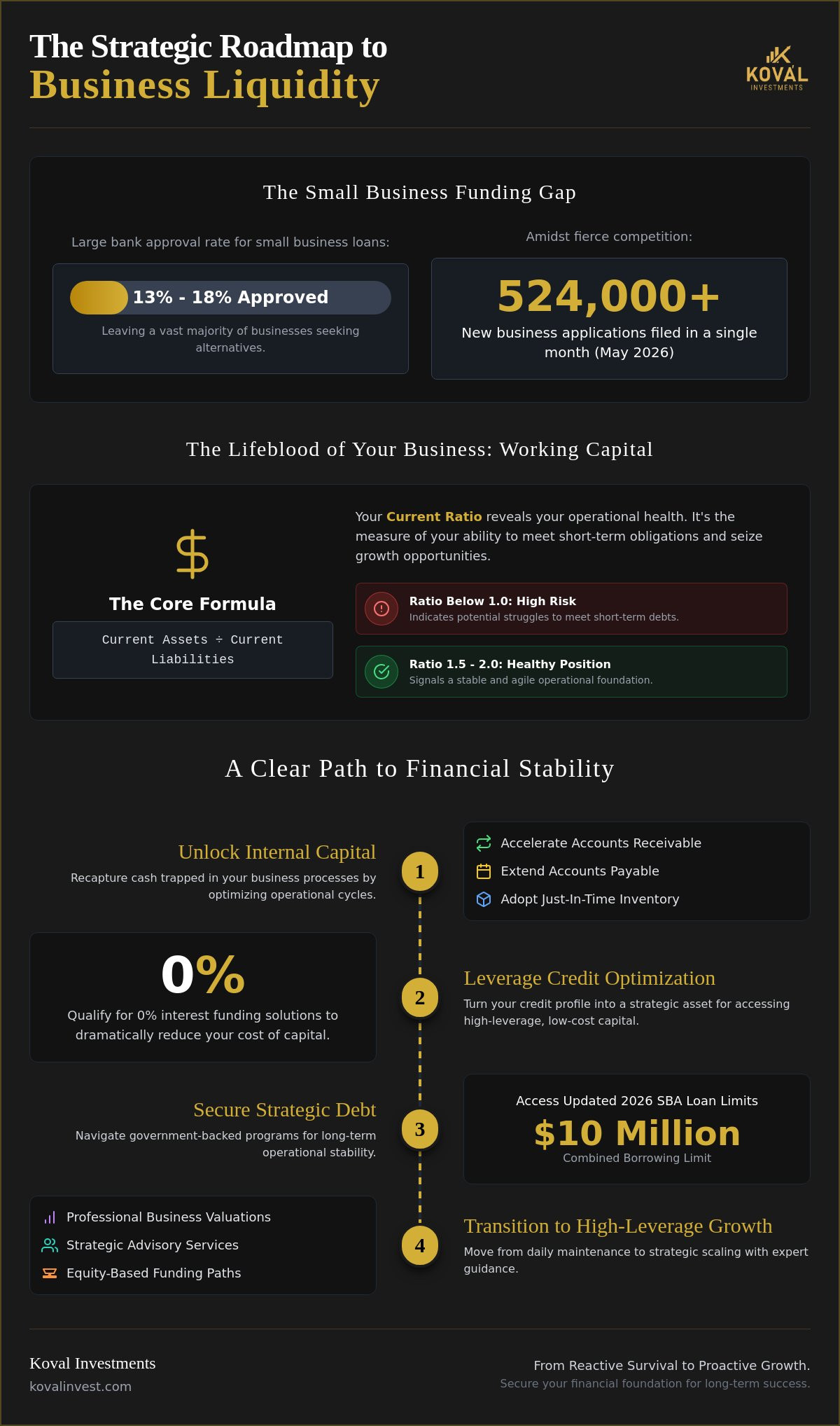
Large banks currently approve only about 13% to 18% of small business loan applications, leaving many entrepreneurs struggling with tight cash flow cycles and interest rates that eat into their margins. While over 524,000 new business applications were filed in May 2026 alone, the competition for traditional financing is fierce and often exclusionary. You might feel that your only options are predatory debt or stagnant growth, but securing an SBA loan for working capital is more attainable than it seems when you approach the process with a strategic roadmap.
We understand the frustration of having a viable business model but lacking the liquid capital to scale effectively. It's a common challenge, but it doesn't have to be your permanent reality. This guide provides a clear path to improving your operational liquidity by combining internal efficiency with external funding strategies. You'll learn how to optimize your credit profile to access 0% interest funding and how the 2026 increase in combined borrowing limits to $10 million offers new opportunities for growth. We'll explore the practical steps to secure high-leverage funding without the burden of excessive interest, ensuring your business remains agile and well-funded.
Key Takeaways
- Identify and recapture liquid capital currently trapped in your internal business processes through a cash-flow-centric procurement and sales strategy.
- Leverage credit optimization as a strategic asset to qualify for 0% interest funding solutions, significantly reducing your overall cost of capital.
- Navigate the updated 2026 borrowing limits to secure an SBA loan for working capital, providing a government-backed foundation for long-term operational stability.
- Utilize professional business valuations and strategic advisory to transition from daily maintenance to high-leverage scaling and equity-based funding.
Understanding Working Capital: The Lifeblood of Small Business Growth
Working capital is more than just a line item on your balance sheet; it is the measure of your business's operational agility. At its core, Working capital represents the difference between your current assets and your current liabilities. It's the liquid fuel that keeps your day-to-day functions running, from paying your team to purchasing the inventory required to fulfill new orders. For many founders, there's a vital distinction to make between gross working capital, which is the sum of all current assets, and net working capital, which is what remains after you've accounted for every short-term obligation.
Transitioning from survival mode to a mindset of strategic growth requires a fundamental shift in how you view liquidity. When cash is tight, every decision is reactive. You're forced to choose which bill to pay first rather than deciding which market to capture next. By securing an SBA loan for working capital, you create a financial foundation that allows for proactive decision-making. In a 2026 economic environment where the Prime Rate sits at 6.75%, having a reliable cash buffer acts as a shield against market volatility and sudden shifts in consumer demand. This stability isn't just about safety; it's about having the freedom to say yes to high-value opportunities that your competitors might have to decline due to cash constraints.
The Working Capital Formula and What It Reveals
To assess your financial health, you must look at your Current Ratio. This is calculated by dividing your current assets by your current liabilities. A ratio below 1.0 suggests that your business may struggle to meet its short-term obligations, while a ratio between 1.5 and 2.0 generally indicates a healthy position. You should also be wary of hidden liabilities, such as accrued expenses or unrecorded short-term debts, that can drain your reserves unexpectedly. The operating cycle represents the total time required to convert cash spent on inventory back into cash received from customers, directly dictating how long your liquidity remains tied up in business processes.
Why Negative Working Capital Is a Growth Killer
Operating with negative working capital is a high-risk strategy that often leads to a cycle of expensive, short-term borrowing. When you don't have enough cash on hand, you lose the ability to negotiate bulk purchase discounts, which can significantly improve your profit margins. This lack of liquidity also creates a fragile environment where a single late payment from a client could lead to missed payroll or vendor defaults. Utilizing an SBA loan for working capital helps break this cycle by providing long-term, lower-interest funding that stabilizes your balance sheet and protects your reputation with both employees and suppliers.
Operational Tactics to Unlock Internal Working Capital
Before seeking external debt, look at the cash already circulating within your business. Much of your operational liquidity is likely trapped in inefficient cycles. Cultivating a Cash Flow First culture ensures that every department, from sales to procurement, understands how their actions affect the company bank balance. By 2026, technology allows for real-time monitoring of these cycles, making it easier to spot bottlenecks before they become crises. While cutting waste is essential, it's vital that these efficiencies never compromise the quality of your product or service. Efficiency should enhance your value proposition, not hollow it out.
Optimizing Accounts Receivable and Payable Cycles
The gap between paying suppliers and receiving customer payments is where many businesses fail. To manage this, focus on accelerating your accounts receivable. This doesn't require aggressive collection tactics; it requires consistent, automated systems. Implement automated invoicing and offer multiple digital payment channels to reduce friction. On the flip side, negotiate extended terms with your vendors. Keeping cash in your business for an extra 15 to 30 days can provide a significant liquidity cushion. Offering early payment discounts to customers can speed up collections, but you must weigh that cost against your profit margins. If the gap remains too wide despite these efforts, an SBA loan for working capital can provide the necessary bridge to stabilize your operations.
Inventory Management and Reducing Operational Waste
Inventory is often the largest drain on working capital. Adopting a Just-In-Time approach ensures you only hold what you need for immediate production or sales. Regularly audit your warehouse to identify obsolete stock. Liquidating this inventory, even at a discount, provides an immediate cash injection. By 2026, AI-driven data analytics have become standard for demand forecasting, helping you avoid over-purchasing and keeping your capital liquid. It's about precision. When you reduce the amount of cash sitting on shelves, you increase the amount of cash available for growth.
Optimizing these internal levers is the first step toward a healthier balance sheet. If your internal efforts reveal a need for more substantial growth capital, it might be time to explore a strategic funding plan tailored to your specific needs. Demonstrating this level of disciplined financial management also makes your application for SBA 7(a) loans much more attractive to lenders. A well-managed business is always a lower risk, and having a clear handle on your internal cash flow is the best way to prove your readiness for an SBA loan for working capital.
Leveraging Credit Optimization for 0% Interest Funding
Your credit profile is the most valuable asset in your capital procurement toolkit. It acts as a digital resume that tells lenders how much risk they're taking by partnering with you. In 2026, the correlation between credit scores and funding limits has never been more direct. As traditional banks become more selective, a pristine credit profile allows you to bypass high-interest debt and access 0% interest funding. This type of capital is the gold standard for working capital because it provides the liquidity you need without the immediate burden of interest payments eating into your margins.
Positioning your business for this level of funding requires a proactive approach to credit health. Lenders aren't just looking for the absence of negatives; they're looking for a robust history of responsible credit utilization. When you treat your credit score as a strategic growth lever, you unlock doors that remain closed to most small business owners. This isn't about just getting by. It's about securing the lowest possible cost of capital to fuel your long-term ambitions.
The Direct Link Between Credit Repair and Capital Access
Many business owners are unaware that common inaccuracies on their credit reports are suppressing their true borrowing power. These errors, ranging from misreported payment histories to incorrect credit utilization ratios, create unnecessary barriers to high-leverage funding. Engaging with professional business credit repair services is a strategic investment rather than a simple administrative task. By removing these hurdles, you create the foundation required to qualify for 0% APR offers. The timeline for this optimization typically ranges from 90 to 120 days, but the return on investment is realized through thousands of dollars in saved interest costs over the life of your business operations.
Navigating 0% APR Business Credit as a Working Capital Tool
Strategic use of 0% interest business credit lines allows you to fund inventory purchases or marketing campaigns without any cost of capital during the introductory period. This unsecured funding acts as a bridge for operational gaps, providing a win-win scenario where you grow your revenue using the bank's money for free. You can also employ credit stacking, which involves securing multiple lines of credit simultaneously to maximize your total available working capital. This approach is particularly effective when used in conjunction with SBA 7(a) loans for working capital. While the 0% lines handle short-term needs, an SBA loan for working capital provides the long-term stability needed for major expansions. By balancing these two types of capital, you ensure your business remains liquid and ready for any market shift.
Strategic Debt: SBA Loans and Alternative Funding Solutions
Internal optimization and 0% interest credit lines provide an excellent foundation, but they eventually reach a ceiling in terms of total volume. When your business is ready for major expansion or needs to survive significant market shifts, strategic debt becomes the next logical step. Government-backed loans play a vital role in stabilizing your balance sheet by providing lower interest rates and longer repayment terms than traditional commercial products. This stability allows you to focus on long-term objectives rather than immediate debt service.
Choosing the right funding partner is just as critical as the capital itself. We believe in a success-based philosophy where our objectives are perfectly aligned with your growth. This collaborative approach ensures that the debt you take on is a tool for progress, not a burden that creates financial risk. By moving from internal cash management to external scaling, you position your firm as a serious contender in your industry.
Qualifying for SBA Loan Assistance in 2026
Securing SBA loan assistance for working capital has become more streamlined due to recent regulatory updates. As of March 1, 2026, the SBA discontinued the FICO Small Business Scoring Service (SBSS) prescreen for 7(a) Small Loans of $350,000 or less, which has significantly accelerated the approval process for many founders. To qualify, you'll need a comprehensive documentation package, including tax returns and a professional business valuation. The 2026 updates also increased the combined borrowing limit for 7(a) and 504 loans to $10 million, allowing you to secure up to $5 million in each program concurrently. This expanded capacity makes an SBA loan for working capital a powerful tool for businesses ready to move beyond maintenance into aggressive scaling.
When to Pivot to Alternative Lending Options
There are scenarios where the 30 to 90 day closing window of a government-backed loan is simply too slow. If you need to capitalize on a time-sensitive bulk purchase or a sudden market opportunity, alternative business funding solutions offer the speed you require. These options often provide unsecured funding, which is particularly beneficial for service-based businesses that don't have significant physical collateral. While the interest rates may be higher than SBA programs, the speed of funding can outweigh the cost when the potential ROI is high. Integrating these with an SBA loan for working capital allows you to maintain a blended capital stack that is both affordable and responsive to market changes. To determine which mix of debt is right for your current lifecycle, you can explore our strategic funding options to see which programs align with your specific goals.
Scaling Through Strategic Advisory and Valuation
Scaling a business requires more than just a larger bank balance. It demands a shift from tactical survival to long-term strategic deployment. While previous sections focused on the mechanics of securing an SBA loan for working capital, this final stage is about ensuring that capital generates the highest possible return. Professional advisory provides the framework to move beyond simple maintenance. It allows you to identify where a dollar of capital will have the most impact, whether that's in market expansion, product development, or operational automation. Strategic planning ensures that every cent of your funding is working toward a predefined objective rather than being absorbed by inefficient overhead.
Founders who view their business as an investable asset rather than just a job are the ones who scale most effectively. By partnering with a strategic advisor, you gain an outside perspective on your capital stack and operational hurdles. This collaboration helps you navigate the complexities of high-level finance, from credit optimization to debt management. When your capital is deployed effectively, it creates a virtuous cycle of growth that increases both your liquidity and your overall enterprise value.
How Professional Business Valuations Influence Funding Limits
An objective business valuation is a powerful tool for building lender trust. When you can present a third-party assessment of your company's worth, you improve your loan-to-value ratios and demonstrate a level of sophistication that banks value. This data is equally important when negotiating terms with alternative lenders, as it provides a concrete basis for your creditworthiness. In 2026, Goodwill significantly impacts a small business valuation by quantifying the financial value of brand reputation and customer retention in an increasingly competitive digital marketplace. Knowing these numbers allows you to unlock higher tiers of equity-based funding that might otherwise be unavailable without a formal appraisal.
M&A Consulting: Acquiring Capital Through Strategic Transitions
Mergers and acquisitions provide a unique path for rapid working capital acquisition. By utilizing working capital for business acquisition, you can scale your operations and consolidate cash reserves through a single transaction. Merging with or acquiring a complementary firm often improves your collective credit profile, making future rounds of funding even more accessible. If your ultimate goal is an exit, optimizing your working capital today is the best way to increase your eventual sales price. A business with clean cycles and high liquidity is always more attractive to buyers. Whether you are scaling up or preparing to move on, an SBA loan for working capital provides the fuel for these high-level strategic transitions.
Securing Your Financial Future Through Strategic Liquidity
Optimizing your operational liquidity is a multi-layered process that begins with internal discipline and ends with high-leverage growth. You've seen how accelerating your accounts receivable and managing inventory can reveal hidden cash, while credit optimization opens the door to 0% interest funding. When your internal systems are lean, an SBA loan for working capital becomes a powerful instrument to scale without the stress of predatory interest rates. With the 2026 borrowing limits now increased to $10 million for combined programs, the opportunity to stabilize and expand your footprint has never been more accessible.
Success in this landscape requires a partner who understands the nuances of credit repair and capital procurement. We operate with a success-based philosophy, meaning we take on the heavy lifting of facilitating 0% interest solutions and navigating SBA requirements with no upfront risk to you. Our expert consultants are ready to help you bridge the gap between your current cash flow and your long-term ambitions. Secure your 0% interest funding and optimize your working capital today with Koval Investments. You've built a strong foundation; let's work together to ensure your business remains liquid, resilient, and ready for whatever the future holds.
Frequently Asked Questions
What is the fastest way to increase working capital for a small business?
The fastest way to increase liquidity is often through unsecured business credit lines or by accelerating your accounts receivable cycle. While an SBA loan for working capital provides long term stability, the funding process can take 30 to 90 days. Unsecured 0% interest lines can often be secured in just a few weeks, providing immediate cash for inventory or payroll without the burden of immediate interest.
Can I get working capital funding if I have a low credit score?
You can secure funding with a lower score, but you'll likely face high interest rates and aggressive repayment schedules that strain your cash flow. It's usually more strategic to invest in credit repair before applying for major capital. Improving your score allows you to transition from predatory debt to government backed programs or 0% interest solutions that protect your profit margins and support sustainable growth.
What is the difference between a working capital loan and 0% interest funding?
A traditional loan provides a lump sum with fixed monthly payments and interest starting from day one. In contrast, 0% interest funding typically involves revolving credit lines with an introductory period where no interest is charged. This makes 0% funding ideal for managing short term operational gaps, while traditional loans are better suited for long term structural investments and larger expansions.
How does credit repair help me get more business funding?
Credit repair removes inaccuracies and negative marks that artificially suppress your borrowing power. By optimizing your profile, you present significantly less risk to lenders, which leads to higher funding limits and much lower interest rates. It's a strategic investment that transforms your credit from a barrier into a high leverage asset, allowing you to access the most competitive capital in the market.
Is an SBA loan the best option for increasing working capital in 2026?
For many businesses, an SBA loan for working capital remains the gold standard due to its low rates and extended repayment terms. In 2026, the increased borrowing limits and streamlined approval for loans under $350,000 make these programs even more accessible for small firms. It provides the permanent stability needed for aggressive scaling rather than just acting as a temporary fix for cash flow issues.
How much working capital should a small business ideally have on hand?
Your ideal amount depends on your specific industry, but a common benchmark is maintaining a current ratio between 1.5 and 2.0. This means your current assets are roughly double your current liabilities. Having this buffer ensures your business can handle sudden market volatility or unexpected operational expenses without disrupting your daily functions or missing key opportunities for growth.
What are the risks of using alternative lending for working capital?
The primary risks include a high cost of capital and rigid repayment structures that can trap a business in a debt cycle. Many alternative lenders require daily or weekly withdrawals directly from your business bank account. If your revenue fluctuates, these fixed payments can quickly lead to a liquidity crisis, making it difficult to maintain your standard operations or invest in new projects.
How often should I perform a professional business valuation?
You should perform a professional business valuation at least once a year or whenever you prepare for a major capital raise. Knowing your exact value helps you negotiate better terms with lenders and identify areas where you can improve operational efficiency. It's also a critical prerequisite for mergers and acquisitions, ensuring you receive the maximum value during any strategic transition or exit.