
Strategic Alternatives to Venture Capital Funding: Retaining Equity in 2026
Equity is the most expensive currency a founder can spend, yet many entrepreneurs sacrifice a seat on their board and 20% of their company before they even hit their stride. You've likely felt the pressure to pursue a traditional raise because it's often framed as the only viable path to scale. It's natural to fear losing control to outside investors or worry about the high costs of traditional loans, especially with the prime rate sitting at 6.75% as of July 2026. If you're looking for alternatives to venture capital funding, you're actually prioritizing the long-term value of your hard work.
We understand that your goal is growth without compromise. In this guide, you'll discover how to scale your business using high-leverage capital solutions that protect your ownership and avoid common VC pitfalls. We'll provide a clear roadmap to funding eligibility, covering everything from 0% interest strategies to specialized SBA programs that let you keep your equity. By the end of this article, you'll have a strategic plan to access low-interest capital while retaining full control of your company's future.
Key Takeaways
- Learn why equity is considered "permanent" capital and how to protect your company from the restrictive growth mandates often imposed by outside investors.
- Identify how SBA loans and working capital solutions serve as the gold standard for long-term growth while allowing you to retain full equity.
- Master the use of 0% interest business credit lines as strategic alternatives to venture capital funding for scaling your marketing and inventory.
- Understand the direct link between your financial profile and your ability to access high-leverage capital with the most favorable terms.
- Gain a clear roadmap for qualifying for non-dilutive funding through a results-oriented, success-based consulting approach.
The True Cost of Equity: Why Founders Seek Alternatives to Venture Capital Funding
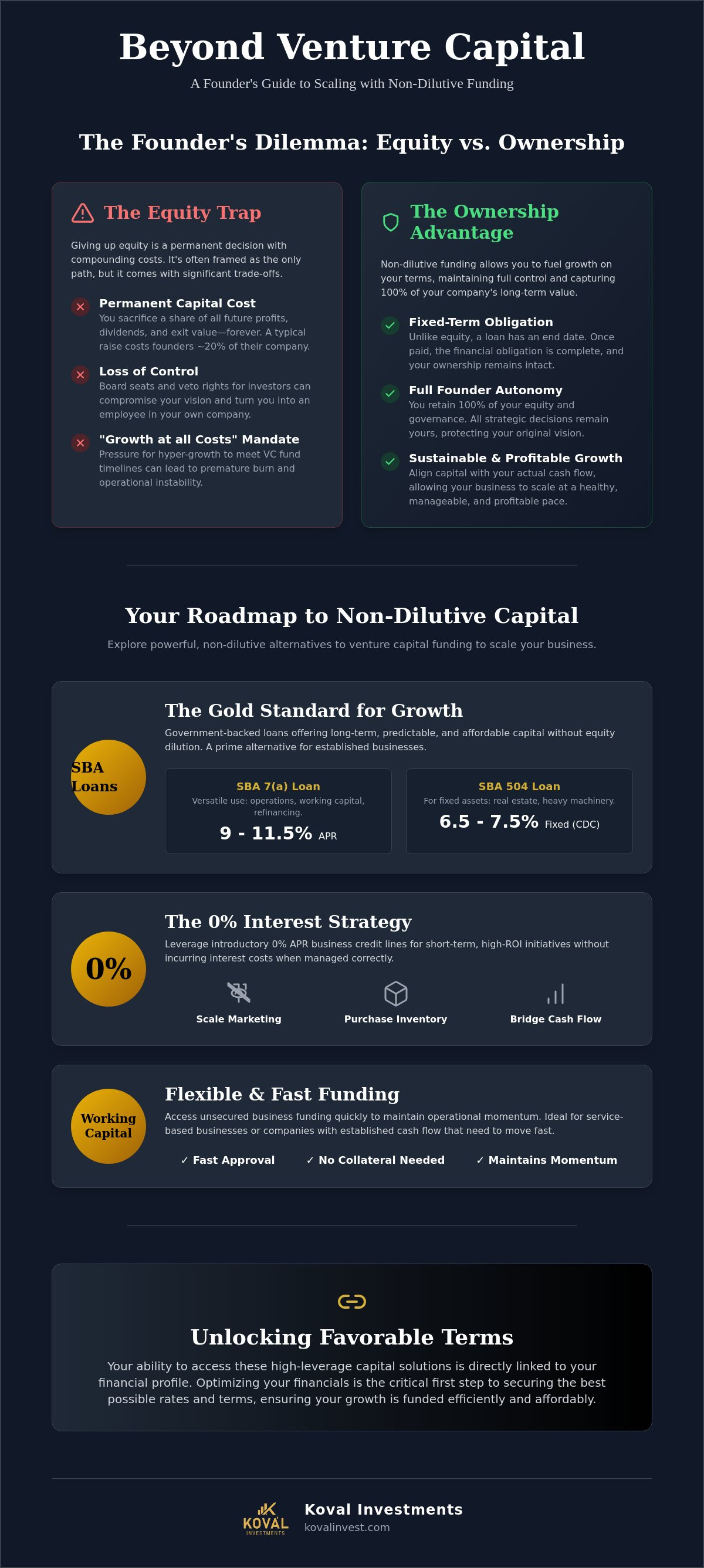
Venture capital is often celebrated as the ultimate milestone for a startup. However, sophisticated founders view it differently. They see it as permanent capital. Unlike a loan that you eventually pay off, equity stays on your cap table forever. It never stops costing you. Every dollar of future profit, every cent of an eventual exit, and every dividend is shared with investors who provided cash years prior. This is why many entrepreneurs are actively seeking alternatives to venture capital to fuel their expansion without sacrificing their long-term wealth.
The venture model usually carries a growth at all costs mandate. VCs need to see massive returns to satisfy their own fund timelines, which often forces a company to scale faster than its infrastructure allows. This can lead to premature burn and operational instability. In contrast, debt-based alternatives to venture capital funding have a fixed-term nature. Once the principal and interest are paid, the obligation ends. Your ownership remains entirely intact, allowing you to reap the full rewards of your success. For the modern founder, non-dilutive capital has become the preferred tool for maintaining control while driving progress.
The Dilution Trap and Loss of Governance
When you take venture money, you aren't just selling a piece of your company; you're often selling a piece of your autonomy. Board seats and veto rights can hamper your original vision, turning you from an independent founder into an employee of your own creation. Liquidation preferences further complicate the exit. If an investor has a 2x preference, they get double their money back before you see a single dime from a sale. Retaining 100% ownership provides a massive strategic advantage for future M&A. It keeps your cap table clean and ensures you receive the full value of the sweat equity you've invested over the years.
Silicon Valley Bias vs. Sustainable Growth
The venture model is designed for hyper-growth tech companies with winner-take-all potential. Non-tech companies or service-based businesses often struggle with the VC model but thrive with debt-based alternatives. Sustainable growth means expansion funded by a revenue-aligned capital stack where debt service is covered by predictable cash flow. Equity dilution is the permanent surrender of future profits for present-day cash. By choosing a path that prioritizes ownership, you ensure that your business grows at a pace that is both healthy and profitable for you, the owner.
Leveraging Government-Backed and Traditional Debt: SBA Loans and Working Capital
SBA loans represent the gold standard for founders seeking modern financing strategies that don't involve giving up a board seat. With the prime rate at 6.75% as of July 2, 2026, these government-backed programs offer predictable, long-term capital that is significantly more affordable than the permanent cost of equity. While venture capital often requires a six-month cycle of pitching and due diligence, traditional debt solutions can be secured much faster. This allows you to maintain operational momentum without waiting for a committee's approval. Service-based businesses, which often lack the heavy physical collateral required by commercial banks, find particular value in unsecured business funding. This flexibility makes debt one of the most powerful alternatives to venture capital funding for companies that already have established cash flow and a clear path to repayment.
The SBA 7(a) and 504 Advantage
Choosing between an SBA 7(a) vs. 504 loan depends entirely on your specific growth objectives. The 7(a) program is highly versatile, covering everything from general operations to debt refinancing. As of July 2026, variable rates for 7(a) loans typically range between 9% and 11.5% APR, depending on the loan size and lender margin. The 504 program is specifically designed for fixed assets like real estate or heavy machinery. The CDC portion of a 504 loan currently holds a fixed rate between 6.5% and 7.5%, providing stability in a fluctuating market. These programs are excellent alternatives to venture capital funding because they prioritize your ability to keep 100% of your business's upside.
Working Capital for Operational Agility
Working capital acts as the fuel for day-to-day scaling. It bridges the gap between your initial investment in inventory or marketing and the eventual arrival of revenue. Beyond daily operations, many sophisticated owners are using working capital for business acquisition to grow through M&A. This strategy allows you to buy out competitors or add complementary service lines without diluting your own stake. It's a faster, more surgical way to expand than the traditional VC route.
Navigating these programs requires precision and a deep understanding of lender requirements. The application process is notoriously complex, making professional SBA loan assistance a necessity for founders who value their time. If you want to explore how these debt instruments fit into your broader roadmap, our team at Koval Investments can help you evaluate your current eligibility. We focus on identifying the most efficient path to capital so you can stay focused on execution rather than paperwork.
The 0% Interest Strategy: A Modern Alternative to High-Cost Financing
While traditional debt and SBA programs provide long-term stability, many founders need tactical, short-term capital to fuel immediate growth. This is where 0% interest funding becomes a powerful tool. Unlike venture debt providers who often expect internal rates of return (IRRs) between 15% and 25%, 0% APR business credit lines allow you to deploy capital with zero immediate debt service costs. This makes them one of the most efficient alternatives to venture capital funding for agile companies that need to move fast. By utilizing these lines for high-impact activities like inventory purchasing or scaling proven marketing campaigns, you can grow your revenue without the burden of high interest or the permanent loss of equity.
This approach is often overlooked in traditional circles because it requires a more hands-on management style. However, for a sophisticated founder, it represents a "win-win" scenario. You access the same leverage that a venture-backed competitor might have, but you retain every bit of the upside. It's a cornerstone of our 0% interest business funding strategy, allowing you to bridge the gap between initial investment and profitability without ever stepping into a boardroom to defend your decisions.
Maximizing the Interest-Free Window
Most introductory 0% APR periods on business credit lines last between 12 and 15 months, though some specialized offers extend to 21 months. The key to success is a "cycling" strategy where you use this capital as a revolving resource. 0% interest capital acts as a bridge to profitability without equity surrender. By refinancing or rotating these tranches as introductory periods expire, you can maintain a low-cost capital stack for years. This methodical approach ensures your business stays liquid while your competitors are weighed down by expensive interest payments or restrictive covenants.
Risk Management and Repayment Strategy
Some founders worry that credit lines are unstable compared to a lump-sum investment. This risk is easily managed with a disciplined repayment plan focused on ROI-positive activities. If you're using these funds for customer acquisition, you should have a clear understanding of your customer lifetime value (LTV) relative to the cost of acquisition (CAC). When your marketing spend returns capital within 90 days, the 12-month interest-free window provides more than enough runway. Managing multiple 0% interest tranches requires professional guidance to ensure timing and limits are optimized. This isn't about taking on "bad debt"; it's about using strategic leverage to outpace the market while keeping your ownership intact.
Optimizing Your Financial Profile: Unlocking the Best Alternatives
Access to the most favorable alternatives to venture capital funding is rarely a matter of luck. It's the result of a deliberate, data-driven strategy to optimize your financial profile. Many founders believe their current credit standing or lack of audited financials disqualifies them from high-leverage capital. This perspective is a mistake. Your financial profile is an asset that can be developed, and improving it is often the single most effective way to lower your cost of capital. When you strengthen your position, you move from being a supplicant to a strategic partner in the eyes of lenders.
The most common objection we hear is that a founder's credit isn't "good enough" for top-tier alternative business funding solutions. We view this as a temporary operational hurdle rather than a permanent barrier. There is a direct, measurable correlation between your credit score and the funding limits you can secure. A higher score doesn't just mean lower rates; it unlocks access to larger tranches of 0% interest capital and more flexible SBA terms. Investing in your financial profile is a strategic move that pays dividends in the form of cheaper, non-dilutive growth capital.
The Strategic Impact of Credit Restoration
Strategic credit restoration is a prerequisite for founders who want to access high-limit funding without surrendering equity. This process involves more than just paying down balances. It's about identifying and disputing inaccuracies that may be suppressing your score. You also need to understand the distinction between your personal credit and building a robust business credit profile. While your personal score often provides the initial bridge, a strong business profile allows you to separate your personal liabilities from your company's growth. Utilizing professional business credit repair services ensures this optimization happens quickly and accurately, positioning you for the best possible alternatives to venture capital funding.
Valuation as a Funding Compass
Knowing your worth is essential before you choose any funding path. A professional business valuation acts as your compass, preventing you from "over-selling" your equity to VCs out of a sense of desperation. If you don't know the true value of your cash flow and assets, you can't accurately calculate the cost of dilution. This is especially critical for asset-heavy ventures, where valuation plays a major role in securing funding for real estate investors and logistics companies. By establishing a clear valuation, you can confidently negotiate for debt or credit lines that align with your company's actual market standing.
Ready to see where your profile stands? You can schedule a strategic assessment with our team to identify your current funding capacity and build a roadmap to higher limits.
Choosing the Right Path: How Koval Investments Facilitates Growth
Selecting the right capital strategy is one of the most consequential decisions a founder will ever make. While the allure of a venture capital round is often amplified by media coverage, the reality of equity dilution can fundamentally alter your company's trajectory. We believe that your ownership shouldn't be the price of your progress. As a strategic partner, Koval Investments looks at your entire financial picture to identify the most efficient alternatives to venture capital funding. Our role is to act as a steady hand, helping you navigate complex financial landscapes while you remain focused on your operational milestones. We don't just point you toward a loan; we build a comprehensive capital stack designed for long-term sustainability.
Our approach is built on a success-based philosophy that ensures our goals are perfectly aligned with yours. This creates a collaborative environment where we act as an "insider" advisor rather than a distant service provider. By combining credit optimization with diverse capital procurement, we help you unlock doors that many founders don't even know exist. Whether you're looking for 0% interest introductory lines to scale marketing or a long-term SBA solution for a major acquisition, we provide the expertise needed to qualify for top-tier terms. This isn't about high-pressure sales; it's about a pragmatic, results-oriented partnership that respects your vision and your bottom line.
A Collaborative, Results-Oriented Approach
The journey begins with a thorough financial audit to determine your current funding capacity. We look for inaccuracies in your credit profile and identify opportunities to maximize your borrowing power. From there, we move toward capital deployment, navigating the SBA, real estate, and 0% interest markets simultaneously. This multi-market approach ensures you aren't reliant on a single source of capital. Our partnership model is designed to minimize financial risk to you, framing our engagement as a shared venture. We win when you secure the capital you need to scale, ensuring that every strategic move we make is focused on your tangible advancement.
Securing Your Business Legacy
Scaling your business shouldn't mean surrendering its future. The ultimate goal of exploring alternatives to venture capital funding is to ensure that when you reach your growth milestones, you still own the rewards of your hard work. Retaining 100% of your equity is more than just a financial metric; it's about securing your legacy and maintaining the freedom to exit on your own terms. We invite you to a consultation focused entirely on your specific objectives and timeline. Together, we can build a roadmap that provides the leverage you need without the compromises you don't. Partner with Koval Investments to secure your 0% interest funding today.
Scaling Your Vision Without Sacrifice
You've built your business through dedication and strategic insight, so it's only right that you retain the rewards of that effort. By shifting your focus from permanent equity dilution to high-leverage debt and credit optimization, you can maintain full control over your company's future. Whether you choose the stability of an SBA loan or the tactical agility of 0% interest lines, the alternatives to venture capital funding we've explored provide a clear path to growth without compromise. You don't have to trade your board seats for a chance to scale.
Founded in 2018, Koval Investments has specialized in identifying these non-dilutive paths, with a particular focus on 0% interest solutions. Our approach is grounded in a success-based philosophy; we only win when you successfully secure funding. By combining deep expertise in credit restoration with a sophisticated understanding of capital procurement, we act as a steady partner in your financial advancement. Secure your non-dilutive growth capital with Koval Investments and take the first step toward optimized funding today. Your business legacy deserves a capital strategy that works as hard as you do.
Frequently Asked Questions
What are the main disadvantages of venture capital for a small business?
The primary drawbacks include the permanent loss of equity and the surrender of operational control. Unlike debt-based alternatives to venture capital funding, equity stays on your cap table forever, meaning you share all future profits and exit values with investors. VCs also typically impose a "growth at all costs" mandate that can force a company to scale faster than its infrastructure allows, potentially leading to instability.
Can I get business funding if my credit score is currently low?
You can still access capital, but it usually requires a strategic phase of credit restoration to unlock the best terms. Improving your financial profile through professional credit repair services is a strategic investment that quickly boosts your eligibility for high-leverage programs. A higher score doesn't just lower your interest rates; it significantly increases the funding limits you can secure for your business.
How does 0% interest business funding actually work?
This strategy leverages business credit lines that offer introductory 0% APR periods, often lasting between 12 and 21 months. It provides a tactical way to fund ROI-positive activities, such as inventory or customer acquisition, without immediate debt service costs. By using a disciplined repayment plan, you can treat this capital as a revolving resource that bridges the gap to profitability while keeping your ownership intact.
Is an SBA loan better than venture capital for a startup?
An SBA loan is often the superior choice for founders who want to retain 100% of their company's upside. While venture capital is "permanent" and never stops costing you, an SBA loan is a fixed-term obligation that eventually ends. With the prime rate at 6.75% as of July 2, 2026, these government-backed programs offer a predictable and much cheaper path to scale than selling a piece of your vision.
What is the difference between dilutive and non-dilutive funding?
Dilutive funding requires you to trade a percentage of your company's ownership for capital, which permanently reduces your share of future profits. Non-dilutive funding refers to capital solutions like SBA loans and working capital that don't require you to give up any equity. Sophisticated founders prioritize non-dilutive options to ensure they receive the full rewards of their hard work during a future merger or acquisition.
How long does it take to secure alternative funding compared to VC?
Securing alternative funding is typically much faster than the standard six-month venture capital cycle. Working capital solutions and 0% interest credit lines can often be secured in just a few weeks, providing immediate liquidity for growth. Even more complex SBA loans generally close within 45 to 90 days, allowing you to maintain operational momentum without the lengthy distraction of multiple pitching rounds.
What documents do I need to prepare for non-VC funding procurement?
Most lenders require two years of business and personal tax returns, recent bank statements, and a current profit and loss statement. You should also have a clear balance sheet and a specific plan for how the capital will be deployed to drive revenue. Having these documents professionally organized and optimized before you apply ensures a much higher probability of approval and faster access to funds.
Why is professional business valuation important when looking for alternatives?
A professional valuation serves as your strategic compass, ensuring you don't over-leverage your assets or under-value your company. It provides the data you need to calculate the true cost of different alternatives to venture capital funding relative to your current cash flow. Knowing your worth allows you to negotiate from a position of authority and select a capital stack that aligns with your long-term growth milestones.