
Business Debt Consolidation Loan: A Strategic Guide to Financial Optimization in 2026
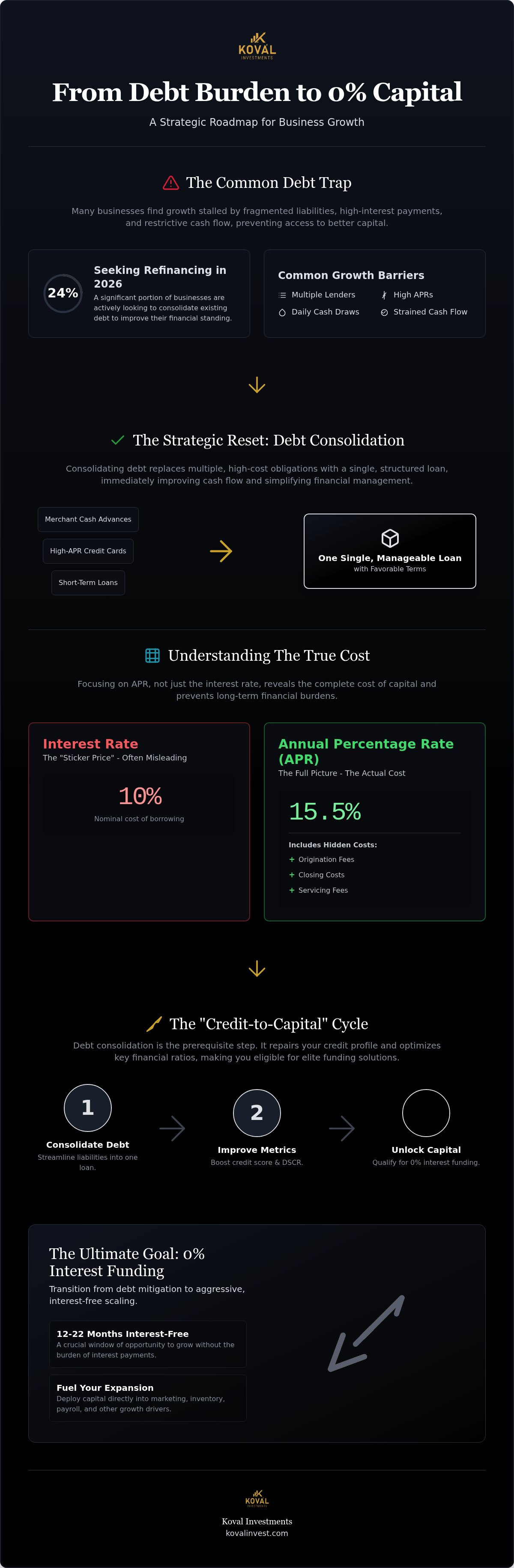
What if your current debt obligations aren't just a cost of doing business, but the primary barrier preventing you from accessing 0% interest capital? In 2026, data shows that 24% of businesses are seeking financing specifically to refinance or pay down existing debt. It's common to feel your growth is stagnant because of high monthly cash outflows and restrictive debt service coverage ratios. Many entrepreneurs find themselves caught in a cycle of high-interest payments, often struggling to distinguish between complex APR structures and simple interest rates while managing multiple lenders.
We believe that your capital structure should support your ambitions, not hinder them. This guide explains how a strategic business debt consolidation loan can transform fragmented liabilities into a streamlined capital strategy. You'll learn how to lower your total monthly payments and improve your business credit score, which are the essential prerequisites for unlocking 0% interest funding solutions. We'll provide a clear preview of the 2026 lending landscape and a methodical roadmap to help you transition from debt mitigation to aggressive, interest-free scaling. By aligning your current obligations with a long-term growth plan, you can reclaim your cash flow and focus on what matters most: expanding your enterprise.
Key Takeaways
- Learn how a business debt consolidation loan serves as a strategic reset to simplify fragmented liabilities into a single, manageable capital strategy.
- Discover how optimizing your Debt Service Coverage Ratio (DSCR) through debt reduction can significantly enhance your business valuation for future mergers or acquisitions.
- Understand the "Credit-to-Capital" cycle and how credit repair services act as a prerequisite to unlocking higher capital limits and lower interest rates.
- Explore the transition from high-interest debt to a 0% Interest Funding Solution that provides interest-free capital for 12-22 months to fuel expansion.
- Identify why a success-based, collaborative partnership ensures your financial goals are aligned with your funding provider’s objectives without unnecessary financial risk.
What is a Business Debt Consolidation Loan and How Does It Work?
Managing a growing enterprise often results in a patchwork of financing agreements that can eventually stifle progress. Business debt consolidation is a strategic restructuring of liabilities to enhance operational liquidity. By utilizing a business debt consolidation loan, you can replace high-frequency, high-cost obligations with a single, structured facility. This process involves a new lender paying off existing creditors, such as merchant cash advance (MCA) providers, business credit cards, or vendor lines, and issuing a new term loan with more favorable repayment terms. For a foundational overview of these concepts, you may review the general principles of What is Debt Consolidation? to understand how these structures function across different financial sectors.
The primary objective of this transition is to reduce your weighted average cost of capital (WACC) while immediately improving monthly cash flow. With the prime rate sitting at 6.75% in September 2026, many older, high-interest liabilities carry costs that no longer align with current market realities. Consolidating these debts allows you to recapture the margin that was previously lost to aggressive daily or weekly draws. It's a method of regaining control over your balance sheet so you can focus on scaling rather than just servicing debt.
Common Types of Debt Eligible for Consolidation
Strategic consolidation targets the most predatory and cash-intensive liabilities first. By rolling these into a single business debt consolidation loan, you simplify your balance sheet and prepare for more advanced funding strategies. Common eligible debts include:
- Merchant Cash Advances (MCAs) and high-daily-draw funding.
- Business credit card balances with high APRs.
- Short-term working capital loans, equipment financing, and vendor lines.
The Difference Between Interest Rate and APR in 2026
Founders often make the costly mistake of focusing solely on the nominal interest rate. In the 2026 lending environment, the total Annual Percentage Rate (APR) provides the only accurate measure of cost. A loan might advertise a competitive interest rate but hide significant expenses in origination fees, closing costs, and ongoing servicing fees. We prioritize transparency because a lower monthly payment can sometimes result in a higher total cost of capital if the term is extended too far without a corresponding drop in APR. You don't want to trade a short-term cash flow fix for a long-term interest burden. Understanding this distinction is vital for ensuring that your debt reset actually creates tangible value.
Calculating the Real ROI: When Does Consolidation Make Sense?
Determining if a business debt consolidation loan is the right move requires more than a glance at your bank balance. You need to calculate the actual Return on Investment (ROI) of the restructuring. We analyze the Debt Service Coverage Ratio (DSCR) to ensure your business can scale comfortably. If your current debt service consumes too much of your operating income, your growth hits a ceiling. A strategic reset identifies the "Break-Even" point. This is where interest savings and cash flow improvements outweigh the origination fees and closing costs of the new facility. When evaluating top business debt consolidation loans, consider the opportunity cost. Every dollar spent on high-interest debt service is a dollar not invested in marketing, inventory, or payroll.
Consolidation and Business Valuation
A cleaner balance sheet directly impacts your company's market worth. Lenders and M&A consultants view consolidated, structured debt as a sign of financial maturity. By reducing high-frequency draws and "bad debt," you improve your EBITDA. This improvement often leads to a higher multiple in a professional business valuation. If you plan to exit or attract real estate investment funding, showing a disciplined capital strategy is essential. It demonstrates that the business is managed with a focus on long-term stability rather than short-term survival.
The Cash Flow Multiplier Effect
The real power of consolidation lies in the cash flow multiplier. When you lower your monthly obligations, you free up capital that can be redirected into growth initiatives. For instance, a $5,000 monthly reduction in debt service provides an additional $60,000 per year in scaling capital. This liquidity can be used as working capital for business acquisition or to qualify for higher limits on future funding rounds. We believe in creating a win-win scenario where your financial progress is the primary metric of success. You can explore strategic planning options to see how these savings might accelerate your specific roadmap.
Consolidation Loans vs. 0% Interest Funding Solutions
Choosing between a traditional business debt consolidation loan and a 0% Interest Funding Solution depends on your current growth trajectory and immediate cash needs. Traditional loans provide fixed terms and immediate principal reduction through monthly amortization, offering a predictable path for businesses with stable, moderate growth. However, high-growth companies often prefer credit-based funding because it allows them to leverage their credit profiles to access capital with zero interest for 12 to 22 months. This interest-free window provides a massive competitive advantage for founders who need to reinvest every dollar of profit back into scaling their operations. Choosing between 0% interest solutions and term loans is a choice between immediate savings and long-term amortization.
Strategic Advantages of 0% Interest Capital
The primary benefit of a 0% interest solution is the complete elimination of interest payments during the introductory period. This allows every dollar of your monthly payment to go directly toward the principal, which significantly accelerates your path to a debt-free balance sheet. There's also a level of flexibility that traditional bank loans simply cannot match. You can pay down the balance faster without the risk of prepayment penalties, a common hurdle in institutional finance. This approach integrates seamlessly with alternative business funding solutions, giving entrepreneurs a sophisticated way to manage cash flow while funding expansion. It turns debt from a burden into a strategic tool for leverage.
SBA Loans as a Consolidation Vehicle
For businesses that require longer repayment windows and higher capital amounts, SBA business loans remain a powerful consolidation tool. The SBA 7(a) program is particularly effective for debt refinancing, offering government-backed security and lower interest rates than most online lenders. In 2026, fixed rates for these loans typically range from 11.75% to 14.75%, making them a stable alternative for consolidating expensive short-term debt like high-APR credit cards or vendor lines.
The application process is notoriously rigorous. It requires a high level of documentation and a strong understanding of federal underwriting standards. This is where SBA loan assistance becomes invaluable. Navigating the specific requirements for manufacturers or service-based businesses requires expert consulting to ensure approval and to maximize fee waivers. While SBA loans offer long-term stability, they lack the rapid deployment and interest-free benefits of credit-based funding. We act as strategic partners to help you determine which vehicle aligns best with your operational constraints.
Preparing Your Credit Profile for a Successful Debt Reset
Securing a business debt consolidation loan is rarely just about filling out an application. It's about participating in the 'Credit-to-Capital' cycle. This cycle dictates that your credit profile is the primary lever for financial optimization. Higher credit scores don't just improve your chances of approval. They unlock significantly lower rates on your business debt consolidation loan and higher limits for 0% interest business funding. Lenders in 2026 use automated underwriting that heavily weights debt-to-income ratios and credit history. If your profile is cluttered with inaccuracies, you're essentially leaving money on the table through higher interest costs.
Fixing Credit for SBA and Traditional Loans
Professional business credit repair services are often a prerequisite for obtaining the most favorable loan terms. Many founders are surprised to find that simple clerical errors can sink an otherwise strong application. Incorrect SIC codes, outdated physical addresses, or 'ghost accounts' that should have been closed years ago are common culprits. We identify these friction points and handle the dispute process on your behalf. Our success-based approach means we only value results. You don't take on additional financial risk while we work to restore your eligibility for institutional-grade capital.
Strategic Credit Building for Founders
Building a resilient credit profile requires more than just removing negatives. You need to proactively manage your utilization. We teach techniques to lower credit utilization ratios without closing existing accounts. This maintains the average age of your credit history. As you move through 2026, the goal is to transition from relying on personal guarantees to establishing robust corporate-only credit profiles. This shift protects your personal assets while positioning your company as a standalone, creditworthy entity. A stronger profile allows you to access the capital needed for aggressive expansion without the constraints of personal debt-to-income limitations. If you're ready to optimize your credit profile for better funding opportunities, start your credit restoration journey with us today.
Navigating Capital Procurement with Koval Investments
Securing a business debt consolidation loan is often the first step in a much larger journey toward financial optimization. At Koval Investments, we don't operate as a distant service provider or a simple loan broker. Instead, we act as a strategic partner, aligning our objectives with your long-term growth. Our success-based philosophy means we're equally invested in your progress. We believe in creating a win-win environment where our compensation is tied to the results we deliver for your enterprise. This approach eliminates the traditional financial risk for our clients and establishes a foundation of trust and accountability. It's the voice of a mentor who's invested in your success, providing a steady hand through complex financial landscapes.
The Success-Based Funding Process
Our engagement begins with a methodical assessment of your current financial profile. We analyze your existing debt structures and credit standing to identify exactly where your cash flow is being restricted. Once we understand the landscape, we develop a customized procurement plan. This plan might prioritize a business debt consolidation loan to clean up your balance sheet, or it may move directly toward 0% Interest Funding Solutions or SBA loans. Every step is transparent and focused on your specific ROI. We don't just find capital; we find the right capital that supports your operational goals without adding unnecessary burden. Our process is designed to be thorough, ensuring that the solution we implement today doesn't create new challenges tomorrow.
Long-Term Strategic Advisory
Financial optimization doesn't end with a single transaction. We integrate strategic planning and M&A consulting to prepare your business for future milestones. Whether you're looking at strategic funding for real estate investors or preparing for a high-value exit, we provide the expertise needed to navigate these transitions. Our advisory services help you move from managing debt to aggressively pursuing mergers and acquisitions. We help you build a business that isn't just surviving, but is intentionally positioned for a successful merger or sale. Getting started is straightforward. We begin with a comprehensive financial profile audit to determine your current standing and map out your path to 0% interest scaling. This audit serves as the roadmap for our collaborative partnership, ensuring every action we take is aligned with your ultimate objectives.
Taking the Next Step Toward Capital Optimization
Transitioning from high-interest, fragmented debt to a structured capital strategy is the most effective way to regain control of your enterprise's future. You've learned that a business debt consolidation loan serves as more than a simple repayment plan. It's a foundational reset that improves your Debt Service Coverage Ratio and enhances your company's overall valuation. By integrating comprehensive credit restoration, you don't just fix past issues; you proactively unlock access to 0% interest solutions that fuel aggressive scaling.
We're committed to a success-based funding philosophy that prioritizes your ROI above all else. Our expertise in 0% interest solutions ensures that your debt management efforts lead directly to interest-free expansion capital. You don't have to navigate these complex financial landscapes alone. We invite you to schedule a strategic consultation with Koval Investments to begin your comprehensive profile audit. Let's work together to align your current liabilities with your long-term ambitions and build a resilient, high-value business.
Frequently Asked Questions
Can I get a business debt consolidation loan with bad credit?
You can obtain a business debt consolidation loan with sub-optimal credit, but you'll likely face higher APRs and tighter repayment terms. We recommend a strategic approach that begins with credit repair services to identify and dispute inaccuracies. Improving your score first allows you to qualify for institutional-grade capital and lower interest rates. This sequence ensures you aren't just moving debt around, but actually optimizing your company's financial profile for long-term growth and better liquidity.
What is the difference between debt consolidation and debt refinancing?
Debt consolidation involves combining multiple liabilities into a single monthly payment to simplify your balance sheet. In contrast, debt refinancing typically refers to replacing one specific high-interest loan with a new one that offers better terms, such as a lower interest rate or a longer repayment period. Both strategies aim to reduce your weighted average cost of capital. A consolidation loan is particularly effective for founders managing several cash-intensive obligations like merchant cash advances and credit cards.
Will a consolidation loan hurt my business credit score?
A consolidation loan might cause a minor, temporary dip in your business credit score due to the hard inquiry and the opening of a new account. However, the long-term impact is overwhelmingly positive. By paying off multiple high-interest accounts, you significantly lower your overall credit utilization ratio. Consistently making a single, manageable monthly payment also builds a strong repayment history. This progress eventually qualifies you for higher funding limits and more advanced 0% interest capital opportunities.
Are there 0% interest options for consolidating business debt?
Yes, interest-free options exist through our 0% Interest Funding Solution. This strategy leverages your credit profile to access capital with zero interest for 12 to 22 months. It's an excellent alternative to a traditional business debt consolidation loan for high-growth companies that want to eliminate interest payments entirely during their scaling phase. Using this interest-free window allows you to pay down principal faster and reinvest saved cash flow back into your core operations without friction.
How long does the business debt consolidation process typically take?
The timeline for a business debt consolidation loan varies based on the lender and the complexity of your current liabilities. Traditional bank or SBA options often take several weeks or even months due to rigorous documentation requirements. Online alternative lenders can sometimes move in a few days. Our collaborative process focuses on a methodical assessment and customized procurement plan. We prioritize accuracy and alignment with your long-term goals over rushed transactions that might not provide the best ROI.
Can I consolidate Merchant Cash Advances (MCAs)?
Consolidating Merchant Cash Advances (MCAs) is one of the most effective ways to reclaim your business's daily cash flow. MCAs often feature aggressive daily or weekly draws that can stifle growth. By rolling these advances into a structured term loan or a 0% interest solution, you replace unpredictable draws with a stable, monthly obligation. This strategic reset improves your operational liquidity and allows you to focus on expansion rather than just managing high-frequency debt servicing.
What documents are required for a business consolidation loan application?
Lenders typically require several key documents to evaluate your eligibility for a business debt consolidation loan. You should prepare your most recent business and personal tax returns, at least six months of bank statements, and a detailed debt schedule. You'll also need to provide your current business credit reports and a profit and loss statement. Having these documents organized and accurate is essential for a smooth procurement process and helps demonstrate your company's financial maturity to potential creditors.
Is it better to use an SBA loan for debt consolidation?
An SBA loan is an excellent vehicle for debt consolidation if you require a high capital amount and a long repayment term. SBA 7(a) loans offer government-backed security and competitive rates, which are often lower than traditional bank products. However, the application process is complex and demands expert SBA loan assistance to navigate federal underwriting standards. For businesses looking for rapid deployment or interest-free periods, a credit-based 0% interest solution might be a more agile alternative.