
Business Growth Strategy: 2026 Capital Procurement Guide
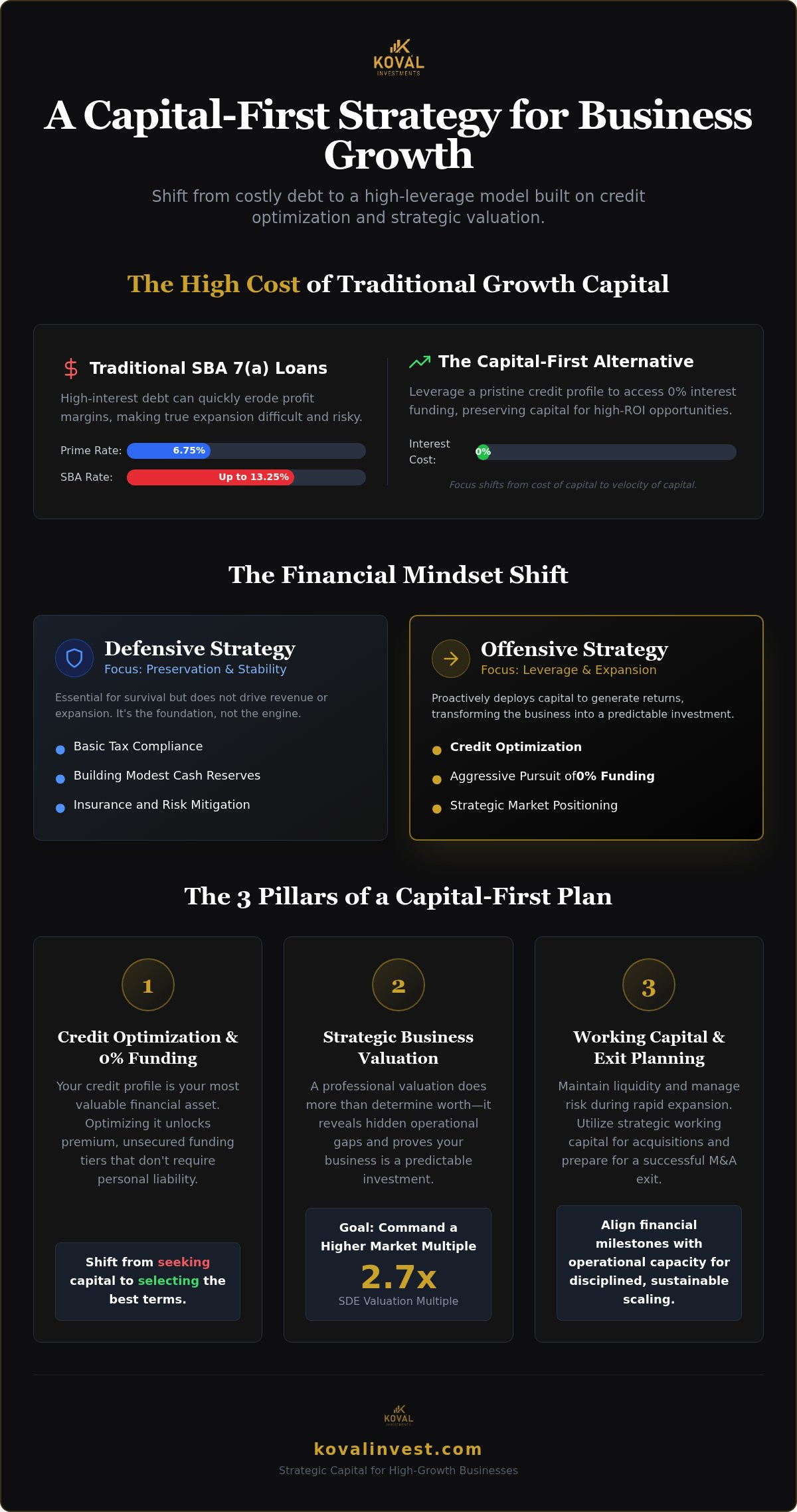
What if the greatest obstacle to your company's expansion isn't a lack of opportunity, but the high cost of the capital used to chase it? With the prime rate sitting at 6.75% in 2026, many entrepreneurs find that traditional SBA 7(a) loans, which can carry interest rates as high as 13.25%, quickly erode profit margins. Relying on high-interest debt or diluting your ownership with equity partners shouldn't be your default business financial strategy for growth.
It's frustrating to feel stuck between predatory rates and an inability to qualify for better terms because of a less than perfect credit profile. We understand that you want to scale without compromising your bottom line or losing sleep over your company's true market value. This guide will show you how to integrate credit optimization, 0% interest funding, and strategic valuation into a comprehensive financial plan that scales your business. We'll explore the roadmap for maximizing your borrowing power, accessing interest-free capital, and understanding the metrics that drive a 2.7x SDE valuation multiple in today's market.
Key Takeaways
- It's essential to shift from basic cash flow management to a capital-first model that prioritizes high-leverage growth opportunities.
- You'll learn how to optimize your credit profile to access 0% interest funding, which is a core component of a modern business financial strategy for growth.
- Discover how professional business valuations reveal hidden operational gaps and help you command a higher market multiple.
- Find out how to maintain liquidity and manage risk during rapid expansion by utilizing strategic working capital solutions.
- Understand the role of SBA loan assistance in facilitating acquisitions and preparing your company for a successful exit.
Beyond the Books: Why Business Owners Need a Capital-First Financial Plan
Traditional bookkeeping provides a historical record of where your money went, but it rarely explains where your business is going. Many founders conflate personal wealth management with corporate financial strategy. While personal planning often prioritizes tax mitigation and retirement, a robust business financial strategy for growth focuses on leverage, velocity, and the procurement of capital. In 2026, managing cash flow alone is no longer a sufficient catalyst for scaling. The market demands a proactive approach to funding that bridges the "Capital Gap," which is the distance between your current liquid assets and the resources required to reach the next tier of operations.
A strategic plan serves as a professional roadmap for both lenders and investors. It proves that you've moved beyond survival mode and are thinking like a strategic operator. By articulating how you'll deploy capital to generate a return, you transform your business from a risky venture into a predictable investment opportunity. This clarity is what separates stagnant companies from those that successfully navigate the complexities of modern expansion.
The Defensive vs. Offensive Financial Mindset
Every sustainable business needs a balance between defensive and offensive planning. Defensive strategies are the pillars of stability; they include insurance, basic tax compliance, and building a modest cash reserve. These are essential for preservation, but they don't drive revenue. Offensive planning is where true expansion happens. It involves credit optimization, market positioning, and the aggressive pursuit of 0% interest funding solutions to maximize your ROI.
Founders who master both mindsets treat capital as a raw material for growth rather than a last resort. By utilizing core entrepreneurial finance principles, you can structure your debt in a way that minimizes risk while maximizing borrowing power. This offensive posture allows you to act on opportunities while your competitors are still waiting for their bank balances to catch up.
Setting Growth-Oriented Financial Milestones
Your business financial strategy for growth must be anchored by specific, time-bound milestones. Instead of vague aspirations, you need to define your capital requirements for the next 12 to 36 months with precision. This involves aligning your financial goals with your actual operational capacity and current market demand. A success-based framework allows you to measure health through metrics that matter to lenders, such as debt-to-income ratios and credit utilization depth. When your financial milestones are clearly mapped, every dollar you procure has a predefined job to do, ensuring that your scaling efforts remain disciplined and sustainable.
The Foundation of Growth: Credit Optimization and 0% Interest Funding
Your business credit profile is your most valuable financial asset. It's the silent partner in every negotiation, dictating the terms of your leases, the limits on your supply lines, and the interest rates on your loans. In an environment where SBA 7(a) rates can reach 13.25%, a pristine credit profile acts as a necessary shield for your profit margins. By prioritizing credit health within your business financial strategy for growth, you shift from a position of seeking capital to one of selecting the best possible terms. This leverage is essential for maintaining the agility required to outpace competitors who are burdened by high-cost debt.
Professional credit restoration isn't just about fixing mistakes; it's about unlocking premium funding tiers that remain invisible to the average business owner. When your profile is optimized, you gain access to unsecured funding options that don't require you to pledge personal assets or real estate. This allows you to scale with confidence, knowing that your growth isn't tied to personal liability. If you're ready to see how your current profile measures up, you can schedule a strategic credit review to identify your maximum borrowing power.
Strategic Credit Restoration for Founders
Many entrepreneurs don't realize that minor inaccuracies on a credit report can trigger automatic loan rejections. These errors often involve outdated business addresses, misreported high credit limits, or incorrect industry classification codes. Utilizing professional business credit repair services is a proactive move to ensure your record is flawless before you approach lenders. A cleaned profile does more than just secure an approval; it positions you to qualify for significantly larger SBA loan amounts. Lenders view a well-managed credit history as a proxy for operational depth, which directly increases your perceived capacity for handling larger capital injections.
Accessing Zero-Interest Capital in 2026
Savvy operators now use 0% APR business credit lines as a primary source of working capital. These introductory periods, which typically last 12 months, provide a debt-free growth cushion that traditional term loans can't match. When you compare this interest-free capital to the current effective rates for SBA 504 loans, which hover around 6.27%, the cost savings are substantial. 0% interest funding provides the necessary liquidity to scale operations rapidly without surrendering equity to investors or taking on the burden of compounding interest. This capital can be deployed into high-ROI activities like marketing or inventory, allowing the business to pay for its own expansion before the introductory period ends.
Strategic Business Valuation: Knowing Your Worth Before You Scale
Every successful business financial strategy for growth begins with a clear understanding of the company’s current market value. You can't chart a course to a higher tier of operations if you don't know your starting point. Many owners rely on outdated rules of thumb that fail to account for the unique strengths of their specific model. A professional valuation does more than just assign a dollar amount to your hard work; it identifies the operational levers that will drive future expansion. By analyzing your Seller’s Discretionary Earnings (SDE) or EBITDA, you can pinpoint exactly where inefficiencies are eating into your margins and which departments are generating the highest returns.
Hidden assets often provide the most significant boost to a company's multiple. Proprietary processes, a loyal customer base, and established brand equity frequently outweigh the value of physical inventory. These intangible factors are what professional consultants look for when determining if a business is ready for a size premium. When these assets are properly documented, they also provide the necessary leverage to secure real estate investment funding. Lenders are far more likely to approve capital for property acquisition when the underlying business shows a predictable and scalable valuation.
The Role of Professional Valuation Consulting
Professional valuation consulting moves you beyond guesswork and into the realm of expert-led analysis. This level of detail is critical if you are considering using working capital for business acquisition as part of your expansion plan. In 2026, the average small business sells for approximately 2.6 to 2.7 times its SDE. However, understanding the specific multiplier effect in your industry allows you to make strategic adjustments that could push that number toward the 6.8x EBITDA average seen in larger M&A deals once you cross the $2 million revenue threshold.
Valuation as a Tool for Capital Procurement
A documented valuation acts as a powerful tool for capital procurement. Lenders view a third-party valuation as proof of stability, which often leads to higher working capital limits and more favorable terms. If your growth plan involves specialized real estate capital, an asset-based valuation provides the collateral assurance required by traditional and private lenders alike. By documenting your value growth over time, you create a compelling narrative for future funding rounds. This transparency builds trust with partners and ensures you aren't leaving money on the table when it's time to seek a major capital injection.
Managing Working Capital and Risk for Sustainable Scaling
Scaling a business often requires a paradoxical approach to cash. While you need liquidity to handle unexpected expenses, holding too much stagnant cash can actually hinder your progress. In a high-growth phase, every dollar should be deployed to generate a return. This is the fundamental difference between simple bookkeeping and a sophisticated business financial strategy for growth. By optimizing your working capital, you ensure that money isn't trapped in accounts receivable or excess inventory, but is instead available for high-impact investments that drive your next stage of expansion.
Diversifying your funding sources is the most effective way to mitigate risk during these aggressive expansion periods. Relying solely on a single bank or personal savings creates a single point of failure that can jeopardize your entire operation. A balanced approach utilizes a mix of SBA loans for long-term stability and unsecured lines for immediate flexibility. Credit optimization plays a silent but critical role here. By maintaining a high credit profile, you reduce the cost of your "risk insurance," securing lower rates and higher limits that provide a safety net when market conditions shift.
Working Capital Solutions for 2026
Effective management involves a delicate balance between inventory levels and growth investments. If your capital is tied up in slow-moving stock, you can't pivot when a new opportunity arises. Many successful founders now use alternative business funding solutions to bridge seasonal gaps or cover large purchase orders. This success-based approach to debt ensures that you only borrow what you can deploy effectively. It keeps your operational debt-to-income ratio in a healthy range, which is essential for maintaining the trust of future lenders and investors.
Risk Mitigation in a High-Growth Environment
Rapid growth can expose cracks in your corporate structure that were invisible during slower periods. It's essential to maintain a strict separation between personal assets and business liabilities to protect your family's future. Proper structuring ensures that a business setback doesn't become a personal catastrophe. You should also monitor your financial health indicators to identify potential pitfalls before they impact your credit score. A flexible capital procurement strategy allows you to adjust your borrowing based on economic shifts, ensuring you remain liquid even if traditional markets tighten. If you're looking to fortify your operations, you can apply for a working capital assessment to identify your best funding options today.
Executing the Exit: M&A and Long-Term Strategic Planning
The final stage of a mature business financial strategy for growth is the transition from active operator to strategic investor. This shift requires you to view your company not just as a source of income, but as a tradable asset. Achieving a premium exit isn't a matter of luck. It's the result of intentional, long-term strategic planning that begins years before you intend to step away. With global M&A deal value projected to reach $4 trillion in 2026, the opportunity for a high-value exit is substantial for those who prepare correctly. Positioning your business as a high-value acquisition target involves more than just increasing revenue; it requires proof of operational depth and financial transparency.
Strategic growth often involves acquiring competitors to increase market share and command higher valuation multiples. Utilizing expert SBA loan assistance can facilitate these acquisitions, allowing you to use leverage to buy established cash flow. This "buy-and-build" approach can significantly accelerate your timeline to a lucrative exit by moving your company into a higher tier where size premiums apply. By the time you are ready to sell, your business should operate as a turnkey system that doesn't depend on your daily presence.
M&A Advisory for the Modern Entrepreneur
You should begin identifying potential buyers and strategic partners at least 24 months before a planned sale. This window allows you to clean up your credit profile and align your books with the rigorous requirements of due diligence. Buyers apply intense scrutiny to financial history, and even minor discrepancies can lead to price re-negotiations or collapsed deals. In an era where boards are applying more scrutiny than ever, having a flawless financial record is your best defense. Strategic planning today dictates your exit price tomorrow.
Your Next Chapter: Reinvesting for Long-Term Wealth
A successful exit is rarely the end of a founder's journey. Many entrepreneurs use their proceeds to pivot into new asset classes, such as seeking funding for real estate investors to build a passive income portfolio. Maintaining a high-tier credit profile post-exit is essential for these future ventures. It ensures you retain your borrowing power even without the backing of your former company. Partnering with a long-term strategic advisor helps you navigate these multiple business lifecycles, ensuring that your business financial strategy for growth evolves into a comprehensive wealth preservation plan. This continuity allows you to maintain your momentum as you transition from building a single company to managing a diversified portfolio of assets.
Scaling with Strategic Precision
Building a resilient company requires moving beyond defensive accounting and embracing a capital-first mindset. By optimizing your credit profile and leveraging 0% interest funding, you create a low-risk environment for aggressive expansion. Integrating accurate business valuations into your planning ensures that every operational move increases your market multiple, preparing you for a lucrative exit or a strategic acquisition. A sophisticated business financial strategy for growth isn't just about surviving today's market; it's about engineering a company that thrives independently of its founder.
At Koval Investments, we operate on a success-based philosophy because we believe our partnership should be a win-win venture. Our expertise in credit restoration unlocks premium capital tiers that traditional banks often overlook. Whether you need a precise valuation or a roadmap for M&A, we provide the steady hand required to navigate complex financial landscapes. You don't have to navigate these challenges alone. Secure your 0% interest funding and start your strategic plan with Koval Investments to ensure your company reaches its full potential. We're ready to help you turn your vision for expansion into a tangible reality.
Frequently Asked Questions
What is the most important part of financial planning for a business owner?
The most critical aspect is transitioning from a defensive mindset to an offensive capital procurement model. While bookkeeping tracks the past, a proactive business financial strategy for growth focuses on the future procurement of capital to fuel expansion. It involves identifying the "Capital Gap" and ensuring your credit profile, cash flow, and operational capacity are synchronized. This alignment allows you to act on market opportunities without the friction of high-interest debt or equity dilution.
How does credit repair help me get a business loan?
Credit repair services directly influence your eligibility for premium funding tiers by removing inaccuracies that trigger automatic bank rejections. Lenders view your credit score as a proxy for your ability to manage larger capital injections. By identifying and disputing outdated addresses or misreported limits, you improve your debt-to-income ratio and overall borrowing power. This optimization allows you to qualify for significantly larger SBA loan amounts while securing the lowest possible interest rates available in 2026.
Can I get 0% interest funding if my business is still in the growth phase?
Yes, businesses in the growth phase can access 0% interest funding solutions by leveraging introductory APR business credit lines. These tools function as a debt-free growth cushion, providing essential liquidity for high-ROI activities like marketing or inventory purchasing. Unlike traditional term loans that carry immediate interest burdens, these 12-month interest-free periods allow your business to pay for its own expansion before variable rates apply. This strategy is particularly effective for companies with optimized credit profiles.
Why do I need a professional business valuation if I am not selling yet?
A professional valuation provides a baseline for your growth trajectory and identifies the operational levers that drive your company's market multiple. It reveals hidden assets like brand equity and proprietary processes that traditional balance sheets often overlook. By understanding your current SDE or EBITDA multiple, you can pinpoint inefficiencies and make strategic adjustments today. This data-driven approach ensures you are building a scalable asset that will eventually command a premium "size premium" during a future exit.
What is the difference between working capital and a traditional business loan?
Working capital refers to the liquid funds used for day-to-day operations, such as inventory and payroll, whereas traditional business loans are typically structured for long-term assets or major expansions. While a traditional loan often carries a fixed repayment term and interest rate, working capital solutions provide the flexibility to bridge seasonal gaps or capitalize on immediate purchase orders. Maintaining optimized working capital ensures your company remains agile without trapping too much stagnant cash in accounts receivable or slow-moving stock.
How long does it take to optimize a business credit profile for funding?
The timeline for credit optimization varies depending on the complexity of your current report, but most owners see significant progress within three to six months. This process involves a methodical approach to disputing inaccuracies and building new, positive tradelines. While some errors can be resolved quickly, building the depth of credit required for unsecured funding tiers takes consistent management. Starting this process early ensures your profile is ready when you need to execute a major capital procurement phase.
What are the benefits of success-based financial consulting?
Success-based consulting creates an inherent alignment between your goals and your advisor's objectives. At Koval Investments, we win only when you win, which removes the financial risk often associated with traditional consulting fees. This philosophy ensures that our strategies for credit restoration and capital procurement are results-oriented rather than transaction-driven. It fosters a collaborative partnership where the advisor is equally invested in the long-term success and scalability of your business financial strategy for growth.
How does an SBA loan consultant improve my chances of approval?
An SBA loan consultant acts as a strategic guide through the complex underwriting requirements of federal loan programs. They ensure your financial package is presented in a way that highlights your operational depth and debt-service coverage. By matching your specific needs with the right lender and optimizing your credit profile beforehand, a consultant significantly reduces the risk of rejection. This expertise allows you to navigate the 2026 market with confidence, securing the long-term capital needed for sustainable scaling.