
Business Loan Denied for Bad Credit? Your 2026 Strategic Recovery Roadmap
A rejection letter from a bank isn't a verdict on your company's future; it's a diagnostic report that reveals the exact gaps in your financial profile. Finding your business loan denied bad credit can feel like a sudden halt to your growth plans, especially when you're facing the pressure of 2026's tighter ownership requirements and shifting SBA standards. It's frustrating to watch opportunities slip away because of a three-digit number or inaccuracies on a report you haven't seen in months.
We understand that the stress of capital rejection often stems from a lack of clarity rather than a lack of potential. You deserve a partner who views your situation with pragmatism and expertise. This guide provides a strategic roadmap to help you transition from a denial to securing prime capital. You'll discover how to navigate the current lending landscape, utilize credit restoration as a gateway to SBA-backed funding, and access 0% interest solutions that protect your bottom line. We'll break down the hidden reasons for bank rejection and outline the specific steps to make your business lender-ready.
Key Takeaways
- Decode the updated 2026 standards for the "5 Cs of Credit" to understand why traditional lenders now view a 680 FICO score as a mandatory floor.
- Identify the strategic distinction between simply paying off debt and optimizing credit utilization to address the root causes of a business loan denied bad credit.
- Position credit restoration as a critical gateway to 0% interest funding solutions, which offer unsecured, interest-free capital for up to 18 months.
- Evaluate alternative working capital paths and SBA-backed options that can sustain your operations while you execute a long-term financial recovery plan.
- Transition from basic credit repair to comprehensive financial optimization through a success-based partnership that aligns expert guidance with your specific funding goals.
Why Business Loans Are Denied in 2026: Decoding the Rejection Letter
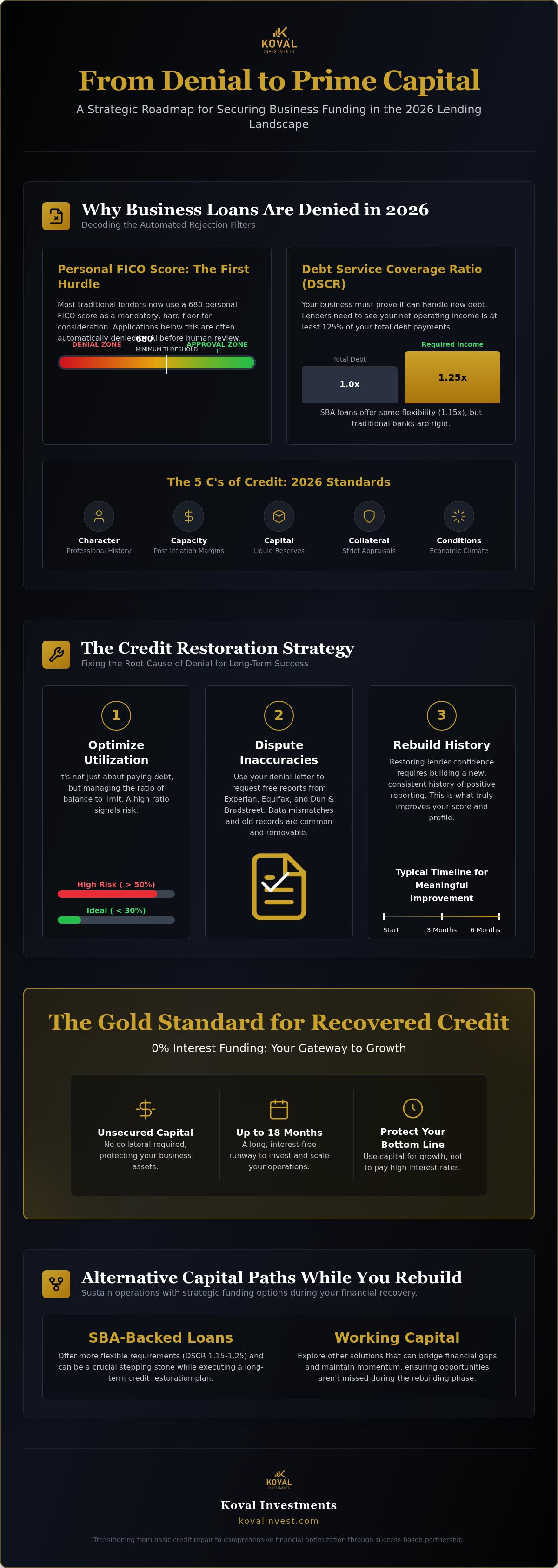
A rejection letter is a data point, not a dead end. In the 2026 lending environment, institutional banks have sharpened their scrutiny, evaluating the "5 Cs of Credit" through a more rigid lens. Character now involves a deeper look at your professional history; Capacity focuses on your post-inflation margins; Capital requires more liquid reserves; Collateral values are strictly appraised; and Conditions account for the current 6.75% prime rate. Most traditional lenders now treat a personal FICO score of 680 as a hard floor. If your score sits below this, your application often faces an automatic AI-driven denial before a human underwriter even reviews your file. Disorganized financials or missing tax transcripts trigger these same automated filters, making meticulous documentation a prerequisite for any serious capital search.
The Role of Personal vs. Business Credit Scores
Lenders lean heavily on personal FICO scores because they view your individual financial habits as a proxy for your business’s reliability. A foundational step in understanding your credit score is recognizing how your personal and business profiles interact. For those seeking SBA loan assistance, the FICO SBSS score has become the primary filter. This score aggregates data from both your personal and business reports to create a unified risk assessment. If you find your business loan denied bad credit, the culprit is often a simple inaccuracy on one profile that has poisoned the other. We view this as a strategic challenge that requires professional optimization rather than just a basic fix.
Cash Flow and Debt Coverage Ratios
Banks aren't just looking at what you owe; they're looking at your consistent ability to pay. Debt Service Coverage Ratio (DSCR) is the primary metric for measuring a business’s ability to handle new debt. In 2026, most traditional institutions look for a DSCR of 1.25 or higher. This means your net operating income must be at least 125% of your total debt obligations. While SBA loans offer some flexibility with ratios between 1.15 and 1.25, irregular revenue patterns remain a major red flag for bank algorithms. Even a profitable business can face rejection if its cash flow lacks the steady, predictable rhythm that lenders crave. We work with you to restructure these ratios, ensuring your business presents a profile of stability that aligns with modern lending standards.
The Credit Restoration Strategy: Fixing the Root Cause of Denial
Finding your business loan denied bad credit is a clear signal that your financial profile needs recalibration. Most entrepreneurs focus solely on paying down debt balances, but they often miss the strategic nuance of credit utilization. A high balance relative to your credit limit suggests risk to lenders even if your payment history is spotless. Strategic credit restoration involves shifting these ratios and ensuring your file reflects the stability required for high-limit capital access. Professional business credit repair services provide a level of precision that DIY efforts often lack, especially when dealing with complex commercial files that involve multiple reporting bureaus.
A successful recovery requires a methodical approach to your credit architecture. We don't just look for errors; we look for opportunities to align your profile with the current 2026 lending standards. This involves a success-based philosophy where the goal isn't just a higher number, but a lender-ready status that commands prime interest rates. If you're ready to transition from a rejection to a strategic advantage, our team can help you optimize your financial standing for long-term growth.
Disputing Inaccuracies and Errors
In 2026, business credit reports from Experian Business, Equifax, and Dun & Bradstreet frequently contain data mismatches or outdated public records. You should use your denial letter as a catalyst to request a free credit report review, as you're legally entitled to this within 60 days of a rejection. A realistic timeline for restoration typically spans three to six months to see meaningful score jumps. While some errors are corrected quickly, building a consistent history of positive reporting is what truly restores lender confidence.
Optimizing Your Financial Profile for SBA Approval
To fix credit for SBA loan approval, you must meet specific SBA funding requirements that now include strict ownership verification as of March 2026. Credit repair acts as a mandatory prerequisite for both SBA 7(a) vs 504 loan eligibility. After inaccuracies are removed, you must "season" your credit by maintaining low utilization and perfect payment history for several months. This period of stability proves to the SBA that your improved score is a reflection of sustainable financial management rather than a temporary fix.
0% Interest Funding: The Gold Standard for Recovered Credit
Securing 0% interest capital is the ultimate reward for a successful credit restoration strategy. While many entrepreneurs feel stuck after finding their business loan denied bad credit, this solution offers a path to high-limit, unsecured funding that traditional banks often overlook. By leveraging an optimized credit profile, you can access capital that remains interest-free for six to eighteen months. This window provides the breathing room needed to scale operations or bridge the gap until you qualify for long-term SBA financing. Because this funding is unsecured, your personal and business assets remain protected, which significantly reduces the pressure on your balance sheet.
How 0% Interest Funding Works
The mechanism involves securing high-limit business credit lines that feature introductory 0% interest periods. This approach is fundamentally superior to high-interest working capital loans or merchant cash advances (MCAs), which often trap owners in a cycle of expensive daily repayments. By using these lines strategically, you avoid the predatory rates that often target those with previous credit challenges. Utilizing 0% interest business funding preserves cash flow during expansion by ensuring that every dollar borrowed goes directly toward growth rather than interest expenses. It transforms debt from a burden into a surgical tool for operational efficiency.
Qualification Criteria for Zero-Interest Capital
Approval for these programs requires a precise credit profile that goes beyond just a high FICO score. Lenders typically look for a score of 700 or higher, along with low personal credit utilization and a clean reporting history. While many advisors suggest startups must wait two years for capital, these credit-based solutions are accessible much earlier if the owner's profile is correctly optimized. Industry classification also plays a role, as certain sectors are viewed with higher risk by automated underwriting systems. To maximize your total capital procurement, we often assist clients in stacking multiple 0% interest lines from different issuers simultaneously. This coordinated effort ensures you secure the maximum aggregate limit possible without triggering the red flags that occur with uncoordinated, multiple applications. It's a selective process that rewards those who have moved past the frustration of a business loan denied bad credit and invested in a professional financial recovery.
Alternative Capital Paths While You Rebuild
Facing a business loan denied bad credit scenario requires a two-pronged approach: repairing the financial foundation and securing bridge capital to maintain operational momentum. While your credit restoration is underway, you don't have to put growth on hold. We help you evaluate alternative business funding solutions that prioritize your current cash flow over historical credit scores. This phase is about strategic positioning, ensuring you have the liquid working capital to meet demands without falling into predatory lending traps. Many alternative lenders target denied owners with merchant cash advances (MCAs) that carry effective APRs exceeding 36%. We steer you toward more sustainable options, such as strategic funding for real estate investors if your portfolio includes property assets that can be leveraged for liquidity.
Working Capital vs. Long-Term Debt
Short-term working capital acts as a tactical bridge for specific growth milestones. For example, using working capital for business acquisition allows you to seize a market opportunity while your primary credit profile recovers. The cost of this capital is typically higher than a traditional bank loan, but it's often more affordable than the opportunity cost of missing a deal. When comparing sources, look beyond the interest rate to the total cost of capital and the impact on your monthly debt-service coverage ratio (DSCR). Our goal is to ensure your short-term debt doesn't compromise your long-term eligibility for prime rates.
Preparing for Future SBA Eligibility
Building a "capital stack" involves blending immediate funds with your long-term goal of SBA approval. The 2026 market, with a prime rate of 6.75%, rewards those who are proactive about their financial health. A professional SBA loan consultant helps you navigate the re-application process by ensuring your current funding mix doesn't over-leverage your balance sheet. This methodical approach ensures that when your credit reaches the 640 threshold required for SBA 7(a) loans, your business is perfectly positioned for approval. If you're navigating a complex recovery, connect with our strategic advisors to build your custom funding roadmap.
Partnering for Success: The Koval Investments Advantage
Moving past the frustration of a business loan denied bad credit requires more than just a temporary fix; it demands a comprehensive shift in your financial architecture. At Koval Investments, we don't operate as a distant service provider. We function as a seasoned strategic partner. Our approach moves beyond basic credit repair to focus on total financial optimization and capital procurement. We understand that a loan denial is often a symptom of deeper structural gaps in a business profile. By addressing these gaps through a collaborative lens, we reduce the operational stress that typically follows a bank rejection, allowing you to focus on your core business while we handle the complexities of the lending landscape.
Our firm is built on a success-based philosophy that fundamentally aligns our goals with your outcomes. This "win-win" mentality means we are equally invested in your ability to secure capital. We view our clients through a lens of long-term value rather than high-volume transactions. This selective and intentional approach ensures that every strategy we implement is designed for tangible progress and stability. Whether you're recovering from a recent denial or preparing for a major expansion, our team provides the steady hand needed to navigate 2026's complex financial environment.
Collaborative Capital Procurement
Koval Investments acts as an "insider" mentor, sharing deep industry knowledge that is typically reserved for institutional players. As a national-scale advisory firm, we maintain extensive connections across a diverse range of capital sources, from traditional banks to private credit funds. This network allows us to match your optimized profile with the lenders most likely to offer favorable terms. Our success-based engagement model ensures there is no financial risk to you, as our objectives are perfectly aligned with your actual funding outcomes. This structure reinforces our commitment to delivering results that move the needle for your business.
Beyond Funding: Strategic Growth and M&A
Securing capital is rarely the final goal; it's a means to fuel long-term objectives like mergers, acquisitions, or eventual exits. We integrate your funding strategy with your broader strategic planning to ensure every dollar works toward your ultimate vision. A professional business valuation serves as the critical first step in any major capital request, providing a clear benchmark that builds credibility with underwriters. By understanding your true market value, you can negotiate from a position of strength and clarity. Ready to turn your denial into a 0% interest success story? Contact Koval Investments today to begin your strategic recovery.
Transforming Financial Rejection into Strategic Capital
Finding your business loan denied bad credit doesn't define your company's potential; it simply marks the beginning of a more intentional capital strategy. By decoding your rejection letter and addressing the root causes of credit friction, you can transition from institutional denial to prime eligibility. This roadmap has shown that strategic restoration is the gateway to 0% interest funding and long-term SBA assistance. These solutions protect your assets while providing the interest-free runway necessary for sustainable growth.
Success in the 2026 lending market requires more than just a higher score; it requires a partner who understands the nuances of financial optimization. At Koval Investments, our success-based philosophy ensures that our interests are perfectly aligned with your funding outcomes. We provide the expertise in 0% APR procurement and comprehensive credit repair needed to secure your business's future. Our collaborative approach removes the traditional risks of financial consulting, replacing them with a steady hand and a clear path to success.
Secure Your 0% Interest Funding Strategy with Koval Investments
Your path to prime capital is clear, and we're ready to navigate it alongside you.
Frequently Asked Questions
How long do I have to wait to reapply for a business loan after being denied?
You should wait at least 30 to 90 days before reapplying, but the specific timeframe depends on the reasons cited in your rejection letter. If your business loan denied bad credit was the primary issue, it's essential to wait until your score has materially improved through credit restoration. Reapplying too soon with the same profile often leads to an automatic denial, as bank algorithms flag repetitive inquiries without any improved data points to consider.
Can I get a business loan with a 500 credit score?
While traditional banks generally require a score of 680 or higher, some alternative lenders may provide funding to owners with scores as low as 500. However, these options often carry high interest rates and aggressive repayment terms that can strain your cash flow. We recommend focusing on credit repair to reach the 640 threshold for SBA programs or a 700+ score to unlock 0% interest funding solutions that offer significantly better long-term value for your business.
What is the most common reason for SBA loan denial?
The most common reasons for SBA denial in 2026 include a personal credit score below 640 and a Debt Service Coverage Ratio (DSCR) under 1.15. The updated March 2026 requirement for 100% U.S. citizen or national ownership has also become a frequent disqualifier. Incomplete documentation or a lack of liquid capital also trigger automatic rejections, as the SBA requires a clear demonstration of your business’s ability to handle new debt obligations without compromising operations.
Is professional credit repair worth it for business owners?
Professional credit repair is often a critical investment for owners who want to move past the frustration of a business loan denied bad credit. Experienced advisors identify and dispute inaccuracies across Experian Business, Equifax, and Dun & Bradstreet that DIY efforts frequently miss. By optimizing your profile, you gain access to 0% interest funding and prime SBA rates. This strategic shift can save your business thousands of dollars in interest and fees over the life of your capital procurement.
How does 0% interest business funding differ from a traditional bank loan?
Traditional bank loans are term-based products with fixed or variable interest rates, currently ranging from 8% to 17.25%. In contrast, 0% interest funding solutions utilize high-limit business credit lines with introductory periods of 6 to 18 months of zero interest. This funding is typically unsecured, meaning it doesn't require business assets as collateral. It provides a more flexible, low-cost bridge for growth compared to the rigid repayment structures and high costs of institutional bank debt.
What documents do I need to fix my business credit profile?
To begin fixing your business credit profile, you'll need your recent denial letter, which entitles you to a free credit report review. You should also gather current reports from all three major business bureaus and personal credit transcripts. Supporting documentation includes two years of business tax returns, recent bank statements, and proof of identity. These records allow a strategic partner to identify reporting errors and verify that your financial history is represented accurately to future lenders.
Will a business loan denial hurt my credit score further?
The denial itself does not impact your credit score, but the hard inquiry performed during the application process can cause a temporary dip. If you apply to multiple lenders in a short period, these cumulative inquiries can signal risk to automated underwriting systems. This is why we advocate for a selective, "lender-ready" approach. By optimizing your profile before you reapply, you ensure that every inquiry counts and leads toward a successful funding outcome rather than a repetitive rejection.
Can I qualify for working capital if I have been rejected by a bank?
You can often qualify for working capital even after a bank rejection by exploring alternative capital paths. Options such as revenue-based financing or real estate investment funding focus more on your current cash flow or property assets than on historical credit scores. These solutions act as a tactical bridge, providing the liquidity needed to maintain operations while you execute a long-term credit restoration strategy to qualify for prime interest rates and more traditional funding in the future.