
Can I Get an SBA Loan with a 600 Credit Score in 2026?
What if the automated denial you received from a commercial bank says more about their internal overlays than your actual eligibility? If you are wondering, "can I get an SBA loan with a 600 credit score," the pragmatic answer is yes. However, securing an approval requires a deliberate strategy rather than submitting blind applications into standard bank algorithms.
It is exhausting to watch urgent capital needs clash with rigid underwriting standards, especially when your real-world revenue and operational performance tell a stronger story than your personal credit history. You don't have to pause your business momentum to wait out traditional institutional friction. In this guide, you will discover realistic SBA loan approval pathways for a 600 credit profile, the primary compensating factors that lenders evaluate, and actionable bridge solutions to keep your growth on track.
We break down specific program thresholds, examine how lenders evaluate risk beyond standard scorecards, and provide a clear roadmap to secure funding while strengthening your financial profile.
Key Takeaways
- Understand how private lender overlays differ from statutory guidelines to answer the core question: can I get an SBA loan with a 600 credit score?
- Identify accessible federal borrowing pathways, including SBA Microloans, designed with flexible credit criteria for growing enterprises.
- Learn how compelling compensating factors, such as high debt service coverage and valuable collateral, offset lower personal credit marks.
- Explore non-dilutive bridge options, such as 0% interest business funding, to support immediate capital needs during underwriting.
- Execute a structured credit optimization plan to correct reporting inaccuracies and unlock prime commercial financing terms.
The Reality of SBA Loan Requirements for a 600 Credit Score
If you ask a commercial loan officer, "can I get an SBA loan with a 600 credit score," the immediate response is almost always negative. That reaction reflects the institution's internal risk tolerance rather than federal statutes. Securing government-backed capital with fair credit is challenging, but it isn't impossible. Success depends on understanding how underwriters evaluate risk and finding institutions willing to look past automated filters. While preferred lenders favor pristine profiles, federal guidelines provide room for approval when a business demonstrates reliable revenue and clear viability.
SBA Statutory Guidelines vs. Bank Lender Overlays
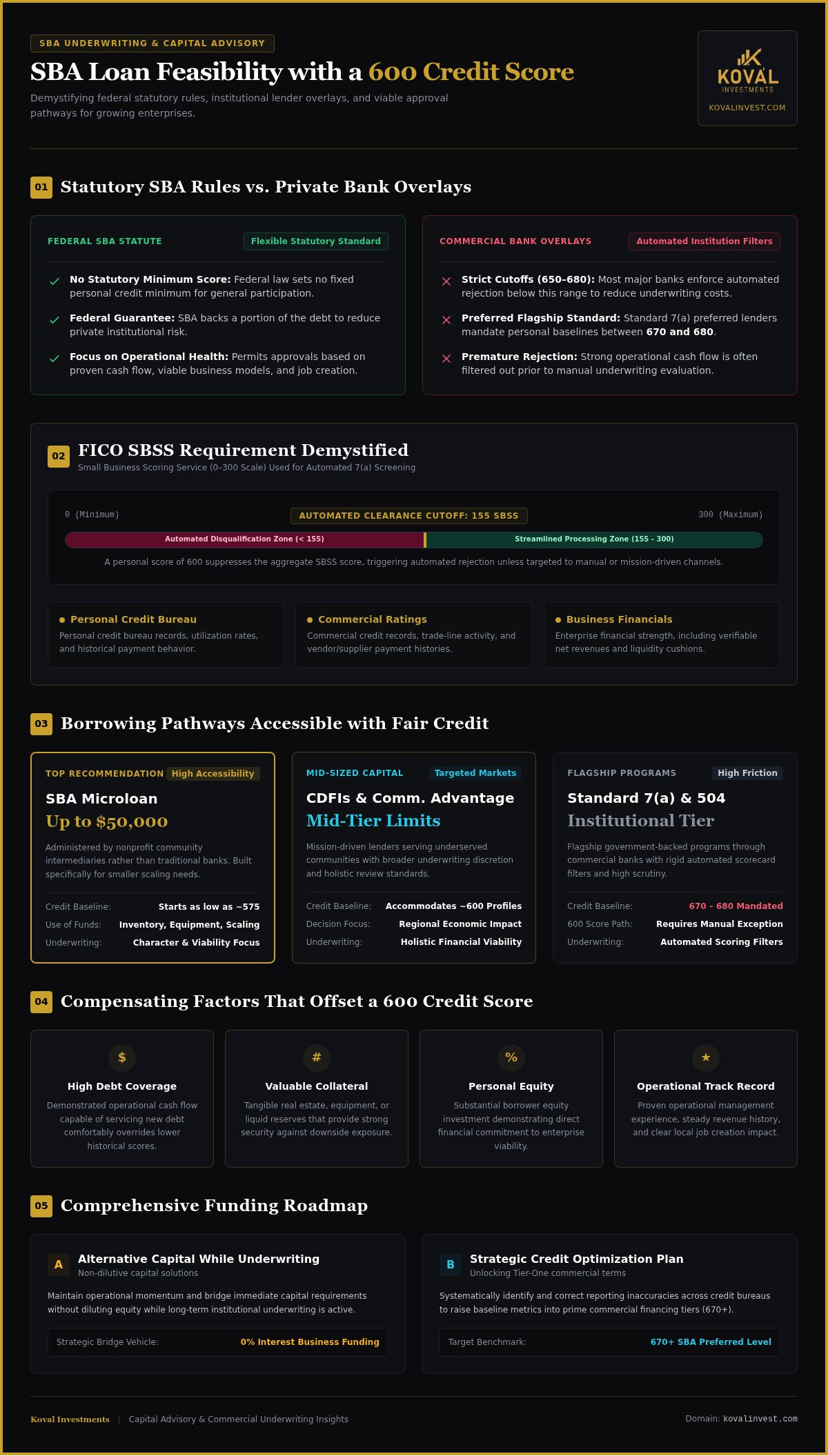
The federal government does not set a mandatory minimum personal credit score for general participation. Instead, the Small Business Administration (SBA) provides a federal guarantee on a portion of the debt, reducing exposure so private lenders feel confident extending capital to growing companies.
Private financial institutions introduce their own criteria, termed lender overlays. Most national banks enforce a strict personal credit threshold between 650 and 680. Because large institutions manage high transaction volumes, they rely on automated filters that disqualify a 600 score immediately. They do this to control processing costs, even when an enterprise holds sufficient cash flow to manage debt service comfortably.
Demystifying the FICO SBSS Score Requirement
For automated evaluation, lenders frequently use the FICO Small Business Scoring Service (SBSS). This model aggregates personal and commercial credit data into a single rating from 0 to 300, factoring in several core areas:
- Personal credit bureau records and past payment behavior
- Commercial credit history and supplier payment ratings
- Business financial metrics, including net revenues and liquidity
For streamlined 7(a) processing, applications traditionally require a 155 SBSS minimum to clear automated screening. Because personal credit history carries significant weight within the algorithm, a 600 personal score suppresses the overall result. When an application falls below the automated cutoff, it is rejected before an underwriter evaluates true operational health. Securing financing at this tier requires presenting strengths that justify full manual underwriting or targeting lending vehicles with distinct qualification structures.
SBA Loan Options Accessible with Fair or Challenged Credit
Entrepreneurs evaluating their capital options often stop at the question, "can I get an SBA loan with a 600 credit score?" While conventional 7(a) avenues present clear hurdles, the agency oversees distinct lending channels designed precisely for businesses operating outside standard institutional credit boxes. Selecting the right program structure determines whether your application faces automated disqualification or receives a manual, holistic review.
The SBA Microloan Program as an Entry Point
The Microloan initiative provides financing up to $50,000 to help small businesses scale operations, purchase inventory, or acquire equipment. These funds are administered through nonprofit community-based intermediaries rather than traditional commercial banks. These mission-aligned lenders prioritize local job creation, operational management experience, and character over strict numerical thresholds. Several intermediary organizations actively review files with personal credit marks starting around 575, provided the borrower demonstrates a viable business model and reliable debt service capacity.
Community Advantage and Mission-Driven Lenders
For mid-sized requirements above the microloan limit, Community Advantage lenders and Community Development Financial Institutions (CDFIs) deliver targeted capital to underserved markets. These institutions utilize expanded underwriting discretion. Rather than filtering applications through rigid scorecards, CDFI loan committees assess holistic financial viability, regional economic impact, and personal equity investment. This framework allows entrepreneurs with scores around 600 to secure government-backed capital when supported by steady operational cash flow.
Standard SBA 7(a) and 504 Structural Barriers
Securing flagship program approval remains significantly more restrictive. Comprehensive reviews of industry-wide SBA loan requirements show that most preferred institutional lenders mandate a personal baseline of at least 670 to 680. Unsecured 7(a) working capital lines face the steepest scrutiny because the institution relies heavily on personal credit reliability to offset operational risk.
Conversely, 504 financing focuses on major fixed assets like commercial real estate and heavy machinery. While credit history matters, substantial real estate equity and hard collateral can occasionally offset an imperfect score. For an in-depth breakdown of these distinct structures, review our guide on SBA 7(a) vs 504 loan options. If institutional requirements feel restrictive, partnering with a strategic advisor like Koval Investments can clarify which specific funding channels match your actual financial profile.
Compensating Factors That Strengthen a 600 Credit Score Application
A lower personal credit profile raises flags for underwriting committees, but it doesn't close every door. When evaluating whether you can get an SBA loan with a 600 credit score, human underwriters look for operational evidence that mitigates past payment issues. These institutional strengths are known as compensating factors. By demonstrating exceptional stability in other financial areas, you shift the underwriter's focus from historical credit setbacks to proven operational performance.
Cash Flow Strength and Debt Service Coverage
Debt Service Coverage Ratio (DSCR) remains the primary benchmark for commercial viability. While standard SBA programs require a baseline DSCR of 1.15x, presenting a ratio of 1.25x to 1.35x or higher significantly offsets personal score deficiencies. Lenders want clear proof that historical net operating income easily absorbs proposed loan payments. Providing clean, accountant-reviewed financial statements showcasing stable profit margins across the trailing twelve months reassures the committee that your business generates reliable liquidity regardless of your personal credit history.
Collateral Pledges and Equity Commitments
Substantial equity investment immediately decreases an institution's risk exposure. For acquisitions or expansion financing, offering a cash down payment of 20% to 30%, well above the typical 10% statutory minimum, signals absolute alignment with the business's success. Lenders also place significant weight on tangible collateral pledges, including:
- Unencumbered commercial or residential real estate equity
- Heavy machinery and enterprise-grade equipment
- Pledged liquid deposits and securities accounts
Pledging valuable assets gives underwriters the secondary repayment source required to justify an exception. Navigating these requirements demands precise portfolio presentation. Reviewing professional guidance on SBA loan assistance helps structure asset disclosures properly to satisfy institutional committees.
Documenting Credit Events with Letters of Explanation
Underwriters distinguish between habitual non-payment and isolated financial shocks. A well-constructed Letter of Explanation isolates historical credit damage from your current operational habits. If your 600 score stems from a past medical emergency, an anomalous business disruption, or an resolved commercial vendor dispute, document it thoroughly. Provide formal release letters, paid-in-full receipts, and a concise narrative. Showing that the adverse event is completely resolved allows risk officers to underwrite your present financial discipline with confidence.
Alternative Capital Strategies While Building Your Credit Profile
Waiting months for institutional credit rehabilitation or manual underwriting delays operational growth. If you are asking, "can I get an SBA loan with a 600 credit score right now," the candid reality is that the approval process requires deliberate patience. Pausing vendor payments, inventory purchases, or team expansion while waiting for federal clearance damages commercial momentum. Savvy business owners deploy pragmatic bridge capital strategies to maintain daily liquidity while methodically positioning their balance sheets for future institutional approval.
Zero-Percent Interest Business Lines
Deploying structured 0% interest business funding provides a non-dilutive runway to cover immediate operating costs. These unsecured commercial facilities grant interest-free financing for introductory windows often lasting 12 to 18 months. Because these accounts report primarily to commercial credit bureaus, they help separate business debts from personal profiles. This structure prevents high utilization from dragging down your personal score, avoiding compounding interest charges while you direct cash flow toward high-ROI initiatives.
Asset-Based Lending and Revenue Financing
When enterprise revenue flows consistently but credit ratings lag, asset-based facilities convert existing operational momentum into immediate liquidity. Alternative financing channels look at underlying business collateral rather than personal credit history:
- Accounts receivable factoring that advances capital against verified, outstanding commercial invoices within days
- Equipment financing agreements where the purchased machinery serves as the direct security for the underlying loan
- Revenue-based financing structured around predictable daily or weekly business cash receipts
These short-term vehicles carry different cost structures than long-term government debt, making precise deployment essential. If your expected return on capital exceeds the cost of capital, these facilities serve as an effective springboard. Evaluating comprehensive alternative business funding solutions helps determine which specialized vehicles support your current margins.
You don't have to pause your business expansion while addressing credit challenges. Combining immediate bridge financing with disciplined balance sheet optimization solves urgent capital needs while preparing your firm for prime bank packaging. When you want to evaluate custom financing options designed around your cash flow, connect with Koval Investments to access strategic capital solutions.
Strategic Roadmap to Elevate Your Score for Tier-One SBA Financing
Securing a microloan or an asset-backed bridge provides tactical breathing room, but unlocking prime commercial financing terms requires long-term credit discipline. While you may ask, "can I get an SBA loan with a 600 credit score," elevating your profile above 680 fundamentally transforms your institutional borrowing power. It expands your lender selection, lowers equity injection demands, and captures the lowest available interest rates. Moving between these tiers requires a structured, multi-stage optimization process.
Professional Credit Repair and Dispute Strategies
Bureau reporting inaccuracies frequently drag viable profiles down into the low 600s. Erroneous late payment remarks, duplicate collection records, and outdated balance calculations artificially suppress personal scores. Leveraging professional business credit repair services allows entrepreneurs to audit their bureau files systematically. Removing unverified adverse items directly elevates baseline ratings, often restoring substantial points within three to six months and clearing automated underwriting hurdles.
Strategic Tradeline and Balance Management
Revolving debt utilization heavily influences commercial risk algorithms. Lowering balances across existing revolving cards below thirty percent of total available limits delivers immediate score improvements. In addition, strengthening your commercial profile offsets personal credit limitations. Implement these core balance sheet steps:
- Establish tier-one commercial vendor accounts that report prompt payment data to major business bureaus
- Distribute company operating expenses across dedicated corporate cards to keep personal utilization minimal
- Impose a strict moratorium on new personal hard inquiries during the six months leading to an SBA submission
Engaging Expert Advisory for Loan Packaging
Presenting a borderline file requires specialized packaging expertise. Blindly applying to commercial banks generates hard credit pulls that degrade your score further without yielding capital. A boutique advisory team identifies institutions whose current underwriting appetite matches your actual balance sheet strength. Strategic packaging aligns your trailing financials, tax filings, and compensating narratives to satisfy credit committees on first submission. To transition your company into tier-one lending vehicles, you can schedule a strategic consultation through Koval Investments today.
Positioning Your Enterprise for Long-Term Capital Access
If you began researching, "can I get an SBA loan with a 600 credit score," you now know that a three-digit rating doesn't define your commercial future. While private bank overlays create immediate friction, viable pathways exist through mission-focused lenders. Presenting compelling compensating factors, such as reliable debt service coverage and tangible collateral, shifts the underwriting focus back to your actual operational performance.
Maintaining business momentum while repairing credit requires a coordinated financial strategy. Serving entrepreneurs across the United States, Koval Investments provides strategic business advisory paired with specialized expertise in 0% interest business funding and capital procurement. We deploy targeted credit optimization strategies designed for commercial loan approvals, helping you bridge immediate operational needs while building tier-one borrowing power. You don't have to navigate institutional guidelines by trial and error. Partner with Koval Investments to secure optimal business funding and optimize your capital readiness. With the right capital framework in place, sustainable commercial growth is well within your reach.
Frequently Asked Questions
Can I get an SBA 7(a) loan with a 600 credit score?
Securing a standard SBA 7(a) loan with a 600 credit score is difficult through traditional commercial banks, but it is achievable through specialized non-bank lenders. Most national institutions require a personal score of 650 to 680 to pass internal underwriting screens. However, community development lenders evaluate applications manually if you show exceptional compensating factors like strong debt service coverage and stable operational revenue.
What is the absolute minimum credit score required for an SBA loan?
The Small Business Administration does not set a statutory minimum personal credit score for general participation. Instead, individual lending institutions establish their own internal thresholds, known as lender overlays. While mainstream lenders typically set their cutoff at 650, alternative pathways like the SBA Microloan program routinely consider business owners with credit scores starting as low as 575.
How does the SBA calculate the FICO SBSS score for business applicants?
The FICO SBSS algorithm synthesizes personal credit bureau data, commercial payment records, and enterprise financial performance into a score ranging from 0 to 300. Streamlined 7(a) processing historically required a minimum score of 155 to clear automated screening. A 600 personal score suppresses this calculation, often triggering a manual review where the underwriter scrutinizes cash flow directly.
Can a strong business revenue profile compensate for a low personal credit score?
Robust commercial revenue acts as one of the strongest compensating factors during manual underwriting. If your enterprise demonstrates a Debt Service Coverage Ratio exceeding 1.25x alongside consistent year-over-year top-line growth, lenders recognize that your operating cash flow offsets personal credit risk. Documented business stability reassures credit committees that loan payments will be serviced punctually.
What happens if a bank denies my SBA loan application due to credit?
An institutional denial does not prohibit you from applying with another lender. Commercial banks maintain differing risk tolerances, meaning a rejection from a national brand does not reflect the broader market. When facing a denial, you can pivot toward mission-focused intermediary lenders, deploy bridge capital such as 0% interest business funding, or optimize your credit profile before resubmitting.
How quickly can credit repair improve my score enough to qualify for an SBA loan?
A focused credit repair strategy often yields measurable score improvements within three to six months. Correcting erroneous late marks, eliminating outdated collection files, and paying down revolving credit utilization below thirty percent can elevate a 600 score into prime institutional territory. This targeted timeline allows you to qualify for significantly lower interest rates and higher capital allocations.
Is a co-signer or guarantor permitted to help qualify for an SBA loan?
The SBA requires any individual holding a 20% or greater equity stake in the company to provide an unlimited personal guarantee. Adding a creditworthy partner as an equity owner strengthens an application, but it does not erase poor credit from existing owners. Every primary guarantor must satisfy the lender's character standards and background clearance to secure approval.