
Creative Financing for Real Estate Investors: The 2026 Strategy Guide
What if your ability to scale a portfolio had nothing to do with your personal debt-to-income ratio or the restrictive limits of a traditional bank? Many investors hit a ceiling when their credit profile looks full to a conventional lender, or when high interest rates, currently averaging 6.58% for a 30-year fixed loan, start to erode every cent of potential cash flow. It's frustrating to find a perfect deal only to realize your capital is tied up or blocked by a rigid underwriting process. This is why creative financing for real estate investors has evolved from a niche tactic into a necessary survival strategy for the 2026 market.
We understand that the traditional path often leads to a dead end for ambitious entrepreneurs. In this guide, you'll learn how to bypass these roadblocks by leveraging sophisticated capital procurement and credit-based financing strategies that most retail investors overlook. We'll explore how to access 0% interest business capital to fund your next down payment and use debt service coverage ratio models to ensure your growth remains decoupled from your personal financial limits. It's time to move toward a more strategic, success-based approach to building your wealth.
Key Takeaways
- Shift your perspective from one-off deals to a strategic capital stack that integrates diverse funding methods for long-term portfolio growth.
- Master the mechanics of seller financing and Subject-To acquisitions to control high-yield assets without triggering traditional bank red tape.
- Leverage business credit lines to decouple your personal liability from your investments while creating a sustainable source for down payment capital.
- Prioritize credit health as a strategic asset, as a 700+ score is often the gatekeeper to the most effective tools in creative financing for real estate investors.
- Learn how 0% interest funding solutions can act as a bridge to fill capital gaps and accelerate your acquisition timeline.
What is Creative Financing for Real Estate Investors in 2026?
Success in the current property market requires a departure from the rigid standards of traditional banking. At its core, What is Creative Financing? involves any method of funding a deal that bypasses institutional lending or modifies standard terms to benefit the investor's cash flow. For creative financing for real estate investors in 2026, the goal isn't just to close a deal; it's to maximize return on investment while keeping personal cash reserves liquid. Traditional lenders often look at your debt-to-income ratio and personal credit utilization as a ceiling. Creative strategies treat these as mere variables to be managed within a larger, more efficient capital stack.
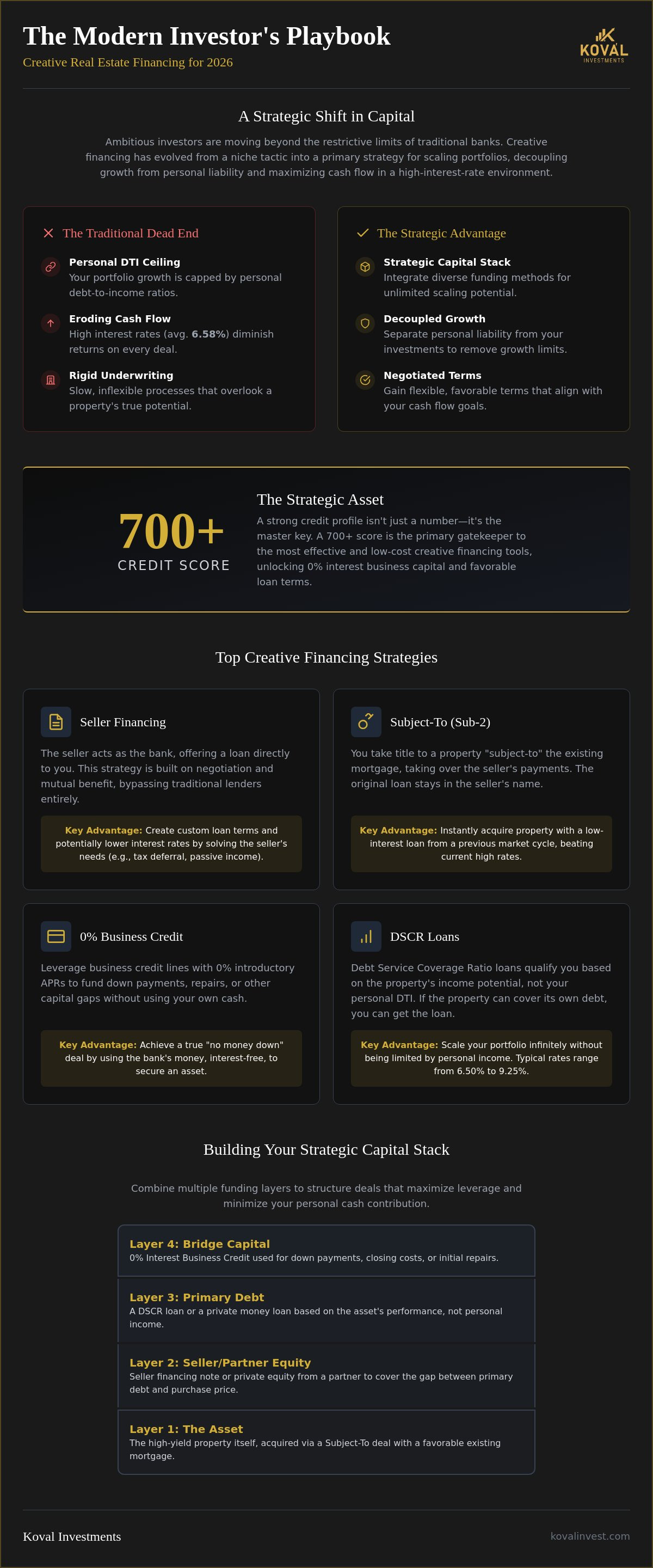
The year 2026 marks a significant transition in how these tools are utilized. In previous market cycles, creative funding was often seen as a last resort for those who couldn't qualify for a bank loan. Today, it's a sophisticated choice for high-net-worth individuals and scaling entrepreneurs. We're seeing a definitive shift from desperation-based deals to strategic capital stacks. This means combining multiple layers of funding, such as seller notes, private equity, and business credit, to create a structure that out-earns a simple bank mortgage. The primary objective is to decouple your personal financial identity from your portfolio's growth, allowing for unlimited scaling potential.
The Evolution of Creative Real Estate Capital
We've moved past simple seller carry-backs. The modern investor uses multi-layered funding structures that often involve fintech platforms and alternative credit solutions. You've likely heard the phrase "no money down," but that's a common misnomer in the industry; every deal requires capital. The secret lies in ensuring it's none of your money down. By leveraging 0% interest business lines or strategic partnerships, you can cover the gap between a first mortgage and the purchase price without depleting your own savings or limiting your future borrowing power.
Why Investors are Shifting Strategies Now
The current interest rate environment makes traditional financing less attractive for long-term cash flow. With the average 30-year fixed mortgage rate at 6.58% as of July 2026, the spread on rental properties has tightened significantly. When you add the fact that the baseline conforming loan limit for one-unit properties has risen to $832,750, the barrier to entry for high-quality assets is higher than ever. Investors are shifting to creative financing for real estate investors because it allows them to bypass the rigid underwriting of banks that often ignore the actual income potential of a property. Using creative tools like Subject-To or DSCR loans, which typically range from 6.50% to 9.25%, allows for faster execution and more flexible terms that a traditional bank simply cannot match.
Top Creative Financing Strategies for Modern Portfolios
The transition from theory to execution requires a deep understanding of the legal and financial frameworks that govern non-traditional deals. For those utilizing creative financing for real estate investors, the primary goal is to solve a seller's problem while securing an asset with favorable terms. This might mean providing a steady stream of income to a retiring landlord through seller financing or helping a distressed homeowner avoid foreclosure via a Subject-To acquisition. Unlike traditional bank loans, these methods are built on negotiation and mutual benefit rather than rigid algorithms.
Mastering Seller Financing and Subject-To
Seller financing allows you to act as the borrower while the seller acts as the bank. Success here depends on the "Note," which outlines the repayment terms, and the "Deed of Trust," which secures the property as collateral. Many investors hesitate due to the "Due on Sale" clause, a contractual provision that allows a lender to demand full payment if a property is transferred. In the 2026 market, banks rarely trigger this clause as long as payments remain consistent and the loan stays performing. When negotiating, focus on the seller's needs; perhaps they want to avoid a large tax hit or simply desire passive income without property management headaches.
Subject-To (Sub-2) involves taking over the seller's existing mortgage payments while the deed transfers to your name. It's a powerful tool when the existing interest rate is significantly lower than the current 2026 market average of 6.58%. It allows you to step into a low-interest loan without the need for a new bank application. If you find a deal that requires a small cash injection to catch up on arrears, utilizing a 0% interest funding solution can be an effective way to bridge that gap without using your own capital.
Equity Sharing and Joint Venture Partnerships
While debt-based strategies are common, equity sharing allows you to scale by trading a portion of the property's future upside for immediate capital. Joint venture partnerships are ideal for investors who have the "deal flow" but lack the liquid cash for renovations or down payments. The key is to structure the agreement so you retain management control while the "silent" partner provides the capital. This is the foundation of the BRRRR method 2.0, where you use private money or hard money, currently ranging from 9% to 12% in 2026, to acquire and rehab, then transition into a creative exit that preserves your equity. This collaborative approach ensures that capital constraints never dictate the size of your portfolio.
The Strategic Advantage of Business Credit in Real Estate
One of the most effective ways to scale a portfolio is to stop acting like a consumer and start acting like a corporation. While many focus on finding the deal, the most successful practitioners of creative financing for real estate investors focus on the capital structure behind the deal. Decoupling your personal liability from your real estate portfolio isn't just about legal protection; it's about financial optimization. By building a robust business credit profile, you create a corporate identity that lenders often trust more than an individual. This transition allows you to access high-limit lines of credit that don't appear on your personal credit report, keeping your debt-to-income ratio clean for future traditional lending if needed.
Business credit acts as an "infinite" down payment source because it isn't tied to your personal income. Instead, it's based on the business's ability to manage debt. This allows you to bypass the restrictive underwriting that often stops individual investors after their third or fourth property. When your business has its own credit history, you can secure funding based on the strength of your corporate entity, providing a level of agility that your competitors likely lack.
Leveraging 0% APR Capital for Down Payments
The primary barrier to most deals is the 20-25% down payment requirement. Using 0% interest business funding provides a strategic "gap filler" that allows you to close deals without depleting your cash reserves. This creates a "Zero-Cost" acquisition model when you stack these unsecured business lines with seller financing. For example, if a seller agrees to carry 80% of the purchase price, your business credit line covers the remaining 20%. You essentially acquire the asset with no personal cash out of pocket. Managing the velocity of money is the final step; you use the property’s cash flow to pay down the credit lines, effectively recycling that capital for your next acquisition.
Building a Fundable Entity for Your REI Business
Lenders don't just look at a score; they look at the entity's "fundability." This process begins with a few essential steps to establish your corporate presence:
- Form an LLC and obtain a federal EIN.
- Set up a D-U-N-S number through Dun & Bradstreet.
- Establish a business address and dedicated phone line.
- Open a business checking account to separate all transaction data.
From there, you move through a credit tier system, starting with vendor credit and progressing to high-limit cash lines. A well-structured REI business needs its own working capital funding solutions to handle unexpected repairs or bridge the time between a purchase and a refinance. By establishing this foundation, you ensure your business remains a steady, reliable partner in any market cycle. This methodical approach builds trust incrementally with lenders, moving you from a distant service seeker to a seasoned strategic partner.
Overcoming the #1 Barrier: Credit Health and Qualification
A common misconception about creative financing for real estate investors is that it serves as a safety net for those with poor credit. While some strategies like seller financing allow for more flexibility, the most aggressive and profitable tools are reserved for those with a solid financial foundation. In the 2026 market, your personal credit score remains the primary trust signal for lenders, even when you're borrowing through a corporate entity. The personal guarantor is the anchor of the deal. Without a clean profile, you'll find yourself locked out of 0% interest lines and high-leverage bridge loans that make the "none of your own money down" model possible.
Aiming for a 700+ score isn't just about vanity; it's about unlocking capital at the lowest possible cost. When your score sits below this threshold, you're often forced into high-interest hard money loans, which currently range from 9% to 12%. This eats into your cash flow and reduces your margin for error. Additionally, errors on your report can specifically block your path to SBA loan assistance, which is a critical tool for investors looking to acquire mixed-use properties or storage facilities. Speed is the currency of the modern market, and professional credit restoration ensures you're ready to move when a deal surfaces, rather than waiting months for a DIY dispute process to show results.
Fixing Credit for High-Limit Access
The most frequent "credit killer" for active investors is high revolving utilization. When you use personal cards to fund a renovation or a down payment, your score can drop 50 to 100 points overnight, even if you never miss a payment. This creates a paradox where your investment activity actually blocks you from future funding. Following a structured business credit repair services roadmap allows you to identify and dispute inaccuracies while strategically shifting debt from your personal profile to your business entity. This rapid optimization is what allows for the "infinite" scaling discussed in previous sections.
Strategic Capital Procurement vs. Passive Searching
Success in creative financing for real estate investors requires a shift in mindset from "asking for a loan" to "procuring capital." This is a professional business activity that involves preparing a comprehensive financial package for private lenders and partners. This package should include your optimized credit profile, a track record of property performance, and a clear exit strategy. Professional consulting plays a vital role here, especially when valuing your REI business for potential acquisitions or mergers. By treating capital procurement as a core operation, you move from a passive seeker to a seasoned strategic partner that lenders want to work with. If you're ready to stabilize your foundation and access higher limits, you can start your credit optimization journey today.
How to Build Your Creative Capital Stack with Koval Investments
Building a scalable portfolio in 2026 requires more than just finding a good deal; it requires a sophisticated approach to capital. Many investors find themselves stuck in a cycle of "deal chasing" without a clear strategy for the capital behind those acquisitions. Identifying the gaps in your current strategy is the first step toward true financial agility. Whether you're hitting debt-to-income limits or struggling to find the 20% down payment for a high-value asset, the solution lies in a multi-layered capital stack that combines credit optimization with high-limit funding. This isn't a one-size-fits-all process. Effective funding for real estate investors requires a bespoke plan that accounts for your specific growth objectives and current financial standing.
The Koval approach is built on the principle of alignment. We act as your seasoned strategic partner, moving beyond the role of a distant service provider to navigate the complexities of the 2026 financial landscape alongside you. Our process starts with stabilizing your foundation through credit restoration and progresses toward the deployment of 0% interest capital. This methodical progression ensures that you don't just get funded once, but that you build a sustainable machine for continuous acquisition.
The 0% Interest Funding Solution for REI
Our 0% interest funding solution is designed to act as the perfect "gap filler" for real estate transactions. Koval facilitates access to unsecured business lines of credit that can be used for property deposits, earnest money, or renovation costs. This strategy is rooted in our success-based philosophy. We focus on win-win engagements where our goals are directly aligned with your portfolio growth. Because these lines are unsecured and often carry 0% introductory rates, they represent a low-pressure way to bridge the capital gap without high-interest debt eating your cash flow.
Consider a recent scenario where an investor used this stack to secure a multifamily deal. The seller was willing to finance 80% of the purchase price but required a 20% cash deposit. By utilizing $150,000 in 0% interest business credit lines procured through our system, the investor closed the deal with zero personal cash out of pocket. The property's existing cash flow was then used to pay down the credit lines during the introductory period, effectively creating a self-funding acquisition model.
Securing Your Financial Foundation
As you move from individual properties to larger portfolios, professional business valuation becomes a critical tool for scaling. Understanding the true value of your REI company allows you to leverage your existing equity for even larger acquisitions or mergers. We provide consulting for mergers and acquisitions, helping you identify and buy out other investors' portfolios to accelerate your growth. This high-level financial strategy ensures that your business remains a steady hand, even in shifting markets. If you're ready to stop hitting ceilings and start scaling with precision, the next step is a clear, actionable plan. Schedule your strategic funding consultation today and let's build your creative capital stack together.
Scaling Your Portfolio Beyond Traditional Limits
Transitioning from a traditional borrowing mindset to a strategic capital procurement model is the defining shift for successful investors in 2026. By decoupling your personal liability from your acquisitions and leveraging optimized credit profiles, you transform creative financing for real estate investors from a survival tactic into a sustainable growth engine. We've explored how building a fundable business entity and utilizing 0% interest "gap fillers" allows you to close deals that once seemed out of reach due to high interest rates or restrictive bank underwriting.
At Koval Investments, we operate with a success-based funding philosophy, ensuring our objectives are perfectly aligned with your long-term progress. We provide national coverage for US investors, offering deep expertise in 0% interest capital procurement to help you maintain momentum in any market cycle. Your next acquisition shouldn't be stalled by rigid institutional red tape. It's time to build a capital stack that respects your ambitions and provides the agility needed to capture high-yield opportunities as they arise.
Secure your 0% interest funding for your next real estate deal today with Koval Investments. We're ready to act as your steady partner in navigating these complex financial landscapes and ensuring your portfolio continues to scale without limits.
Frequently Asked Questions
Is creative financing legal in real estate?
Yes, creative financing is entirely legal when it's documented through proper legal instruments such as promissory notes and deeds of trust. These strategies involve standard contract law and real estate regulations that allow parties to negotiate their own terms. It's essential to work with a real estate attorney to ensure all disclosures and filings comply with local and federal laws.
How can I buy a house with 0% interest?
Buying a property with 0% interest typically involves using introductory business credit lines to cover the acquisition costs or the down payment. While a traditional mortgage currently averages 6.58% for a 30-year fixed rate, you can use 0% interest funding solutions to bridge the cash gap. This allows you to acquire the asset without the immediate burden of high interest on your initial capital injection.
Can I use business credit for a real estate down payment?
You can use unsecured business credit lines to fund a real estate down payment if your business entity is structured correctly. This is a primary strategy in creative financing for real estate investors who want to preserve their personal liquidity. By leveraging the creditworthiness of your LLC, you can meet the 20% to 25% deposit requirements without depleting your personal savings.
What is the 'Subject-To' method in real estate?
The 'Subject-To' method involves a buyer taking over the seller's existing mortgage payments while the deed transfers into the buyer's name. The buyer doesn't formally assume the loan; instead, the loan stays in the seller's name while the buyer takes ownership. This is a powerful way to secure properties at lower interest rates that were locked in before the current market increases.
Do I need a high credit score for creative financing?
While some strategies like seller financing are flexible, you generally need a 700+ credit score to unlock the most aggressive funding tools. High-limit business lines and 0% interest capital procurement usually require a solid personal guarantor. If your score is currently lower, prioritizing credit repair services is the most effective way to gain access to these sophisticated capital stacks.
How does seller financing work for the buyer?
In a seller financing arrangement, the buyer makes monthly principal and interest payments directly to the property owner instead of an institutional bank. The seller acts as the lender, and both parties negotiate the interest rate, down payment, and repayment schedule. This often results in faster closing times and more flexible underwriting than a traditional bank would allow.
What are the risks of creative financing?
The primary risks include the "due on sale" clause in Subject-To transactions and the high cost of capital associated with hard money loans. Hard money rates in 2026 can range from 9% to 12%, which can erode cash flow if you don't have a fast exit strategy. Proper legal documentation and a clear refinance plan are necessary to mitigate these financial risks.
Can SBA loans be used for real estate investment?
SBA loans are available for real estate, but the business must generally occupy at least 51% of the property. This makes them an excellent tool for mixed-use assets or owner-occupied commercial buildings rather than passive residential rentals. They offer competitive terms for investors who are scaling a business that requires physical operational space.