
Dispute Business Credit Errors: 2026 Capital Access Guide
An invisible error on your business credit report is effectively a tax on your growth, siphoning away capital through inflated interest rates you didn't earn. It's a common frustration for many entrepreneurs who realize, often too late, that a single reporting glitch is blocking their access to 0% interest business funding. You've worked hard to build your company, so it's only fair that your credit profile reflects that dedication accurately. Dealing with automated bureau systems can feel like a secondary job, but it's a necessary step to protect your bottom line and ensure your capital works as hard as you do.
This guide provides the exact roadmap to reclaim your financial standing. You'll learn the precise steps for how to dispute business credit report errors to remove the inaccuracies that inflate your costs. By cleaning your profile, you can secure lower interest rates on SBA 7(a) loans and real estate capital while opening doors to elite 0% interest funding solutions. We'll walk through the 2026 protocols for major bureaus and the strategic steps required to build a fundable credit profile. This methodical approach ensures your business is positioned for long term expansion and sustainable success.
Key Takeaways
- Recognize how outdated balances and mixed files create a "cliff effect" that triggers significantly higher interest rates on your business debt.
- Follow a structured framework for how to dispute business credit report errors to ensure your profile is accurate across Experian, Equifax, and TransUnion.
- Calculate the specific opportunity cost of credit inaccuracies, such as the massive difference in interest payments on long-term SBA or real estate loans.
- Leverage your restored credit profile to unlock the 0% Interest Funding Solution, turning your financial reputation into a strategic growth tool.
- Shift your focus from simple credit repair to long-term capital access by positioning your business as a low-risk candidate for elite funding.
The Hidden Tax: Why Credit Report Errors Are a Strategic Threat
When a lender reviews your file, they aren't looking for the story of your hard work; they're looking at a data set. If that data is flawed, you pay a "hidden tax" on every dollar your company borrows. This tax doesn't show up on a balance sheet, but it manifests as higher monthly payments and tighter cash flow. Errors like outdated balances or incorrectly reported credit limits make your business look over-leveraged. Risk-based pricing is the automated mechanism lenders use to assign interest rates and terms based on the perceived risk of a credit profile, often penalizing businesses for errors beyond their control.
The psychological toll on a founder is just as damaging as the financial one. When you receive a high-rate quote because of an invisible reporting mistake, it often discourages expansion. You might delay a critical hire or skip a real estate opportunity because the "math doesn't work," unaware that the math is based on fiction. This hesitation creates a stagnation that can be difficult to reverse, especially when competitors with cleaner profiles are moving faster with cheaper capital.
Common Errors Haunting Modern Business Owners
Credit bureaus handle massive volumes of data, and mistakes are systemic. Identifying these issues is the first step toward reclaiming your capital. Common inaccuracies include:
- Incorrectly reported late payments: Payments marked as delinquent on accounts that are actually current or were paid within the grace period.
- Duplicate debts: The same liability appearing twice, which artificially inflates your debt-to-income (DTI) ratio and lowers your score.
- Satisfied liens: Public records that have been resolved but still appear as active, signaling high risk to potential lenders.
- Mixed files: Data from a business with a similar name being merged into your report, often bringing their negative history with it.
The Personal and Business Credit Intersection
In the current 2026 lending environment, the line between personal and business credit remains thin. Most unsecured business funding still requires a Personal Guarantee, meaning an error on your consumer report can disqualify you from a 0% interest business line. While the Fair Credit Reporting Act (FCRA) provides a legal framework for consumer protections, business credit requires a more strategic approach to restoration.
Understanding how to dispute business credit report errors is essential because a clean profile is the foundation for elite capital. Professional credit repair services must address the total financial profile, ensuring both personal and commercial data are optimized. This holistic view is what allows a business to transition from high-interest survival to low-interest scaling. By cleaning up the intersection of these two profiles, you create a fundable entity that is ready for the 0% Interest Funding Solution.
The Mechanics of Risk-Based Pricing: How Errors Inflate Rates
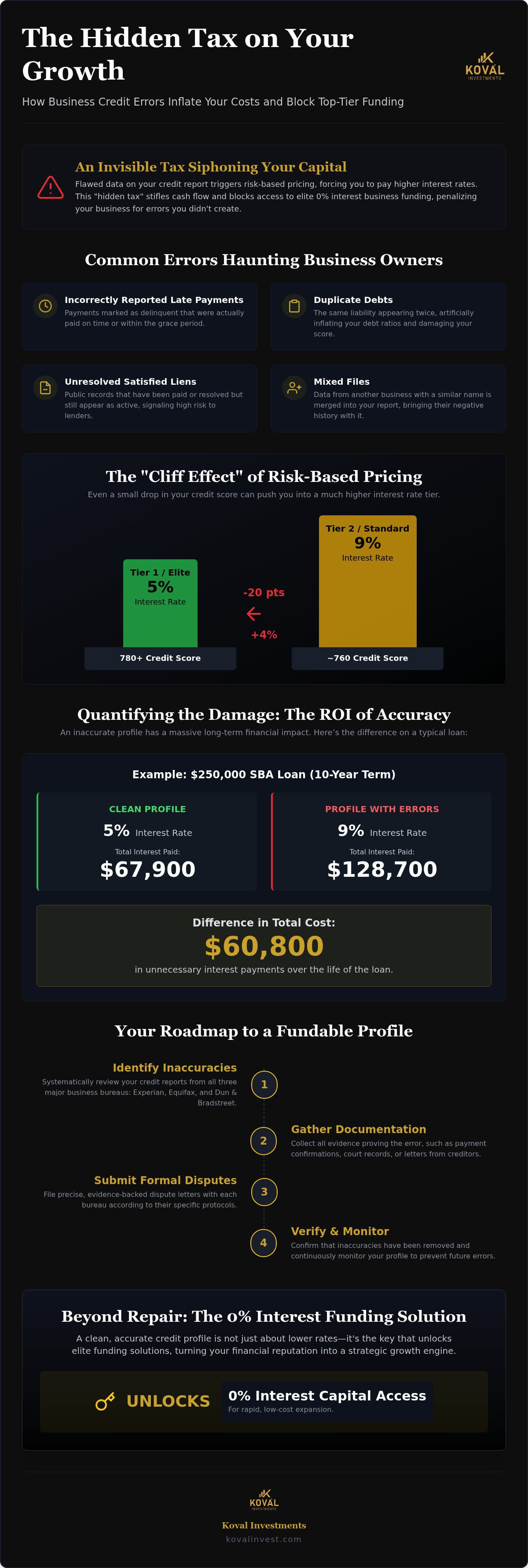
Lenders in 2026 rely heavily on automated underwriting to categorize applicants instantly. These algorithms don't account for the context of your business; they simply sort your profile into pricing buckets based on data points. When errors exist in your file, you're often subjected to the "Cliff Effect." This describes a scenario where a marginal 20-point score drop triggers a disproportionate 4% interest rate hike. Beyond the cost of capital, these inaccuracies lead to shorter repayment windows and higher collateral requirements that can stifle your operational flexibility. A single "30-day late" error on your report can instantly disqualify you from the 0% APR introductory periods essential for low-cost scaling.
Understanding Tiered Pricing Buckets
The 2026 market differentiates sharply between Tier 1 (Elite) and Tier 2 (Standard) thresholds. When reporting errors push a Prime borrower into Alternative or Hard Money categories, the financial impact is immediate. You aren't just paying more interest; you're losing the ability to reinvest that cash into inventory or headcount. This compounding effect on monthly business cash flow creates a widening gap between your company and competitors who maintain pristine profiles. Learning how to dispute business credit report errors is not just about administrative cleanup; it's a capital preservation strategy that keeps you in the elite tier where the most favorable terms reside.
The Role of Debt-to-Income (DTI) Ratios
Inaccuracies often manifest as incorrectly reported credit limits, which make your business look significantly more over-leveraged than it is. If a lender perceives your utilization is near its max because a bureau failed to update a limit increase, your global cash flow analysis will look weak. This perceived risk prevents you from accessing the best rates for SBA loans or real estate capital. Following a formal process for disputing errors on credit reports ensures your DTI reflects reality. Accuracy is the foundational first step in exploring alternative business funding solutions that bypass traditional bank hurdles. Our team at Koval Investments acts as a strategic advisor to help you navigate these complexities and ensure your financial profile aligns with your growth ambitions.
Quantifying the Damage: The Long-Term ROI of Accuracy
Financial inaccuracies represent a tangible leak in your company’s profitability. When you understand how to dispute business credit report errors, you aren't just performing administrative cleanup; you're engaging in high-level capital preservation. Consider a $500k loan structured over ten years. A business with an elite profile might secure a 7.5% rate, while a company plagued by reporting errors could be forced into an 11.5% rate. This four-point spread isn't just a number. It represents a massive diversion of cash flow that could have been used for strategic expansion. A $2,000 monthly interest overpayment equals $240,000 in lost growth capital over a decade.
The opportunity cost of this lost capital is staggering. That monthly overpayment could fund a senior manager's salary or a robust quarterly marketing campaign. Beyond the immediate cash flow impact, these errors directly depress your business valuation. Since valuation is typically a multiple of net income, every dollar wasted on unnecessary interest reduces your company’s total worth. Accuracy ensures your financial statements reflect your true operational efficiency rather than the cost of bureau negligence.
Impact on SBA Loan Approval and Rates
Reporting errors act as immediate red flags during the SBA loan assistance process. Lenders rely heavily on the FICO SBSS score, which pulls data from both personal and business reports, to determine 7(a) eligibility. If your score falls below current 2026 thresholds due to inaccuracies, your application might be rejected before a human even reviews it. Fixing these errors is significantly cheaper than paying the "risk premium" often attached to government-backed loans with sub-optimal scores.
The Real Estate Investor Perspective
For those in property acquisition, credit accuracy is the difference between a deal closing or collapsing. Errors can negatively impact your Debt Service Coverage Ratio (DSCR), making it harder to qualify for specialized investor loans. High bridge loan rates caused by a low score can eat your entire profit margin during the renovation phase. Utilizing a resource like an FTC sample dispute letter is a practical first step toward optimization. Once your profile is clean, you can access the best funding for real estate investors, ensuring your capital stack is as efficient as your property management.
A Strategic Framework for Identifying and Disputing Inaccuracies
Transitioning from a penalized profile to a fundable one requires more than just identifying mistakes. It demands a methodical execution that aligns with how bureaus process data. Understanding how to dispute business credit report errors starts with a comprehensive audit. You can't rely on a single report; you must conduct a tri-merge audit across Experian, Equifax, and TransUnion. Errors are rarely uniform. An outdated balance on one report might be correctly listed on another, but lenders often pull from the lowest common denominator. Identifying these discrepancies across all three platforms ensures no bureau remains a weak link in your capital search.
Once you've identified the errors, the second step is gathering objective evidence. Automated systems prioritize documentation over narrative. Letters of Satisfaction from creditors and certified bank statements serve as the gold standard for evidence. In the third step, you should prioritize "low-hanging fruit" like incorrect addresses or business names before tackling complex payment history disputes. This builds initial score momentum. Finally, time your funding re-applications to align with bureau update cycles, which typically occur every 30 to 45 days. This ensures lenders see your optimized profile at the exact moment it reflects your true creditworthiness.
The Professional Advantage in Credit Restoration
In the 2026 credit landscape, bureaus use advanced AI filters to manage the surge in dispute volume. Generic, automated template disputes are frequently flagged as frivolous and ignored. This is where professional business credit repair services provide a distinct advantage. Experts understand how to navigate the nuances of the FCRA while leveraging "Creditor Direct" disputes. By going directly to the information furnisher, you can often secure corrections faster than waiting for a bureau investigation to conclude. This collaborative approach removes the friction from the restoration process.
Common Pitfalls to Avoid
Many entrepreneurs fall into the "dispute all" trap, where they challenge every negative item regardless of its accuracy. This approach often triggers a blanket rejection from the bureau. Another critical error is closing old accounts during the cleanup phase. While an account might have a past error, its age is a vital component of your score; closing it can inadvertently lower your rating. Maintain a meticulous paper trail of every communication. This documentation is essential if you need to request a manual lender reconsideration after your profile is restored. If you're ready to move beyond generic advice and secure a fundable profile, consult with a strategic advisor at Koval Investments to explore our success-based solutions.
Beyond Repair: Optimizing Your Profile for 0% Interest Funding
Achieving a clean credit report is a significant milestone, but it's only the baseline for true financial leverage. Once you've mastered how to dispute business credit report errors and removed the drag of inaccuracies, your focus must shift toward optimization. A profile that is merely "error-free" isn't necessarily "funding-ready" in the eyes of elite lenders. Transitioning to a fundable status involves strategically managing your credit utilization and ensuring your reporting tradelines align with the specific requirements of 0% APR lenders. This proactive approach transforms your credit from a defensive necessity into an offensive tool for business expansion.
While the initial goal is often simply to fix a mistake, learning how to dispute business credit report errors effectively is actually the first step in a much larger strategic play for capital access. The logic of the 0% Interest Funding Solution is built on the principle of institutional trust. When your profile is pristine, you can access unsecured business lines of credit that offer interest-free capital for 12 to 22 months. This allows you to deploy capital into high-ROI activities, such as inventory or marketing, without the immediate burden of debt service or interest payments.
The Path to 0% Interest Business Funding
To qualify for elite 0% APR business lines, your profile must meet specific criteria regarding score thresholds, account age, and recent inquiry volume. Leveraging a cleaned profile for working capital without collateral is the most efficient way to scale in the current market. This funding doesn't require personal assets as security, provided your business and personal credit scores are optimized. For a detailed breakdown of these requirements, you can explore the ultimate guide to 0% interest business funding in 2026.
Koval Investments: Your Strategic Growth Partner
At Koval Investments, we don't view credit restoration as a detached, institutional service. Instead, we see it as a collaborative venture. We're committed to identifying the specific inaccuracies that stand between you and your capital. Our win-win philosophy is the core of our brand; we succeed only when you secure the funding required to meet your objectives. This success-based approach ensures that we remain as invested in your results as you are.
The next step in your growth journey is to align your financial profile with your 2026 expansion goals. We invite you to schedule a professional financial profile audit with our team. During this consultation, we'll review your current standing and map out a precise path to secure the funding your business deserves. Let's work together to turn your credit profile into a strategic asset that fuels your long-term success.
Securing Your Business Legacy Through Financial Accuracy
Reclaiming your credit profile is a strategic necessity for any founder aiming for 2026 expansion. We've explored how inaccuracies act as a silent drain on your cash flow and how automated pricing buckets can penalize your hard work. By mastering how to dispute business credit report errors, you move beyond mere repair and begin the process of true optimization. This clarity allows you to qualify for lower rates on SBA 7(a) loans and prepares you for interest-free capital solutions.
Koval Investments provides the nationwide strategic advisory and expertise in capital procurement needed to navigate these complex financial landscapes. Our success-based credit restoration results are designed for high-growth founders and real estate investors who value precision and long-term results. We're ready to act as your steady hand in this process, ensuring your path to funding remains clear and predictable. Optimize your credit profile and unlock 0% interest funding with Koval Investments today.
Your vision deserves a financial foundation that supports growth rather than hindering it. We look forward to building that future alongside you.
Frequently Asked Questions
How long does it take for business credit report errors to be corrected?
Most business credit bureaus investigate and resolve disputes within 30 days. However, the total timeline often depends on how quickly the original information furnisher responds to the bureau's inquiry. If you're learning how to dispute business credit report errors for a pending loan, it's best to start the process at least 45 days before applying. This buffer allows for the update to reflect across all major reporting agencies.
Can a single error cause a loan denial for an established business?
Yes, a single major error can trigger an automatic denial even for a highly successful business. Automated underwriting systems often use "hard stops" for specific negative indicators, such as a tax lien that's actually been satisfied or a 60-day late payment that never occurred. If an error drops your score below a lender's minimum threshold, the system will reject the application before a human underwriter ever sees your actual revenue.
Is it better to fix credit errors myself or hire a professional service?
While you can manage the process yourself, professional services offer a strategic advantage in navigating complex bureau filters. Many entrepreneurs who try the DIY route inadvertently trigger "frivolous" designations by using generic templates found online. A professional firm uses a success-based approach to ensure disputes are documented correctly. This partnership allows you to focus on operations while experts handle the technical nuances of financial profile optimization.
What is the most common error on business credit reports in 2026?
Outdated account balances and mixed files are the most frequent inaccuracies seen in 2026. A mixed file occurs when data from a business with a similar name is incorrectly merged into your report. Additionally, many creditors fail to update "paid in full" status promptly. These errors make your business appear more leveraged than it is, which directly impacts your debt-to-income ratio and your eligibility for 0% interest funding.
How much can I save on an SBA loan by fixing my credit score errors?
Savings on an SBA 7(a) loan can reach tens of thousands of dollars over the life of the loan. By correcting errors and improving your FICO SBSS score, you can often move from a standard interest rate to a preferred rate. A one or two percent reduction in interest on a large working capital loan significantly lowers your monthly debt service. This increased cash flow can then be reinvested into your company's long-term growth.
Will disputing an error temporarily lower my business credit score?
Disputing an error doesn't lower your business credit score. In fact, the bureaus often temporarily suppress the negative data point while it's under investigation. This means your score might actually see a slight temporary increase during the 30-day window. Once the error is permanently removed, your score will adjust to reflect your true creditworthiness. It's a risk-free step toward building a more fundable and transparent financial profile for your enterprise.
What should I do if a credit bureau refuses to remove an obvious error?
If a bureau refuses to correct an error, you should immediately contact the original information furnisher. Request a "Letter of Satisfaction" or a formal correction notice from the creditor's management. Providing this direct evidence back to the bureau's compliance department often breaks the stalemate. If the bureau remains unresponsive, engaging a strategic advisor can help you navigate the escalation process and ensure your rights to an accurate report are respected.
How do I know if my interest rate was affected by a specific report error?
Lenders are required to provide an adverse action notice if they deny your application or offer less favorable terms based on your credit. This document lists the specific factors that influenced their decision. By reviewing these reasons, you can identify which reporting errors are driving up your costs. Understanding how to dispute business credit report errors allows you to address these specific red flags before your next capital procurement attempt.