
Exit Strategy Planning for Small Business: 2026 Guide
Your exit strategy isn't a sign that you're finished; it's actually the most powerful growth tool you have in your current arsenal. Many owners view exit strategy planning small business as a distant task for the twilight of their careers, but the most successful transitions are built years in advance. It's completely understandable if you feel uncertain about what your company is truly worth or worry about the complex due diligence process. You've poured years of effort into building a legacy, and the thought of a failed transition or a low valuation is a heavy burden to carry.
This 2026 guide is designed to replace that anxiety with a clear, professional roadmap for your eventual departure. We'll walk through how to maximize your company’s enterprise value and ensure a seamless transition to new ownership or management. You'll discover how professional business valuations and strategic M&A consulting can help you clean up the books and scale your value long before a sale occurs. By focusing on tangible financial success and operational efficiency today, you're securing a win-win outcome for your future self and the next generation of leadership.
Key Takeaways
- Effective exit strategy planning small business begins at least 24 months before a transition to ensure you maximize enterprise value and address operational gaps.
- Clean financial records and optimized EBITDA are the most critical factors in securing higher valuation multiples during the due diligence process.
- Choosing between strategic M&A and management buyouts requires an early assessment of your long-term financial goals and the legacy you wish to leave behind.
- Professional business valuations serve as the essential baseline for identifying the specific growth initiatives needed to improve your company's marketability.
- Improving both business and personal credit profiles before hitting the market significantly enhances the "sellability" and financial stability of your organization.
Beyond the Departure: Why Small Business Exit Strategy Planning Starts Today
A business exit strategy is far more than a simple contingency plan; it's a comprehensive roadmap that outlines how a founder will eventually transition ownership while protecting the company's legacy. For the 2026 founder, a professional exit strategy serves as a precision tool for value maximization that ensures long-term financial security through strategic growth. Most entrepreneurs wait until they feel ready to sell before they begin the process, but this is often the costliest mistake an owner can make. By the time you're tired or ready for a change, you've likely lost the window to fix operational inefficiencies that could have significantly boosted your valuation.
Effective exit strategy planning small business owners implement today creates a direct link to higher final sale multiples in the future. Buyers aren't just purchasing your past revenue; they're buying the future stability and growth potential of the enterprise. When you plan early, you have the time to clean up the books and demonstrate a track record of consistent, scalable performance. This preparation allows you to dictate the terms of your departure rather than being forced into a deal by external circumstances or burnout.
The Strategic Benefits of Early Planning
The most attractive businesses are those that don't rely entirely on the founder's daily involvement. Early planning helps you identify and reduce this operational dependency, making the company a turnkey asset for a potential buyer. It also gives you the space to spot value killers, such as high client concentration or aging technology, before they become deal-breakers during due diligence. This period of preparation ensures your personal financial goals remain perfectly aligned with the business’s trajectory, so the final payout actually meets your retirement or reinvestment needs.
Dispelling the "Exit Equals Failure" Myth
It's time to reframe the exit as a successful graduation rather than an end. A clear plan provides immediate security for your employees and stakeholders, as they'll know the business has a future beyond your tenure. This clarity fosters loyalty and maintains morale during what could otherwise be an uncertain time. From a psychological standpoint, having a documented strategy gives you a massive advantage; you'll negotiate from a position of calm preparation rather than desperation. You're not just leaving a job; you're successfully transitioning a valuable asset you built from the ground up.
Evaluating Your Exit Paths: From M&A to Management Buyouts
Choosing the right path isn't just about the highest price; it's about finding the best fit for your long-term goals. Successful exit strategy planning small business owners weigh several options to determine which transition offers the most stability. You might consider a "friendly sale" to a trusted employee or family member, which often preserves the company culture you've spent years building. Conversely, selling to a competitor might yield a higher valuation multiple, though it often comes with significant changes to your operational legacy. While liquidation is generally a last resort, it's sometimes the most practical choice for asset-heavy companies with low goodwill. In those cases, the focus shifts to minimizing losses and fulfilling all obligations efficiently.
Strategic Acquisitions and M&A
Strategic buyers value your business differently than financial buyers. While a financial buyer looks primarily at your cash flow, a strategic buyer looks for synergies that can expand their own market share or capabilities. This often results in a premium price for your enterprise. Engaging in mergers and acquisitions consulting is essential during this phase to help you navigate the intensive due diligence process. A professional advisor ensures your data is organized and your value proposition is clear, preventing potential deals from stalling due to lack of preparation.
Internal Transitions and Legacy
For many family-owned businesses, the goal is to keep the company in the hands of those who helped build it. Management buyouts (MBOs) and Employee Stock Ownership Plans (ESOPs) offer powerful, tax-advantaged ways to transition ownership while maintaining continuity. Succession planning for family enterprises requires a delicate balance of emotional and financial considerations. It's helpful to consult the SBA guide on selling your business to understand the legal frameworks involved in these transfers. Often, the incoming management team will utilize SBA loan assistance to fund the purchase, making the transition smoother for both parties. Starting with a professional business valuation allows you to see which of these paths is most financially viable for your specific situation.
Maximizing Enterprise Value: The Role of Financial Optimization
Many owners focus solely on top-line revenue, but sophisticated buyers prioritize the quality of your earnings. Clean financials are the bedrock of any successful exit strategy planning small business owners undertake. When your books are professional and transparent, you drive higher valuation multiples by reducing the perceived risk for the buyer. Most transitions hinge on EBITDA, which measures your core operational profitability; if your personal expenses are tangled with business accounts, you're likely leaving money on the table. Professionalizing these records years in advance allows you to demonstrate a track record of consistent, verifiable success.
Your company's "sellability" also depends heavily on its corporate credit profile. A strong credit score proves that the business is a stable, low-risk entity capable of securing its own financing. If your profile has been neglected, utilizing business credit repair services can resolve discrepancies and strengthen your financial standing before you hit the market. This preparation ensures that when a buyer conducts due diligence, they see a lean organization with a healthy balance sheet rather than a liability.
Professional Business Valuations as a Benchmark
An objective business valuation is the essential starting point for your roadmap. It's vital to understand the distinction between book value, which is based on assets and liabilities, and market value, which reflects what similar companies are currently commanding. Intrinsic value goes even deeper by calculating the present value of your future cash flows. When developing a business exit plan, remember that valuation is a dynamic metric that fluctuates with market trends and operational improvements, not a static number written in stone. Using this benchmark helps you identify exactly where the "value gaps" exist in your current model.
Strategic Capital Infusion Before Sale
You can fuel a significant "pre-exit growth spurt" by leveraging 0% interest business funding to modernize your operations. This capital allows you to upgrade outdated equipment or integrate new technology without eating into your cash reserves. Improving your margins through debt restructuring and credit optimization makes the business more attractive to financial buyers. By demonstrating scalability through recent successful capital projects, you prove to potential owners that the business has plenty of room to grow under new leadership, which directly translates to a higher final purchase price.
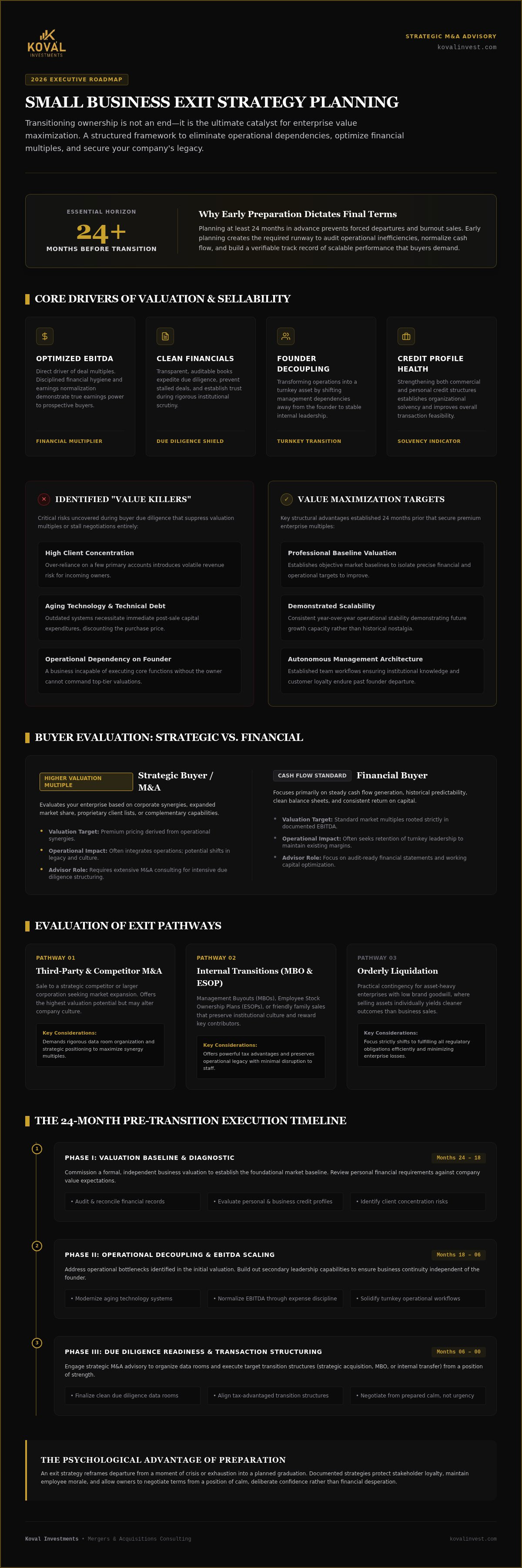
The 24-Month Roadmap: Preparing for a Seamless Transition
A common misconception in the small business world is that you can prepare for a sale in just a few months. In reality, maximizing your return requires a deliberate, multi-year approach. Successful exit strategy planning small business owners use a 24-month roadmap to ensure every operational and financial detail is polished before the first offer arrives. This timeline allows you to move beyond reactionary fixes and toward strategic value creation.
- Phase 1 (Months 1-6): This period focuses on the initial professional valuation and a deep dive into operational gaps. You'll identify why the business might be worth less than you hope and create a list of "value drivers" to improve.
- Phase 2 (Months 7-12): This is the time for financial cleanup and strategic growth. You'll implement the credit optimization and funding strategies discussed earlier to show a clear upward trend in profitability and EBITDA.
- Phase 3 (Months 13-18): Focus shifts to market positioning. You'll work with advisors to identify potential strategic or financial buyers and prepare your confidential information memorandum to highlight the company's future potential.
- Phase 4 (Months 19-24): The final stage involves active negotiation, due diligence, and closing the deal. This is where your previous 18 months of hard work pay off in a smoother, faster transaction with fewer surprises.
Financial and Operational Cleanup
Buyers look for turnkey operations. If your business relies on your personal presence for daily decisions, it's inherently less valuable to an outsider. You must standardize your operating procedures (SOPs) so the company runs smoothly without you. Additionally, you'll need to separate personal and business expenses completely to provide a clear financial picture. Any lingering legal or tax issues should be resolved now; finding these during due diligence often leads to price chipping or a cancelled deal. If you're ready to start this process, you can schedule a professional business valuation to see exactly where you stand today.
Building the Transition Team
You shouldn't manage this complex process alone. A high-quality transition team typically includes M&A advisors, CPAs, and legal counsel who specialize in business transfers. These professionals help you maintain strict confidentiality, which is vital to prevent employee turnover or competitor interference during the sale. You'll also want to consider stay-bonuses or other incentives for key employees. Keeping your core team intact through the transition preserves the enterprise value and reassures the buyer that the business's success will continue long after you've moved on to your next chapter.
Strategic Advisory for Your Next Chapter: How Koval Investments Facilitates Successful Exits
The exit strategy planning small business owners undertake requires more than just basic templates; it needs a steady hand and deep industry expertise. Koval Investments brings a success-based philosophy to every engagement, meaning our goals are perfectly aligned with yours from day one. We don't view our work as a distant service. Instead, we operate as a strategic partner in a collaborative venture where we only succeed when you achieve your desired outcome. This partnership ensures that every move we make is designed to maximize your final payout while protecting the legacy you've built.
Preparation often requires a strategic infusion of capital to fix operational gaps. We integrate alternative business funding solutions to help you optimize your company's financial profile before it reaches potential buyers. By utilizing these specialized tools, you can address inefficiencies without depleting your personal cash reserves. Our professional business valuations provide a grounded, realistic market perspective that moves beyond hopeful guesses. We focus on the practicalities of business advancement to ensure your enterprise is positioned for a win-win transition.
A Collaborative Approach to Valuation and Growth
We act as an "insider" mentor throughout the complex exit process, bridging the gap between high-level financial strategy and your day-to-day operational reality. Every small business owner has unique personal and financial goals, whether it's a quick sale for a new venture or a slow transition to family members. We tailor each plan to these specific ambitions, ensuring the transition feels like a logical progression. This methodical approach builds trust incrementally and guides you through the narrative of a successful sale with quiet confidence.
Getting Started with Your Exit Plan
There's no financial risk to starting this journey with our team. Our success-based model prioritizes your results above all else, reinforcing our commitment to delivering tangible value. As we move through 2026, the market for well-prepared small businesses remains highly competitive, making this the ideal year to evaluate your market position. A no-risk initial consultation allows us to align our objectives and determine the best path forward for your organization. Don't wait until you're forced to sell; take control of your timeline today. Schedule your professional business valuation with Koval Investments today to begin your journey toward a seamless and profitable exit.
Securing Your Future with Strategic Intent
Transitioning away from a business you've built is one of the most significant financial milestones of your career. It's not a process that should be left to chance or handled in a rush. We've explored how a proactive roadmap can transform your operations and how financial optimization directly impacts your final valuation multiple. By focusing on exit strategy planning small business owners can ensure their legacy remains intact while maximizing the enterprise value they've worked so hard to create. Whether you're considering a strategic acquisition or an internal transition, starting with a professional valuation is the only way to move forward with confidence.
Koval Investments offers a success-based advisory model led by an expert M&A and valuation team. We provide the strategic foundation you need, including access to specialized 0% interest funding solutions to optimize your profile before a sale. Secure Your Legacy with Professional Exit Strategy Planning from Koval Investments. Your next chapter is waiting, and with the right partner by your side, it can be your most rewarding one yet.
Frequently Asked Questions
What is the best exit strategy for a small business owner?
The best strategy depends on your specific financial goals and the legacy you wish to leave behind. For many, a strategic acquisition offers the highest valuation multiple, while a management buyout or succession plan preserves the existing culture. Effective exit strategy planning small business owners perform early allows for a tailored approach that balances immediate liquidity with the long-term stability of the organization. Each path has unique tax and legal implications that require professional guidance.
How long does it take to plan and execute a business exit?
A successful transition typically requires a 24-month preparation period. While the legal closing of a sale might take six months, the preceding 18 months are vital for financial cleanup and operational optimization. This timeline ensures you have enough history of clean books to justify your asking price. Rushing the process often leads to price chipping during due diligence or a complete failure to close the deal due to unaddressed risks.
How much does a professional business valuation cost?
Fees for a professional business valuation depend on the scope of the analysis and the complexity of your operations. A summary valuation might be sufficient for internal planning, but a comprehensive appraisal is often necessary for formal negotiations or tax purposes. Since this is a core service Koval Investments provides, we recommend a consultation to determine the specific needs of your business. This investment ensures you don't undervalue your life's work during negotiations.
Can I sell my business if I have poor credit?
You can sell a business with poor credit, but it often complicates the buyer's ability to secure financing. A weak corporate credit profile can signal operational instability to potential investors, leading to lower offers or more aggressive deal terms. It's often beneficial to utilize credit repair services to optimize your financial standing before you hit the market. This preparation builds trust and simplifies the transition for the incoming ownership team by proving financial reliability.
What is the difference between a strategic buyer and a financial buyer?
A strategic buyer is usually a competitor or a company in a related industry looking for synergies, such as a larger customer list or new technology. They often pay a premium because your business adds specific value to their existing operations. A financial buyer, such as a private equity group, focuses primarily on your cash flow and return on investment. They value the business as a standalone entity based on its current earnings and growth potential.
How do I keep the sale of my business confidential from employees?
Maintaining confidentiality is essential to prevent staff turnover or customer anxiety during a transition. You should work with a professional advisor who can market the business using a blind profile that doesn't reveal the company's name until a non-disclosure agreement is signed. Conducting meetings off-site and limiting the number of people who know about the potential sale helps protect the day-to-day stability of your operations until the deal is officially finalized.
What documents are required for business due diligence?
Buyers typically require three to five years of federal tax returns, year-to-date profit and loss statements, and current balance sheets. You'll also need to provide copies of all leases, customer contracts, and employee agreements. Standardizing your operating procedures (SOPs) is another critical step; documented workflows prove to the buyer that the business can function profitably without your constant involvement. Organized documentation is the absolute key to a smooth and fast due diligence process.
How can 0% interest funding help me sell my business for more?
Utilizing 0% interest funding allows you to modernize your business and address operational gaps without increasing your debt-to-income ratio. By upgrading equipment or technology just before a sale, you demonstrate a clear growth trajectory and scalability to potential buyers. This pre-exit growth spurt can significantly increase your valuation. It shows the next owner that the business is a contemporary, efficient asset ready for immediate expansion under their leadership without heavy initial capital requirements.