
Strategic Alternatives to Merchant Cash Advances for Business Growth in 2026
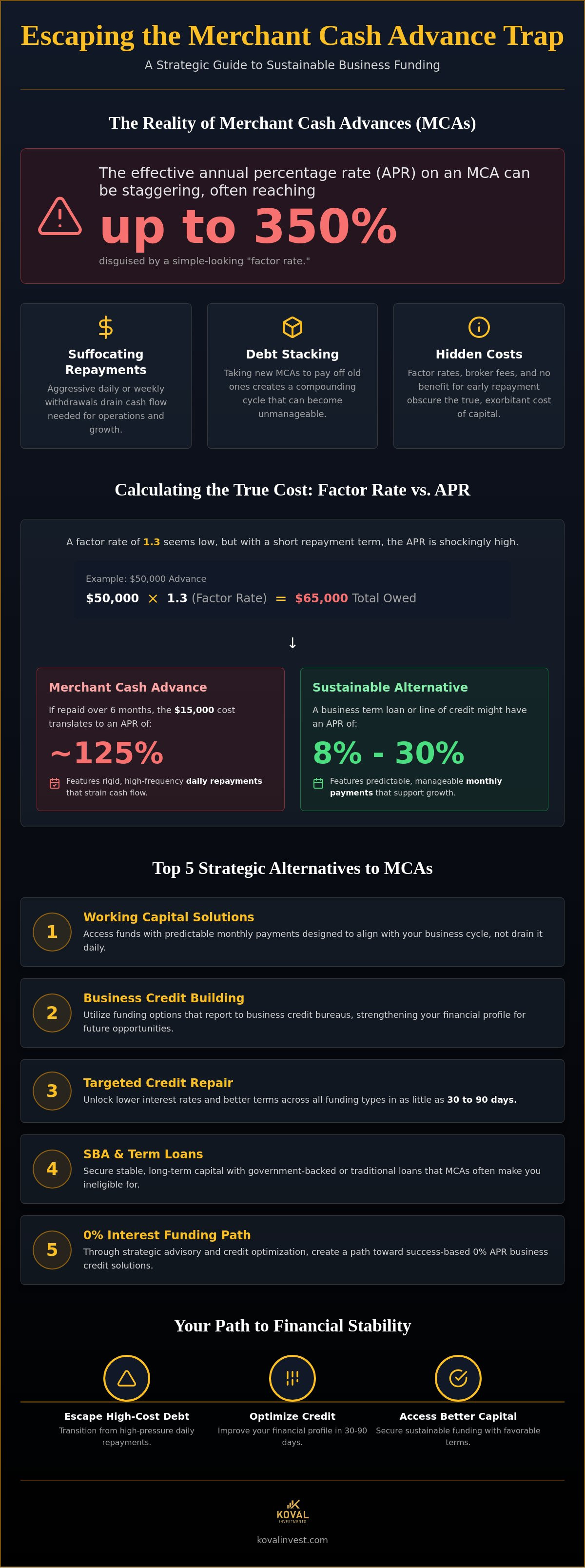
Did you know that the effective annual percentage rate on a merchant cash advance often climbs as high as 350%? While these products offer fast access to capital, the cost of that convenience frequently results in suffocating daily repayment schedules that stall your business growth. If you feel caught in a cycle of high-interest debt, it's time to shift your focus toward more sustainable alternatives to merchant cash advances. We understand the pressure of managing cash flow when traditional banks have turned you away due to credit issues or strict requirements.
This guide will show you how to escape predatory debt traps and access capital that actually works for your bottom line. You'll discover how to secure predictable monthly payments and significantly lower your overall cost of capital. We'll outline a clear path toward credit optimization and 0% interest funding solutions that prioritize your success. By the end of this article, you'll have a methodical framework to move away from high factor rates and toward a partnership that values your long-term stability.
Key Takeaways
- Learn how to translate complex factor rates into clear APR percentages to reveal the true cost of your current funding.
- Discover five strategic alternatives to merchant cash advances that build business credit while providing sustainable working capital.
- Understand how targeted credit repair services can unlock lower interest rates and more favorable terms in as little as 30 to 90 days.
- Transition from high-pressure daily repayment schedules to predictable monthly structures that support long-term operational growth.
- Explore a success-based path toward 0% interest funding through professional strategic advisory and credit optimization.
The Reality of Merchant Cash Advances in 2026
To understand the current funding landscape, we must first clarify what a merchant cash advance is. It isn't a loan in the traditional sense. Instead, it's a commercial transaction where a provider purchases a specific percentage of your future sales at a discount. Businesses often choose this route because the approval process is incredibly fast, requires no physical collateral, and remains accessible even for owners with lower credit scores. However, in 2026, the cost of these advances has reached new heights. With the Prime Rate sitting at 6.75% as of July, traditional borrowing costs have risen, and MCA providers have adjusted their factor rates upward to maintain their margins. This shift makes seeking alternatives to merchant cash advances a strategic necessity for any business focused on long-term health.
One of the most significant risks in the current market is "stacking." This occurs when a business owner, feeling the pressure of daily withdrawals from one advance, takes out a second or third to cover operational gaps. This creates a compounding debt cycle that can quickly become unmanageable. It's a situation that often leads to a total loss of control over cash flow, as a larger and larger portion of every sale goes toward servicing debt rather than growing the company.
Why Speed Often Comes with a Hidden Price
The psychological pressure of a cash flow gap can make speed feel like the only priority. When you need to meet payroll or secure inventory by Friday, a 24-hour approval is seductive. But capital speed often comes at the expense of capital quality. Because MCAs aren't classified as loans, they aren't subject to federal usury laws that cap interest rates. This regulatory gap allows effective APRs to soar into the triple digits. It's vital to step back and evaluate if the immediate relief is worth the long-term cost to your margins. Looking for alternatives to merchant cash advances allows you to find funding that offers a balance between speed and sustainability.
The Impact on Long-Term Business Valuation
Your funding choices today directly influence your company's worth tomorrow. High-interest debt and aggressive daily repayment schedules can significantly lower a professional business valuation by signaling financial instability to potential buyers or partners. These withdrawals drain the liquidity you need for operational agility and reinvestment in growth. From a lender's perspective, heavy MCA debt severely damages your debt-to-income ratio, which often disqualifies you from more favorable funding options. Specifically, the presence of multiple merchant cash advances can make a business ineligible for SBA loans because it demonstrates a reliance on high-cost, short-term debt that compromises the ability to meet long-term obligations.
Calculating the True Cost: Factor Rates vs. APR
Understanding the actual cost of capital requires looking past the simple decimal of a factor rate. A factor rate, typically ranging from 1.1 to 1.5, is a multiplier applied to the total funding amount. Unlike traditional interest that compounds on a declining balance, this fee is fixed from day one. If you receive $50,000 with a 1.3 factor rate, you owe $65,000 regardless of how quickly you pay it back. Because these advances are usually repaid in six to nine months, that $15,000 cost often translates to an APR well above 100%. This is why many owners seek alternatives to merchant cash advances that offer more transparent, interest-based structures.
Brokers often complicate these costs further through "buy-rates" and "sell-rates." The buy-rate is the actual cost from the funding source, while the sell-rate includes the broker's added commission. These undisclosed fees, combined with the lack of early repayment benefits, mean you gain no financial advantage by clearing the debt ahead of schedule. In a traditional loan, paying early saves you interest; in an MCA, you're usually locked into the full factor amount.
The Math Behind the Daily Withdrawal
Most MCA contracts require a fixed percentage of your daily credit card sales or a daily ACH draw from your bank account. While this sounds flexible, it can cripple a business during slow periods. Unlike working capital funding solutions that provide fixed monthly payments, daily draws drain your cash before you can cover essential overhead. The "reconciliation" process, which supposedly adjusts payments based on actual sales, is often difficult to trigger and rarely provides the relief owners expect during a seasonal dip.
Total Cost of Capital Comparison
Contrast a $50,000 MCA with SBA 7(a) loans. Over 12 months, an SBA loan at a 11% APR would cost roughly $3,000 in interest. The same $50,000 through an MCA with a 1.3 factor rate costs $15,000, plus origination and underwriting fees that can add another $2,500 to the total. Before signing any offer, use this checklist to spot hidden costs:
- Identify if an origination fee is deducted from the initial wire.
- Check if the contract allows for a "prepayment discount" or if the full factor is due.
- Verify the specific daily ACH amount versus the estimated percentage of sales.
Identifying these alternatives to merchant cash advances is the first step toward reclaiming your margins. If you're unsure how your current debt structure affects your bottom line, consulting with a strategic partner can provide the clarity needed to transition to lower-cost capital.
The Top 5 Strategic Alternatives to Merchant Cash Advances
Moving from survival-based debt to growth-oriented capital requires a shift in how you view your balance sheet. While an MCA provides a quick lump sum, these alternatives to merchant cash advances focus on building your business credit and preserving your cash flow. By selecting the right funding vehicle, you can treat capital as a strategic asset rather than a desperate remedy. These options don't just provide liquidity; they help you establish a track record that traditional banks respect, eventually lowering your cost of capital even further.
0% Interest Funding Solutions
One of the most effective ways to scale without debt pressure is through 0% interest business funding. This strategy involves accessing unsecured business lines of credit based on an optimized credit profile. These lines typically offer introductory periods ranging from 6 to 18 months, allowing you to deploy capital for inventory or marketing without any interest expense. It's a clean way to fuel growth while keeping your margins intact. Managing these accounts correctly also builds your business credit score, which is a significant advantage over MCAs that rarely report to credit bureaus.
SBA 7(a) and Express Loans
For businesses seeking long-term stability, SBA loan assistance remains the gold standard. The SBA 7(a) program offers some of the lowest interest rates in the market, with July 2026 rates for variable loans between 9.0% and 11.5%. If speed is your main concern, the SBA Express program offers a faster turnaround, with initial approval decisions often arriving within 36 to 72 hours. While these loans may require collateral, the extended repayment terms significantly reduce your monthly debt service compared to the aggressive daily draws of an advance.
Asset-Based Lending and Invoice Factoring
Asset-based lending allows you to leverage what your business already owns to secure better terms. Unlike an MCA, which bets on future sales, invoice factoring involves selling existing, verified invoices to a third party. This provides immediate cash flow based on work you've already completed. For those in the property sector, funding for real estate investors can unlock bridge capital using property equity as security. Using tangible assets like equipment or inventory as collateral typically results in interest rates that are a fraction of what you'd pay in a factor-rate agreement.
Term Loans and Business Lines of Credit
Traditional term loans from online lenders or community banks offer a middle ground between speed and cost. In mid-2026, these loans typically feature rates between 8% and 17.25%, with fixed monthly payments that allow for better financial planning. A revolving line of credit is equally valuable, as it gives you the flexibility to draw only what you need and only pay interest on the outstanding balance. These alternatives to merchant cash advances provide the operational agility you need without the risk of a debt spiral.
The Path to Lower Rates: Leveraging Credit Repair for Better Capital
Many business owners assume they are permanently locked into high-interest debt because of their credit history. This belief often leads them to overlook viable alternatives to merchant cash advances. In reality, your credit score is a dynamic asset that can be strategically optimized. By utilizing business credit repair services, you can often remove inaccuracies and boost your score within a 30 to 90 day window. This shift is critical in 2026, as lenders have tightened requirements following recent benchmark rate adjustments. A 50-point increase doesn't just look better on paper; it can save your business tens of thousands of dollars by qualifying you for prime-rate capital instead of triple-digit APR products.
Personal credit scores still play a heavy role in business funding limits. Most traditional lenders and SBA programs require a personal guarantor with a solid history to mitigate risk. When you improve your personal standing, you simultaneously unlock higher credit limits for your business. This creates a win-win scenario where you gain access to the liquidity you need while significantly reducing the interest you pay over the life of the funding.
Identifying and Disputing Credit Inaccuracies
Errors on business credit reports are more common than most realize. These often include incorrect NAICS codes, which can categorize your business as "high risk" without cause, or outdated balances that suggest higher debt-to-income ratios than actually exist. Identity errors or duplicate files can also suppress your score. Under the Fair Credit Reporting Act (FCRA), you have the legal right to challenge any data that is inaccurate, incomplete, or unverifiable. Correcting these items creates a cleaner profile just in time for your next funding application. It ensures you aren't paying a "bad credit tax" on your working capital.
Building a Robust Business Credit Profile
A strong profile goes beyond just removing negatives. It requires active cultivation of trade lines and a high D&B Paydex score. Establishing credit accounts with vendors who report to major bureaus is a foundational step in moving from subprime MCA eligibility to prime SBA eligibility. It's also vital to separate your personal and business credit. This protects your personal assets and allows your company to stand on its own financial merits. When your business has its own strong credit identity, your funding limits increase and your interest rates drop. This opens up sustainable alternatives to merchant cash advances that were previously out of reach. To begin your transition toward prime-rate funding, contact our advisory team for a comprehensive credit assessment.
Scaling Beyond Debt: Strategic Advisory and Long-Term Capital
Scaling your company requires moving past the mindset of "getting a loan" to a more sophisticated model of "procuring capital." This transition marks the difference between a business that simply survives and one that dominates its market. Identifying sustainable alternatives to merchant cash advances is just the first step in a larger financial evolution. At Koval Investments, we act as the bridge between the credit optimization discussed previously and the procurement of high-leverage capital. By treating capital as a strategic function, you ensure that every dollar brought into the company serves a specific growth objective rather than just plugging a hole.
When capital is procured strategically, it aligns with your long-term vision. This involves analyzing your current cash flow, identifying upcoming opportunities, and matching them with the most affordable funding source. Professional consulting helps you identify the right capital mix, whether that includes 0% interest lines for short-term needs or SBA loans for permanent expansion. This methodical approach ensures you aren't just trading one debt for another, but are instead building a ladder of increasingly affordable capital.
The Role of Capital Procurement Services
In the 2026 market, the sheer volume of lenders and funding products can be overwhelming for a busy owner. An advisor provides the necessary filter to identify the right capital mix for your specific goals. Our success-based philosophy ensures that our interests are perfectly aligned with yours; we only succeed when you secure the funding you need. This collaborative approach removes the financial risk of high-level consulting and replaces it with a partnership focused on tangible results. Strategic planning also plays a vital role here, as it allows us to forecast needs and prevents the need for emergency, high-cost funding during seasonal dips.
Preparing for Future Transitions
A clean financial profile and low-cost debt structure significantly increase your company's value for future transitions. Whether you are looking to exit through a sale or expand through mergers and acquisitions, your debt-to-income ratio is a primary metric that buyers examine. An annual business valuation is essential to track this health and ensure your growth remains on the right trajectory. With the right strategy, you can access capital for business expansion without sacrificing your hard-earned equity or depleting your operational cash flow. This long-term focus on alternatives to merchant cash advances builds a foundation of stability that supports your ambitions for years to come.
Take Control of Your Business Capital Strategy
The transition from high-interest debt traps to sustainable growth requires a deliberate shift in strategy. By translating factor rates into clear APR percentages and optimizing your credit profile, you position your business to access the most affordable capital in the 2026 market. Exploring alternatives to merchant cash advances allows you to preserve your margins and reinvest in the areas that truly drive value. Whether you are seeking SBA assistance or interest-free credit lines, the path to financial health is paved with transparency and professional alignment.
Koval Investments offers a boutique strategic advisory experience with a national reach, specializing in credit restoration and capital procurement. Our success-based funding philosophy ensures that we're as committed to your growth as you are. We bridge the gap between where your financials are today and where they need to be for long-term success. Secure your 0% interest funding solution with Koval Investments today and start building a more stable future for your company. You've built your business with hard work; let's ensure your capital works just as hard for you.
Frequently Asked Questions
What is the main difference between an MCA and a business loan?
An MCA is technically the sale of future credit card sales or bank deposits at a discount, whereas a business loan is a debt instrument involving principal and interest. Because an MCA is not classified as a loan, it lacks the federal usury protections and interest rate caps that govern traditional commercial lending. This distinction is why MCA providers use factor rates rather than APR to describe their costs, often resulting in much higher effective rates.
Can I qualify for an alternative to an MCA with a credit score below 600?
You can qualify for certain alternatives to merchant cash advances with a credit score below 600, though your options are more limited. Asset-based lending or invoice factoring are viable paths because they rely on the value of your collateral or unpaid invoices rather than your personal credit history. However, we often recommend a short-term credit restoration phase to unlock significantly lower interest rates and more favorable repayment terms that support long-term growth.
How long does it take to secure 0% interest business funding?
Securing 0% interest business funding generally takes between three and five weeks, depending on the current state of your credit profile. The process involves a strategic optimization phase to ensure your scores meet lender requirements followed by the application and funding sequence. If your credit already meets the necessary benchmarks, the timeline can be shorter, providing a rapid but sustainable alternative to high-cost advances without the burden of immediate interest.
Will a merchant cash advance hurt my business credit score?
Most merchant cash advances do not help or hurt your business credit score because providers rarely report payment history to major credit bureaus. This lack of reporting means you don't build a positive credit history even if you pay on time. However, the aggressive daily withdrawals can severely strain your cash flow, making it harder to meet other obligations that do impact your credit standing, such as vendor payments or traditional loan installments.
What are the most common hidden fees in a merchant cash advance contract?
Common hidden costs in MCA contracts include origination fees, underwriting fees, and documentation fees that are often deducted from your initial wire. You might also encounter daily ACH processing fees or reconciliation fees that add up over the life of the agreement. It's vital to review the offer letter to ensure the amount you receive matches your expectations after all these deductions are applied, as these fees can significantly increase your total cost of capital.
Is it possible to refinance a merchant cash advance with an SBA loan?
It is possible to refinance a merchant cash advance with an SBA loan, but the process is rigorous and requires careful preparation. The SBA requires proof that the original funding was used for eligible business purposes and that the new loan will significantly improve your company's cash flow. Successfully transitioning to an SBA loan is one of the most effective alternatives to merchant cash advances for stabilizing long-term debt and reducing monthly overhead.
How can credit repair help me get a lower interest rate on a business loan?
Credit repair improves your interest rate by moving you from a subprime risk category to a prime category in the eyes of lenders. Higher scores signal reliability, which allows you to qualify for bank-rate products and SBA programs that feature rates as low as 9% to 11.5% as of July 2026. Removing just a few inaccuracies can bridge the gap between triple-digit APRs and affordable capital, saving your business thousands in unnecessary interest expenses.
What is a factor rate and how do I convert it to APR?
A factor rate is a fixed decimal, such as 1.3, used to calculate the total amount you will owe by multiplying it by the funding amount. To estimate the APR, you must account for the repayment term and the frequency of payments. For example, a 1.3 factor rate on a six-month term often results in an effective APR exceeding 100% because you are paying the full fee on a rapidly declining balance, unlike a traditional loan where interest is charged on the remaining principal.