
Best Ways to Fund a New Business in 2026
Most entrepreneurs believe the first step to launching is securing a traditional bank loan, but the most efficient path actually starts with your personal credit profile. While you might assume that a high-interest SBA loan is your only option, the best way to fund a new business in 2026 involves a more strategic, low-cost approach. You're likely concerned about variable interest rates, which can now reach 11.5% for SBA 7(a) loans, potentially eating into your margins before you even scale. It's a valid fear, especially when complex requirements and credit score hurdles make traditional capital feel out of reach.
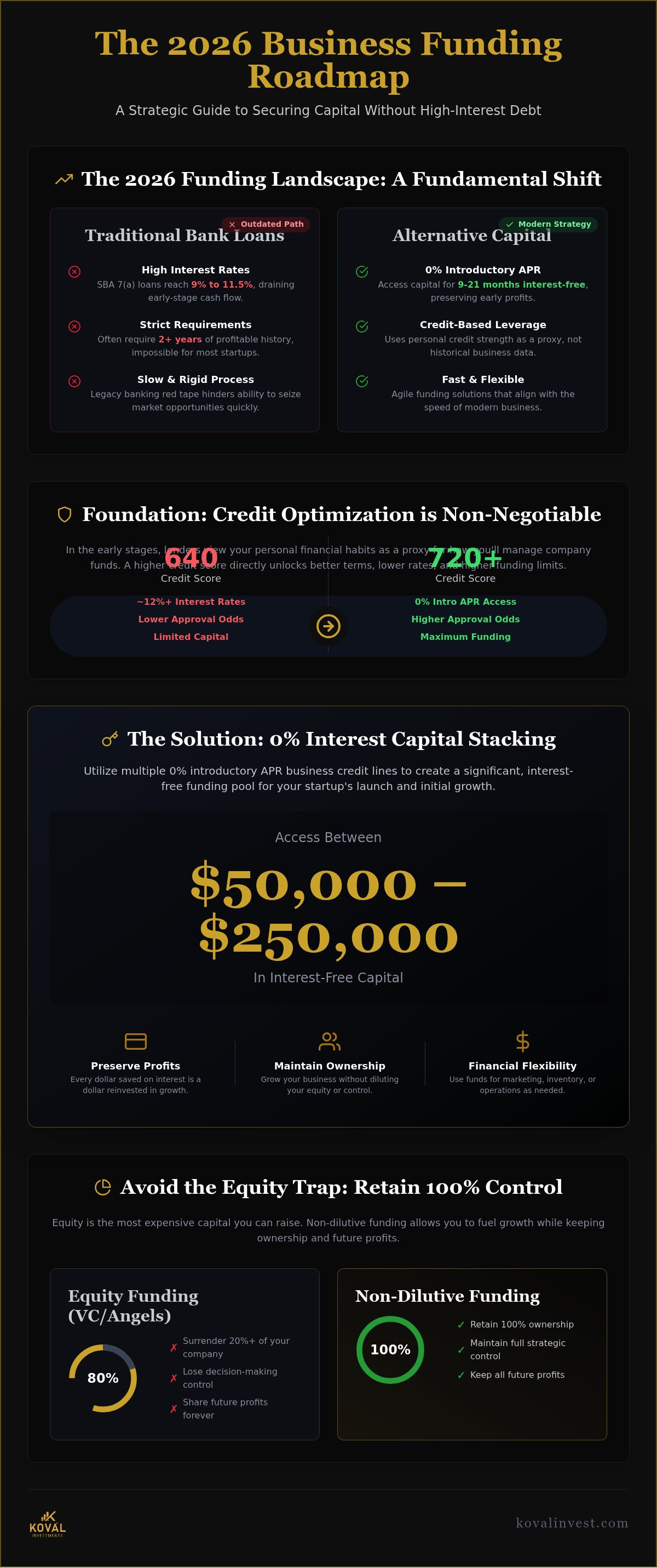
We're here to help you bypass these debt traps by focusing on credit optimization and 0% interest funding strategies. You'll discover how to access between $50,000 and $250,000 in interest-free capital through credit card stacking and other modern financial tools. This article provides a clear roadmap to improve your financial eligibility and secure funding that supports long-term growth. We'll examine the shift toward holistic lending and how you can position your startup for a successful, low-risk launch without the burden of immediate, high-interest repayments.
Key Takeaways
- Modern entrepreneurs are shifting away from traditional bank loans toward alternative capital sources to navigate high interest rates in 2026.
- Strategic credit optimization serves as the foundation for your funding journey. It transforms your personal financial profile into a powerful tool for leverage.
- Utilizing 0% introductory APR business credit lines is the best way to fund a new business without sacrificing early-stage profits to interest payments.
- Professional SBA loan assistance can help you bridge the gap between initial startup capital and the long-term debt needed for major operational scaling.
- Pairing your funding strategy with a professional business valuation ensures that every dollar of capital is deployed toward measurable growth.
Evaluating the 2026 Business Funding Landscape
The environment for launching a company has changed significantly. In 2026, the traditional path of walking into a local bank for a startup loan is no longer the most viable route for many. Banks have tightened their lending standards, often requiring two years of profitable history that most new founders simply don't have. This shift makes it essential to understand that the best way to fund a new business today involves looking beyond the neighborhood branch and toward more innovative capital structures.
High interest rates remain the primary obstacle for entrepreneurs. With the Prime Rate sitting at 6.75% as of August 2026, even government-backed options like SBA 7(a) loans carry variable rates between 9% and 11.5%. For a startup, these monthly payments can suffocate cash flow before the business reaches profitability. Capital efficiency isn't just a buzzword anymore; it's a survival requirement. Every dollar of interest paid is a dollar not spent on customer acquisition or product development. Choosing the best way to fund a new business requires a cold, hard look at the total cost of capital over the first 24 months of operation.
Successful entrepreneurs in 2026 prioritize funding that doesn't require immediate equity dilution or predatory interest rates. They look for pathways that leverage their personal credit strength to unlock business-side capital. This strategy allows for a cleaner balance sheet and more flexibility when it's time to seek larger-scale working capital later. By focusing on capital efficiency early on, you ensure that your business stays lean and responsive to market shifts without being weighed down by rigid debt obligations.
Traditional Loans vs. Alternative Funding
While institutional lenders focus on rigid assets and historical data, fintech platforms and private firms prioritize your current financial trajectory and strategic potential. Understanding various Small business financing options is the first step toward avoiding a "no" from a traditional bank. We often see founders struggle because they rely on outdated models of debt that don't account for the speed of modern commerce. In contrast, alternative business funding solutions provide the agility needed to capitalize on market opportunities without the red tape associated with legacy banking systems. These alternatives often prioritize your creditworthiness and business plan over years of tax returns.
The Hidden Costs of Equity Funding
Many founders look to venture capital or angel investors as a badge of honor. However, equity is the most expensive capital you'll ever use. Giving up 20% of your company today might seem like a fair trade for immediate cash, but you're also surrendering future profits and decision-making power. This "freedom tax" often includes a board of directors that may not share your long-term vision. Modern founders increasingly prefer non-dilutive capital, which allows them to retain 100% ownership while still accessing the funds necessary for growth. It's about maintaining control of your destiny while fueling your ambition without the pressure of outside shareholders who may prioritize a quick exit over sustainable success.
The Foundation: Credit Optimization for Maximum Funding Leverage
Securing capital is rarely about the strength of your business idea alone. In the early stages, lenders view your personal financial habits as a proxy for how you'll manage company funds. This is why credit optimization is the essential first step. Credit optimization is the deliberate process of repairing and restructuring your financial profile to appear as a low-risk borrower. It goes beyond simply paying bills on time. It involves managing how your debt is reported and ensuring your profile meets the specific data points that automated underwriting systems look for in 2026.
Your personal credit score acts as the primary gatekeeper to business capital. Even when you're looking for the best way to fund a new business through corporate lines, most lenders will still require a personal guarantee and a hard pull of your individual report. A strategic improvement in your score doesn't just increase your chances of approval; it directly lowers your interest rates and raises your funding limits. For instance, moving from a 640 to a 720 score can be the difference between a 12% interest rate and a 0% introductory offer. If you aren't sure where your profile stands, a professional credit audit can reveal the specific levers you need to pull to unlock higher capital tiers.
A "funding-ready" profile differs significantly from a standard high credit score. You might have a 750 score, but if your report only shows $500 limit retail cards, a lender is unlikely to grant you a $50,000 business line. Lenders want to see "comparable credit," meaning you've successfully managed high-limit accounts in the past. Optimization ensures your profile has the depth, age, and diversity required to support significant capital injections.
Identifying and Disputing Credit Report Inaccuracies
Common errors like outdated balances, incorrect late payments, or identity fragments can suppress your score by dozens of points. These inaccuracies often kill loan applications before a human ever sees them. Under the Fair Credit Reporting Act, you have the legal right to dispute any data that isn't 100% accurate, verifiable, and timely. Utilizing business credit repair services is a strategic investment because it handles the complex back-and-forth with bureaus, ensuring your profile is clean before you apply for funding.
Building a Stronger Financial Profile for Lenders
To prepare for a major funding round, you must focus on your debt-to-income ratio and credit utilization. Keeping your revolving balances below 10% is a proven strategy for rapid score improvement. When you're researching funding your small business, you'll find that the most accessible capital often requires a clean personal slate. By optimizing your personal profile now, you create the necessary leverage to secure high-limit business credit that doesn't rely solely on your company's early-stage revenue.
0% Interest Funding: The Best Way to Fund a New Business
While traditional debt often feels like a weight around a new company's neck, 0% interest funding offers a cleaner path to growth. This solution involves securing a strategic stack of unsecured business credit lines that feature an introductory APR of 0% for 12 to 21 months. It's the best way to fund a new business because it provides the liquidity of a loan without the immediate interest expense. By leveraging these interest-free windows, you can deploy capital into revenue-generating activities like inventory and marketing, effectively using the bank's money to build your profit margins before the first dollar of interest is ever charged.
The mechanism relies on your optimized personal credit profile to unlock high-limit business accounts. These accounts don't typically report to your personal credit bureau, protecting your individual debt-to-income ratio while giving your business the fuel it needs. At Koval Investments, our approach is built on a success-based model. We don't just point you toward a card; we navigate the complex landscape of lender preferences to ensure you access the maximum amount of interest-free capital possible in a single funding round. This collaborative process ensures your business has the runway it needs to reach its next milestone without the pressure of monthly interest payments.
0% APR Funding vs. Traditional SBA Loans
Speed is often the deciding factor for a startup. While an SBA loan can take several months to process, 0% interest business lines can often be secured in just a few weeks. The savings are equally significant. If you borrow $100,000 at a 10% interest rate, you're paying $10,000 a year just for the privilege of having the money. With 0% interest business funding, that $10,000 stays in your business to fund operations. This makes interest-free capital the ultimate tool for founders who want to scale quickly without the drag of variable-rate debt. You can find more foundational information on these paths in the U.S. government guide to funding a business, which outlines the basic landscape for new entrepreneurs.
Qualification Requirements for Interest-Free Capital
Securing this type of capital requires more than just a good idea. Lenders generally look for a personal credit score of 680 or higher and a clean report free of recent derogatory marks. Your business entity structure also matters; having a properly registered LLC or Corporation with a dedicated EIN and a professional business address is a baseline requirement. We act as your strategic partner throughout this process, handling the nuances of the application sequence to prevent unnecessary credit inquiries. This methodical approach ensures you meet lender-specific criteria the first time, allowing you to focus on operations while we secure the capital that makes those operations possible.
Navigating SBA Loans and Working Capital for Growth
Once your business has utilized its initial interest-free runway, you'll reach a point where larger, long-term capital is necessary for sustainable scaling. This is where SBA-backed debt becomes a strategic tool rather than a burden. While 0% interest lines are ideal for the launch phase, the best way to fund a new business as it matures involves integrating government-guaranteed loans into your capital stack. These loans offer longer repayment terms and lower down payments than conventional bank products, allowing you to preserve cash for daily operations.
Transitioning to these products requires meticulous preparation. Lenders look for specific debt service coverage ratios (DSCR), which the SBA currently sets at a minimum of 1.10:1 for smaller 7(a) loans, though many lenders prefer 1.25. Utilizing professional SBA loan assistance ensures your financial package meets these evolving 2026 standards. This methodical approach increases your approval odds while minimizing the time spent on complex paperwork, positioning your business as a low-risk candidate for institutional capital.
SBA 7(a) vs. 504: Which Capital Strategy Fits?
Choosing between an SBA 7(a) vs 504 loan depends on your specific growth objectives. The 7(a) program is highly versatile, making it suitable for purchasing equipment or securing working capital. Conversely, the 504 program is designed for fixed asset acquisition, such as purchasing commercial real estate with as little as 10% down. For businesses with a tangible net worth under $20 million, the 504 loan remains a primary vehicle for securing long-term, fixed-rate financing at a lower cost than variable 7(a) options.
Securing Working Capital for Scaling
Working capital is the lifeblood of a growing operation. It bridges the gap between paying for inventory or payroll and receiving payment from customers. In 2026, accessing unsecured working capital allows you to move quickly without risking personal or business assets as collateral. This flexibility is vital when you need to capitalize on a sudden market opportunity or manage seasonal fluctuations. By combining these funds with long-term SBA debt, you create a robust financial foundation that supports both immediate needs and future expansion.
If you're ready to transition from startup credit to long-term growth capital, apply for a strategic funding consultation to see which SBA program fits your roadmap.
Strategic Planning: Ensuring Your Funding Drives Profitability
Capital is a tool, not a solution in itself. Securing funds is only the first step in a much larger journey toward operational success. The best way to fund a new business is to ensure every dollar has a pre-determined destination before it even hits your account. Without a strategic plan, you're likely to experience capital leakage, where funds are diverted toward non-essential overhead instead of revenue-generating activities. A well-constructed roadmap ensures that your capital acts as an investment that fuels growth rather than an expense that weighs down your balance sheet.
Strategic advisory bridges the gap between simply having money and actually making money. It turns a one-time funding event into a long-term corporate development strategy. By aligning your capital structure with your specific operational milestones, you ensure that your business remains agile. This methodical approach allows you to navigate the complexities of 2026 market shifts while maintaining a healthy debt-to-income ratio. When your funding is tied to a clear strategy, you move from a position of survival to one of market leadership.
The Power of Professional Business Valuations
You can't effectively manage what you haven't measured. A professional business valuation provides a clear baseline for your company's worth, which is essential when you're looking for the best way to fund a new business through external partners. These valuations do more than just satisfy a lender's curiosity; they directly influence your loan limits and the interest rates you'll receive. Lenders are significantly more comfortable extending high-limit credit when they see a documented valuation that supports your financial projections. Accurate reporting also prepares you for future mergers and acquisitions, ensuring you know the exact value of the equity you've worked so hard to build.
Funding the Acquisition of an Existing Business
In many cases, the most efficient path to entrepreneurship isn't starting from scratch but acquiring a company that already has a proven track record. This approach bypasses the initial struggle for market share and provides immediate cash flow. In 2026, using working capital for business acquisition has emerged as a winning strategy for founders who want to scale quickly. It allows you to leverage existing assets and customer bases to secure more favorable funding terms than a typical startup might receive.
Navigating an acquisition requires specialized M&A consulting to ensure you aren't inheriting hidden liabilities. At Koval Investments, we act as your strategic partner, providing the expertise needed to evaluate targets and secure the necessary capital. Our success-based philosophy means our goals are perfectly aligned with yours. We're committed to ensuring your acquisition is profitable from day one, providing a steady hand as you navigate the transition into business ownership. This partnership model ensures that your funding isn't just a transaction, but a foundational step toward long-term corporate success.
Empowering Your Startup Journey with Strategic Capital
Success in the 2026 market requires a shift from traditional debt toward high-leverage, low-cost capital structures. You've seen how credit optimization acts as the necessary foundation for any funding round, transforming your personal profile into a powerful asset for your company. By prioritizing 0% interest funding solutions, you protect your early-stage margins and maintain the agility needed to respond to market shifts. Identifying the best way to fund a new business is about more than just finding the largest check; it's about building a sustainable financial foundation through expert SBA loan assistance and strategic valuations.
Koval Investments is your trusted strategic partner for national business growth. We operate on a success-based consulting model, which means we're fully invested in your results with no upfront risk to you. Whether you're repairing credit to unlock higher limits or navigating complex M&A transitions, we provide the steady hand you need in a complex financial landscape. Take the first step toward efficient, interest-free growth and secure your 0% interest funding with Koval Investments today. Your vision deserves a financial partner that values long-term success as much as you do.
Frequently Asked Questions
What is the fastest way to get funding for a new business in 2026?
The fastest way to secure capital is through 0% interest business credit lines, which can often be accessed in as little as two to three weeks. Unlike traditional bank loans that require months of exhaustive underwriting, these unsecured lines prioritize your personal credit strength to provide immediate liquidity. This speed allows you to capitalize on time-sensitive market opportunities without the delays of institutional bureaucracy.
Can I get a business loan with a low personal credit score?
While a low personal credit score can block access to traditional capital, utilizing professional credit repair services is the most strategic way to reopen those doors. Most SBA lenders and 0% interest programs prefer a personal score of at least 680 to ensure approval. By repairing your financial profile first, you transform yourself into a low-risk borrower, which is essential for securing competitive interest rates and higher funding limits.
How does 0% interest business funding actually work?
This funding method involves strategically applying for multiple unsecured business credit cards that offer 0% introductory APR for 12 to 21 months. It's a process often called credit card stacking, and it allows you to use the bank's money interest-free during your critical launch phase. This approach is the best way to fund a new business because it provides a flexible runway without the immediate burden of monthly interest payments eating into your profits.
Is it better to use a credit card or an SBA loan to start a business?
It depends on your specific needs, but 0% interest credit cards are generally better for initial operating expenses and marketing because they lack interest costs during the introductory period. SBA loans are better suited for major asset purchases, such as real estate or heavy machinery, where long-term repayment terms are necessary. Using 0% capital first preserves your cash flow while you build the revenue history required for an SBA application.
What are the requirements for an SBA 7(a) loan in 2026?
In 2026, the SBA requires a Debt Service Coverage Ratio (DSCR) of at least 1.10:1 for small 7(a) loans, though many lenders look for 1.25 or higher. You'll also need a comprehensive business plan with financial projections and a personal guarantee from any owner with 20% or more equity. These loans are designed for businesses that can demonstrate a clear ability to repay debt through future cash flow rather than just collateral.
How much does professional credit repair cost for business owners?
The cost of credit repair varies based on the complexity of your report, but it should always be viewed as a strategic investment rather than a simple expense. At Koval Investments, we focus on a success-based philosophy that aligns our objectives with your ability to secure capital. Improving your score by even 50 points can save you thousands of dollars in interest over the life of a single business loan, making it the best way to fund a new business efficiently.
What is the difference between working capital and a startup loan?
Working capital is specifically designed to cover day-to-day operational expenses like payroll and inventory, bridging the gap between sales and expenses. A startup loan is a broader term for the initial capital used to launch a business, which often includes fixed assets and long-term debt. Working capital provides the agility to manage short-term cash flow, while startup loans provide the foundation for your entire corporate structure.
Why should I use a funding consultant instead of going to my bank?
A funding consultant acts as a strategic partner who navigates the entire lending landscape, whereas a bank only offers its own limited products. Consultants understand the specific data points that different lenders look for and can optimize your profile to ensure you find the most efficient capital. This insider knowledge helps you avoid unnecessary credit inquiries and secures the most effective funding for your specific business roadmap.