
Business Expansion Loan Requirements: The 2026 Guide to Scaling Capital
The biggest barrier to your next phase of growth isn't a lack of capital; it's a lack of architectural precision in your financial profile. With the prime rate sitting at 6.75% as of September 2026, the margin for error has narrowed significantly. You've likely felt the frustration of inconsistent advice or the fear that a minor credit blemish might stall your momentum. Understanding the specific business expansion loan requirements is no longer just about checking boxes. It's about engineering a profile that compels lenders to offer their most competitive terms.
We recognize that the recent shifts in SBA residency rules and the rising costs of conventional debt can make scaling feel like an uphill battle. This guide is designed to strip away that complexity and provide a clear path forward. You'll learn how to optimize your financial standing to secure the lowest possible rates and even access 0% interest funding solutions through strategic planning. We'll walk through the current 2026 lending standards, from DSCR benchmarks to the critical role of credit restoration as a first step. This isn't just about finding money. It's about building a collaborative partnership that ensures your expansion is both sustainable and highly profitable.
Key Takeaways
- Identify the specific profitability and Debt Service Coverage Ratio (DSCR) thresholds that 2026 lenders use to evaluate your expansion readiness.
- Master the current business expansion loan requirements by conducting a strategic audit of your financial profile before starting the application process.
- Determine whether an SBA 7(a) loan, a conventional bank facility, or a 0% interest funding solution offers the best alignment with your growth objectives.
- Learn how proactive credit restoration can significantly lower your interest rates and eliminate the risk of rejection due to minor report inaccuracies.
- Understand the benefits of a success-based procurement model that prioritizes your funding outcomes through a collaborative, low-pressure partnership.
Understanding the 2026 Landscape of Business Expansion Loans
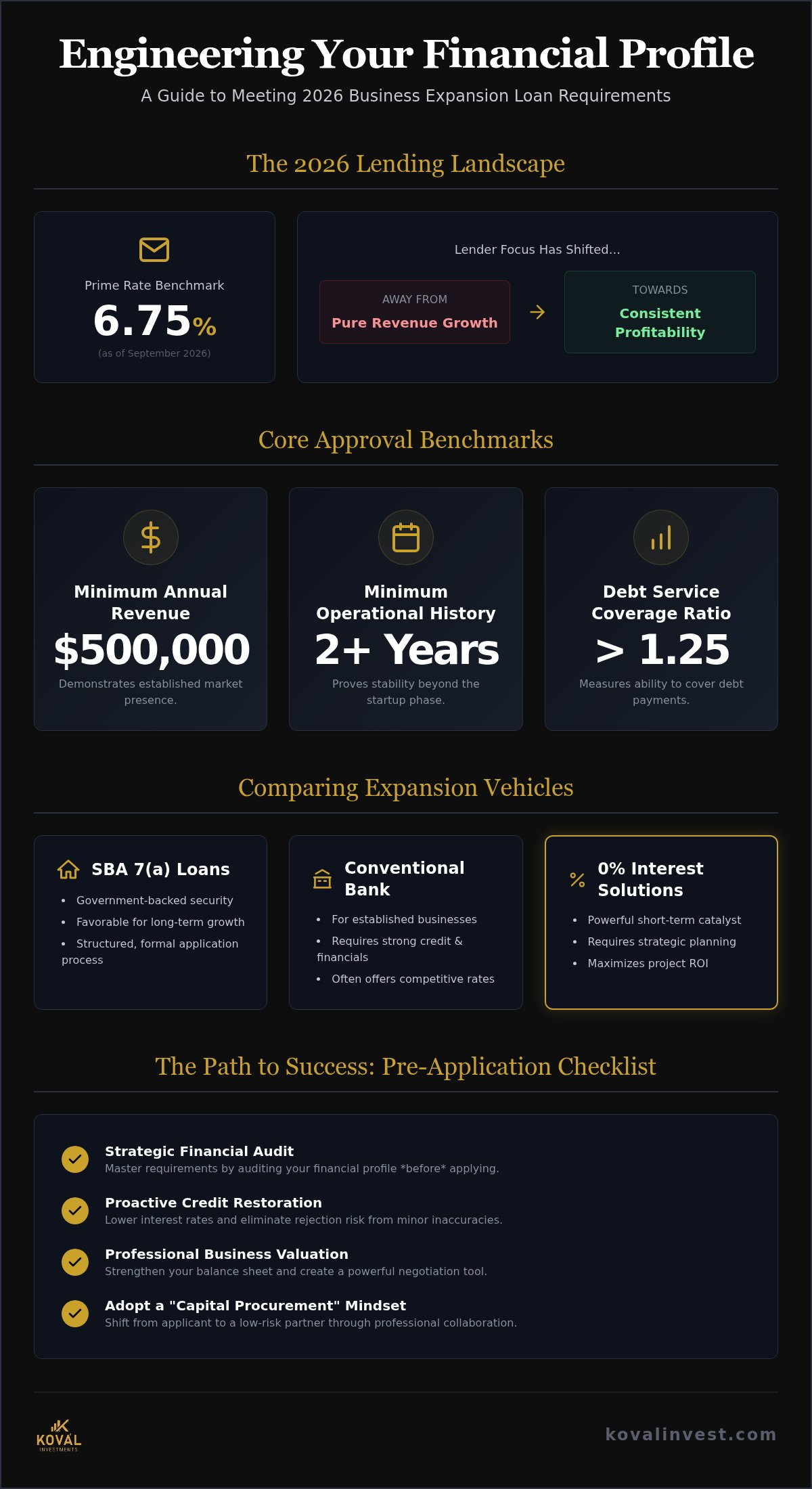
The 2026 lending environment demands a higher level of preparation than previous years. While the prime rate has stabilized at 6.75%, financial institutions have tightened their underwriting standards significantly. Meeting basic business expansion loan requirements is no longer a guarantee of approval or competitive pricing. Today, lenders prioritize what we call "Optimized Eligibility." This means your financial story must demonstrate long-term resilience and operational efficiency alongside your growth potential. Lenders have shifted their focus away from pure revenue growth, now favoring businesses that can prove consistent profitability in a complex economic climate.
Before moving forward, it's essential to have a clear Understanding Business Loans and how they differ by their intended purpose. While startup funding focuses on initial viability and working capital addresses short-term cash flow gaps, expansion capital is specifically designed to fuel high-yield projects. In the current market, the primary capital sources include SBA 7(a) and 504 loans, conventional bank facilities, and alternative 0% interest solutions. Each vehicle has distinct business expansion loan requirements that dictate who qualifies for the lowest possible rates.
Growth Capital vs. Operational Capital
Expansion loans require a fundamentally different strategic approach than simple lines of credit. While operational capital keeps your business running, growth capital is a deliberate investment in your company's future value. To secure the best terms, you must clearly identify the ROI of your expansion project to justify the capital cost to an underwriter. Business expansion funding for 2026 is a strategic tool for scaling market share.
The Role of Strategic Capital Procurement
Busy founders are increasingly moving away from the traditional model of "applying for a loan" toward a more sophisticated process of "procuring capital." This shift involves working with professional partners who understand the nuances of the 2026 market and the specific preferences of various national lenders. Professional consulting reduces the time-to-funding by ensuring every document is perfect before a lender ever sees it. This collaborative approach often uncovers more efficient paths, such as a 0% interest funding strategy that acts as a powerful expansion catalyst. By focusing on procurement rather than simple application, you position your business as a low-risk partner rather than just another applicant.
Core Financial Requirements for Expansion Approval
Underwriting in 2026 has evolved into a highly granular process. Lenders no longer just look at your bank balance; they analyze the structural integrity of your cash flow. To meet modern business expansion loan requirements, most national lenders look for a minimum annual revenue of $500,000 and at least two years of consistent operational history. This two-year benchmark allows underwriters to verify that your business has moved past the volatile startup phase and possesses the historical data necessary to project future success. If your revenue is lower, you may still qualify, but your "financial story" must be exceptionally well-documented to offset the perceived risk.
The Importance of Professional Business Valuations
Many founders overlook the power of an objective valuation when preparing for capital procurement. Utilizing professional business valuation services strengthens your balance sheet by providing a third-party verification of your company's worth. This data is a potent negotiation tool. When you can prove your business is worth more than its liquid assets, you can often secure higher funding limits and lower interest rates. It transforms your application from a request for debt into a proposal for a strategic investment in a proven asset.
DSCR and Cash Flow Management
The Debt Service Coverage Ratio (DSCR) remains the "magic number" in expansion lending. It measures your ability to cover your debt obligations with your net operating income. A DSCR above 1.25 is typically the minimum requirement for expansion approval. If your current ratio is lower, it doesn't necessarily mean rejection. You might use working capital funding solutions to bridge short-term gaps and improve your liquidity profile before applying for long-term expansion debt. This is particularly relevant when applying for the SBA 504 loan program, where cash flow projections play a critical role in the approval of large-scale equipment or real estate purchases.
Founders often forget that their personal credit is inextricably linked to their business's borrowing power. In 2026, a personal credit score of 720 or higher is the gateway to the most favorable terms. Minor inaccuracies on your report can inflate your risk profile and lead to higher interest rates that eat into your expansion margins. If you're unsure how your current numbers align with these benchmarks, our strategic advisory team can help you audit your profile before you submit a single application. This proactive approach ensures you're positioned for success rather than just hoping for an approval.
Comparing Expansion Vehicles: SBA vs. Conventional vs. 0% Interest
Selecting the right funding vehicle is a strategic decision that dictates your company's long-term financial flexibility. While conventional bank loans offer the fastest processing times, they often come with the strictest collateral mandates and higher credit score thresholds. In 2026, many national banks have increased their equity requirements, making it harder for founders to scale without significant out-of-pocket capital. Lenders often have different Business Loan Requirements depending on the specific vehicle chosen, which is why understanding the nuances of government-backed versus private capital is essential for a successful procurement strategy.
SBA Loan Assistance and Strategic Navigation
Government-backed options remain a cornerstone for businesses looking to preserve cash. The SBA 7(a) program is highly versatile, providing capital for everything from working capital to debt refinancing. However, for those looking to expand their physical footprint or acquire heavy machinery, comparing SBA 7(a) vs 504 loans reveals that the 504 program often provides better long-term fixed rates for real estate. Navigating these programs requires precision; even a minor documentation error can lead to a months-long delay. Utilizing professional SBA loan assistance is often the difference between a swift approval and a frustrating rejection, especially for founders with complex corporate structures or multiple entities.
The 0% Interest Funding Solution
One of the most effective yet underutilized strategies in 2026 is the procurement of 0% interest business funding. This approach leverages introductory 0% APR business credit lines to provide high-leverage capital without immediate debt service costs. It's an ideal "bridge" or primary funding source for rapid expansion projects where immediate cash flow is needed for inventory or marketing. The business expansion loan requirements for this strategy are unique; they prioritize personal credit excellence and a clean financial profile over traditional collateral. This method is particularly attractive for founders who wish to maintain 100% equity in their company while avoiding the 9.75% to 12.75% variable rates currently seen in the SBA 7(a) market. By stacking these interest-free tools, you can fuel growth while keeping your margins intact. This success-based approach ensures that your capital works for you, rather than you working to pay off high-interest debt from day one.
For specialized real estate investment funding, the requirements shift toward the property's projected income and your experience in the sector. Whether you're moving into a larger facility or diversifying your holdings, aligning your project with the right capital source is the first step toward a sustainable expansion.
Audit and Optimize: The Pre-Application Checklist
Lenders in 2026 don't just review your application; they stress-test it. Most founders make the mistake of gathering documents and applying immediately. This reactive approach often leads to higher interest rates or outright rejections based on minor inaccuracies. A proactive audit of your financial profile is the most effective way to meet business expansion loan requirements while securing the lowest cost of capital. By the time an underwriter sees your file, it should be optimized for maximum approval limits.
Strategic Business Credit Repair
Step 1 of a successful checklist is conducting a comprehensive audit of both your personal and business credit reports. Even a small error in your industry classification code or a misreported payment can inflate your risk profile. Step 2 requires identifying and disputing these inaccuracies with technical precision. Utilizing professional business credit repair services can turn a potential rejection into a high-limit approval. This is a technical process that requires professional oversight to ensure disputes are handled correctly. Ideally, you should start this optimization 3 to 6 months before you intend to scale. This window allows credit bureaus to update their records, ensuring your score is at its peak when the review begins.
Step 3 involves optimizing your debt-to-income (DTI) ratios to maximize potential funding limits. Lenders look at your existing obligations to determine how much new debt your cash flow can safely support. By restructuring current liabilities or utilizing 0% interest strategies to pay down high-cost debt, you can effectively improve your liquidity profile. This phase is about making your balance sheet as lean and attractive as possible before the formal application.
Alignment and Strategic Planning
Step 4 is aligning your growth-focused strategic plan with your financial data to create a cohesive lender pitch. Underwriters need to see a narrative that explains exactly how the capital will be deployed to generate a return. If your expansion involves acquiring a competitor, our mergers and acquisitions consulting can help frame that narrative as a low-risk, high-value move. We work alongside you to finalize a "Lender-Ready" package that anticipates every question a lender might ask. This collaborative preparation ensures that your strategic vision is backed by undeniable financial logic.
Success in capital procurement isn't about luck; it's about preparation and strategic alignment. If you're ready to see how your current profile measures up against 2026 standards, schedule a strategic audit with our team today to begin your optimization journey.
Securing Your Growth Capital with Koval Investments
Scaling a business in 2026 requires more than a standard bank application. It demands a partnership with a firm that understands the intricacies of capital procurement and financial restructuring. At Koval Investments, we don't act as a distant service provider. We position ourselves as a seasoned strategic partner, navigating the complex landscape of business expansion loan requirements alongside you. Our success-based philosophy ensures that our objectives are perfectly aligned with yours. We only succeed when you secure the capital necessary to reach your growth milestones. This win-win approach removes the financial risk typically associated with professional consulting, allowing you to focus on your operations while we handle the complexity of the procurement project.
The Koval Procurement Process
Our process is methodical and transparent. It begins with a deep dive into your current financial health, including a professional business valuation and a comprehensive credit audit. By identifying potential friction points early, we bridge the gap between your high-level growth strategy and the day-to-day realities of your balance sheet. Whether you're pursuing a complex merger or a simple facility expansion, we provide the steady hand needed to navigate the nuances of national lending standards. Founders often trust us to manage the procurement of 0% interest solutions and SBA facilities because we understand that every dollar saved on interest is a dollar that can be reinvested into your company's future value.
Your Next Steps to Scaling
The difference between a successful expansion and a stalled project often comes down to timing. Taking a proactive approach to your funding needs allows for the optimization window we discussed in previous sections. Reactive funding usually leads to high-cost debt that erodes your margins. By starting early, you give yourself the leverage to choose the best possible capital vehicle for your specific needs. Our team is ready to help you translate your vision into a lender-ready profile that demands the best terms the market has to offer.
The path to scaling your business shouldn't be a solitary journey filled with uncertainty. It should be a deliberate, strategic venture supported by experts who are as invested in your success as you are. Schedule your strategic capital consultation with Koval Investments today and let's begin building the financial foundation your expansion deserves.
Mastering Your Path to Strategic Growth
Securing capital in 2026 is a project of financial engineering rather than simple application. Success hinges on a proactive approach to your profile, where profitability and debt service coverage ratios take center stage. By conducting a thorough audit and addressing credit report inaccuracies early, you position your firm as a low-risk, high-value partner for national lenders. Meeting the modern business expansion loan requirements is simply the baseline; the real objective is to optimize your eligibility to secure the most competitive rates available.
We believe that capital procurement should be a collaborative venture with shared objectives. Our success-based consulting model ensures we're fully invested in your growth, offering deep expertise in credit restoration, SBA navigation, and strategic advisory for corporate expansion. We bridge the gap between your ambitious vision and the day-to-day realities of corporate finance to ensure your scaling project remains sustainable. It's time to move from simply applying for debt to strategically procuring the capital your business deserves.
Partner with Koval Investments for Your 0% Interest Funding Strategy and let's turn your scaling objectives into a tangible reality. Your business has the potential to lead your industry; we have the steady hand to help you fund that journey.
Frequently Asked Questions
What is the minimum credit score for a business expansion loan in 2026?
A personal credit score of 720 or higher is generally the benchmark for securing the most competitive rates in 2026. While some SBA programs accept scores as low as 680, lower scores often trigger higher interest rates or stricter collateral demands. Meeting business expansion loan requirements with a top-tier score ensures you have the leverage to negotiate. If your score is currently below this threshold, strategic credit restoration is a vital first step to optimize your financial profile.
Can I get a business expansion loan with no collateral?
Yes, securing capital without physical collateral is possible through specific vehicles like our 0% interest funding solutions or unsecured working capital lines. These options prioritize your credit excellence and historical cash flow over equipment or real estate. While traditional bank loans often require significant assets to back the debt, credit-based procurement allows you to scale rapidly while maintaining full control over your company's equity and physical holdings.
How long does the SBA loan approval process take for expansion?
The standard SBA loan approval process for expansion typically ranges from 60 to 90 days. This timeline includes the initial underwriting, the SBA's secondary review, and the final closing procedures. You can significantly reduce this duration by submitting a "lender-ready" package from the start. Professional assistance ensures that all business expansion loan requirements are met in the first submission, preventing the common back-and-forth delays that often stall growth projects for months.
What is the difference between an expansion loan and a working capital loan?
The primary difference lies in the intended use and the expected return on investment. Working capital loans address short-term operational needs like payroll, inventory, or seasonal cash flow gaps. In contrast, expansion loans are strategic investments designed to increase market share, such as opening new locations or acquiring a competitor. Expansion funding typically involves larger capital amounts and longer repayment terms, as the projects they fuel are expected to generate significant long-term revenue growth.
How can credit repair help me get a better business loan rate?
Credit repair directly impacts your loan rate by lowering your perceived risk profile in the eyes of an underwriter. By identifying and disputing inaccuracies on your report, you can raise your score and qualify for lower APR brackets. Even a minor improvement can save your business thousands of dollars in interest over the life of a loan. It's a critical component of financial restructuring that ensures you don't pay a "risk premium" for errors.
Is 0% interest business funding real for expansion purposes?
True 0% interest funding is a highly effective strategy that involves stacking introductory 0% APR business credit lines. This method allows you to access significant capital for expansion without immediate debt service costs, which is ideal for marketing or inventory-heavy growth. It's a legitimate alternative to high-interest debt, provided you have the credit profile to qualify. This approach is a cornerstone of a success-based procurement strategy for founders looking to scale efficiently.
What documents do I need to prepare for an expansion loan application?
Preparing for an expansion loan requires a comprehensive set of financial and legal documents. You'll typically need to provide:
- Three years of business and personal tax returns
- Current profit and loss statements and balance sheets
- A detailed debt schedule and business bank statements
- A growth-focused strategic plan outlining the use of funds
Having these documents organized and verified beforehand is essential to meeting 2026 business expansion loan requirements and ensuring a smooth underwriting process.
How does a business valuation impact my ability to get funded?
A professional business valuation acts as a powerful negotiation tool by providing third-party verification of your company's actual worth. It proves to lenders that your business has the structural value to support higher funding limits. Instead of relying solely on liquid assets, a valuation highlights your intangible assets and market position. This often results in more favorable terms and lower interest rates, as it shifts the lender's perspective from high-risk debt to strategic investment.