
Business Line of Credit for Cash Flow Gaps: 2026 Guide
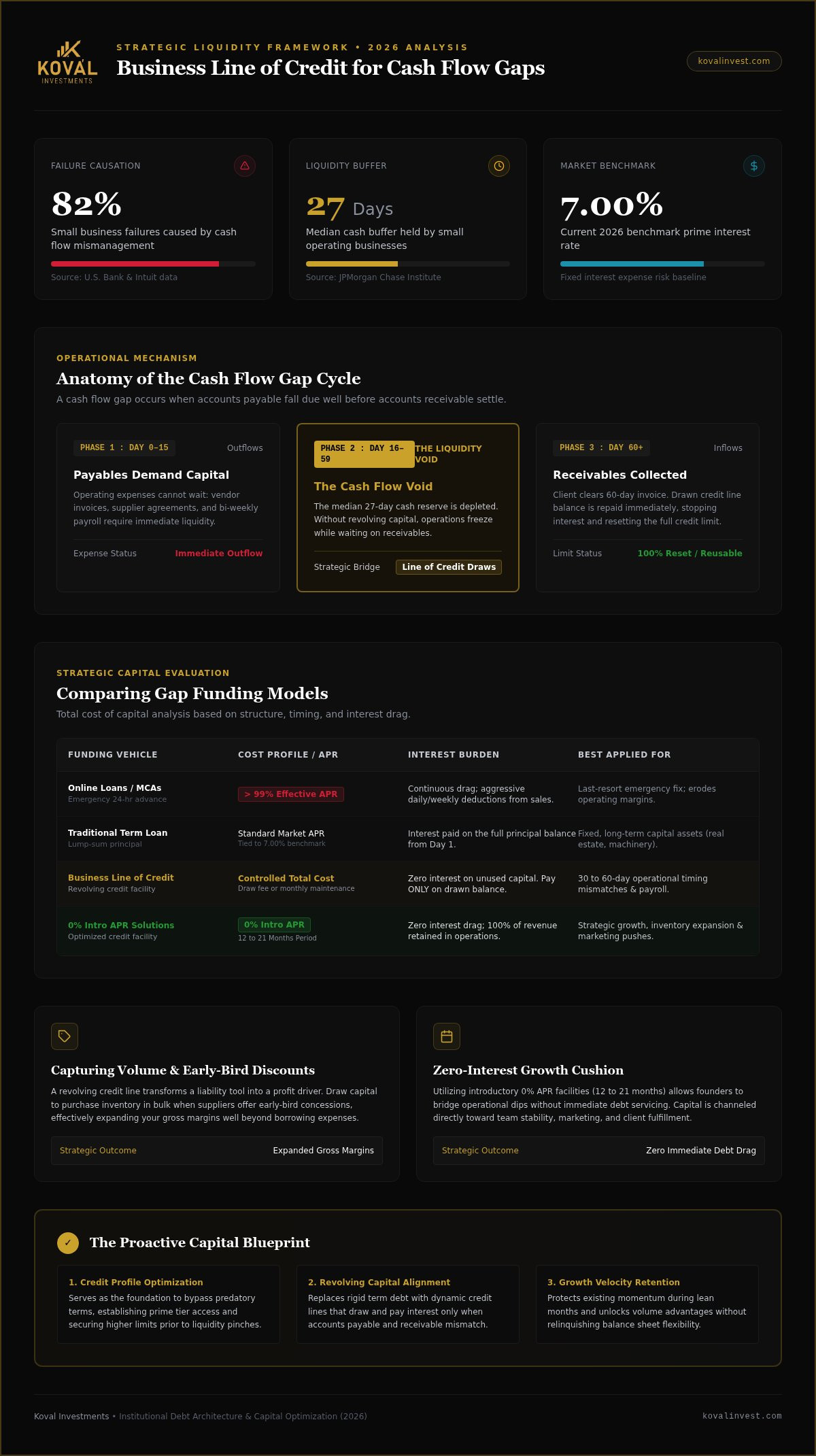
Recent data from U.S. Bank and Intuit indicates that 82% of small business failures stem from cash flow mismanagement rather than a lack of profitability. Even the most successful firms often operate with a median cash buffer of only 27 days, leaving them vulnerable when vendor payments lag. You likely understand the stress of watching accounts receivable grow while operating expenses demand immediate attention. Utilizing a business line of credit for cash flow gaps is a tactical necessity to ensure these timing mismatches don't stall your growth or force you into high-cost capital agreements.
In this 2026 guide, you'll discover how to leverage revolving credit to maintain your operational pace during lean months and protect your bottom line. We'll share the strategic secrets to optimizing your credit profile, which acts as the primary key to unlocking 0% interest funding solutions. By shifting from reactive borrowing to a proactive, success-based debt architecture, you can access the capital you need while keeping your interest expenses to an absolute minimum. This approach allows you to build a stronger financial profile for future scaling while maintaining your current momentum.
Key Takeaways
- Learn how a business line of credit for cash flow gaps acts as a flexible safety net, allowing you to draw capital only when timing mismatches occur between payables and receivables.
- Discover why credit optimization is the essential first step to bypassing predatory rates and qualifying for prime interest tiers.
- Explore the strategic use of 0% introductory APR facilities to fund operations and growth without the burden of immediate interest expenses.
- Understand the differences between revolving lines and term loans to ensure you select the capital structure that protects your long-term liquidity.
- Identify the benefits of a success-based partnership model that aligns funding strategies with your specific scaling objectives.
What is a Business Line of Credit for Cash Flow Gaps?
A business line of credit for cash flow gaps serves as a strategic reservoir of capital for your company. Unlike a standard term loan where you receive a lump sum and pay interest on the full amount immediately, this is a revolving line of credit. It allows you to draw only what you need, exactly when you need it. In 2026, where the benchmark prime rate sits at 7.00%, maintaining this level of control over interest expenses is vital for protecting your profit margins.
The "cash flow gap" usually isn't a sign of a failing business; it's often a side effect of rapid growth. It occurs when your accounts payable, such as money owed to suppliers or employees, comes due before your accounts receivable actually hits your bank account. JPMorgan Chase Institute data shows the median small business operates with just 27 days of cash buffer. A line of credit bridges that timing mismatch, ensuring you don't have to pause operations while waiting for a client to clear a 60-day invoice.
Modern founders prioritize flexibility. With a line of credit, you only make interest payments on the capital you've actually drawn. Once you repay the balance, the limit resets, making it a reusable tool for the next cycle. This is why successful companies in 2026 are moving away from rigid, lump-sum financing that carries interest on the entire principal from day one, regardless of whether the money is being used.
How Revolving Credit Supports Daily Operations
Managing payroll during seasonal dips shouldn't feel like a crisis. Revolving credit serves as a perpetual safety net for operational expenses, providing a reliable source of liquidity that resets as you repay what you've used. Beyond survival, it offers a significant competitive edge. You can use drawn funds to purchase inventory in bulk when suppliers offer volume discounts or "early bird" pricing. This transforms a debt facility into a tool for increasing your gross margins and overall profitability.
Line of Credit vs. Traditional Working Capital
Choosing between different working capital funding solutions requires an understanding of the total cost of capital. Traditional term loans provide stability for long-term investments like real estate, but they are often too heavy for short-term gaps. A line of credit is more surgical. While you might encounter draw fees or monthly maintenance costs, the ability to avoid interest on unused capital usually results in a lower total cost. It's an essential first step in a broader strategy to maintain liquidity while scaling.
Comparing Funding Models: Which is Right for Your Gap?
Choosing the wrong capital structure can quietly erode your margins. While many founders focus solely on the headline APR, the total cost of capital is the more critical metric. Fast-approval online loans or merchant cash advances might solve a liquidity crisis in 24 hours, but they often carry effective APRs that exceed 99%. In contrast, a business line of credit for cash flow gaps provides a more sustainable, revolving solution where you only pay for what you draw. It's the difference between a high-cost emergency fix and a strategic financial tool.
The right model depends entirely on your objective. Term loans are excellent for fixed, long-term investments like real estate or heavy equipment where the return on investment is realized over several years. However, using a fixed loan to cover a 30-day payroll gap is inefficient because you'll continue paying interest long after the gap has closed. For recurring operational needs, a flexible line remains the superior choice for maintaining momentum without over-leveraging the balance sheet.
The Advantage of 0% Interest Funding Solutions
Savvy entrepreneurs in 2026 view 0% interest funding as the gold standard for bridging gaps. By utilizing introductory 0% APR periods, which typically range from 12 to 21 months, you can access unsecured capital without any immediate interest drag. This allows you to reinvest your revenue back into the business rather than servicing debt. Integrating 0% interest business funding into your financial plan provides a low-risk buffer for inventory expansion or marketing pushes. If you're looking to optimize your current setup, our team can help you evaluate your funding options to find the most efficient path forward.
SBA Loans as a Long-Term Capital Strategy
As your business matures, you might transition from private lines of credit to more formal SBA business funding programs. The SBA 7(a) Working Capital Pilot (WCP) program is particularly relevant for 2026, offering facilities up to $5,000,000 with competitive rate caps. While the application process is more rigorous than private credit lines, leveraging professional SBA loan assistance can significantly improve your approval odds. These loans offer longer terms and lower rates, making them ideal for permanent working capital needs rather than just temporary gaps.
The Critical Role of Credit Optimization in Securing High Limits
Securing a high-limit business line of credit for cash flow gaps requires more than just a profitable balance sheet. In 2026, lenders rely heavily on automated underwriting algorithms that treat your personal credit profile as a primary indicator of commercial reliability. There is a direct, measurable correlation between your credit health and the interest rate tiers you'll qualify for. While some fintech lenders approve files with scores in the low 600s, reaching the 750+ range often doubles your available limit while cutting your APR by several percentage points.
Lenders look for specific red flags that trigger instant rejections, regardless of your revenue. Excessive hard inquiries within a six-month window, credit utilization exceeding 30%, and any history of late payments can stall your application. Understanding the nuances of business loans vs. lines of credit helps you see why lenders require different credit benchmarks for revolving facilities. When your score sits in the prime range, a business line of credit for cash flow gaps becomes a significantly cheaper tool that acts as a lever for broader alternative business funding solutions.
Repairing Credit to Unlock Better Terms
Credit restoration isn't just about removing negative marks; it's about maximizing your borrowing capacity. Inaccuracies in your report, such as incorrectly reported balances or outdated collections, can suppress your score by 50 points or more. Utilizing professional business credit repair services creates a win-win scenario where the cost of the service is dwarfed by the interest savings on your new credit line. In 2026, most founders should expect a timeline of 90 to 180 days to see a full profile optimization that satisfies prime lender requirements.
Building a Robust Business Credit Profile
True financial stability comes from separating your personal and business liabilities. By establishing a dedicated business credit profile, you allow lenders to assess your company's risk independently of your personal finances. This process involves several key steps:
- Registering with major business credit bureaus like Dun & Bradstreet.
- Opening trade lines with vendors who report your on-time payment history.
- Maintaining a low debt-to-income ratio on both personal and commercial accounts.
Credit repair is an investment in capital access, not just a fix for the past. By building a robust profile now, you ensure that when you need to draw on your line of credit, the capital is available at the lowest possible cost.
How to Maximize and Manage Your Business Line of Credit
Effective management of a business line of credit for cash flow gaps transforms a simple safety net into a powerful engine for growth. The first step is calculating your "True Gap." This involves analyzing your burn rate against confirmed receivables over a standard 30 to 90 day vendor cycle. By knowing exactly how much capital you need to bridge these periods, you avoid the trap of over-borrowing and paying unnecessary fees on unused funds.
Proactive negotiation is equally vital. You should request limit increases when your cash flow is strongest, not when you're facing a shortfall. Lenders are more likely to grant higher limits when your debt-to-income ratio is healthy. Once secured, prioritize using the funds for revenue-generating activities. This might include scaling a proven marketing campaign or purchasing inventory at a discount. If you use the line solely for survival, you're merely delaying a crisis rather than building a bridge to your next milestone.
Protecting your future borrowing power requires constant monitoring of your credit utilization ratio. Keeping your drawn balance below 30% of your total limit signals to lenders that you're a responsible borrower. Finally, schedule an annual review of your entire funding mix with a strategic advisor. This ensures your debt architecture remains aligned with your 2026 scaling goals. If you're ready to refine your strategy, speak with our team about a customized funding plan.
Tactical Uses for a Line of Credit
A revolving line provides the speed necessary for high-stakes opportunities. For example, it serves as excellent funding for real estate investors who need to cover renovation costs during property flips before the final sale proceeds arrive. Similarly, it can facilitate "quick-close" business acquisitions, allowing you to move faster than competitors who rely on slow-moving term loans. During a high-ROI launch phase, a line of credit can fund an aggressive marketing spend that pays for itself within a single quarter.
Avoiding the Debt Trap
Revolving credit is not a substitute for long-term capital. Using a line of credit for permanent expenses like multi-year leases or major equipment can lead to a dangerous cycle of perpetual debt. Establish clear internal triggers for when to draw capital and, more importantly, when to pay it down. Maintaining a clean balance sheet with low revolving debt is essential for future SBA loan applications, as underwriters look for a history of disciplined repayment. This disciplined approach ensures your business line of credit for cash flow gaps remains a tool for progress, not a weight on your operations.
Partnering for Success: Koval Investments' Strategic Funding Approach
Traditional brokers often focus on a single transaction, prioritizing a quick close over your company's long-term financial health. At Koval Investments, we operate as a seasoned strategic partner. Our success-based philosophy ensures that our objectives remain perfectly aligned with yours; we succeed only when you secure the capital necessary to scale. We don't just find you a loan. We build a customized debt architecture that protects your cash flow and minimizes your total cost of capital.
The "Koval Method" distinguishes our approach from standard brokerage services. We integrate professional credit restoration with the strategic procurement of high-limit, 0% interest facilities. By addressing credit profile imperfections first, we ensure you access the most competitive interest tiers available. This proactive strategy makes a business line of credit for cash flow gaps a significantly more affordable tool for your operations. We navigate the complex 2026 lending landscape for you, leveraging our insider knowledge to bypass common underwriting hurdles that often lead to rejections or punitive rates.
A Collaborative Path to Capital
Our team begins by identifying the specific funding mix that suits your unique operational needs. We don't believe in one-size-fits-all solutions. Instead, we analyze your current revenue cycles and expansion goals to determine which combination of 0% interest lines and SBA facilities provides the most stability. Business owners choose us because we focus on the win-win nature of our engagements, removing the financial risk of standard consulting fees and replacing them with a results-oriented partnership.
Next Steps: Securing Your Business's Future
Securing prime funding in 2026 requires meticulous preparation. We help you organize your documentation and optimize your financial narrative before it reaches a lender's desk. Having a seasoned advisor navigate the underwriting process provides a layer of credibility that individual applicants often lack. We speak the language of lenders and understand the specific metrics they prioritize. This insider advantage allows us to bridge the gap between your current financial state and your future scaling ambitions. Partner with Koval Investments to bridge your cash flow gaps today.
Master Your Cash Flow Strategy for 2026
Navigating the financial landscape of 2026 requires more than just access to capital; it demands a strategic approach to debt architecture. By prioritizing credit optimization, you transform your personal and business profiles into powerful levers for growth. We've explored how a business line of credit for cash flow gaps provides the necessary flexibility to bridge timing mismatches without the heavy burden of traditional interest. Leveraging 0% interest facilities and SBA working capital programs allows you to maintain operational momentum while protecting your profit margins.
Koval Investments is committed to your success through our unique partnership model. We combine success-based credit repair with expert 0% interest procurement and professional SBA loan consulting to ensure you never pay more for capital than necessary. This collaborative approach moves your business beyond survival and into a phase of sustainable scaling.
Secure Your 0% Interest Funding Solution with Koval Investments
You've built the foundation of a great company. We're here to provide the steady hand and financial expertise needed to secure its future.
Frequently Asked Questions
What is the typical interest rate for a business line of credit in 2026?
In 2026, interest rates vary by lender type and your credit profile. With the benchmark prime rate at 7.00%, traditional secured lines typically range from 8% to 14% APR. Unsecured facilities often fall between 10% and 16%. Top-tier fintech lenders may charge 12% to 18%, while short-term options can exceed 22%. Your specific rate depends on your ability to meet prime underwriting standards.
How does a business line of credit help with seasonal cash flow gaps?
A business line of credit for cash flow gaps provides immediate liquidity when seasonal revenue dips occur. It allows you to cover fixed costs like payroll or rent while waiting for peak season receivables to clear. Because it is revolving, you only pay interest on the funds you draw. This flexibility ensures you don't have to pause operations or miss bulk inventory discounts during slower months.
Can I get a business line of credit with a 600 credit score?
While some online lenders accept scores as low as 600, you'll likely face punitive interest rates and low limits. We recommend prioritizing credit optimization to reach a 700 or 750+ score before applying. Improving your profile allows you to bypass high-cost debt and qualify for 0% interest solutions. This strategic approach ensures your business line of credit for cash flow gaps remains an affordable growth tool.
What is the difference between a secured and unsecured business line of credit?
A secured line of credit requires collateral, such as accounts receivable or inventory, to back the facility. These usually offer lower interest rates and higher limits because they reduce the lender's risk. An unsecured line requires no physical collateral but relies heavily on your credit score and business revenue. Unsecured options provide faster access to capital but often carry higher APRs to offset the increased risk.
How much of a credit line should a small business have on hand?
Most financial advisors suggest having access to a credit line equal to three to six months of operating expenses. However, you should calculate your "True Gap" by analyzing your specific vendor payment cycles and receivable lags. Having a buffer that covers your peak seasonal inventory needs ensures you can maintain momentum. Secure this limit when your financials are strong to ensure the highest possible approval.
How quickly can I access funds from a business line of credit?
Funding speeds depend on the lender's underwriting process. Fintech and online lenders can often provide approval and fund access within 24 to 48 hours. Traditional banks and SBA facilities typically take several weeks due to more rigorous documentation requirements. If speed is your priority, unsecured private lines are the most efficient option. Preparing your documentation in advance can significantly accelerate any application process.
Is 0% interest funding better than a traditional line of credit?
0% interest funding is often superior for short-term needs because it eliminates interest drag during the introductory period. These facilities, often lasting 12 to 21 months, allow you to reinvest 100% of your revenue back into scaling. Traditional lines are better for permanent, long-term working capital needs that extend beyond introductory windows. Combining both models creates a robust debt architecture that minimizes your total cost of capital.
Will applying for a business line of credit hurt my personal credit score?
Applying for a business line of credit usually involves a hard inquiry, which may cause a temporary, minor dip in your personal score. However, many business lenders report only to commercial bureaus, meaning your ongoing utilization won't impact your personal debt-to-income ratio. The long-term benefit of establishing a commercial credit profile far outweighs the initial impact of an inquiry. Using these tools responsibly eventually strengthens your overall financial standing.