
Business Valuation Methods: Strategic Guide for 2026
With US M&A deal value reaching $1.2 trillion in the first half of 2026, your company's worth is your most powerful negotiating tool. Many entrepreneurs feel a deep sense of uncertainty when it comes to the fairness of an offer or the complexity of different business valuation methods. It's common to worry that you're leaving money on the table during a critical exit simply because the financial jargon feels exclusionary.
We believe that transparency is the foundation of a successful partnership. This guide helps you master the core frameworks used by industry professionals to determine your true market worth. Whether you're preparing for an SBA loan or an M&A transition, you'll learn how to leverage your company's data to secure strategic funding and drive future growth.
We'll examine the latest 2026 valuation standards, industry-specific EBITDA multiples, and the impact of recent tax regulations like the One, Big, Beautiful Bill Act. You'll gain a clear roadmap to optimize your operations, maximize your exit value, and approach the negotiating table with the confidence of a seasoned insider.
Key Takeaways
- Understand how professional valuation shifts from a simple estimate to a strategic growth asset that navigates 2026's complex market dynamics.
- Identify which core business valuation methods, such as the income or market approach, provide the most accurate benchmark for your specific industry.
- Master advanced models like Discounted Cash Flow (DCF) and EBITDA multipliers to quantify your company's future wealth-generating capacity.
- Learn how a defensible valuation serves as a critical prerequisite for securing SBA loans and optimizing your capital procurement strategy.
- Gain the precision needed to structure M&A deals effectively, using valuation data to bridge gaps and protect your equity during due diligence.
Understanding Business Valuation as a Strategic Growth Tool
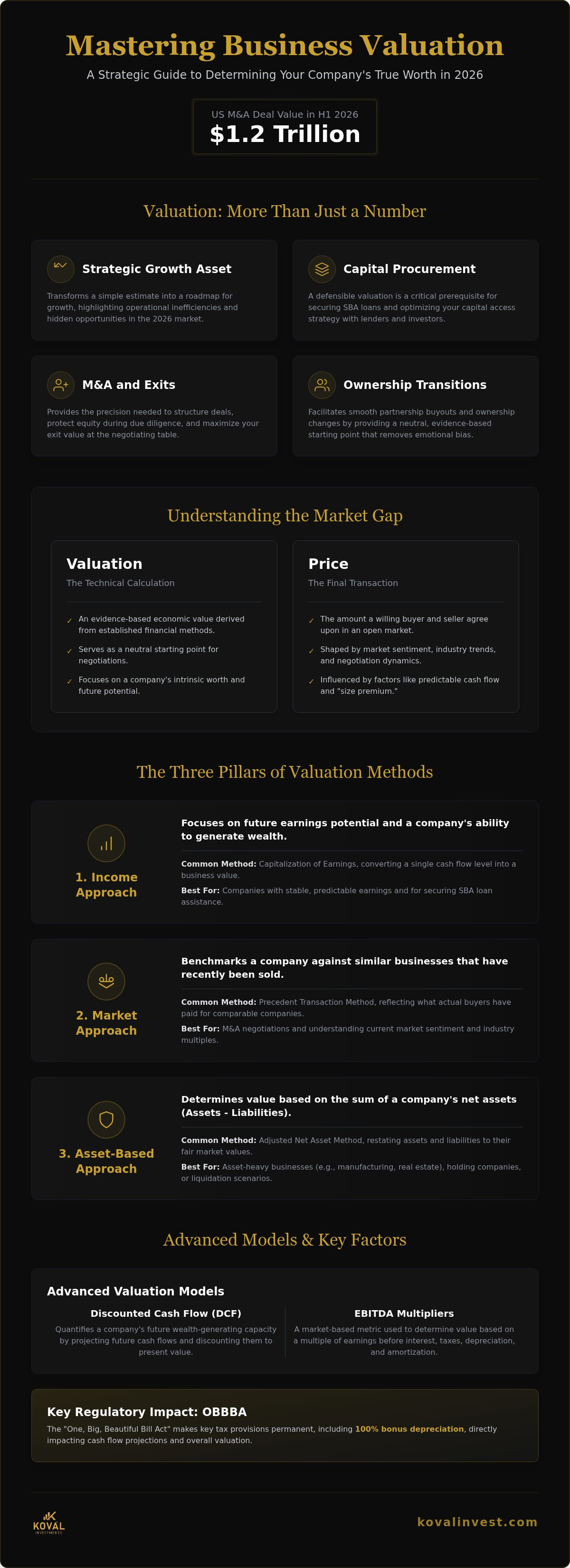
Business valuation is the systematic process of determining the total economic value of a business entity and its underlying assets. While many owners view this as a one-time task for tax reporting or legal disputes, it's actually a vital diagnostic tool for long-term success. In the 2026 market, where US M&A deal value reached $1.2 trillion in just the first five months, a "rule of thumb" approach to worth is a liability. Precision is now the baseline for any serious negotiation.
Modern Business Valuation Methods do more than just provide a number. They highlight operational inefficiencies and reveal hidden growth opportunities that might otherwise go unnoticed. For instance, the "One, Big, Beautiful Bill Act" (OBBBA) has made several tax provisions permanent, including the 100% bonus depreciation. A professional valuation accounts for these regulatory shifts, ensuring your cash flow projections reflect the current fiscal reality. This data becomes a roadmap for capital access, allowing you to present a defensible case to lenders and investors.
The Purpose of Determining Fair Market Value
A formal valuation facilitates smooth ownership transitions and partnership buyouts by providing a neutral, evidence-based starting point. It removes the emotional bias often present when founders estimate their own company's worth. This process establishes a critical baseline for strategic business planning services, helping you identify which levers to pull to increase equity. By setting realistic expectations early, you avoid the frustration of failed deals or undervalued exits later on.
Valuation vs. Price: Navigating the Market Gap
It is common for the calculated value of a business to differ from its final transaction price. While business valuation methods provide a technical framework, the final check is often shaped by market sentiment and industry-specific trends. In 2026, we see a significant "size premium" where larger private companies command higher multiples than their smaller counterparts. Specific factors, such as owner dependency or predictable subscription revenue, can also bridge or widen this gap. Fair Market Value is the price a willing buyer and seller agree upon in an open market.
Understanding this distinction helps you prepare for the realities of the M&A market. Buyers in 2026 are prioritizing predictable, repeatable cash flow over raw profitability. By using a professional valuation to identify what buyers actually value, you can strategically optimize your operations before entering the market. This preparation ensures that when you do reach the negotiating table, your asking price is backed by rigorous financial logic rather than speculation.
The Three Pillars of Professional Business Valuation Methods
Professional advisors rarely rely on a single calculation to determine worth. Instead, they utilize a combination of business valuation methods to establish a defensible range of value. This multi-method approach is essential for lenders and investors who require a comprehensive view of a company’s financial health. By triangulating data from different perspectives, you create a valuation that stands up to the rigorous due diligence of a 2026 market.
Income-Based Valuation: Future Earnings Potential
The Income Approach treats a business as an investment vehicle, focusing primarily on its ability to generate future wealth. For companies with stable and predictable earnings, the Capitalization of Earnings method is often the preferred choice. It converts a single representative cash flow level into a business value using a capitalization rate. This method is particularly effective when seeking SBA loan assistance, as it provides lenders with clear evidence of your company's ability to meet debt obligations through future operations. By using historical data to project future cash flows, you build a narrative of stability that appeals to conservative credit committees.
Market-Based Valuation: Industry Benchmarking
The Market Approach looks outward, benchmarking your company against similar businesses that have recently sold. This involves two primary techniques: the Public Company Comparable method and the Precedent Transaction method. The latter is highly valued in M&A because it reflects what buyers are actually paying for similar assets in the current climate. According to Harvard Business School Online, these market-derived multiples must be adjusted to account for your unique proprietary technology or dominant market share. In 2026, we see SaaS companies commanding multiples between 8x and 15x, while professional services typically range from 4x to 7x. These benchmarks ensure your valuation remains grounded in real-world transaction data.
Asset-Based Valuation: The Net Worth Perspective
The Asset-Based Approach calculates the net cost of recreating the business from scratch. This method is most appropriate for asset-heavy industries like manufacturing or real estate investment. Advisors use the Adjusted Net Asset Method to update the book value of assets to their current market rates. It’s vital to distinguish between Liquidation Value, which assumes a forced sale, and Going Concern Value, which assumes the business will continue to operate. For manufacturing firms, this approach often serves as the "floor" for valuation, ensuring that the physical value of the plant and equipment is fully recognized. If you're looking to leverage your balance sheet for growth, our team can help you determine the most effective valuation strategy for your specific industry.
Advanced Valuation Models for Specialized Business Scenarios
While the three pillars provide a sturdy foundation, certain business models require a more nuanced lens. High-growth startups or companies with significant intellectual property often find that traditional asset-based or simple market approaches fail to capture their true potential. In these cases, we look toward advanced business valuation methods that account for non-linear growth and intangible assets like brand equity, customer loyalty, and proprietary patents.
The Times Revenue Method, for instance, is frequently used when top-line growth is the primary value driver, even if the company hasn't yet reached full profitability. This is common in early-stage tech where market share acquisition is prioritized. However, for a valuation to be defensible in a 2026 audit or a high-stakes acquisition, it must align with recognized standards such as the IRS Business Valuation Guidelines. These guidelines ensure that even specialized models remain grounded in economic reality and professional transparency.
Discounted Cash Flow (DCF) Deep Dive
The Discounted Cash Flow model is often considered the gold standard for businesses with predictable but rapidly changing trajectories. DCF estimates today's value based on projections of how much money a business will generate in the future. To make this model accurate, we calculate a "Terminal Value," which represents the company's worth beyond the initial projection period, typically five to ten years. This ensures the valuation reflects long-term sustainability rather than just a short-term spike in performance.
A critical component of this model is the discount rate. This rate accounts for the time value of money and the specific risk profile of your industry. In 2026, with the prime rate holding at 6.75%, the cost of capital has shifted significantly compared to previous years. We adjust these rates to reflect current market volatility, ensuring your startup's valuation isn't artificially inflated or unfairly suppressed by outdated risk assumptions. It's about finding the balance between ambitious growth and realistic risk.
Multiples and Industry Standards
For many small to mid-sized businesses, EBITDA (Earnings Before Interest, Taxes, Depreciation, and Amortization) multipliers remain the most practical tool. These multipliers vary by sector. For example, 2026 data shows SaaS companies commanding 8x to 15x EBITDA, while retail and e-commerce businesses often sit in the 3x to 5x range. Smaller owner-operated firms might instead use Seller’s Discretionary Earnings (SDE), which currently averages between 2.6x and 2.7x for the lower-middle market.
These multipliers are sensitive to the broader economic environment. Higher interest rates, like the current SBA 7(a) variable rates ranging from 9.75% to 13.25%, can lead buyers to seek lower multiples to offset their increased borrowing costs. We help you navigate these industry-specific variations so you don't enter a negotiation with a metric that doesn't fit your business reality. Understanding these nuances is how you protect your equity and secure the best possible terms for your exit or funding round.
The Crucial Link Between Valuation and Capital Procurement
An accurate assessment of your company's worth is often the deciding factor in whether a lender approves your funding application. In a financial climate where the prime rate sits at 6.75%, banks and private investors are increasingly selective about the risks they take. By utilizing professional business valuation methods, you provide a clear, evidence-based narrative that reduces perceived risk. This transparency transforms your operational data into a powerful argument for your company's "bankability," making it easier to secure the terms you need for expansion.
A rigorous valuation also serves as the foundation for more specialized financial products. For example, having precise valuation data is a common prerequisite to qualify for 0% interest business funding. When you can prove the tangible value of your assets and the stability of your cash flows, you move from being a "risky bet" to a strategic partner. This shift in perception is what allows founders to access capital that doesn't dilute their equity or burden them with excessive interest payments.
Leveraging Value for SBA Loan Approval
When you're deciding between an SBA 7(a) vs. 504 loan, the valuation becomes a mandatory part of the due diligence process for larger loan amounts. The SBA requires independent valuations to ensure the loan amount aligns with the actual market value of the business or its underlying assets. Lenders specifically scrutinize your debt-service coverage ratio (DSCR) to determine if your projected cash flow can comfortably support the new debt. By preparing your financial statements to reflect a maximum defensible value, you demonstrate a stronger equity position. This preparation is vital in 2026, as SBA 7(a) variable rates can climb as high as 14.75%, requiring your business to show robust earning power to offset borrowing costs.
Credit Optimization and Its Effect on Valuation
Your firm's credit profile directly impacts its net present value by influencing the "cost of capital." This is why business credit repair services are often a prerequisite for achieving the highest possible valuation. When you reduce interest expenses through better credit, you increase the net cash flow available to the business. This financial restructuring can turn a business that looks "risky" on paper into a prime acquisition target. Higher credit scores lead to lower discount rates in your valuation models, which mathematically increases the total value of your company. It's a simple equation: lower risk equals higher value.
If you're ready to see how a professional valuation can unlock your next round of capital, connect with our strategic advisory team to discuss your specific funding goals.
Navigating Mergers, Acquisitions, and Exit Strategies with Precision
Valuation is the bridge between a successful operation and a life-changing exit. Selecting the right business valuation methods is critical when entering the high-stakes environment of M&A due diligence. At this stage, the numbers on your balance sheet are no longer just internal metrics; they are the basis for a binding legal agreement. A professional valuation ensures that your asking price is defensible, protecting you from leaving significant equity on the table during the final hours of a deal.
Structuring the deal requires as much strategic foresight as the valuation itself. When a gap exists between a buyer’s offer and a seller’s valuation, we often utilize earn-outs, stock options, or tiered cash payments to align interests. This approach manages risk for the buyer while allowing the seller to capture the full value of future growth. Preparing for this transition should ideally begin 24 months before you intend to go to market. This runway allows you to address any red flags that could devalue the business in the eyes of a sophisticated acquirer.
Strategic M&A Consulting for SMBs
Effective consulting goes beyond simple arithmetic to identify "synergies" that can drive a purchase price well above fair market value. These synergies occur when the combined value of two companies exceeds the sum of their individual parts, often through shared distribution channels or reduced overhead. For buyers, engaging in business acquisition consulting is essential to ensure they aren't overpaying for potential that may never materialize. Managing the emotional and financial complexities of a transition requires a partner who understands the day-to-day realities of business ownership.
Maximizing Value Before the Sale
To secure a premium multiple, you must present a "clean" business. This involves removing non-operating assets, such as personal vehicles or unrelated real estate, and eliminating discretionary expenses that artificially depress your EBITDA. Institutionalizing knowledge is equally vital; buyers will discount a business if the owner is the sole keeper of vital processes. Reducing "key person" risk makes the company a more stable, attractive acquisition target. You should treat valuation as a continuous health check rather than a one-time event. At Koval Investments, our success-based approach ensures our goals remain perfectly aligned with your outcome, providing a steady hand through the complexities of the M&A landscape.
Empower Your Strategic Growth with Professional Precision
Mastering the right business valuation methods is about more than just finding a number. It's about building a defensible narrative that resonates with lenders and acquirers alike. By understanding your company's true worth, you can identify operational gaps and position your business for maximum leverage in a competitive 2026 market. Whether you're preparing for a transition or seeking to optimize your balance sheet, the right data makes the difference.
Our success-based strategic growth advisory is designed to walk alongside you through every stage of the process. We bring deep expertise in 0% interest funding and SBA loan assistance to ensure you access the capital you need on the best possible terms. Our team also provides comprehensive financial restructuring and credit repair to strengthen your firm's bankability from the ground up. We're committed to a win-win partnership where your success is our primary objective.
Secure your business's future with a professional valuation from Koval Investments. We look forward to helping you turn your company's potential into tangible, lasting value.
Frequently Asked Questions
What is the most common business valuation method for small businesses?
Seller’s Discretionary Earnings (SDE) multiples are the most frequent choice for small, owner-operated businesses. This method focuses on the total cash flow available to a single owner after adding back non-essential expenses and one-time costs. In 2026, these multiples typically average between 2.6x and 2.7x, though high-growth sectors may see higher figures based on their specific market stability.
How often should a business owner perform a professional valuation?
You should perform a professional valuation at least once a year or 24 months before a planned exit. Regular valuations act as a strategic health check, helping you identify "value killers" like owner dependency before they impact a sale. This proactive rhythm ensures you have enough time to optimize your operations and maximize your equity when you finally decide to go to market.
Can I value my own business using online calculators?
Online calculators provide a rough estimate, but they lack the defensibility required for SBA loans or M&A transactions. Professional business valuation methods account for nuanced factors like proprietary technology, local market conditions, and 2026 tax regulations. Relying on generic tools often leads to overestimating your worth or leaving significant money on the table because they can't capture your unique competitive advantages.
What documents are required for a professional business valuation in 2026?
Expect to provide three to five years of federal tax returns, current year-to-date balance sheets, and detailed profit and loss statements. In 2026, advisors also require documentation related to the "One, Big, Beautiful Bill Act" (OBBBA) to account for permanent tax provisions like bonus depreciation. You should also prepare a list of "add-backs," which are personal or one-time expenses that shouldn't count against your profitability.
How does my personal credit score affect my business's valuation?
Your personal credit score influences the business's "cost of capital," which directly impacts the firm's net present value. Higher credit scores allow for lower interest rates on debt, increasing the net cash flow available to the company. When borrowing costs are lower, the business becomes less risky to a buyer, often resulting in a higher multiplier being applied to your earnings during a sale.
What is the difference between asset-based and income-based valuation?
Asset-based valuation calculates the net cost of recreating your company's physical holdings, while income-based valuation focuses on future wealth-generating capacity. Asset-based methods often serve as the "floor" for manufacturing or real estate firms. Income-based methods are the gold standard for service companies or SaaS startups, where the primary value lies in future cash flows rather than physical equipment or inventory.
How do 2026 interest rates impact business valuation multiples?
Higher interest rates, such as the current prime rate of 6.75%, generally put downward pressure on valuation multiples. As borrowing costs for buyers increase, they often seek lower purchase prices to maintain their expected returns. We help clients navigate this challenge by focusing on predictable, repeatable cash flow, which remains a premium asset for buyers even when financing conditions are tighter.
Why do lenders require an independent valuation for SBA loans?
Lenders require independent valuations to ensure the loan amount is fully supported by the company's actual market value. This unbiased report protects both the lender and the SBA from over-leveraging the business. It provides a benchmark that confirms the company can meet the required debt-service coverage ratio, ensuring the business has the financial strength to repay the loan under current market terms.