
Financial Modeling for Business Funding: 2026 Guide
A spreadsheet is often treated as a record of the past, but for a lender, it's a window into your future reliability. You've likely felt the frustration of having a profitable operation yet facing rejection or sky-high interest rates because your data doesn't speak the bank's language. It's a common pain point for entrepreneurs who know their business is ready for growth but struggle to present that reality in a way that satisfies strict underwriting criteria. Mastering financial modeling for business funding is the bridge between where you are now and the capital you need to scale.
We understand that the fear of rejection or the confusion over complex metrics can feel like a barrier to your success. This guide provides a clear roadmap to transform your raw data into a persuasive narrative that secures 0% interest funding and SBA approvals. You'll discover exactly which metrics lenders prioritize and how to optimize your credit profile to unlock the most favorable terms available in 2026. We'll walk through the essential components of funding-ready financials and show you how to enter your next negotiation with the confidence of a seasoned strategist.
Key Takeaways
- Learn why a predictive narrative serves as the essential passport for securing professional capital in the 2026 lending environment.
- Understand how to integrate your personal and business credit metrics into a three-statement model to optimize interest rate assumptions.
- Master financial modeling for business funding to effectively navigate the distinct data requirements for SBA loans and 0% interest capital.
- Identify the core value drivers and historical data points that transform a standard spreadsheet into a persuasive funding narrative.
- Discover how professional business valuations and strategic advisory provide the necessary bridge between a model and a successfully funded account.
The Strategic Role of Financial Modeling in Business Funding
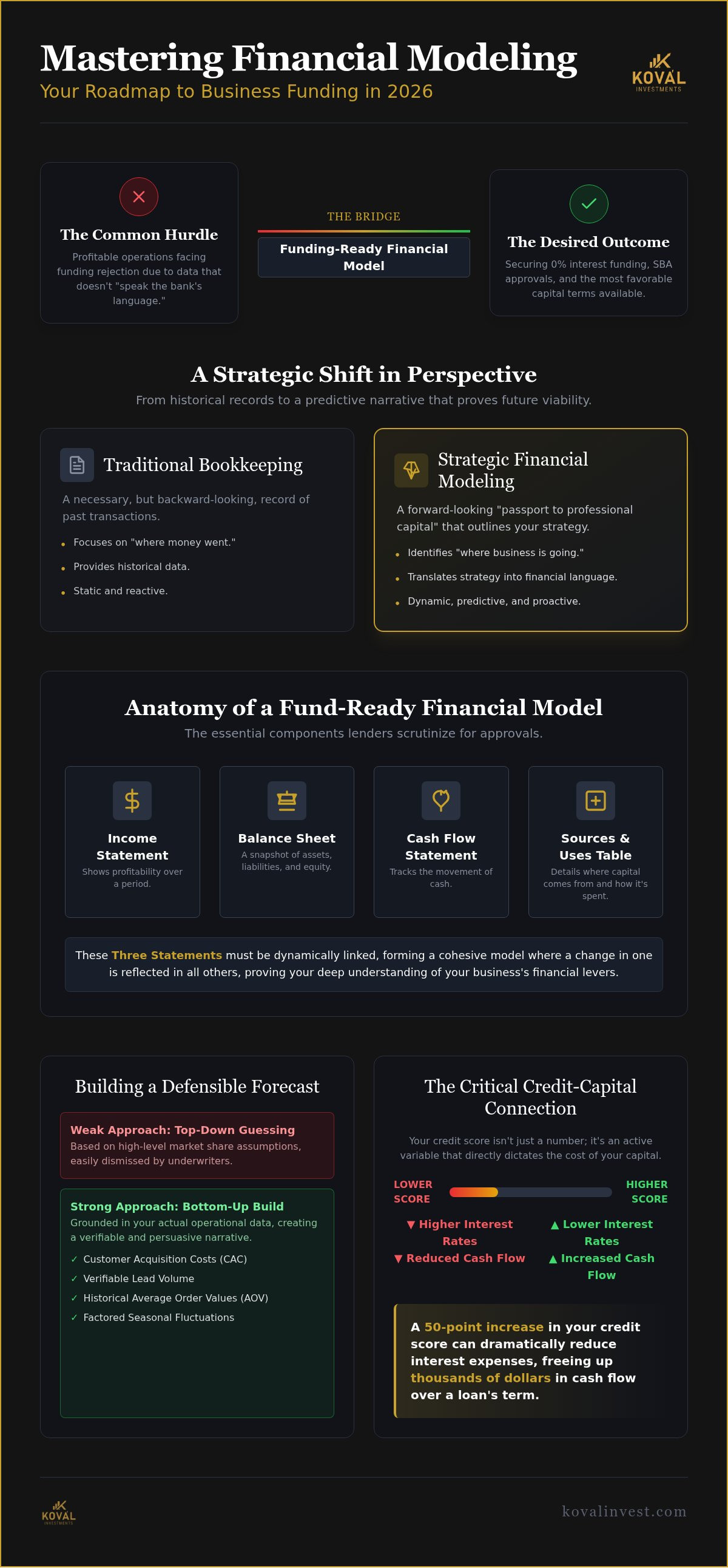
Financial modeling is far more than a complex spreadsheet of rows and columns. In the current 2026 capital market, it serves as a predictive narrative that translates your business strategy into a language lenders and investors understand. While bookkeeping provides a necessary record of where your money went, financial modeling for business funding looks forward. It identifies where your business is going and exactly how much fuel it needs to get there. Think of it as a strategic roadmap that proves your venture's viability before a single dollar is committed.
A well-constructed model acts as a passport to professional capital. Without it, you're effectively locked out of the most favorable tiers of financing. High-quality modeling distinguishes your business from the competition by demonstrating a deep understanding of your operational levers. It moves beyond simple fundability and into the territory of fund-ready financials. This level of preparation is a mandatory prerequisite for anyone seeking low-cost debt or strategic equity in a crowded marketplace.
Why Traditional Lenders Demand Projections
SBA and commercial lenders operate with a strict risk-mitigation mindset. They aren't just looking at your past success; they're scrutinizing your future capability to repay. A robust financial model proves your Debt Service Coverage Ratio (DSCR) viability by showing that your projected cash flow can comfortably handle new loan payments. By presenting clear, data-backed projections, you reduce the lender's perceived risk. This transparency often leads to faster approvals and more competitive terms because the lender can see a logical path to their return on investment. It shifts the conversation from your history to your potential.
The Shift to Strategic Capital Procurement
Effective modeling does more than just secure a standard loan. It helps you identify the need for alternative business funding solutions that might better suit your specific growth phase. For example, a precise model might reveal that your business qualifies for 0% interest opportunities or specific working capital lines that traditional bookkeeping would miss. By aligning your capital needs with specific operational milestones, you ensure that you aren't just getting money, but getting the right kind of money at the right time. This strategic approach turns funding from a stressful event into a calculated component of your long-term success.
Essential Components of a "Fund-Ready" Financial Model
The Three-Statement Model is the industry standard for 2026 funding, linking the income statement, balance sheet, and cash flow statement into a cohesive, dynamic tool. This integration ensures that every operational change, from hiring new staff to increasing inventory, is reflected across your entire financial health. Beyond these core statements, your application must include a clear "Sources and Uses" table. This section tells the lender exactly where the capital originates and how every dollar is spent, which builds immediate trust in your operational discipline.
Revenue Drivers and Operational Assumptions
Reliable financial modeling for business funding requires a bottom-up approach to revenue forecasting. Instead of guessing at market share, you should build your projections from the ground up using verifiable data points such as customer acquisition costs, lead volume, and average order values. This method provides a defensible logic that stands up to the scrutiny of bank underwriters. It's also vital to account for seasonal fluctuations in your working capital needs. A model that assumes linear growth often ignores the cash flow gaps that occur during inventory build-ups or slow quarters. Incorporating sanity checks against industry averages ensures your projections remain grounded in reality rather than optimism.
The Credit-Capital Connection
Most models overlook the direct relationship between credit health and capital cost. In 2026, your personal and business credit scores are not just checkboxes; they are active variables that dictate your interest rate assumptions. A 50-point increase in a credit score can dramatically reduce your interest expense over a five-year term, freeing up thousands of dollars in cash flow. If your scores are currently a hurdle, utilizing professional business credit repair services can directly improve the terms of your funding. This strategic improvement should be modeled to show lenders how your cost of capital will decrease as your profile strengthens.
Successful models also incorporate 0% interest introductory periods for business lines of credit. By forecasting these windows, you can plan aggressive growth phases while minimizing initial debt service burdens. This level of detail in your financial modeling for business funding demonstrates to lenders that you are a sophisticated borrower who understands how to leverage capital efficiently. If you are ready to align your data with these high-level strategies, partnering with Koval Investments can help you navigate the complexities of procurement and secure the most favorable terms for your business.
Tailoring Your Model to Specific Funding Vehicles
Every capital source views risk through a different lens, meaning your financial modeling for business funding must be customized to the specific vehicle you're pursuing. An SBA lender prioritizes long-term stability and collateral, while an unsecured funding provider focuses almost exclusively on your cash flow velocity and credit health. If you're seeking 0% interest business funding, your model needs a sharp focus on short-term liquidity. You must demonstrate that you can manage the repayment of introductory lines without compromising your operational cash reserves.
For companies seeking working capital to fuel growth, modeling the "burn rate" is essential. This calculation shows how quickly you're spending your cash reserves before reaching profitability or the next funding milestone. In contrast, real estate investors must pivot their modeling to focus on Loan-to-Value (LTV) and After-Repair Value (ARV). These metrics prove to the lender that the underlying asset provides enough equity to cover the debt even in a market downturn. By matching your model's outputs to the lender's specific requirements, you show a level of sophistication that builds immediate credibility.
Modeling for SBA Loan Assistance
When you seek SBA loan assistance, your financial model must address the specific underwriting standards of the Small Business Administration. These lenders look for a strong collateral coverage ratio and clearly identified secondary repayment sources. Your model should also compare the long-term impact of different loan structures. For instance, you might need to model the difference between SBA 7(a) vs 504 loans. The 7(a) is often better for general working capital, while the 504 is tailored for major fixed assets like real estate. Showing the impact of these specific debt schedules on your projected balance sheet is a critical step in the approval process.
Modeling for Unsecured and 0% Interest Capital
Unsecured capital models require a different strategy. Here, liquidity ratios and credit utilization take center stage because there is no physical collateral to seize. You'll need to model the "cycling" of credit lines, showing how you'll use and repay funds to maintain 0% interest status throughout the introductory period. This type of financial modeling for business funding emphasizes repayment velocity. It proves to the lender that your revenue is consistent enough to pay down balances quickly, which keeps your credit profile healthy for future rounds of capital. In this environment, your ability to manage debt-to-income ratios is more persuasive than the value of your equipment or inventory.
Step-by-Step: Building Your Funding Narrative
Constructing a model that wins over lenders requires a logical progression from historical facts to future potential. Start by gathering three years of historical tax returns and financial statements to establish a baseline of performance. This data serves as the anchor for your projections, proving that your future goals are rooted in past results. Once the foundation is set, you must identify your core value drivers. Metrics such as customer acquisition cost and churn rate are essential because they dictate the efficiency of your growth. If you can't explain the mechanics behind your revenue increases, a lender will assume your model is a guess rather than a strategic plan.
Your narrative gains significant credibility when you develop three distinct scenarios: Conservative, Most Likely, and Aggressive. This range demonstrates that you've considered multiple paths for your business and aren't relying on a "best-case only" outcome. It's also critical to stress-test your model against potential economic downturns or sudden interest rate hikes. A Stress Test identifies the minimum revenue needed to service debt, providing a clear safety margin for both you and the lender. This level of transparency shows that you're focused on long-term sustainability, which is a key requirement for successful financial modeling for business funding.
Scenario Analysis and Risk Mitigation
Building "What-if" scenarios for 2026 market changes is a powerful way to mitigate perceived risk. Lenders want to see that you have a "Plan B" for debt repayment if your primary revenue streams face unexpected pressure. Sensitivity analysis plays a key role here by proving business resilience under stress. By isolating variables like supply chain costs or shifts in consumer demand, you show that your business can remain profitable even when the environment is less than ideal. This proactive approach transforms your model from a simple prediction into a comprehensive risk-management tool that protects the lender's capital.
Presenting the Model to Lenders
A complex model is only useful if it's accessible and easy to interpret. Create a high-level executive summary that distills your findings into three or four key takeaways that align with the lender's goals. Use charts to visualize your data, specifically highlighting the "Inflection Point" where your growth accelerates beyond your initial capital investment. This visual evidence makes your case more persuasive and helps you prepare for the rigorous due diligence phase of the funding process. If you're ready to build a narrative that secures results, partner with Koval Investments to turn your business data into a funded reality.
Beyond the Spreadsheet: The Koval Investments Advantage
A sophisticated spreadsheet is a powerful tool, but it remains a static document without the right execution strategy. Professional strategic advisory bridges the critical gap between a theoretical model and a funded bank account. While software can generate projections, it cannot navigate the nuances of lender relationships or advocate for your business during a rigorous underwriting process. Koval Investments acts as a seasoned partner, ensuring that your financial modeling for business funding aligns perfectly with the current appetite of national lenders in 2026. This collaborative approach transforms your data into a compelling business case that commands attention.
When seeking expansion capital, accurate business valuation services are indispensable. A model that lacks a professional valuation often fails to capture the true worth of your intangible assets, such as brand equity or proprietary processes. By establishing a defensible valuation early, you provide lenders and investors with a clear benchmark for their ROI. This preparation is especially vital for businesses looking toward long-term exit strategies or mergers and acquisitions. We ensure your financial narrative supports not just your immediate funding needs, but also your ultimate goal of maximizing shareholder value.
Success-Based Capital Procurement
Our success-based philosophy eliminates the financial risk often associated with seeking capital. We believe a strategic partner should be as invested in the outcome as the business owner. This alignment means we only win when you secure the funding you need to scale. In the complex 2026 lending environment, we handle the heavy lifting of procurement, from identifying 0% interest opportunities to managing the synergy between credit restoration and capital access. This "insider" perspective allows you to focus on running your business while we ensure your financial profile meets the highest standards of fundability.
Strategic Planning for Long-Term Growth
Your financial model should serve as a living document that guides your most ambitious moves, such as using working capital for business acquisition. Strategic planning involves more than just keeping the lights on; it requires a roadmap for aggressive, sustainable expansion. Whether you're preparing for a future sale or looking to acquire a competitor, your financial modeling for business funding must reflect these high-level objectives. We help you build the resilience and transparency needed to attract premium offers and secure the best possible terms. Partner with experts who treat your growth as their own and turn your financial potential into tangible progress.
Transform Your Financial Data into Strategic Capital
Your business data is more than just a record of the past; it's the foundation of your future growth. By shifting your focus from simple bookkeeping to robust financial modeling for business funding, you create a narrative that lenders can trust. You've seen how a dynamic three-statement model provides the transparency underwriters demand and how optimizing your credit profile can significantly lower your long-term interest expenses. These strategic steps move you closer to the low-cost capital needed to scale your operations in 2026.
Building a fundable business doesn't have to be a solo journey. As national strategic advisory experts, we specialize in bridging the gap between complex models and actual capital procurement. Our success-based funding solutions ensure our goals are perfectly aligned with yours, providing a steady hand through every stage of the negotiation process. Secure Your 0% Interest Funding Strategy with Koval Investments and turn your financial projections into a tangible expansion plan. You have the vision; now it's time to back it with the professional precision your business deserves.
Frequently Asked Questions
What is the difference between a financial forecast and a financial model?
A forecast is a static prediction of future performance, while a model is a dynamic tool with adjustable inputs. A model allows you to change variables like pricing or volume to see the immediate impact on cash flow. In 2026, lenders require the flexibility of a model to test different scenarios. It's the difference between a single snapshot and a functioning simulation of your business operations that responds to changing market conditions.
How far into the future should my business funding model go?
Most business funding models should project three to five years into the future. The first twelve months should be broken down monthly to show short-term cash flow management. Subsequent years can be presented quarterly or annually. This timeframe proves you have a long-term vision while maintaining a tight grip on immediate operational needs. It's the standard window that SBA and commercial lenders use to assess your repayment capability and growth potential.
Do I need a financial model to qualify for an SBA loan in 2026?
Yes, a comprehensive financial model is a mandatory requirement for SBA loan approvals in 2026. Underwriters use these models to verify your Debt Service Coverage Ratio and ensure your business can handle the debt load. Without a forward-looking model that includes an income statement, balance sheet, and cash flow statement, your application will likely face rejection for lack of financial transparency. It's the primary tool lenders use for risk mitigation and validation.
Can financial modeling help me get 0% interest business funding?
Financial modeling for business funding is essential for securing 0% interest capital. It allows you to demonstrate that you have the cash flow velocity to repay introductory lines before higher interest rates kick in. By modeling your repayment schedule against revenue growth, you prove to lenders that you can manage the debt responsibly. This level of preparation often unlocks the most favorable terms by reducing the perceived risk of default during the initial introductory period.
What are the most common mistakes in financial modeling for business loans?
The most common mistakes include over-optimistic revenue projections and ignoring seasonal cash flow dips. Many business owners fail to account for the burn rate during growth phases, which leads to unexpected liquidity crises. Another frequent error is neglecting to include a Sources and Uses table. This table is critical because it tells the lender exactly how their capital will be deployed and where it fits within your overall financial structure and operational goals.
How does my credit score affect my business financial model?
Your credit score is a primary variable that dictates the interest rate assumptions in your model. In 2026, a higher score directly translates to lower debt service costs, which improves your projected net income and cash flow. If your current score is low, your financial modeling for business funding should reflect the higher cost of capital or include a plan for credit restoration. This integration shows lenders you understand how your personal financial health impacts business profitability.
Is it better to build a financial model in-house or hire a consultant?
While building in-house is possible, hiring a consultant provides an insider perspective that internal teams often lack. A professional partner understands specific lender appetites and current underwriting trends for 2026. They can bridge the gap between a technical spreadsheet and a persuasive funding narrative. Choosing a success-based partner ensures their interests are aligned with yours, as they only profit when your model successfully results in capital procurement and business growth.
What metrics do lenders look for most in a financial model?
Lenders prioritize the Debt Service Coverage Ratio, which measures your ability to cover loan payments with operating cash flow. They also scrutinize your liquidity ratios, such as the current ratio, to ensure you can meet short-term obligations. Finally, they look at your customer acquisition cost and lifetime value to judge the efficiency of your growth. These metrics provide a clear picture of your business health beyond simple top-line revenue numbers and historical tax returns.