
Fix Business Credit for a Loan: 2026 Strategic Guide
What if your company’s inability to secure an SBA loan has less to do with your annual revenue and everything to do with a credit profile that lenders simply don't trust? In a financial market where the prime rate sits at 6.75 percent as of August 2026, even a minor reporting error can force you into high interest alternative lending that drains your monthly cash flow. You've likely felt the frustration of being trapped by sub-prime scores or the confusion of how your personal finances are bleeding into your business evaluations. Understanding how to fix business credit to get a loan is no longer just a clerical task; it's a strategic necessity for any owner seeking to scale without the weight of predatory debt.
We believe that your credit profile should be a tool for growth, not a barrier to entry. This guide provides a methodical roadmap to help you master the dispute process and restructure your financial identity to meet strict 2026 underwriting standards. By following this step by step approach, you'll learn how to clean up your business profile to unlock SBA loans and access 0% interest capital. We will explore the nuances of global cash flow analysis and the specific actions you can take right now to transform a rejected application into a funded approval.
Key Takeaways
- Learn why repairing your credit profile is the essential first step to escaping high-interest debt and qualifying for prime capital.
- Master a systematic five-step framework to audit your reports and prioritize the removal of high-impact inaccuracies that suppress your score.
- Discover the "stair-stepping" dispute strategy and how to fix business credit to get a loan by using evidentiary support instead of generic templates.
- Understand the specific "funding-ready" checklist required to unlock 2026 SBA loan approvals and 0% interest funding solutions.
- Explore how a success-based partnership model can align your credit restoration efforts with your long-term strategic growth objectives.
Why Your Business Credit Score Is the Gatekeeper to Capital
Business credit represents your company’s financial reputation in the eyes of the market. It is a numerical assessment that lenders, suppliers, and insurance providers use to determine the level of risk your business presents. When you're researching how to fix business credit to get a loan, you're essentially looking for ways to prove that your company is a reliable partner that honors its obligations. In 2026, this profile is more than just a score; it is the primary filter that determines whether you access prime capital or remain trapped in a cycle of expensive debt.
The "funding gap" is a reality for many entrepreneurs whose credit profiles don't meet the stringent standards of traditional institutions. When your score falls below certain thresholds, you're often rejected by banks and forced toward predatory lenders who charge exorbitant rates. With the prime rate currently at 6.75 percent, the margin for error has narrowed. Traditional banks have tightened their lending standards, making a clean credit profile the absolute prerequisite for any meaningful capital procurement. Understanding the nuances of understanding your business credit report is the first step in bridging this gap and positioning your firm for long term success.
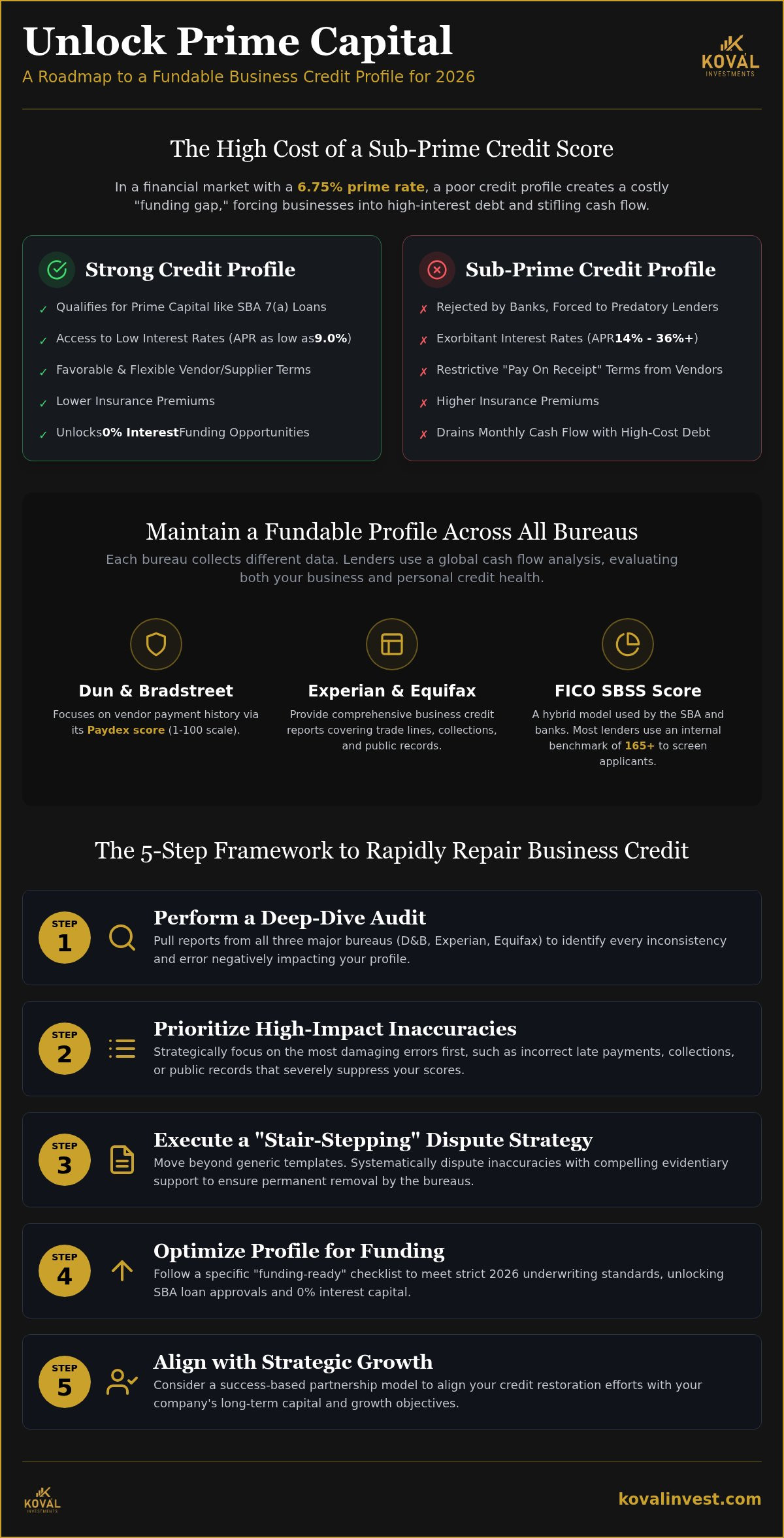
Lenders look at different metrics depending on the type of funding you seek. For instance, Dun & Bradstreet’s Paydex score focuses almost exclusively on your payment history with vendors, scoring you on a scale of 1 to 100. Conversely, the FICO Small Business Scoring Service (SBSS) is a hybrid model that the SBA and many banks use to evaluate creditworthiness. While the SBA officially ended the mandatory minimum SBSS score of 165 in March 2026, most lenders still use this internal benchmark to screen applications. If you don't meet these specific underwriting standards, your path to funding will remain blocked.
The Real Cost of Sub-Prime Business Credit
The financial impact of a poor credit score is most visible in the interest rate spread. A business with a strong profile might qualify for an SBA 7(a) loan with an APR as low as 9.0 percent. In contrast, a company with sub-prime credit might be limited to online lenders where rates frequently range from 14 percent to 36 percent. This difference can cost your business tens of thousands of dollars in annual interest. Furthermore, poor credit limits your access to alternative business funding solutions that offer more flexible terms. Beyond loans, a weak score often results in higher insurance premiums and restrictive "pay on receipt" terms from vendors, which can severely stifle your daily cash flow. Mastering how to fix business credit to get a loan is the most effective way to eliminate these hidden costs.
Bureaus You Must Monitor: D&B, Experian, and Equifax Business
Maintaining a fundable profile requires active monitoring of the three major agencies: Dun & Bradstreet, Experian Business, and Equifax Small Business. Each bureau collects different data points, meaning an error on one report might not appear on the others. It's also vital to recognize that for "personally guaranteed" loans, your personal credit health remains a critical factor. Lenders in 2026 increasingly use global cash flow analysis, which considers both your business performance and your personal household debt. The SBA plays a pivotal role here by setting the eligibility requirements that banks must follow, making it essential that your profiles across all bureaus are accurate, consistent, and optimized for high level scrutiny.
The 5-Step Framework to Rapidly Repair Business Credit
Repairing business credit isn't just about deleting negative items; it's about a tactical restructuring of your company's financial identity. Successfully learning how to fix business credit to get a loan requires a methodical approach that addresses both historical errors and future reporting potential. We view this process as a collaborative effort to move your profile from a liability to an asset that attracts prime capital. To achieve this, you must follow a structured framework that prioritizes the most impactful changes first.
- Step 1: Perform a deep-dive audit. You must pull reports from Dun & Bradstreet, Experian Business, and Equifax Small Business to identify every inconsistency.
- Step 2: Prioritize high-impact inaccuracies. Focus on late payments, collections, or judgments that are incorrectly reported, as these carry the most weight in scoring algorithms.
- Step 3: Lower credit utilization ratios. Aim to keep your revolving business credit usage below 30 percent. High utilization signals financial distress to underwriters.
- Step 4: Establish new tradelines. Open accounts with vendors and suppliers that report to the bureaus immediately to build a positive payment history.
- Step 5: Synchronize business data. Ensure your business name, address, and phone number are identical across all public records, including the Secretary of State and your credit files.
Implementing these steps correctly is often the difference between a rejection letter and a successful capital raise. If you're looking for a partner to manage this complexity, our credit repair services are designed to align with your specific funding goals through a success-based model.
Auditing Your Reports for "Low-Hanging Fruit"
The first stage of credit restoration involves identifying simple administrative errors that trigger red flags. Look for outdated addresses, mismatched business names, or "zombie" accounts that should have aged off your report. A single incorrect industry code can lead to an automatic loan denial if it misidentifies your business as being in a high-risk sector. These errors are common but easily corrected with the right documentation. You should also ensure your Standard Industrial Classification (SIC) and North American Industry Classification System (NAICS) codes are accurate to avoid being filtered out by automated underwriting systems.
The Importance of LexisNexis and UCC-1 Filings
Underwriters look beyond just your credit score; they examine your public record footprint through databases like LexisNexis. Uniform Commercial Code (UCC) filings act as a lien on your credit profile, signaling to other lenders that your assets are already pledged as collateral. If you've paid off a loan but the lender failed to file a UCC-3 termination statement, your profile will appear over-leveraged. You must proactively manage these filings to ensure satisfied liens are correctly marked as "released." Cleaning up these public records is a critical component of how to fix business credit to get a loan, as it reduces your perceived risk and improves your debt-to-credit standing.
Disputing Inaccuracies and Managing Debt-to-Credit Ratios
Executing a successful dispute requires moving beyond the generic "fill in the blank" templates found online. Credit bureaus and creditors process thousands of automated requests daily; they've become adept at flagging and dismissing templated letters as frivolous. To effectively address how to fix business credit to get a loan, you must craft custom dispute letters backed by concrete evidentiary support. This might include cancelled checks, bank statements, or correspondence from the creditor that contradicts the bureau's data. Providing a clear, logical argument makes it significantly harder for an investigator to verify a false negative item.
We recommend a "stair-stepping" strategy for your disputes. Rather than challenging ten items at once, which often triggers an automatic rejection for being suspicious, focus on two or three high impact errors in each thirty day cycle. This methodical approach builds a credible history of corrections and ensures each item receives the attention it deserves. It is also a vital time to request credit limit increases on your existing accounts. Many creditors will grant these increases based on your internal payment history without performing a "hard pull" on your credit, which immediately improves your available credit without the temporary score dip associated with a new inquiry.
Your debt-to-credit ratio is often the hidden factor that causes sudden, unexpected score drops. Even if you pay every bill on time, a high balance relative to your limit signals to lenders that your business is over-leveraged. Underwriters view high utilization as a sign of cash flow instability. Managing this ratio is a critical part of the process when you're learning how to fix business credit to get a loan, as it demonstrates operational efficiency and financial discipline.
The Art of the Strategic Dispute
Determining whether to contact the creditor or the bureau first depends on the nature of the error. If a vendor has simply failed to update a payment status, reaching out to them directly can often resolve the issue faster than a bureau investigation. Regardless of the route you take, maintaining a meticulous paper trail is non-negotiable. These records are essential when seeking SBA loan assistance, as bank underwriters may ask for proof that a previous delinquency was corrected. For legitimate negative items that cannot be deleted, focus on adding a concise consumer statement to your report to provide context for the event while you work on offsetting it with new, positive tradelines.
Optimizing Credit Utilization for Maximum Score Lift
Targeting a utilization rate below 30 percent on every business line of credit is a primary driver for rapid score improvement. If your balances are high, consider a "balance transfer" strategy where you move business debt to non-reporting accounts or personal lines that don't appear on business credit reports. This move effectively hides the debt from business lenders and lowers your reported utilization overnight. Maxed out credit cards can lower a FICO SBSS score significantly even if payments are on time, as the algorithm views high utilization as a high risk indicator of cash flow instability. By strategically shifting these balances, you create the appearance of a much stronger, more fundable profile.
Optimizing Your Profile for SBA and 0% Interest Funding
Once you've addressed the technical errors on your reports, the focus shifts to strategic optimization. Knowing how to fix business credit to get a loan is only half the battle; you must also ensure your profile meets the specific appetite of prime lenders. For those seeking 0% interest business funding, the requirements are exceptionally high. Lenders in this space look for a pristine combination of low personal credit utilization and a robust business history. Because this funding is often unsecured, your credit profile acts as the primary collateral.
A truly "funding-ready" business maintains a Debt Service Coverage Ratio (DSCR) of at least 1.25, with 1.35 considered strong in the 2026 market. While your score gets you through the door, your financial statements prove you have the capacity to repay. You should prepare tax returns, profit and loss statements, and balance sheets that reflect the same stability shown in your credit reports. If you're deciding between SBA 7(a) vs 504 loans, remember that the 504 program often has more rigid requirements regarding the use of proceeds for fixed assets, whereas the 7(a) is more flexible for working capital. Aligning your repair efforts with these specific loan purposes ensures you don't waste time on applications that don't fit your business model.
The Path to 0% APR Capital
Acquiring 0% APR capital requires a surgical approach to credit applications. If you apply for multiple cards or lines simultaneously, you create "inquiry clusters" that signal desperation to underwriters and can trigger an immediate score drop. Instead, sequence your applications over several months to maintain score stability. This type of capital is a powerful tool for rapid scaling. It allows you to reinvest your revenue directly into growth without the burden of interest payments during the initial phase of your project. We often see clients use this as bridge funding while their long term SBA applications are in process.
Meeting SBA Underwriting Standards
SBA underwriting remains a holistic process that goes beyond simple numbers. While the FICO SBSS score is a primary filter, lenders also evaluate your "character" through background checks and your "capacity" through rigorous cash flow analysis. Most SBA lenders in 2026 look for a personal credit score of at least 640 to even consider the file. Utilizing professional business credit repair services can significantly expedite this process by ensuring your file is submitted correctly the first time. We specialize in navigating these complex requirements to ensure your application stands out in a competitive lending environment. If you're ready to transition from credit repair to capital procurement, contact Koval Investments to discuss our success-based funding solutions.
Scaling with Professional Credit Optimization Services
There is a fundamental difference between basic credit repair and strategic financial optimization. While repair focuses on correcting past mistakes, optimization focuses on building a profile that meets the specific future requirements of institutional lenders. When you are determining how to fix business credit to get a loan, the objective isn't just a higher numerical score. The real goal is a fundable identity that survives the rigorous, manual scrutiny of a bank's underwriting team. A professional approach ensures that every aspect of your financial reputation is aligned with the capital you intend to raise.
Koval Investments operates on a success-based model, which creates a natural partnership between our firm and your business. We don't act as a distant service provider; instead, we function as a strategic advisor invested in your ultimate outcome. Having a consultant who understands the "lender's side" of the desk allows you to anticipate red flags before they trigger a rejection. This perspective is vital when transitioning from the repair phase to active capital procurement. Whether you are seeking working capital for a strategic acquisition or scaling your current operations, an optimized profile provides the leverage needed to negotiate prime terms.
Why DIY Credit Repair Often Fails for High-Limit Loans
Many entrepreneurs attempt a DIY approach only to find that business credit doesn't follow the same rules as personal credit. While personal reports are governed strictly by the Fair Credit Reporting Act (FCRA), business credit bureaus have more latitude in how they report and verify data. This complexity often leads to "temporary" score bumps that disappear during the final stages of a loan closing, potentially derailing your funding at the last minute. Professional optimization leverages expert networks to access private funding sources and ensures that your score improvements are permanent and verifiable. We focus on the underlying data health to ensure your profile remains stable under high-level scrutiny.
Your Partnership for Long-Term Growth
Maintaining a clean credit profile is not a one-time event; it's a core component of your long-term strategic business plan. Ongoing monitoring and optimization protect your ability to secure specialized capital, such as funding for real estate investors, where speed and reliability are paramount. By integrating credit health into your operational framework, you ensure that your business is always ready to capitalize on new opportunities as they arise. We provide the steady hand and industry expertise required to navigate these complex financial landscapes alongside you. If you're ready to move beyond basic repair and build a truly fundable business, schedule a consultation with Koval Investments to optimize your funding profile today.
Securing Your Company's Financial Future
Transforming your business credit profile from a liability into a strategic asset is the most significant move you can make for your firm's long term health. We've explored the tactical steps of auditing reports and managing debt to credit ratios; however, the true value lies in the doors that open once your profile is optimized. By mastering the nuances of how to fix business credit to get a loan, you position your company to bypass predatory rates and secure the prime capital required for sustainable scaling.
Our national strategic advisory team specializes in bridging the gap between credit restoration and capital procurement. We bring deep expertise in SBA loan assistance and 0% APR funding solutions, ensuring your business is always fundable and ready for growth. With our success based results and boutique approach, we act as a steady partner in your financial journey. It's time to stop reacting to credit challenges and start proactively building the capital profile your business deserves.
Access 0% Interest Funding and Professional Credit Optimization with Koval Investments
Frequently Asked Questions
How long does it take to fix business credit before I can apply for a loan?
Most business owners see significant results within three to six months of starting the restoration process. Each dispute cycle with bureaus like Experian or Dun & Bradstreet takes approximately 30 days to conclude. If you're learning how to fix business credit to get a loan, you should account for at least two or three cycles to ensure all high impact errors are permanently removed before submitting your application.
Can I get an SBA loan with a 600 credit score if I fix my business credit?
Securing an SBA loan with a 600 score is highly unlikely even if your business credit is perfect. In 2026, most SBA lenders require a personal credit score of at least 640 to pass initial screening. While improving your business profile is essential, you must also address personal credit deficiencies to meet the global cash flow requirements that underwriters use to evaluate risk.
What is the fastest way to increase my business credit score for a 0% interest loan?
The fastest way to boost your score for 0% interest funding is to aggressively lower your revolving credit utilization below 30 percent. You should also add at least three new tradelines from vendors that report to the bureaus immediately. This combination of reducing debt ratios and increasing positive payment history creates the rapid score lift needed to qualify for unsecured, interest free capital.
Does personal credit repair help my business get a loan?
Personal credit repair is a critical component of securing business financing because most small business loans require a personal guarantee. Lenders use a global cash flow analysis to look at your entire financial picture. If your personal score is suppressed by high utilization or old delinquencies, it can lead to a rejection regardless of how strong your business credit profile appears.
What are the most common errors found on business credit reports?
The most common errors include incorrect industry codes, mismatched business addresses, and outdated UCC-1 filings. Many reports also contain "zombie" accounts that should have aged off or satisfied liens that are still marked as active. These clerical mistakes can lead to automatic denials because they misrepresent your company's risk level to automated underwriting systems.
Is it better to fix business credit myself or hire a professional service?
While you can handle basic disputes yourself, professional services are often more effective for high stakes capital procurement. Experts understand the specific underwriting standards for 2026 and can navigate the complexities of business credit laws that differ from personal consumer protections. A professional partner helps you avoid the "temporary" score bumps that often fail during the manual review of a loan closing.
How much will my business credit score improve after removing a UCC-1 filing?
Removing an outdated or satisfied UCC-1 filing doesn't always result in a specific point increase, but it dramatically improves your "fundability" in the eyes of a lender. A UCC-1 filing acts as a lien, signaling that your assets are already pledged as collateral. Clearing these filings shows underwriters that your business has more unencumbered assets, which is a key factor in how to fix business credit to get a loan.
What credit score do lenders look at for 0% interest business funding in 2026?
For 0% interest business funding in 2026, lenders typically look for a personal credit score between 680 and 720. They also require a clean business credit profile with no recent delinquencies and low utilization. Because this funding is often unsecured, your creditworthiness serves as the primary security for the loan, making both personal and business scores equally important.