
How Much Is My Business Worth? The Strategic Guide to Business Valuation in 2026
What if your business's market value was more than just an exit number, but a direct gateway to interest-free capital today? Most entrepreneurs treat valuation as a final scorecard, yet in 2026, it's actually your most powerful tool for strategic leverage. You might feel uncertain about how the "One, Big, Beautiful Bill Act" impacts your bottom line or fear that messy financial records are hiding your true worth. It's a common concern when you're trying to figure out how to increase business valuation to attract better offers or secure better terms from lenders.
We understand that you want a clear dollar-value estimate and a methodical roadmap for the future. In this guide, you'll discover the exact methods professionals use to value a company and learn how to leverage that value to secure 0% interest funding for long-term growth. We'll explore current EBITDA multiples, the new $10 million SBA loan limits, and the success-based framework needed to unlock capital. This approach moves beyond simple formulas to provide a path toward tangible progress and operational efficiency.
Key Takeaways
- Understand why a professional valuation is the essential foundation for strategic growth and securing SBA loan assistance in 2026.
- Master the three core valuation methods-Income, Market, and Asset-based-to ensure an accurate, weighted estimate of your company's true worth.
- Discover practical steps on how to increase business valuation by recasting earnings and cleaning up financial statements for the last three years.
- Learn how industry-specific multipliers and proprietary operational systems can act as a "secret sauce" to significantly boost your market position.
- Leverage your professional valuation as a proof of concept to unlock 0% interest business funding and long-term capital for expansion.
Why Knowing Your Business Worth is the Foundation of Strategic Growth
Business valuation is the systematic process of determining the economic value of an entire business or a specific unit. It isn't just a static number on a page. Instead, it represents the cumulative potential of your operations, assets, and future cash flows. For many owners, this figure serves as the critical metric for securing SBA loan assistance. With the combined SBA 7(a) and 504 loan limits recently increased to $10 million in July 2026, having an accurate valuation is more important than ever for accessing high-level capital.
A professional valuation provides the baseline data needed to build a roadmap for growth. By identifying your current standing, you can pinpoint specific operational areas that need improvement. This clarity is the first step in learning how to increase business valuation to attract premium investors or lenders. In the current market, valuation acts as a vital benchmark. It allows you to measure the effectiveness of your strategic planning over time. If your initiatives don't move the needle on your company's worth, your strategy may need adjustment.
The 2026 market requires a nuanced approach. Simple revenue multiples are no longer enough. Factors like the "One, Big, Beautiful Bill Act" (OBBBA) have changed how we look at tax deductions and depreciation, which directly impacts your expected cash flows. Understanding The Three Primary Business Valuation Methods helps you see how these external variables influence your internal worth and long-term stability.
The Difference Between Price and Value
Value is what your business is worth based on its fundamentals, while price is what a buyer actually pays. A significant gap often exists between these two numbers. This discrepancy usually stems from factors like the buyer’s urgency or a unique strategic fit that adds "synergy" value. Professional business valuation services use objective data to bridge this gap. They ensure you don't leave money on the table by confusing your intrinsic worth with a low-ball offer. Knowing your baseline helps you identify exactly how to increase business valuation before you ever sit down at the negotiating table.
When Should You Value Your Business?
You shouldn't wait for an exit to run the numbers. Annual health checks are essential for tracking growth and your return on investment. These regular updates help you spot trends early and adjust your operations to maximize equity. Valuation is also a prerequisite for mergers and acquisitions or when a partner seeks a buyout. Finally, a certified valuation is often required when you apply for high-limit alternative business funding solutions. It proves your company's stability to lenders and provides the confidence needed to secure competitive rates.
The Three Primary Business Valuation Methods Used by Professionals
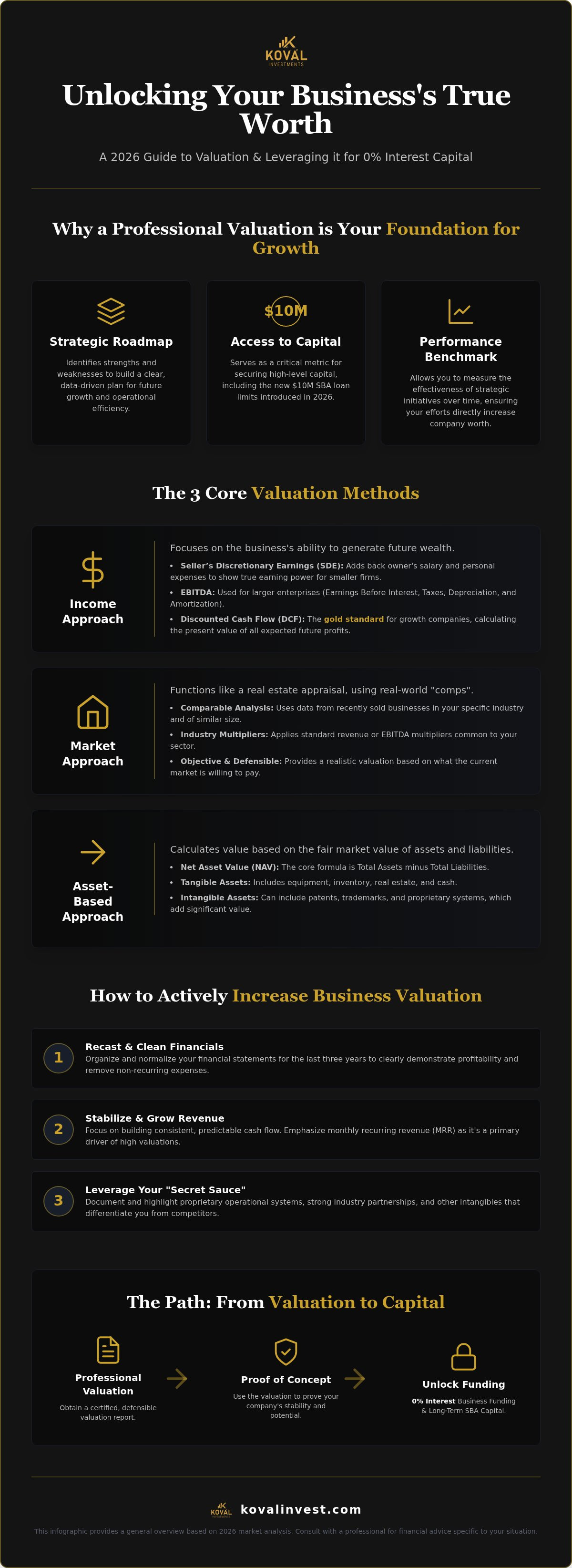
Professional appraisers rarely rely on a single formula to determine a company's worth. Instead, they typically use a weighted average of three core approaches to provide a balanced and defensible figure. This comprehensive perspective is vital for capital procurement, as lenders often scrutinize the methodology behind your numbers before approving high-limit funding. The Discounted Cash Flow method serves as the gold standard for growth-stage companies because it calculates the present value of all expected future profits.
The Income Approach: Profit Potential and Cash Flow
This method focuses on the business's ability to generate wealth. For small to mid-sized firms, we often look at Seller’s Discretionary Earnings (SDE), which adds back the owner’s salary and personal expenses to show true earning power. Larger enterprises typically use EBITDA (Earnings Before Interest, Taxes, Depreciation, and Amortization). To determine current value, we project these earnings into the future and discount them back to today's dollars using a specific rate. Consistent, predictable cash flow remains the primary driver of high valuations. If you're looking for how to increase business valuation, stabilizing your monthly recurring revenue is often the fastest path to success.
The Market Approach: Real-World Comparables
Think of the market approach like a real estate appraisal. It uses "comps" from recently sold businesses in your specific industry. This strategic guide to business valuation from the U.S. Chamber of Commerce highlights that market pricing often relies on industry-specific multipliers applied to revenue or SDE. However, 2026 market volatility requires caution. Shifts in interest rates and consumer behavior mean that a multiplier used six months ago might not apply today. We analyze current transaction data to ensure your valuation reflects the reality of the present landscape.
The Asset-Based Approach: Calculating Net Worth
This method is straightforward: it sums up all tangible assets, such as equipment and real estate, and subtracts all liabilities. While this is the preferred method for asset-heavy industries like manufacturing or in liquidation scenarios, it has significant limitations. It often ignores intangible value, such as brand equity, proprietary systems, and customer goodwill. Relying solely on assets can result in an undervalued business if your primary strength lies in intellectual property or service excellence.
Understanding these methods is the first step toward optimization. If you need a clear picture of your company's standing, our team can provide a professional business valuation tailored to your specific industry benchmarks. By analyzing which method highlights your strengths, you can better understand how to increase business valuation before seeking external capital.
Multipliers, Intangibles, and Industry Benchmarks in 2026
A multiplier is the numerical factor applied to your company's earnings, such as EBITDA or SDE, to determine its total market value. While the valuation methods discussed previously provide the mathematical framework, the multiplier reflects the market's perception of your future potential and inherent risk. If you're researching how to increase business valuation, understanding your industry multiplier is the first step toward a higher exit price. In the current 2026 economic climate, these figures are influenced by the "One, Big, Beautiful Bill Act," which has revived 100% bonus depreciation and permanent tax deductions, effectively increasing the net cash flow buyers can expect.
Multipliers vary drastically by sector based on historical stability and growth projections. For businesses in the lower-middle market with EBITDA between $1 million and $25 million, typical 2026 benchmarks include:
- Home Services: 4x to 6x EBITDA
- Manufacturing: 5x to 7x EBITDA
- Professional Services: 4x to 7x EBITDA
- Healthcare Services: 5x to 9x EBITDA
- SaaS and Tech: 7.2x to 7.5x (Private Equity average), with high-growth firms reaching significantly higher.
The Power of Recurring Revenue
Predictability is the "secret sauce" that commands a premium multiplier. A business with $1 million in annual revenue from 500 subscribers is inherently more valuable than one with $1 million from a few large, one-off contracts. This is because subscription models mitigate the risk of sudden revenue drops. This transition is one of the most reliable ways for an owner to discover how to increase business valuation without necessarily doubling their sales volume. We also look closely at customer concentration. If a single client represents more than 15% of your total revenue, buyers will likely apply a "discount" to your multiplier to account for the risk of that client leaving.
Intangible Assets: Brand, Talent, and IP
Intangibles often represent the gap between a business that just pays the bills and one that is a market leader. Goodwill, which encompasses your brand reputation and customer loyalty, is a major driver of value that doesn't always show up on a balance sheet. A strong management team is equally vital. If the business can't function for a month without the owner's daily involvement, the valuation will suffer. Finally, protecting your intellectual property, such as proprietary software or unique operational systems, ensures that your market position is defensible. These elements transform a standard operation into a high-value strategic asset.
How to Increase Business Valuation: Preparation and Optimization
Preparing your company for a formal appraisal is a methodical process that begins long before you invite a buyer or lender to the table. Most entrepreneurs leave money on the table because they haven't optimized their internal records to reflect their company's true performance. If you're serious about learning how to increase business valuation, your first task is a comprehensive cleanup of your Profit and Loss (P&L) statements and Balance Sheets for the last three years. Messy books suggest operational chaos, which increases the perceived risk and lowers your multiplier.
Recasting Financials for Maximum Impact
Recasting, or "normalizing," your financials is the process of adjusting your earnings to show what the business would look like under new ownership. This involves identifying specific "add-backs" that won't necessarily be expenses for a future buyer. Common examples include your own salary, one-time legal fees, or personal perks like a company vehicle. By presenting a normalized view of your earnings, you provide a more accurate picture of the company's cash-generating power. Transparency is your greatest asset here. When you provide clear documentation for every adjustment, you build the trust necessary to defend a higher asking price.
The Role of Credit in Business Worth
A hidden value killer that many owners overlook is a weak business credit profile. Lenders and savvy investors look at your company's creditworthiness as a proxy for operational risk. Utilizing business credit repair services can directly improve your risk profile, making your business more attractive to institutional capital. Lenders often evaluate both the business valuation and the owner's personal credit score during the underwriting process. Fixing errors on your credit reports can lower your cost of capital. This reduction in interest expense directly increases your net profit, which is a fundamental way to understand how to increase business valuation.
The final step in your preparation should be a mock valuation. This "dry run" helps you identify structural weaknesses, such as high customer concentration or aging equipment, before you officially go to market. By addressing these issues early, you can optimize your operations and present a polished, high-value asset to potential partners. If you're ready to see exactly where your company stands, our team can help you start your strategic valuation process today to ensure no value is left behind.
Leveraging Your Valuation to Secure 0% Interest Funding and SBA Capital
A professional valuation is far more than a vanity metric. It's a "proof of concept" that tells lenders your business is a reliable, high-performing asset. When you provide a certified valuation, you remove the guesswork from the underwriting process. This transparency is exactly how to increase business valuation in the eyes of a lender, as it demonstrates a level of operational maturity that unorganized firms simply lack. By presenting a clear picture of your equity, you position yourself to access the 0% interest business funding solutions that have become the ultimate growth tool for savvy owners in 2026.
This data is also critical when navigating the complexities of SBA 7(a) vs 504 loan options. With the combined SBA loan limits recently raised to $10 million in July 2026, a higher valuation allows you to justify larger capital requests for real estate or major equipment purchases. Koval Investments acts as your strategic partner throughout this journey. We bridge the gap between your current valuation and the capital you need to scale, ensuring your financial profile is optimized for the best possible terms.
Valuation as a Tool for Capital Procurement
Many owners don't realize that a strong business worth can serve as informal collateral for unsecured funding options. When you can prove your company's intrinsic value, you significantly reduce the lender's perceived risk. This lowered risk profile often translates into higher credit limits and lower interest rates across the board. Koval’s success-based philosophy ensures our interests are perfectly aligned with your high-value business goals. By focusing on the win-win, we help you secure the liquidity needed to execute your strategic vision without unnecessary financial exposure.
Strategic Planning for Future Exit
The most effective way to prepare for a lucrative exit is to use your current valuation to acquire competitors or complementary firms. Utilizing working capital for business acquisition is a proven strategy to scale your operations rapidly. This inorganic growth is another key answer to how to increase business valuation before a final sale. Our mergers and acquisitions consulting provides the long-term perspective needed to ensure every acquisition adds tangible value to your bottom line. If you're ready to unlock your company's full potential, contact Koval Investments for a professional business valuation and funding strategy.
Transform Your Business Worth into Strategic Capital
Understanding your company's economic value provides the clarity needed to navigate 2026's complex financial landscape. By mastering professional valuation methods and addressing operational gaps, you've taken the first step toward long-term growth. We've explored how cleaning your financials and optimizing your credit profile are essential actions when you want to learn how to increase business valuation. These steps don't just prepare you for a future exit; they unlock immediate opportunities for interest-free capital and acquisition-led expansion.
Koval Investments is here to act as your seasoned strategic partner. We combine expert M&A and valuation consulting with a success-based, win-win philosophy to ensure your objectives are met with precision. Whether you're aiming to justify a high-limit SBA loan or want to leverage our 0% interest funding solutions, we provide the steady hand needed in modern markets. Get Your Professional Business Valuation and Funding Strategy Today. Your business has untapped potential, and we're ready to help you realize it.
Frequently Asked Questions
How much does a professional business valuation cost in 2026?
Professional valuation costs vary based on the size and complexity of your organization. A small service firm requires less intensive analysis than a multi-state manufacturing company with significant tangible assets. Most reputable firms provide a custom quote after an initial consultation to ensure the appraisal's scope matches your strategic needs. This process ensures the final report is defensible to lenders when you are seeking high-limit capital or preparing for a merger.
Can I value my business based on revenue alone?
You shouldn't rely on revenue alone because it doesn't account for profitability or operational efficiency. While some sectors use revenue multipliers as a shorthand, professional valuations prioritize earnings metrics like EBITDA or SDE. Revenue figures ignore high overhead costs and debt obligations, which can drastically lower your actual market value. Focusing on net profit is a more reliable strategy for those learning how to increase business valuation before a sale.
How does my personal credit score affect my business worth?
Your personal credit score doesn't change your company's intrinsic value, but it significantly impacts your risk profile in the eyes of lenders. A lower score often leads to higher interest rates on debt, which reduces your net profit and cash flow. Improving your credit standing is a foundational step in how to increase business valuation, as it lowers your cost of capital and makes your business more attractive to institutional investors.
What is the most common reason for a business being undervalued?
The most common reason for undervaluation is a lack of clean, transparent financial records. When buyers or lenders encounter disorganized books, they apply a higher risk discount to your multiplier to protect themselves. Other common value killers include high customer concentration and a business model that is too dependent on the owner's daily involvement. Addressing these operational weaknesses before a formal appraisal ensures you receive a figure that reflects your true worth.
How long does the business valuation process typically take?
A standard professional valuation typically takes between two to four weeks to complete. The timeline depends largely on how quickly you can provide three years of tax returns, P&L statements, and balance sheets for review. More complex cases involving proprietary technology or specialized equipment might require additional time for market research and site visits. Starting this process early allows you to identify how to increase business valuation before you officially enter negotiations.
Is an SBA loan valuation different from a market valuation?
Yes, an SBA loan valuation must follow specific guidelines required by the Small Business Administration to ensure the loan is adequately collateralized. While it uses similar income-based methods, the focus is heavily on debt service coverage and asset stability. A market valuation is often broader, accounting for strategic synergies and future growth projections that a bank might consider too speculative during a standard lending or underwriting process.
Can I use a business valuation to get 0% interest funding?
You can certainly use a professional valuation as a proof of concept when applying for 0% interest funding solutions. It demonstrates to lenders that your business has the equity and cash flow necessary to manage unsecured debt responsibly. By proving your company's market worth, you reduce the perceived risk for the lender. This transparency often allows you to access higher credit limits and more favorable introductory terms for interest-free working capital.
What industry has the highest valuation multipliers right now?
The technology and financial services sectors currently command the highest valuation multipliers as of late 2026. High-growth SaaS companies often see EBITDA multiples between 7.2x and 7.5x, while specialized semiconductors can reach even higher benchmarks. These industries are favored for their scalability and recurring revenue models. Investors and lenders prioritize these sectors because they provide the long-term stability and predictable cash flows that are highly valued in the current economic environment.