
How to Increase Business Valuation: 2026 Strategic Guide
What if the true value of your company has less to do with your current revenue and more to do with how easily a buyer could replace you? Many founders spend years building a profitable enterprise only to realize that their own involvement is actually a liability in the eyes of a strategic acquirer. Understanding how to increase business valuation requires looking past the balance sheet and focusing on transferable risk. In a 2026 market where global M&A deal values are projected to reach $4 trillion, the gap between a standard business and a premium asset has never been wider.
It is natural to feel uncertain about how external buyers perceive your company's worth, especially if growth has felt stagnant or the business feels too dependent on your daily input. This guide provides a strategic roadmap to help you boost your valuation by 20% to 50% through operational efficiency and smarter capital structures. We will explore how to pull specific financial levers, such as using 0% interest funding to accelerate growth, and how to optimize your internal systems so the business can thrive without you at the helm.
Key Takeaways
- Learn why shifting from one-off sales to recurring revenue models significantly improves your industry multiple and attracts higher-quality buyers.
- Discover how to increase business valuation by identifying financial "add-backs" that reveal your true profitability to potential acquirers.
- Implement the "Vacation Test" to build an operationally independent company that functions and grows without your daily involvement.
- Leverage strategic credit optimization and 0% interest funding to lower your cost of capital and directly boost your bottom-line EBITDA.
- Understand why annual professional valuations serve as a critical management tool for long-term strategic planning and successful exit preparation.
Understanding the Fundamentals of Business Valuation
Business valuation represents the total economic value of a whole business entity. It isn't just a static number on a tax return; it's a dynamic assessment of what a willing buyer would pay for the rights to your future cash flows. If you're exploring how to increase business valuation, you must first view your company as an investment asset rather than just a source of personal income. This shift in perspective is the foundation of any successful exit or growth strategy.
The metrics used to measure value often change as a company grows. Smaller, owner-operated businesses typically use Seller’s Discretionary Earnings (SDE). This figure includes net profit plus the owner's salary, benefits, and non-essential expenses. As a business scales toward the middle market, buyers transition to EBITDA (Earnings Before Interest, Taxes, Depreciation, and Amortization). This metric is preferred by institutional investors because it strips away the specific financing and tax structures of the current owner to show the core earning power of the operation.
Valuation remains a critical management tool even if you don't plan to sell this year. It provides a clear benchmark for your strategic progress and directly impacts your borrowing power. In the 2026 financial climate, with the federal funds rate holding between 3.50% and 3.75%, lenders are increasingly selective. A professional valuation proves to banks and investors that your company is a stable, high-yield opportunity, which helps you secure better terms for SBA loans or working capital.
Common Valuation Methods for SMBs
There are three primary ways to calculate worth. The Asset-Based Approach totals the value of everything the company owns minus its liabilities, which is often used for struggling firms or equipment-heavy industries. Market Approaches use "comps" to see what similar businesses in your sector have sold for recently. Finally, the Income Approach, such as a Discounted Cash Flow (DCF) analysis, determines value based on the present worth of projected future earnings. This is especially relevant for high-growth firms in the AI or tech sectors.
The Role of the Valuation Multiple
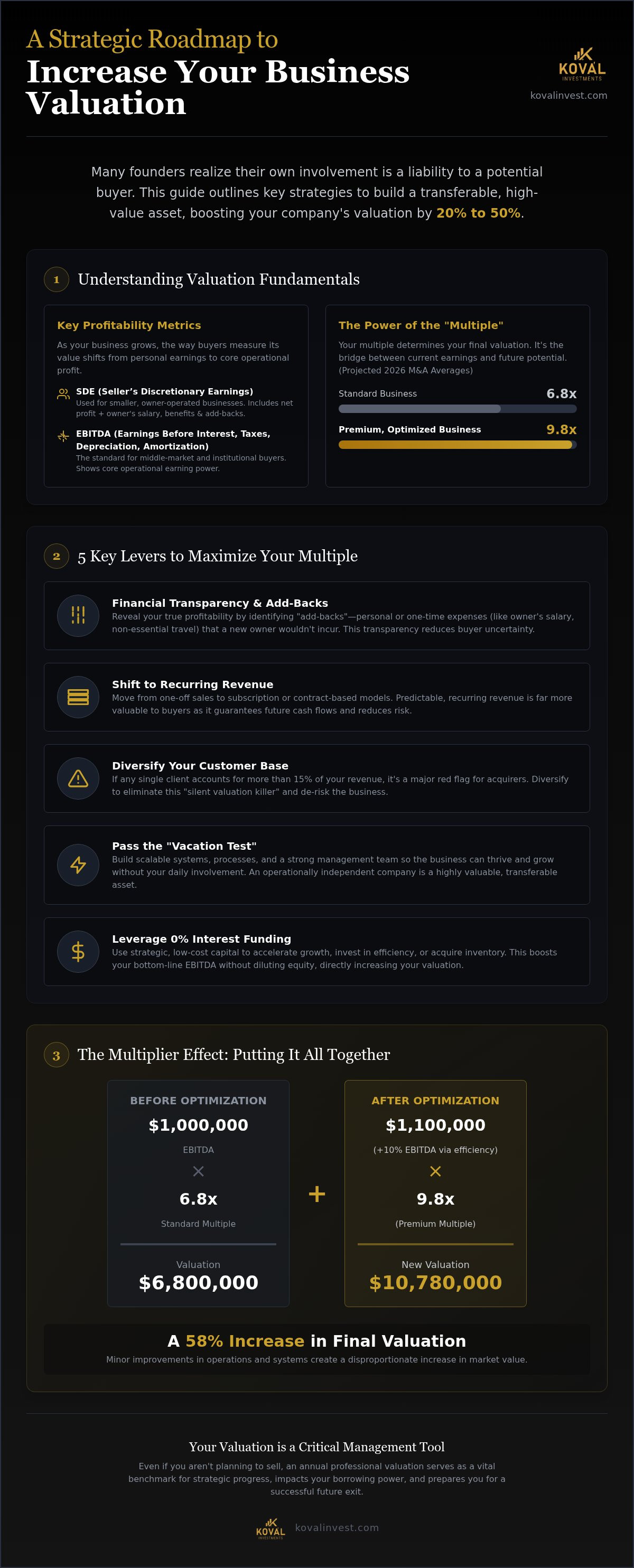
Your "multiple" is the number applied to your earnings to reach a final valuation. While the average M&A EBITDA multiple is expected to be 6.8x in 2026, premium deals are reaching 9.8x. This variance depends on industry trends and internal health. While you can't control the global economy, you can influence your specific multiple by improving your credit profile and documenting your internal processes. A valuation multiple acts as the bridge between current earnings and future potential.
Optimizing Financial Performance and Profitability
Financial health is the most visible indicator of a company's worth. While many owners focus on growing top-line sales, those who understand how to increase business valuation prioritize the quality and transparency of their earnings. Clean financial reporting is the first step toward a premium exit. You must identify "add-backs"-personal or one-time expenses that won't continue under new ownership-to present an accurate EBITDA. This transparency reduces buyer uncertainty and prevents price chipping during the due diligence phase.
Small improvements in gross margins create disproportionate increases in market value. If your business operates on a 5x multiple, a $10,000 increase in profit translates to a $50,000 increase in valuation. Beyond margins, the nature of your revenue matters. Recurring revenue from subscriptions or long-term contracts is far more valuable than one-off transactions because it provides predictable future cash flows. Conversely, customer concentration is a silent valuation killer. If a single client represents more than 15% of your total revenue, buyers will apply a significant risk discount, fearing the business might collapse if that one relationship ends.
Maximizing EBITDA Through Operational Efficiency
Operational efficiency is about more than just cutting costs. It involves building scalable systems that allow you to grow without a linear increase in overhead. Eliminating waste in your supply chain or internal processes directly inflates your EBITDA. To accelerate this growth without diluting your own equity, consider leveraging alternative business funding solutions. These tools provide the liquidity needed to invest in high-margin technology or inventory while maintaining a lean, attractive operation.
Revenue Quality vs. Revenue Quantity
Quality revenue must pass the "transferability" test. If your sales depend entirely on your personal relationships, the business has low value to an outside buyer. You must institutionalize these relationships through formal contracts and brand loyalty. In the 2026 market, proprietary technology or intellectual property also serves as a massive value driver. Protecting your unique processes or software ensures that your revenue is defensible against competitors. If you need assistance identifying these specific value drivers, our team can provide a professional business valuation to help you see where you stand today.
Mitigating Operational Risk and Owner Dependency
The ultimate test of a company's worth is the "Vacation Test." If your business cannot run for 30 days without your direct intervention, you don't own an asset; you own a high-pressure job. Strategic buyers are looking for systems they can scale, not a founder they have to replace. When you focus on how to increase business valuation, reducing owner dependency must be a top priority. This transition requires a shift from personal heroics to documented Standard Operating Procedures (SOPs) that ensure knowledge transfer is seamless across the organization.
Building a second-tier management team is equally vital for a successful exit. A buyer needs to trust that the existing staff can maintain operational continuity and hit performance targets after the closing date. This team acts as a buffer against the "key person risk" that often devalues small and medium-sized enterprises. Additionally, conducting regular legal and compliance audits ensures that no hidden liabilities exist in your contracts or employment agreements. These audits provide the "clean bill of health" necessary to secure premium offers and demonstrate that you have mastered how to increase business valuation through risk reduction.
Institutionalizing Knowledge
Scaling a business requires moving from "hustle" to "process." While early-stage growth often relies on the founder's intuition, mature companies rely on data-driven proof of value provided by CRM and ERP systems. These tools offer buyers a transparent view of the sales pipeline and operational efficiency. Buyers don't buy a job; they buy a cash-flow machine. By institutionalizing knowledge, you prove that the machine will keep running regardless of who sits in the CEO's chair.
Strengthening the Supply Chain
Operational risk often hides in your external relationships. Reducing vendor dependency is essential for ensuring operational continuity, as relying on a single supplier can lead to failures if their business falters. Securing long-term, favorable contracts with key partners locks in margins and adds stability to your valuation. Some owners choose to explore using working capital for business acquisition to verticalize their operations. This strategy allows you to buy out a supplier or a competitor, effectively removing external risks while increasing your market share and EBITDA.
Leveraging Strategic Capital and Credit for Growth
Strategic debt is often misunderstood as a burden, but in the context of professional M&A, it's a powerful tool for value creation. When you lower your cost of capital, you directly increase your net profit and, by extension, your company's market price. Understanding how to increase business valuation requires a sophisticated approach to your balance sheet. By replacing high-interest predatory loans with low-cost institutional capital, you stop the "interest drag" that quietly erodes your EBITDA every month.
A "bankable" business is significantly more attractive to premium buyers. If a buyer can easily secure an SBA loan to purchase your company, your pool of potential acquirers expands, often leading to a more competitive bidding process. Preparing for SBA loan assistance early in your exit planning ensures that your financial records and debt structures meet the rigorous standards of federal lenders. This foresight removes a major hurdle during the closing stages of a deal.
Credit Optimization as a Value Lever
Your business credit score acts as a proxy for operational risk. A strong profile tells lenders and buyers alike that your company is a stable investment. Utilizing business credit repair services to fix inaccuracies or optimize your credit utilization can lower your interest rates almost immediately. This financial grooming doesn't just save money; it streamlines the due diligence process. When a buyer's audit team sees a clean, high-scoring financial profile, it reinforces their confidence in your management and supports a higher valuation multiple.
Strategic Growth Funding
Growth requires capital, but not all funding is created equal. To maximize ROI, you should allocate capital toward high-impact "Value-Add" activities like sales team expansion or R&D. Using 0% interest business funding allows you to fuel these projects without the weight of monthly interest payments. This is particularly effective for short-term inventory purchases or aggressive marketing blitzes that can rapidly scale your revenue before a sale. If you're ready to optimize your capital structure, our team can help you access the strategic funding needed to accelerate your growth and maximize your eventual exit price.
Strategic Advisory: Navigating Valuations and M&A
Many business owners treat valuation as a one-time event triggered by the desire to sell. This reactive approach often leaves significant money on the table. An annual professional valuation is a critical management tool that provides a clear scorecard for your strategic decisions. It allows you to see exactly which operational changes are moving the needle and which are falling flat. When you understand how to increase business valuation through consistent measurement, you can pivot your strategy in real-time to maximize long-term equity.
Professional M&A consulting plays a vital role in this process by preparing your company for the scrutiny of institutional buyers. This isn't just about finding a match; it's about making the business "buyable" at a premium multiple. We believe in a success-based consulting model, which ensures our interests are perfectly aligned with your objectives. By focusing on a partnership rather than a transaction, we help you bridge the gap between current financial health and your maximum potential market value.
Preparing for Due Diligence
The due diligence phase is where deals often fall apart or get re-traded at a lower price. You can mitigate this risk by creating a "Data Room" long before you ever intend to list the business. This centralized repository of clean financials, legal contracts, and SOPs proves to a buyer that your operation is transparent and well-managed. Identifying "Red Flags" early, such as unresolved litigation or messy tax records, allows you to fix them on your own timeline. Part of this preparation involves choosing the right capital structure for the next owner, such as understanding the nuances of an SBA 7(a) vs 504 loan to ensure the deal is bankable.
The Koval Advantage: A Holistic Approach
Koval Investments offers a unique, holistic approach to corporate development. We don't just provide advice; we provide the financial foundation for growth. By combining credit restoration, strategic capital procurement, and expert advisory, we address every lever that influences your company's worth. Our "Win-Win" philosophy means we're invested in your progress, helping you navigate the complexities of the 2026 market with confidence. If you're ready to see the true potential of your company, the best time to start your valuation journey is today. We invite you to reach out for a professional business valuation and take the first step toward a high-value exit.
Building a High-Value Legacy for 2026 and Beyond
Maximizing the worth of your company is a deliberate process that requires aligning financial health with operational excellence. You've seen that understanding how to increase business valuation involves more than just growing revenue; it's about institutionalizing knowledge and ensuring the business thrives without your daily involvement. By focusing on recurring revenue and documented systems, you transform your company into a highly transferable asset that commands a premium multiple in a competitive market.
Koval Investments provides the financial foundation and strategic guidance necessary to reach these milestones. Our success-based consulting philosophy ensures our goals are perfectly aligned with yours as we navigate the complexities of the 2026 landscape together. Whether you need comprehensive credit optimization services to lower your cost of capital or expertise in 0% interest funding and SBA loans to fuel expansion, we act as your steady partner. Secure your business's future with a professional valuation and strategic growth plan from Koval Investments. We look forward to helping you build a more profitable and resilient enterprise.
Frequently Asked Questions
What is the most effective way to increase my business valuation quickly?
The fastest way to increase your company's worth is to document all internal processes and identify "add-backs" in your financials. By proving that personal expenses won't continue under new ownership, you immediately inflate your EBITDA. This transparency reduces the risk for buyers; which often leads to a higher multiple during negotiations. Focusing on how to increase business valuation through clean reporting is a high-ROI activity for any founder.
How much does a professional business valuation cost in 2026?
Industry standards for a professional valuation vary based on the size and complexity of your organization. For most small to mid-sized firms, costs typically range from $3,000 to $10,000 depending on the level of certification required. While some basic online calculators exist, a certified appraisal is necessary for legal or M&A purposes. Investing in a formal report ensures your numbers hold up during intense buyer due diligence and provides a baseline for your growth strategy.
Does my personal credit score affect my business's valuation?
Your personal credit score plays a significant role in your company's financial health and its ultimate market value. A strong credit profile allows you to access premium capital at lower interest rates, which directly lowers your operating expenses. Since valuation is often a multiple of net profit, reducing interest drag through credit optimization effectively increases your company's worth. Buyers also view a clean credit history as a sign of disciplined management.
What is a good EBITDA multiple for a small business?
In the 2026 market, a good EBITDA multiple depends heavily on your annual revenue and industry sector. Small businesses in the $1M to $5M range typically command multiples around 5.5x; while larger firms can reach an average of 6.8x. If your business is in a high-growth sector like AI or has exceptionally low owner-dependency, you could see premium multiples reaching up to 9.8x. These figures represent the bridge between your current earnings and future potential.
How can I reduce owner-dependency to make my business more attractive to buyers?
Reducing owner-dependency starts with the implementation of robust Standard Operating Procedures (SOPs) and a capable second-tier management team. You must move from being the primary rainmaker to being a strategic overseer. If the business can pass the "Vacation Test" and operate profitably for 30 days without your input, its value increases significantly. Buyers are looking for a cash-flow machine that functions independently, not a job they have to work themselves.
Can 0% interest funding actually help increase my company's value?
Utilizing 0% interest funding is a highly effective strategy for scaling your valuation without diluting equity. By funding high-ROI projects, such as a new sales team or proprietary software development, you grow your revenue while keeping interest expenses at zero. This directly inflates your EBITDA, which is the primary metric buyers use to determine price. It's a strategic way to accelerate growth and demonstrate operational efficiency to potential acquirers.
What are the most common 'deal killers' during the valuation process?
The most frequent "deal killers" include high customer concentration and undocumented financial records. If a single client accounts for more than 15% of your revenue, buyers see a massive risk and will likely lower their offer. Similarly, if your books are messy or you lack clear contracts with key vendors, the uncertainty can derail a transaction entirely. Addressing these vulnerabilities is a critical part of learning how to increase business valuation before you list.
How long does it take to see a significant increase in business valuation?
You should expect to see a significant shift in your company's market value within 12 to 24 months of implementing strategic changes. Most buyers look at the trailing twelve months (TTM) of financial performance; so improvements in profit margins or revenue quality need time to stabilize. While some operational fixes provide immediate clarity, building a track record of independent growth and clean credit usually requires a multi-quarter commitment to see the full impact on your exit price.