
How to Use a Working Capital Loan: 5 Strategic Ways to Drive Growth in 2026
What if your next business loan wasn't a safety net for slow months, but a high-performance engine for your 2026 expansion? Most entrepreneurs view debt with a healthy sense of caution, often wondering exactly how to use a working capital loan without compromising their long-term stability. You've likely felt the frustration of missing out on bulk-purchase discounts or watching competitors scale faster because your liquid cash is tied up in day-to-day operations. It's common to worry that mismanaging a loan might hurt your credit score or create a cycle of dependency.
However, once you master the art of using capital as a strategic lever, the math changes. With the combined SBA 7(a) and 504 loan cap now increased to $10 million as of July 2026, the opportunities for significant growth have never been more accessible. We promise to show you how to move beyond patching holes and start driving real ROI. This guide previews five specific ways to deploy capital effectively, from securing 0% interest funding to navigating the new 100% U.S. citizenship requirements for SBA eligibility. You'll discover how to maintain a steady hand on your finances while positioning your business for a sustainable, equity-free leap forward.
Key Takeaways
- Shift your perspective from using debt as a safety net to deploying it as a strategic lever for market expansion and business acquisition.
- Discover how to use a working capital loan to unlock bulk-purchase discounts and fund high-performing marketing campaigns that generate immediate revenue.
- Learn to identify and avoid the "Band-Aid trap" by ensuring your capital isn't wasted on structural losses or long-term assets that require different financing.
- Build a stronger business credit profile through consistent repayment while tracking every dollar to ensure it meets your specific ROI targets.
- Explore how to access 0% interest funding solutions through a success-based partnership that eliminates upfront financial risk.
Understanding the Strategic Role of Working Capital in 2026
Working capital acts as the primary lifeblood of your daily business operations, representing the liquidity available to meet your most immediate obligations. In 2026, market dynamics have shifted significantly. With the prime rate stabilizing between 7.5% and 8%, and new SBA regulations requiring 100% U.S. citizenship for certain loan types, entrepreneurs must be more intentional about their financial structures. A working capital loan is a short-term financing solution designed to cover operational expenses and bridge cash flow gaps. Learning how to use a working capital loan correctly allows you to move beyond simple survival and toward a model of aggressive, sustainable expansion.
Offensive vs. Defensive Capital Strategies
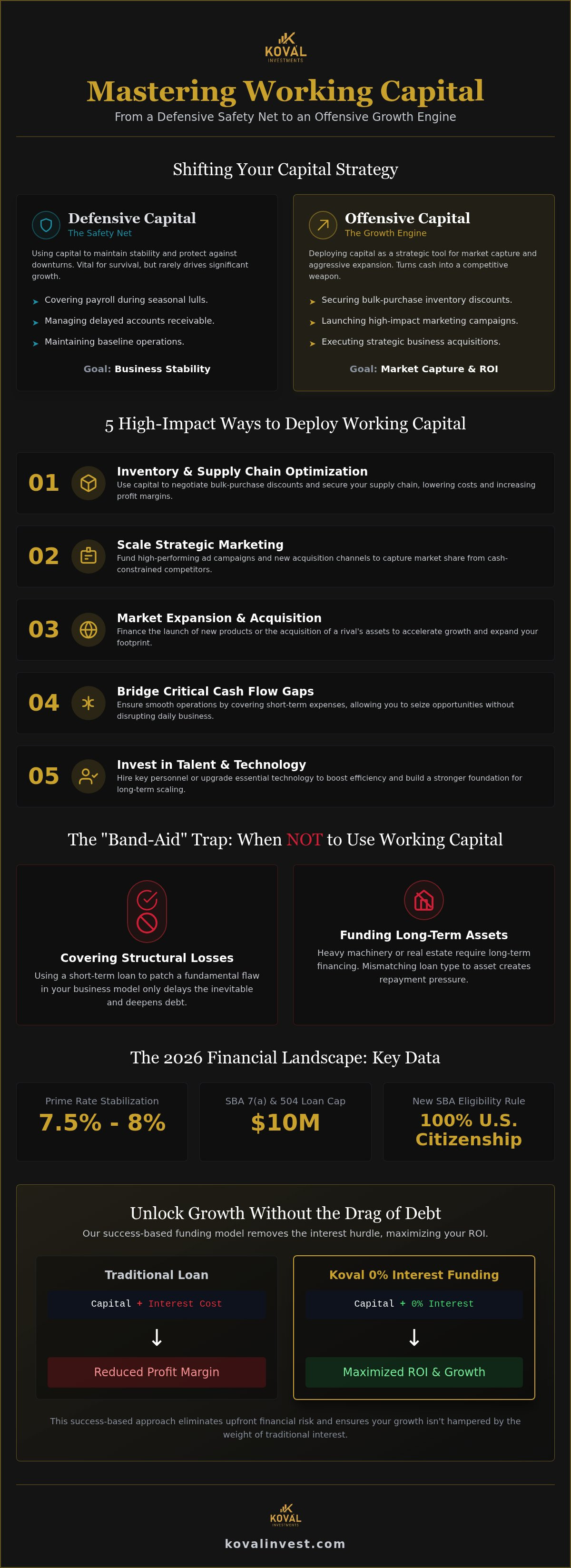
The difference between a stagnant business and a growing one often comes down to how they deploy liquid cash. Defensive strategies are protective. They involve using capital to cover payroll during seasonal lulls or managing the friction caused by delayed accounts receivable. These actions are vital for maintaining stability, yet they rarely move the needle on growth. Offensive strategies, however, treat capital as a weapon for market capture. Consider these examples:
- Inventory Advantage: Buying in bulk to lower your cost per unit and increase margins.
- Market Expansion: Launching a new product line while competitors are retreating.
- Strategic Acquisition: Purchasing the assets or client lists of a rival to expand your footprint.
A healthy business balances both, ensuring that defensive needs are met while reserving enough firepower to act when a profitable opportunity arises. Staying agile in 2026 means having the liquidity to pivot as interest rates and consumer demands fluctuate.
The Relationship Between Working Capital and ROI
Every dollar you borrow should have a clear path to generating more than its own cost. When you analyze how to use a working capital loan, you're essentially looking for high-velocity spending areas where capital can be deployed and returned quickly with a profit. If you can use a loan to secure a bulk inventory discount that exceeds the loan's APR, you've created instant value. This is why our 0% interest funding solution is such a powerful tool for modern owners. By removing the interest hurdle, we help you maximize the margin between the cost of capital and your eventual return. This success-based approach ensures that your growth isn't hampered by the weight of traditional interest, allowing for faster scaling without the typical financial drag.
5 High-Impact Ways to Deploy a Working Capital Loan
Successful owners know that knowing how to use a working capital loan is just as important as securing the funding itself. It's about identifying high-leverage points within your business model where an infusion of cash produces a multiplier effect. Because different Types of working capital loans offer varying levels of flexibility, you can tailor your funding to match the specific speed and demands of your industry.
Inventory and Supply Chain Optimization
Inventory is often a business's largest asset but also its biggest cash trap. You can use capital to negotiate better terms with suppliers by offering early payments in exchange for significant discounts. This strategy lowers your cost of goods sold and improves your overall margin. Additionally, holding strategic reserves allows you to mitigate the supply chain volatility that persists in 2026, ensuring you never miss a sale due to stockouts during peak seasons. Bridging the gap between manufacturing costs and customer fulfillment ensures your operations remain smooth even during rapid growth phases.
Scaling Through Strategic Marketing
Marketing is a prime candidate for capital deployment because it has a direct, measurable link to revenue. Many owners hesitate to scale high-performing campaigns because they don't want to drain their operational cash. A loan bridges this "CAC gap," allowing you to fund the cost of acquiring a customer before their long-term value is fully realized. This approach lets you test new acquisition channels without risking your baseline stability. By scaling proven ad spend, you can capture market share from competitors who are currently constrained by their own cash flow limitations.
Staffing and technology are equally critical components of a growth strategy. Hiring a key operations manager or a specialized sales lead can instantly increase your capacity to handle new business. Similarly, investing in process automation tools reduces long-term overhead by streamlining repetitive tasks. These aren't just expenses; they're investments in your company's infrastructure that allow you to scale without a linear increase in costs. When you evaluate how to use a working capital loan, look for these areas where one-time investments create permanent efficiency gains.
Finally, consider market expansion through acquisition. With the combined SBA loan cap increased to $10 million as of July 2026, there's more room than ever for using working capital for business acquisition. Buying a competitor or a complementary service provider is often the fastest way to double your revenue and expand your footprint. If you're unsure which path fits your specific goals, our team can help you with strategic growth planning to ensure every dollar is deployed for maximum impact.
Managing Capital for Long-Term Growth and Credit Health
Securing funding is only the first step in a successful expansion strategy. True growth depends on how you manage those funds once they're in your account. If you understand how to use a working capital loan effectively, you know that the real work lies in disciplined stewardship and precise tracking. Managing capital isn't just about spending; it's about creating a sustainable cycle where every dollar borrowed strengthens your balance sheet and your reputation with future lenders.
One strategic use of these funds often overlooked is debt restructuring. By using a lower-interest working capital infusion to pay down high-interest merchant cash advances or expensive credit card balances, you can instantly improve your monthly cash flow. This move reduces your debt-to-income ratio and provides the breathing room needed to focus on the "offensive" growth strategies discussed earlier.
Tracking ROI on Capital Spend
Tracking every dollar is non-negotiable for maintaining profitability. You should treat each loan disbursement as a separate project with its own set of Key Performance Indicators (KPIs). We recommend using modern accounting software to segment loan spending from your general operating cash. This transparency allows you to measure specific outcomes, such as:
- Revenue per dollar borrowed: A direct measure of how effectively the capital is generating income.
- Customer Acquisition Cost (CAC) vs. Lifetime Value (LTV): Ensuring your marketing spend remains profitable over time.
- Operational Efficiency Gains: Measuring the time or cost savings achieved through new technology or staffing.
If a particular investment isn't yielding the expected return, you must be prepared to pivot quickly. Reallocating remaining funds to a higher-performing area of the business prevents capital waste and protects your ability to repay the loan on time.
Building Borrowing Power for the Future
There's a powerful feedback loop between successful loan management and your future borrowing capacity. Every on-time payment on a working capital loan strengthens your business credit profile, making it easier to qualify for larger amounts at better rates later. Utilizing professional business credit repair services ensures your foundation is solid before you seek higher limits or more complex financing.
Mastering how to use a working capital loan also means looking ahead to your next funding milestone. This preparation is critical when seeking SBA loan assistance for larger expansion projects, such as real estate purchases or major acquisitions. With the combined SBA 7(a) and 504 loan cap now at $10 million as of 2026, your current credit health determines whether you can seize those massive opportunities when they arise. We view our relationship with you as a long-term partnership, helping you build the creditworthiness necessary to scale indefinitely.
Common Pitfalls: When NOT to Use Working Capital
While access to liquid cash is a powerful growth catalyst, it's equally important to recognize the scenarios where borrowing can do more harm than good. Understanding how to use a working capital loan requires a clear-eyed assessment of your business's underlying health. Misapplying these funds can lead to over-leveraging, where your monthly debt obligations outpace your actual cash flow, creating a cycle of dependency that's difficult to break. Capital should be a bridge to a better future, not a weight that pulls your operations under.
Short-term Capital for Long-term Problems
The most dangerous misuse of funding is the "Band-Aid trap." This occurs when an owner uses a loan to cover chronic, structural losses rather than a temporary timing gap. If your business model has fundamentally poor profit margins or faces declining market demand, an infusion of capital won't solve the issue; it will only accelerate the loss. You must determine if your cash flow struggle is a simple delay in accounts receivable or a sign that your business is no longer competitive. Obtaining a professional business valuation is a critical step in identifying these structural flaws before you commit to new debt.
You should also avoid using short-term working capital to finance long-term assets like real estate or heavy machinery. These assets typically take years to generate a return, while working capital loans often require repayment over a much shorter horizon. This mismatch puts immense pressure on your daily liquidity. Speculative projects also carry high risk. Investing in a new market or product without supporting data is often a recipe for failure. Capital should follow proven results, not chase unverified theories.
The Risk of High-Interest Subprime Business Loans
In the search for quick cash, some owners fall into the trap of subprime business loans. These often come with daily or weekly repayments that can quickly stifle your operational capacity. These structures are often designed to keep you in a debt cycle rather than helping you scale. When evaluating your options, compare traditional rates with more flexible alternative business funding solutions that align with your actual revenue patterns.
If you find yourself trapped in a high-interest cycle, strategic credit optimization can help you exit and transition to more sustainable funding. Knowing how to use a working capital loan involves passing on "easy" money that carries hidden, long-term costs. If you're concerned about your current debt structure or want to ensure your next move is the right one, talk to our strategic advisors today to build a sustainable path forward.
Securing 0% Interest Working Capital with Koval Investments
Koval Investments acts as a strategic bridge between your current operations and your 2026 growth targets. We specialize in helping owners master how to use a working capital loan by first ensuring they access the most cost-effective capital available. Our primary focus is facilitating our 0% interest business funding solution, which allows you to deploy capital without the immediate drag of interest payments. This approach maximizes your margins and provides the flexibility needed to reinvest profits directly back into your expansion efforts.
Our firm operates on a fundamentally different model than traditional lenders. We utilize a "win-win" philosophy, which means our consulting services are success-based. You don't face upfront financial risk; instead, our incentives are perfectly aligned with your ability to secure and utilize capital effectively. This collaborative stance creates a low-pressure environment where we act as a steady hand, guiding you through the complexities of capital procurement while you focus on the day-to-day realities of running your company.
The Koval Advantage: Strategic Growth Advisory
We believe that capital is most effective when paired with a clear deployment plan. Our strategic planning goes beyond simply securing a loan; we help you analyze your business model to identify high-velocity spending areas. Whether you're seeking specialized funding for real estate investors or capital to scale a service-based SMB, we provide the "insider" knowledge necessary to navigate 2026 market dynamics. By integrating credit repair with capital access, we ensure your business has a solid foundation, allowing you to qualify for higher limits and better terms as your needs evolve.
Next Steps: Your Roadmap to 0% Interest Capital
Your path to optimized funding follows a methodical, three-step process designed to build trust and deliver results. We start with a comprehensive consultation to assess your current credit profile and define your specific funding requirements. This allows us to create a customized procurement plan tailored to your ambitions. If your current credit health is a barrier to the best rates, we enter an optimization phase where our credit repair expertise is used to strengthen your borrowing power. Finally, we execute the strategy, securing the capital required to drive your business forward. Understanding how to use a working capital loan becomes a competitive advantage when you have a partner who is equally invested in your long-term success.
Transforming Capital into Competitive Advantage
Your business's trajectory in 2026 depends on the precision of your financial decisions. Shifting from a defensive mindset to an offensive growth strategy allows you to capture market share while others remain stagnant. By mastering how to use a working capital loan, you turn liquid cash into a high-performance engine for inventory optimization, rapid marketing scaling, and strategic acquisitions.
Long-term success isn't just about the initial infusion of cash; it's about the partnership that supports your journey. Koval Investments provides a comprehensive financial solution that integrates credit repair with strategic growth advisory to ensure your foundation is as strong as your ambitions. Our success-based philosophy means we only win when you do, and we focus on facilitating access to 0% interest capital that keeps your margins high and your financial risk low.
Take the first step toward a more efficient and profitable future today. Secure Your 0% Interest Funding Solution with Koval Investments Today and unlock the capital you need to scale without compromise. Your expansion is within reach, and we're ready to help you navigate the path forward with confidence and clarity.
Frequently Asked Questions
How do I determine if my business needs a working capital loan?
You need a loan when your current cash reserves prevent you from seizing growth opportunities or meeting short-term obligations. Evaluate your accounts receivable cycles and upcoming inventory needs. If a cash infusion can generate a return higher than the cost of the capital, it's a strategic move. Learning how to use a working capital loan starts with identifying these ROI-positive gaps in your daily operations before they slow your momentum.
Can I use a working capital loan to pay off other business debts?
Yes, using these funds for debt restructuring is a common strategy. You can replace high-interest merchant cash advances or expensive credit card balances with a lower-cost loan. This move improves your monthly cash flow and reduces your overall debt-to-income ratio. It’s a foundational step in cleaning up your balance sheet so you can focus on more aggressive growth initiatives later without the drag of predatory interest rates.
What is the difference between an SBA loan and a working capital loan?
An SBA loan is a government-guaranteed financing option that can be used for various purposes, including working capital. A working capital loan is a broader category defined by its short-term use for operational expenses. SBA loans often offer better rates but have stricter eligibility rules, such as the 100% U.S. citizenship requirement implemented in early 2026 for certain programs, which requires careful navigation during the application phase.
How does my personal credit score affect my ability to get working capital?
Your personal credit score is a primary factor lenders use to assess risk, especially for small businesses. A score of 720 or higher is typically required to access the best interest rates and higher funding limits in 2026. If your score is lower, our credit repair services can help optimize your profile. This optimization allows you to qualify for more favorable terms and the larger capital amounts necessary for expansion.
Are working capital loan interest payments tax-deductible for businesses?
Generally, the interest paid on business loans is a deductible expense. For the 2026 tax year, the deduction for business interest is limited to 30% of your adjusted taxable income. This deduction helps lower your effective cost of capital and improves your bottom line. We suggest consulting with a tax professional to ensure you're maximizing these benefits while complying with the current federal C corporation flat tax rate of 21%.
What happens if my business cannot repay the working capital loan on time?
Failing to repay on time can severely damage your business and personal credit scores. Lenders may also initiate collection actions or exercise confession of judgment clauses if they exist in your contract. To avoid this, we focus on strategic planning to ensure your revenue projections support your repayment schedule. If you anticipate a struggle, proactive communication with your lender is always the best approach to find a collaborative solution.
Is it better to use a line of credit or a lump-sum working capital loan?
It depends on your specific objective. A line of credit is ideal for managing recurring cash flow gaps or ongoing marketing spend. A lump-sum loan is better suited for specific, one-time investments like a business acquisition or a large bulk inventory purchase. Understanding how to use a working capital loan effectively means matching the funding structure to the timing of your expected ROI to ensure the capital isn't sitting idle.
How quickly can I typically access working capital funding?
Access speed varies depending on the lender and the loan type. Online and alternative lenders can often provide funding within 24 to 72 hours. Traditional bank loans and SBA-guaranteed options typically take several weeks or months due to more rigorous underwriting. We work to streamline this process by helping you prepare your documentation and credit profile in advance. This preparation minimizes delays and gets you to the execution phase faster.