
SBA Loan vs. 0% Interest Funding: A 2026 Guide to Working Capital Strategy
Waiting six months for a bank approval while your competitors move at the speed of the market isn't just frustrating; it's a strategic risk. While the Small Business Administration remains a cornerstone of American enterprise, the current landscape of high interest rates and stricter 10% equity requirements has many owners questioning the traditional path. Choosing between an SBA loan vs 0% interest funding is no longer about which is "better" in a vacuum. It's about which structure aligns with your specific operational margins and growth timeline for 2026.
You've likely felt the pressure of rising capital costs eating into your bottom line. We understand that navigating these financial hurdles requires more than just an application; it requires a calculated strategy. This guide clarifies the superior choice for your business by comparing the stability of long-term SBA debt against the agility of 0% interest structures. We will break down the latest 2026 borrowing limits, the mechanics of strategic credit stacking, and the exact steps to optimize your profile. Our goal is to help you secure the capital you deserve without the typical bank-level friction that holds so many entrepreneurs back.
Key Takeaways
- Identify the strategic differences between an SBA loan vs 0% interest funding to determine which capital structure best supports your 2026 growth objectives.
- Learn how to utilize introductory APR periods to secure interest-free capital for up to 22 months, creating a cost-effective runway for new projects.
- Understand the specific advantages of the SBA 7(a) program for long-term stability, including its role in major equipment purchases and debt refinancing.
- Discover why credit optimization is the essential first step in bypassing bank-level friction and securing higher funding limits.
- Explore how a success-based partnership ensures your interests are prioritized throughout the capital procurement process.
The Capital Dilemma: SBA Loans vs. 0% Interest Funding
Working capital is the lifeblood of operational scalability for US small businesses. It funds the inventory, talent, and technology that drive revenue. For many, the Small Business Administration (SBA) has been the traditional destination for long-term, government-backed debt intended for major investments. However, modern 0% interest funding has emerged as a tactical, non-dilutive alternative for rapid growth. The ultimate decision rests on balancing long-term stability with short-term agility.
The Shift in 2026 Lending Dynamics
The lending environment in 2026 reflects a cautious banking sector. With the prime rate holding at 6.75% as of September, traditional banks have tightened their underwriting standards. They often require a mandatory 10% equity injection for startups and ownership changes, a rule that took effect in mid-2025. This shift has pushed founders toward "unsecured" capital structures. Unsecured funding doesn't require the heavy collateral or personal real estate liens often associated with traditional bank debt. In a post-inflationary landscape, maintaining high liquidity is a survival trait. Businesses now prioritize access to capital that doesn't tie up their balance sheets for decades.
Defining Your Funding Objectives
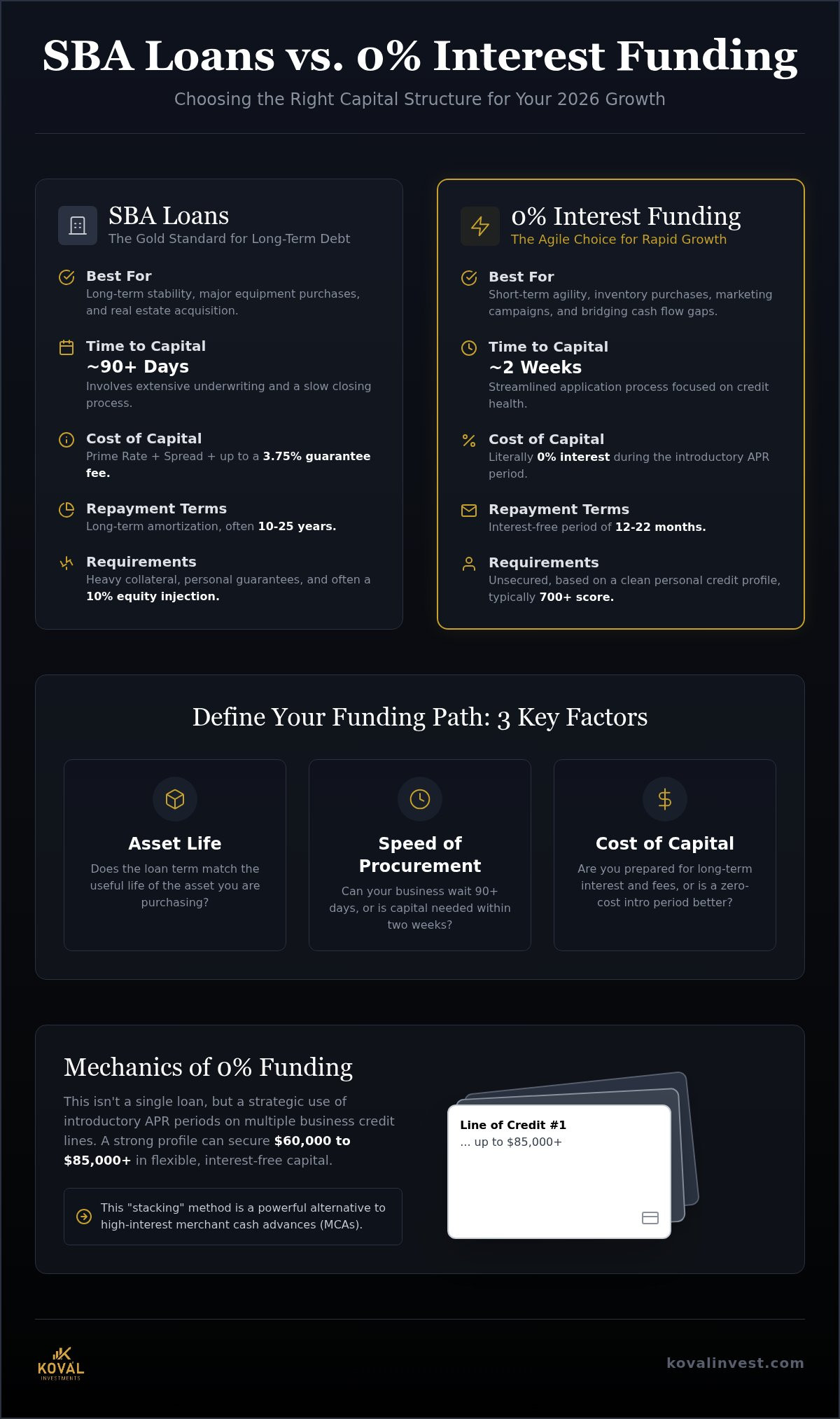
Choosing between an SBA loan vs 0% interest funding depends entirely on your specific growth milestone. If you are acquiring a $2 million manufacturing facility, the SBA 504 program is the logical choice due to its 25-year repayment terms. Conversely, if you need $75,000 to bridge a gap for a seasonal inventory purchase or a marketing blitz, the 0% interest model is vastly superior. It offers speed that traditional institutions simply cannot match.
Consider these factors when evaluating your needs:
- Asset Life: Does the loan term match the life of the asset you are purchasing?
- Speed of Procurement: Can you wait 90 days for an SBA closing, or do you need capital in two weeks?
- Cost of Capital: Are you willing to pay a 3.75% guarantee fee for a million-dollar loan, or would you prefer a zero-cost introductory period?
Matching the right vehicle to your milestone prevents over-leveraging. It ensures you aren't using a 10-year loan to solve a 6-month cash flow problem. At Koval Investments, we see this as a strategic alignment of resources. We help you identify which path preserves your equity while maximizing your operational momentum. The goal isn't just to get funded; it's to get funded in a way that fuels your long-term vision without unnecessary financial drag.
The Mechanics of 0% Interest Business Funding Solutions
0% interest funding isn't a traditional loan; it's a strategic utilization of introductory APR periods on business credit lines. While an SBA loan provides a lump sum with long-term interest, this structure offers interest-free capital for 12 to 22 months. It's perfectly suited for high-ROI activities like marketing campaigns, scaling a sales team, or bulk inventory purchases where you can recoup the investment before the interest kicks in. For a granular look at how these lines operate, you can explore our 0% interest business funding mechanics guide.
How to Structure 0% Capital for Growth
Founders often use a "stacking" method to maximize their limits. This involves applying for multiple unsecured lines in a specific sequence to prevent one application from negatively impacting the others. A business owner with a strong credit profile can potentially secure $60,000 to $85,000 in liquid capital by strategically applying for 3 to 4 business credit cards with 0% introductory APRs. This strategy provides a flexible alternative to high-interest merchant cash advances (MCAs). Unlike MCAs, which take a daily percentage of your sales, 0% lines give you full control over your cash flow. You just need to manage the repayment cycle carefully to avoid the interest "cliff" at the end of the introductory period.
Qualification Criteria for Interest-Free Capital
The barrier to entry for 0% interest business funding is less about your company's revenue and more about your personal credit health. Banks look for a clean personal credit profile, typically requiring a score of 700 or higher. You also need a registered US business entity in good standing. Because these are unsecured lines, your track record as a borrower serves as the primary collateral. This makes it an excellent option for startups or businesses with high growth potential but limited operational history.
If you're weighing an SBA loan vs 0% interest funding, understanding your current credit standing is the first step toward the right decision. You can partner with our team to evaluate your eligibility and build a custom capital roadmap that aligns with your 2026 goals.
SBA Loans: The Gold Standard for Long-Term Debt
SBA loans remain the anchor of long-term financial stability for established American businesses. They provide the lowest sustainable rates and repayment terms that can extend up to 25 years for real estate acquisitions. While 0% funding is a sprint designed for tactical wins, the SBA process is a marathon that builds the infrastructure for decade-long growth. The primary choice between an SBA loan vs 0% interest funding often comes down to the intended use of the capital and your tolerance for a lengthy underwriting process. Successful SBA loan assistance requires months of meticulous financial hygiene to meet the government's rigorous standards.
Navigating the SBA 7(a) vs. 504 Decision
Choosing between the two flagship programs depends on your underlying asset. The 7(a) program is the most versatile option in the Small Business Administration arsenal. It's the preferred vehicle for general working capital, inventory, or business acquisitions. As of late 2026, variable rates for loans over $350,000 are capped at Prime plus 3.0%, making them highly competitive for large-scale expansion. Conversely, the 504 program is the clear winner for fixed assets and real estate. It offers long-term, fixed-rate financing that protects you from market volatility. For a deeper dive into which fits your 2026 strategy, our guide on SBA 7(a) vs 504 loan selection provides a comprehensive breakdown of the specific costs and benefits.
The Reality of SBA Timelines and Requirements
Founders must prepare for a 60 to 90-day window for full approval and funding. This timeline is driven by the "Full Documentation" burden, which includes several years of tax returns, detailed P&Ls, and personal guarantees. The SBA has also maintained stricter underwriting standards, including a mandatory 10% equity injection for startups and ownership changes. These requirements ensure only the most stable businesses receive government backing.
Many savvy owners choose to use 0% interest funding as a bridge while waiting for an SBA close. This approach provides several advantages:
- Immediate Liquidity: You can capture market opportunities today instead of waiting three months.
- Preserved Cash: You keep your existing cash reserves intact for the required 10% equity injection.
- Strategic Momentum: You can begin hiring or ordering inventory while the bank processes your long-term debt.
By viewing these tools as complementary rather than mutually exclusive, you can maintain momentum during the "marathon" of bank underwriting. Our role is to ensure your financial profile is lender-ready so that when the bank finally reviews your file, the answer is a definitive yes.
Credit Optimization: The Bridge to High-Limit Capital
Your credit score is the single most important lever in determining your funding limit. Whether you are weighing an SBA loan vs 0% interest funding, your report acts as your financial resume. A 50-point increase can be the difference between a $25,000 limit and a $150,000 limit. Professional business credit repair services are essential because they identify and remove inaccuracies that artificially suppress scores. You should view credit repair as a strategic investment in your borrowing power rather than a simple administrative fix.
Disputing Inaccuracies for Maximum Funding Access
Banks use sophisticated algorithms to flag risk, and even minor errors can trigger automated rejections. "Zombie" debts, which are old accounts that should have fallen off your report, or incorrect late payments can severely limit your options. The DIY dispute process often fails to produce high-limit results because it lacks the technical precision required to challenge reporting bureaus effectively. Beyond just securing an approval, credit optimization plays a role in lowering your eventual SBA interest rate. Since SBA 7(a) variable rates involve a margin on top of the prime rate, a higher score positions you as a lower-risk borrower, potentially saving you thousands in interest over a 10-year term.
Separating Personal and Business Credit
True scalability requires building a business credit profile through entities like DUNS and Experian Business. This separation protects your personal assets and builds a corporate identity that lenders trust. Strategic tradeline management demonstrates your corporate repayment capacity, showing that the business can sustain its own debt independently. A strong business profile enables alternative business funding solutions that don't require personal liens or the heavy collateral typical of traditional bank loans.
To maximize these benefits, you must focus on three key areas:
- Data Accuracy: Ensuring your business name, address, and EIN are consistent across all bureaus.
- Credit Depth: Opening and maintaining various types of credit accounts to show versatility.
- Utilization Management: Keeping balances low on personal lines to boost your score before a major application.
If your current score is holding you back from the capital you need, partner with Koval Investments to optimize your profile and unlock higher funding limits for your 2026 expansion.
Choosing Your Path: Strategic Procurement with Koval Investments
Koval Investments acts as your strategic partner, navigating the complexity of capital procurement so you don't have to. We don't just provide a list of options; we build a roadmap tailored to your specific operational needs. Our "Success-Based" model ensures we only succeed when you secure the capital, aligning our objectives perfectly with your growth. Whether you are seeking funding for real estate investors or scaling a high-growth startup, we provide the clarity needed to choose the right vehicle.
We offer a holistic approach that most traditional institutions overlook. We fix the credit inaccuracies that suppress your limits, secure the 0% gap funding to maintain your momentum, and prepare your documentation for the eventual SBA close. This integrated strategy allows you to stop choosing between an SBA loan vs 0% interest funding and start using them in tandem to maximize your leverage. We believe that capital should be a tool for progress, not a source of financial drag.
The Koval Advantage: Beyond Traditional Lending
Our firm provides access to "hidden" 0% interest structures that traditional banks rarely advertise to the general public. These are sophisticated credit lines that require specific sequencing and "insider" knowledge to unlock. We operate on a "Win-Win" philosophy, meaning there are no upfront fees for our core funding services. This collaborative advisory model respects your time and your equity, ensuring that your business remains agile while you scale. We act as a steady hand in a complex financial landscape, providing the pragmatism and integrity you expect from a seasoned advisor.
Next Steps for Your 2026 Growth Strategy
The path to capital begins with a professional valuation of your current credit and capital health. We analyze your reports to identify the specific levers that will yield the highest funding limits in the shortest time. Most clients see a clear 30-day roadmap to their first round of 0% interest funding, allowing them to bypass the typical 90-day bank wait times. Once your immediate liquidity is secured, we begin the methodical work of preparing your file for long-term SBA debt if that remains part of your strategy.
It's time to take control of your financial future and move beyond the limitations of traditional banking. You can Partner with Koval Investments to secure your 0% interest funding today and begin building the capital stack your business deserves.
Secure Your Capital Roadmap for 2026
Navigating the choice between an SBA loan vs 0% interest funding is a strategic decision that defines your business's trajectory. You've seen that while the SBA offers long-term stability, 0% interest structures provide the immediate agility required to capture market opportunities. The bridge between these paths is credit optimization; a process that transforms your borrowing power from a limitation into a competitive asset.
Since 2018, Koval Investments has acted as a trusted advisor for founders across the nation. Our success-based model means there's no financial risk to you; we only win when you secure the capital you need. We specialize in high-limit capital procurement, ensuring you have the liquidity to scale without the friction of traditional bank delays. It's time to stop letting capital constraints dictate your growth.
Partner with Koval Investments to secure your 0% interest funding today and take the first step toward a more resilient financial future. Your next growth milestone is closer than you think.
Frequently Asked Questions
What is the main difference between an SBA loan and 0% interest funding?
SBA loans are long-term, government-guaranteed debt structures with repayment periods extending up to 25 years. In contrast, 0% interest funding utilizes introductory APR periods on business credit lines to provide interest-free capital for 12 to 22 months. While the SBA is better for major infrastructure or real estate, 0% lines offer the speed and agility needed for immediate operational scaling without the long-term interest burden during the initial growth phase.
How do I qualify for 0% interest business funding with Koval Investments?
Qualification focuses primarily on your personal credit health rather than your current business revenue. You generally need a personal credit score of 700 or higher and a registered US business entity in good standing. Since these lines are unsecured, your track record as a borrower serves as the primary collateral. We help you evaluate your eligibility and optimize your profile to ensure you secure the highest possible funding limits for your expansion.
Can I use 0% interest funding to bridge the gap while waiting for an SBA loan?
Yes, using 0% interest lines as a bridge is a highly effective strategy for maintaining momentum. The SBA process can take 60 to 90 days for full approval and funding in 2026. By securing interest-free capital first, you can order inventory or hire staff today while the bank processes your long-term debt. This dual approach ensures you don't miss market opportunities during the lengthy bank underwriting cycle.
Do SBA loans require personal collateral in 2026?
Most SBA 7(a) loans require a personal guarantee from any individual owning 20% or more of the business. While the SBA doesn't always require a lien on personal real estate for smaller amounts, lenders often seek collateral for loans exceeding $350,000. This is a significant factor when choosing an SBA loan vs 0% interest funding, as the latter is typically unsecured and does not require you to pledge personal assets or real estate.
How much can a credit score increase impact my business funding limits?
A credit score increase can exponentially expand your access to capital. For instance, a 50-point improvement can be the difference between a $25,000 limit and a $150,000 limit on unsecured lines. Higher scores reduce the lender's perceived risk, which triggers automated approvals for larger amounts. Our credit repair services focus on removing inaccuracies to ensure your score reflects your true borrowing potential and unlocks the maximum funding capacity for your business.
Is 0% interest funding considered unsecured debt?
Yes, the 0% interest funding solutions we facilitate are typically unsecured. This means you aren't required to pledge physical assets like real estate, equipment, or inventory to secure the capital. Instead, the approval is based on the strength of your credit profile and your business's standing. This structure protects your assets while providing the liquid working capital needed for rapid growth without the heavy collateral requirements of traditional, long-term bank loans.
What are the common requirements for an SBA 7(a) working capital loan?
The SBA 7(a) program requires a "Full Documentation" package, including three years of federal tax returns, year-to-date profit and loss statements, and a detailed debt schedule. For startups or ownership changes, the SBA mandated a minimum 10% equity injection starting in 2025. You must also demonstrate that the business has sufficient cash flow to cover the debt payments while maintaining a principal residence in the United States or its territories.
How long does the credit repair process take before I can apply for funding?
The timeline for credit optimization varies based on the complexity of your report, but many clients see significant improvements within 30 to 90 days. We focus on identifying and disputing inaccuracies that suppress your score to make you lender-ready as quickly as possible. Once your profile is optimized, the application process for 0% interest funding is much faster than traditional bank loans, often providing access to capital in just a few weeks.