
Strategic Planning for Entrepreneurs: A 2026 Roadmap to Scalable Growth and Capital Access
What if the primary barrier to your next round of capital isn't your current revenue, but a roadmap that fails to speak the language of modern lenders? Many founders find themselves trapped in the daily grind of operations, acting more like employees than owners. It's a common struggle, but effective strategic planning for entrepreneurs is the bridge that moves you from firefighting to building actual equity. You've likely felt the frustration of being turned down for growth capital or realized you don't actually know what your company would be worth in a potential sale.
This article will master the framework you need to transform your entrepreneurial vision into a fundable, high-valuation asset. We'll break down a concrete 2026 roadmap that prioritizes 0% interest funding solutions, improves your eligibility for SBA loans, and positions your business for a lucrative exit. By the end, you'll have a clear path to scale your business while maintaining the stability and professional alignment required for sustainable growth.
Key Takeaways
- Learn how to transition from a daily operator to a strategic owner by treating your business as a high-value asset.
- Discover a 5-step framework for strategic planning for entrepreneurs that identifies credit gaps and clarifies your growth mission.
- Understand how a documented roadmap significantly improves your eligibility for 0% interest capital and SBA loan assistance.
- Bridge the gap between vision and execution by using a strategic advisory model to ensure your 2026 targets stay on track.
- Learn why beginning with an exit strategy and a professional business valuation is the key to maximizing your company's future sale price.
What is Strategic Planning for Entrepreneurs in 2026?
Strategic planning for entrepreneurs in 2026 has evolved into a dynamic roadmap designed to secure capital and drive aggressive growth. It's no longer just about setting five-year goals that sit untouched in a digital folder. Instead, it's a financial optimization tool that aligns your operational decisions with your long-term valuation objectives. As market volatility continues to define the 2026 business environment, having a structured plan isn't a luxury. It's a survival requirement for any owner looking to scale.
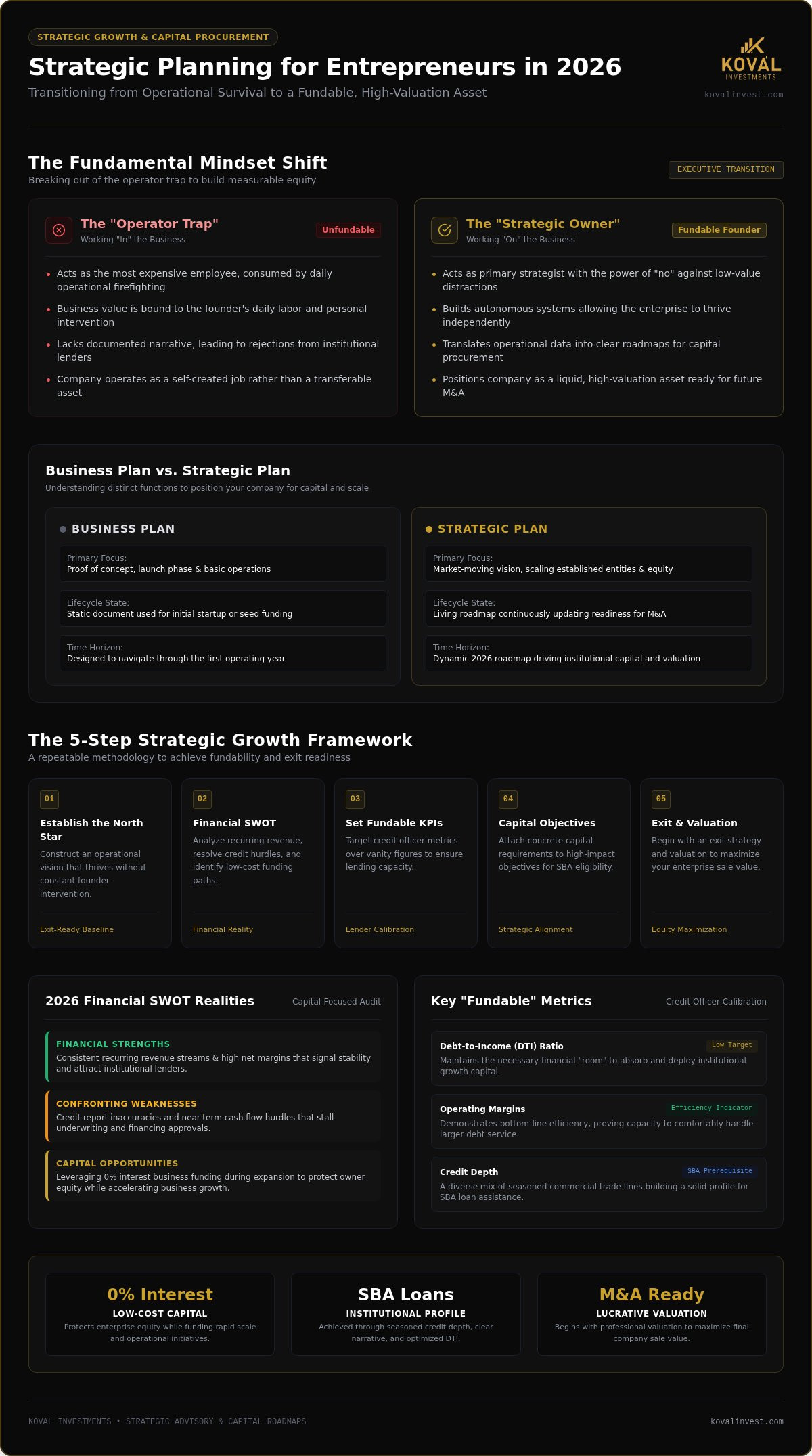
This process forces a critical shift in your mindset. You stop working "in" the business as its most expensive employee and start working "on" it as its primary strategist. By formalizing your strategic planning, you create a clear narrative for lenders and investors. Strategic planning for entrepreneurs is a financial optimization tool that transforms operational data into a roadmap for capital procurement and equity growth.
The Difference Between a Business Plan and a Strategic Plan
Many owners confuse these two documents, but their purposes are distinct. A business plan is typically a static document used to launch a startup or secure initial seed money. It focuses on proving a concept and outlining basic operations. In contrast, a strategic plan is built for scaling established entities. It prioritizes market-moving vision over simple day-to-day efficiency. While a business plan might get you through your first year, a strategic plan ensures you stay attractive for M&A activity. It acts as a living document that constantly updates your readiness for a merger or acquisition, ensuring your company remains a liquid asset rather than a job you can't leave.
The Entrepreneurial "Operator Trap" and How Planning Breaks It
If you're spending your day firefighting minor operational issues, you're caught in the "operator trap." This cycle prevents you from seeing the bigger picture and makes your business nearly impossible to fund. Lenders want to see a leader, not a technician. A 2026 roadmap provides you with the power of "no." It acts as a filter for your time and resources, protecting you from distractions that don't move the needle on your valuation.
Building this transition is essential to becoming a "fundable founder." When you can show a clear path to growth, you're much more likely to secure SBA loan assistance or 0% interest funding. Planning turns you into a partner that lenders can trust and respect, moving you away from the stress of day-to-day survival.
The 5-Step Framework for a Strategic Growth Roadmap
Building a scalable business requires more than ambition; it demands a repeatable process that separates the company's value from the founder's daily presence. The first step in this framework is establishing your North Star. This is a vision of the company that functions independently of your personal labor. When a business can thrive without the owner's constant intervention, it becomes an attractive asset for investors and lenders. Effective strategic planning for entrepreneurs focuses on building these systems early to ensure the enterprise is exit-ready at all times.
Conducting a Financial SWOT Analysis
A traditional SWOT analysis often stays too high-level. In 2026, your analysis must be rooted in financial reality. Start by identifying your strengths, such as consistent recurring revenue or high net margins. These are the traits that make you attractive to lenders. Next, confront your weaknesses. This often includes credit report inaccuracies or cash flow hurdles that could stall an application. Finally, look for opportunities like 0% interest business funding. Leveraging these low-cost capital sources during an expansion phase can significantly protect your equity while accelerating growth.
Once you understand your financial position, you must set "fundable" KPIs. Vanity metrics like social media followers or top-line revenue don't impress credit officers. Instead, focus on the numbers that matter for capital access:
- Debt-to-Income Ratio: Keeping this low ensures you have the "room" to take on growth capital.
- Operating Margins: Demonstrating efficiency proves you can handle larger debt service.
- Credit Depth: A diverse mix of seasoned trade lines builds a stronger profile for SBA loans.
Defining High-Impact Strategic Objectives
Your objectives should move beyond vague desires like "increasing sales." Instead, optimize your goals for SBA loan eligibility and long-term equity growth. Every objective you set needs a clear capital requirement attached to it. If you plan to enter a new market, you should know exactly how much working capital is required and where that money will come from. By using professional business valuation services, you can track how these objectives directly impact your company's market price. This data-driven approach ensures that every 90-day sprint contributes to a higher valuation.
Execution relies on breaking down your three-year vision into manageable 90-day sprints. This rhythm prevents the "planning fatigue" that often causes strategic documents to be ignored. Strategic planning for entrepreneurs also requires a partner who understands the nuances of capital markets to ensure your roadmap remains realistic. If you're ready to see how your current plan stacks up against lender requirements, you can explore our strategic planning resources to refine your approach.
Strategic Planning vs. Tactical Execution: Bridging the Gap
The disconnect between a vision and day-to-day operations is where most businesses stall. Industry data suggests that 90% of strategic plans fail not because they are poorly written, but because they lack a bridge to tactical execution. To be among the 10% that succeed, you must view strategic planning for entrepreneurs as a living system rather than a static document. This requires a dedicated "Strategic Advisory" mindset to maintain accountability and ensure that your high-level goals actually translate into daily actions.
Building an Execution Rhythm
Consistency is the foundation of any successful roadmap. You need a structured cadence that separates the "how" from the "why." Weekly tactical meetings should focus exclusively on the immediate tasks required to hit your 90-day targets. In contrast, quarterly strategic reviews allow you to step back and assess if those targets are still aligned with your long-term vision. Using real-time dashboards to monitor "Strategic Health" prevents you from waiting until the end of a fiscal year to realize you've drifted off course. Straight-talk feedback loops within your team are essential; if a tactic isn't working, the team needs the clarity to pivot immediately.
The Role of Working Capital in Execution
Even the most brilliant strategy will fail if it's starved of resources. Many entrepreneurs build plans that assume perfect cash flow, only to see their initiatives stall when capital is tied up in accounts receivable. Managing cash flow is a strategic act, not just an accounting task. For those looking to grow through buyouts, having working capital for business acquisition ensures you can move quickly when an opportunity arises. Without this liquidity, your plan is just a wish list.
Tactical pivots often require immediate liquidity. Whether you are scaling a successful marketing campaign or navigating a sudden shift in your industry, alternative business funding solutions provide the flexibility needed to stay agile. Leveraging 0% APR credit lines for these short-term tactical wins allows you to execute your strategy without diluting your equity or taking on high-interest debt. By integrating capital procurement directly into your tactical execution, you ensure that your strategic planning for entrepreneurs remains a practical engine for growth rather than a theoretical exercise.
Linking Your Strategy to Capital Procurement
Lenders look at your business through a different lens than you do. While you see a vision for market disruption, a credit officer sees a series of risks and mitigations. A balance sheet only tells them what happened in the past; it's a rearview mirror. Strategic planning for entrepreneurs provides the windshield. It offers a forward-looking narrative that explains exactly how you'll use borrowed funds to generate a return. When you can present a roadmap that aligns your growth targets with specific financial milestones, you move from being a risky applicant to a strategic partner.
This alignment is particularly critical when seeking SBA loan assistance. The SBA requires a clear "use of proceeds" statement, and a well-documented plan justifies every dollar you request. It proves that you aren't just looking for a lifeline, but are investing in a calculated expansion. Additionally, business credit repair services act as a strategic lever for funding, ensuring your financial profile is strong enough to command the best possible terms.
Optimizing Your Financial Profile for Funding
Building a "Lender-Ready" profile is a core strategic objective that should begin months before you actually need the capital. This involves a methodical review of your business credit reports to identify and dispute inaccuracies that could artificially inflate your interest rates. In the 2026 lending environment, even small fluctuations in your credit score can significantly impact SBA loan approval rates. By treating credit optimization as a strategic task rather than an administrative chore, you create a win-win scenario: higher scores lead to a lower cost of capital, which in turn increases your net margins.
Selecting the Right Funding Source for Your Plan
Your strategic plan should dictate your funding source, not the other way around. If your roadmap involves purchasing fixed assets or long-term equipment, an SBA 504 loan might be the most efficient choice due to its fixed-rate structure. For more general needs like inventory or payroll during a pivot, the SBA 7(a) program offers greater flexibility.
Strategic planning for entrepreneurs also identifies when to utilize low-cost options like 0% interest funding for research and development or inventory spikes. This protects your cash flow for more aggressive moves. For those looking to diversify their corporate holdings, using funding for real estate investors can help build long-term corporate wealth alongside your primary business operations. If you're unsure which path fits your 2026 goals, you can speak with our capital advisors to align your strategy with the right funding vehicle.
The Exit Strategy: Planning for Valuation and M&A
Every successful venture eventually reaches a point of transition. Whether you intend to pass the business to the next generation or sell to a private equity firm, your roadmap must begin with the end in mind. Strategic planning for entrepreneurs is fundamentally about building a business asset that is attractive to an outside buyer. If the company's value is tied strictly to your personal labor, its market price will always be limited. By planning for an exit now, you ensure that every operational decision you make increases the ultimate payout of your life's work.
Professional business valuations play a critical role in this process. They don't just tell you what the business is worth today; they influence your 2026 growth targets by highlighting the specific areas where you can add the most equity. M&A consulting provides the framework to navigate these complex transitions, ensuring you don't leave money on the table due to poor preparation or disorganized financials.
Maximizing Business Valuation Through Strategy
To attract premium buyers, you must present a "founder-independent" business model. This means your systems, team, and capital access should function seamlessly without your daily intervention. Cleaning up your financial statements is the first step in this journey. Buyers look for transparency and predictability. You should also identify "Value Drivers" that your competitors might overlook. These could include a robust business credit profile, proprietary operational software, or a diversified customer base that isn't reliant on a single contract. When your strategy focuses on these drivers, you build a company that commands a higher multiple in the open market.
Preparing for Mergers and Acquisitions
A strategic exit requires a long runway. Ideally, you should begin preparing at least two years before you intend to sell. This timeline allows you to optimize your tax structure and prove a track record of consistent growth. Strategic planning for entrepreneurs also helps you identify potential acquisition targets. Sometimes, the best way to increase your own valuation is to acquire a smaller competitor that adds a new capability or geographic reach to your portfolio. This proactive approach positions you as a leader in your industry rather than a passive observer.
Koval Investments acts as the seasoned partner that bridges the gap between high-level planning, capital procurement, and a successful exit. We understand that your business is more than just a series of transactions; it's the result of years of dedication. Our success-based philosophy ensures that our interests are always aligned with yours. If you're ready to transform your vision into a fundable, high-valuation asset, you should schedule a strategic consultation with Koval Investments today.
Chart Your Course Toward Sustainable Equity
Mastering strategic planning for entrepreneurs is the most significant step you can take to move from daily firefighting to long-term wealth creation. By aligning your operational goals with fundable KPIs and a clear exit strategy, you transform your business into a high-valuation asset that attracts lenders and buyers alike. You've seen how structured roadmaps bridge the gap between vision and capital, ensuring your growth remains both scalable and secure.
At Koval Investments, we've facilitated over $500M in capital procurement for owners ready to scale. Our success-based model means there's no upfront risk to you, allowing us to focus entirely on your results. Whether you need professional business valuations, M&A expertise, or specialized funding solutions, we act as your steady hand in a complex financial landscape. Don't let your 2026 growth happen by accident. Secure Your Business Future with a Strategic Growth Consultation today. We're ready to help you build the legacy your hard work deserves.
Frequently Asked Questions
What is the primary goal of strategic planning for entrepreneurs?
The primary goal is to transform your entrepreneurial vision into a fundable, high-valuation business asset. Strategic planning for entrepreneurs focuses on creating a roadmap that prioritizes capital access and long-term equity growth. Instead of just managing daily operations, you build a system that is attractive to lenders and potential buyers. This shift ensures your company remains a liquid asset rather than just a source of personal employment, allowing for sustainable scaling and an eventual lucrative exit.
How often should an entrepreneur update their strategic plan?
You should treat your strategic plan as a living document that requires quarterly updates and weekly tactical check-ins. While your long-term vision might stay consistent for three years, the tactics used to reach it must remain agile. Breaking your goals into 90-day sprints allows you to pivot based on 2026 market shifts or new funding opportunities. This regular rhythm keeps the team accountable and ensures your roadmap never becomes an obsolete file on a hard drive.
Can strategic planning help me get an SBA loan in 2026?
Yes, a well-documented strategic plan is essential for securing SBA loan assistance in 2026. Lenders require a clear "use of proceeds" statement and proof that your business can handle additional debt service. Your plan provides the windshield they need to see your future revenue potential rather than just looking at past tax returns. By demonstrating a structured growth path, you move from a risky applicant to a professional partner that credit officers can trust.
What is the difference between a strategic advisor and a business coach?
A strategic advisor functions as a seasoned partner focused on tangible financial outcomes, capital procurement, and M&A readiness. They provide the "straight-talk" mentorship needed to navigate complex financial landscapes. In contrast, a business coach often focuses on personal development, productivity, or general leadership skills. While coaches help you improve as a person, a strategic advisor works alongside you to improve the actual valuation and fundability of your business through precise financial and operational restructuring.
How does credit repair fit into a strategic business plan?
Credit repair is a strategic lever used to lower your cost of capital and increase your net margins. By identifying and disputing inaccuracies on your reports, you improve your eligibility for the best possible interest rates. High credit scores are a core component of strategic planning for entrepreneurs because they dictate the terms of your future funding. Integrating this optimization into your plan ensures you're always "lender-ready" when a growth opportunity or acquisition target arises.
What documents do I need to begin professional strategic planning?
To begin professional strategic planning for entrepreneurs, you generally need your last two years of financial statements, a current debt schedule, and your most recent tax returns. You should also gather any existing mission statements and a list of your current operational bottlenecks. These documents allow an advisor to conduct a thorough financial SWOT analysis. Having this data ready ensures the planning process is rooted in reality rather than vague aspirations, leading to a more fundable roadmap.
How does a strategic plan impact my business valuation?
A strategic plan directly increases your business valuation by proving that the company is founder-independent and has predictable growth systems. Professional buyers and M&A consultants look for entities that can function seamlessly without the original owner's constant intervention. When you document your "Value Drivers" and show a clear path to future revenue, you command a higher multiple during a sale. Planning turns your business from a job into a high-value asset that is ready for a successful transition.
Is 0% interest funding a viable part of a long-term strategic plan?
0% interest funding is a highly viable tool for short-term tactical wins within a long-term strategic plan. These credit lines allow you to fund research, development, or inventory spikes without diluting your equity or taking on high-interest debt. By using these low-cost capital sources for specific 90-day sprints, you protect your cash flow for more aggressive strategic moves. It's a "win-win" approach that leverages temporary liquidity to reach milestones that permanently increase your company's overall market value.