
The Best Way to Finance a Franchise Purchase: A Strategic 2026 Guide
What if the most effective way to launch your franchise isn't by walking into a local bank with a stack of collateral? For many entrepreneurs, finding the best way to finance a franchise purchase feels like a choice between high interest rates and draining their personal savings. It's frustrating to see your early profits consumed by interest payments before your business even finds its footing. You've worked hard to build your vision; it's natural to feel hesitant about complex SBA paperwork or rigid credit requirements that seem designed to hold you back.
This guide will show you how to secure capital without compromising your personal assets. You'll discover how to leverage 0% interest funding solutions and streamlined SBA pathways to keep more money in your business. We'll explore a strategic sequence that starts with credit optimization and moves into low-cost capital solutions tailored for the 2026 economy. By the end, you'll have a clear roadmap to fund your growth while protecting your financial future.
Key Takeaways
- Learn why diversifying your capital sources is the best way to finance a franchise purchase without depleting your critical liquid cash reserves.
- Understand the specific advantages of SBA 7(a) and 504 loans for achieving long-term stability and securing business real estate.
- Discover how strategic credit optimization can significantly lower your interest rates and total cost of capital before you apply.
- Explore how 0% interest funding solutions can bridge the gap for initial franchise fees and working capital during your ramp-up phase.
- Identify the benefits of a success-based funding partnership that aligns your growth objectives with expert capital procurement.
Beyond Personal Savings: Evaluating the Best Way to Finance a Franchise Purchase
Securing a franchise requires more than just a passion for the brand; it requires a sophisticated capital structure. Most successful owners view their acquisition through the lens of understanding small business financing, which involves a calculated mix of debt, equity, and strategic credit. While it's tempting to use personal savings to avoid interest, this often proves to be a tactical error. Relying solely on your own cash can leave you "cash poor" during the critical first year when unexpected operational costs or slower than expected growth can threaten your liquidity.
The best way to finance a franchise purchase involves balancing your immediate cash needs with your long-term return on investment. This brings us to the concept of cost of capital. Every dollar you borrow has a price. If that price is too high, it eats directly into your franchise ROI. To maintain a healthy bottom line, you must evaluate primary sources such as SBA loans, conventional bank products, and alternative funding options with a focus on how they impact your monthly cash flow.
The Hidden Costs of Traditional Franchise Debt
Traditional loans often carry burdens that extend beyond the headline interest rate. High rates can stifle your cash flow during the first 12 to 24 months, which is the most volatile period for any new location. You must also account for origination fees and closing costs, which can add thousands to your initial investment before the doors even open. Debt service coverage ratio is a measurement of the business's available cash flow to pay current debt obligations, serving as a primary benchmark for lender approval.
Why 2026 Demands a Strategic Funding Approach
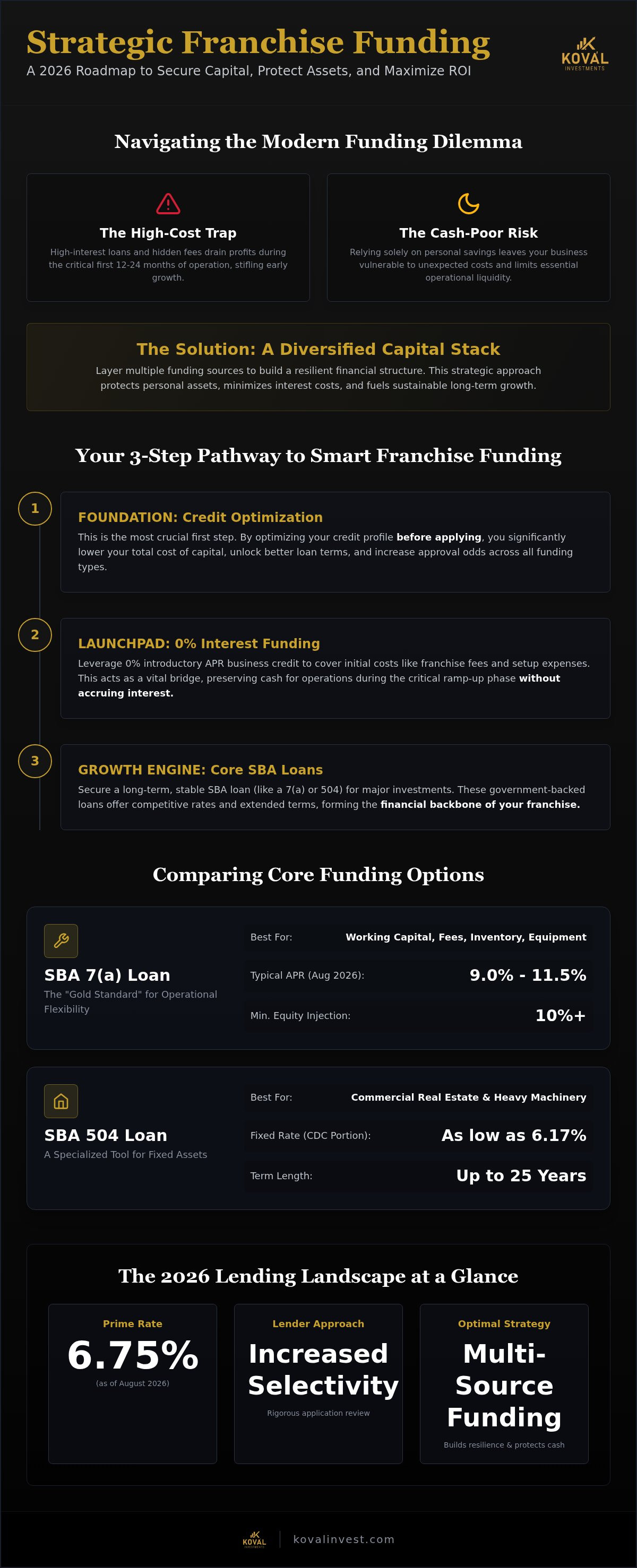
In 2026, the lending environment has become increasingly selective. With the Prime rate sitting at 6.75% as of August, lenders are scrutinizing applications with greater intensity. A single-source funding strategy is no longer the safest path. Instead, a multi-source approach provides a buffer against market volatility. By integrating alternative business funding solutions as a safety net, you can cover gaps in working capital without overextending your primary term loans. This strategic layering ensures you have the liquidity to handle the ramp-up phase while keeping your personal assets protected. Finding the best way to finance a franchise purchase today means looking beyond the bank counter and building a resilient, diversified capital stack.
Comparing Traditional Franchise Loans: SBA 7(a), 504, and Conventional Bank Funding
The SBA 7(a) loan remains the "gold standard" for those seeking the best way to finance a franchise purchase. It offers versatility that few other products can match, allowing you to use funds for initial franchise fees, inventory, and leasehold improvements. Because the SBA guarantees a portion of the loan, lenders are often more willing to work with new owners who might otherwise struggle with conventional requirements. As of August 2026, with the Prime rate at 6.75%, these variable-rate loans typically carry an APR between 9.0% and 11.5%. While the rates are competitive, you should expect a minimum 10% equity injection and a rigorous review of your personal financial history.
The Franchise Registry is another critical tool for streamlining your application. Brands on this list have already had their franchise agreements vetted by the SBA. This pre-approval significantly reduces the administrative burden on your lender, often resulting in a faster path to funding. If your chosen brand isn't on this registry, the legal review of the franchise agreement can add weeks to the process. Aligning your funding strategy with your long-term goals is easier when you have a trusted strategic partner to guide the process.
SBA 7(a) vs. 504: Which Fits Your Franchise Model?
Choosing between an SBA 7(a) vs 504 loan depends entirely on your asset needs. The 7(a) program is built for operational flexibility, making it ideal for working capital and equipment. Conversely, the 504 loan is a specialized tool for fixed assets like commercial real estate or heavy machinery. In 2026, the CDC portion of 504 loans offers attractive fixed rates as low as 6.17% for 25-year terms. However, you must be mindful of the guarantee fees. For 7(a) loans, fees currently range from 3.5% for amounts up to $700,000 to 3.75% for larger sums up to the $5 million cap.
Conventional Bank Lines of Credit
Conventional bank funding offers a faster path to capital for established operators with strong balance sheets. These lenders prioritize collateral and often require higher credit scores than the SBA's common benchmarks. When reviewing your application, banks lean heavily on your Franchise Disclosure Document (FDD), specifically Item 19, to see historical performance data. For more franchise financing tips, look at how successful owners use a line of credit for seasonal inventory shifts while keeping their term loans for the initial build-out. If the paperwork feels overwhelming, utilizing professional SBA loan assistance can bridge the gap between a complex application and a funded business.
The Power of Credit Optimization: Lowering Your Cost of Capital Before You Buy
Your personal credit score acts as the primary lever for your interest rates. When pursuing the best way to finance a franchise purchase, many entrepreneurs overlook the impact of a single score tier. Lenders view your credit history as a roadmap of your financial reliability. A score below 680 often triggers higher risk premiums, which can add thousands of dollars to your total repayment amount. Beyond simple approval, optimizing your score ensures you access the lowest possible cost of capital, directly increasing your business's day-one profitability.
Inaccuracies on your report are more common than most realize. These errors can lead to unnecessary interest charges that accumulate over the life of a ten-year loan. For a comprehensive look at the landscape, this guide to financing a franchise highlights how preparation is key to securing favorable terms. High credit utilization is another common hurdle. Even if you make every payment on time, carrying balances near your limits signals to lenders that you may be overleveraged, which often results in lower funding caps.
Professional credit restoration should be viewed as a strategic investment rather than an expense. The return on investment is often immediate. For instance, moving your score up by just 50 points can result in a 1% to 2% reduction in your interest rate. On a typical $500,000 franchise loan, this small adjustment can save you over $50,000 in interest payments over the term. This makes credit optimization the best way to finance a franchise purchase while keeping your long-term costs as low as possible.
Fixing Credit for SBA Loan Approval
SBA lenders in 2026 have tightened their requirements. While a 680 might get you through the door, a score of 720 or higher is often required to unlock the most competitive terms. Utilizing professional business credit repair services can help you navigate this process efficiently. You should focus on a specific checklist to ensure your profile is lender-ready:
- Identify and dispute all outdated personal information or incorrect addresses.
- Challenge any late payments that are older than seven years but still appear.
- Verify that all settled accounts are correctly marked as "paid in full."
- Address any "soft" or "hard" inquiries that were not authorized.
Building a Stronger Financial Profile
Understanding the distinction between consumer and business credit is vital for long-term growth. Your consumer score often acts as the gateway for your first location, but building a separate business credit profile allows you to scale without tethering every loan to your personal social security number. Strategic steps like lowering your debt-to-income (DTI) ratio can drastically improve your standing. A lower DTI suggests you have the breathing room to handle new debt service payments comfortably. By cleaning up your personal profile now, you create the foundation needed to access higher credit limits and lower rates when you are ready to expand to multiple units.
Strategic Alternatives: Leveraging 0% Interest Funding for Franchise Start-up Costs
While traditional loans provide long-term stability, they often come with immediate interest obligations that pressure your early cash flow. Many entrepreneurs have discovered that the best way to finance a franchise purchase involves integrating 0% interest business funding as a strategic bridge. This method utilizes unsecured business credit lines that offer introductory rates of 0% for periods typically ranging from 12 to 22 months. It's a revolutionary tool for covering initial expenses like franchise fees and opening inventory without incurring a single dollar in interest during your most vulnerable phase of growth.
This funding is fundamentally different from standard consumer credit. Because it's unsecured, you aren't required to pledge your home or other personal assets as collateral. This "bridge" strategy allows you to reach operational profitability before long-term debt service kicks in. It provides a level of financial agility that traditional term loans simply cannot match. By utilizing this capital for the ramp-up period, you preserve your liquid cash for emergencies or unexpected leasehold overruns.
How to Qualify for 0% Interest Business Capital
Accessing these elite financial products requires a high-tier credit profile, typically a score of 720 or higher. This is where the credit optimization discussed previously pays the highest dividends. Successful franchisees often use 0% interest business funding by stacking multiple offers from different lenders. This process, when managed correctly, can aggregate six-figure funding limits. It remains one of the industry's best-kept secrets for scaling quickly without the weight of high-interest debt. If you are ready to explore these options, you can apply for a 0% interest funding solution to see what your business qualifies for today.
Using 0% Capital for Working Capital and Fees
Strategic allocation is the key to maximizing these 0% windows. The initial franchise fee is an ideal candidate for this capital. Since this fee is a one-time cost, paying it off within the 0% introductory period ensures you never pay interest on that specific entry cost. You must have a clear plan for the repayment transition once the introductory period ends, often by refinancing into a low-interest term loan or using business profits. This approach works exceptionally well when using working capital for business acquisition, as it keeps your acquisition costs low while you focus on stabilizing the new location's revenue streams.
Partnering for Success: How Koval Investments Secures Your Franchise Future
Koval Investments operates on a success-based philosophy. This means our objectives are perfectly aligned with yours from the first consultation. We believe the best way to finance a franchise purchase is through a partnership where the advisor has skin in the game. You won't face financial risk during our initial engagement phase; our firm only succeeds when your funding is secured. This approach removes the typical pressure found in institutional finance, allowing us to focus entirely on the practicalities of your business advancement.
Our comprehensive method bridges the gap between your current financial standing and your growth ambitions. We don't simply point you toward a lender. Instead, we provide a consultative process that includes strategic planning and business valuation before you ever sign a franchise agreement. This ensures that the capital you secure is not just available, but optimal for the specific ROI goals of your chosen brand. By acting as a seasoned strategic partner, we navigate the complexities of capital procurement alongside you, providing a steady hand in a shifting financial landscape.
The Koval Capital Procurement Process
The journey to funding is logical and methodical, designed to build your financial strength incrementally. We follow a three-step framework to ensure transparency and accountability:
- Step 1: Financial Profile Audit and Credit Optimization. We begin with a deep dive into your current profile, identifying and resolving any hurdles that could lead to higher interest rates or loan denials.
- Step 2: Identifying the Optimal Mix. We determine the precise balance of 0% interest funding solutions and SBA loans that will minimize your cost of capital while maximizing your liquidity.
- Step 3: Strategic Execution and Capital Injection. Our team handles the heavy lifting of the application and procurement process, ensuring the capital is injected into your business at the right moment for your launch.
Long-term Strategic Growth Advisory
Our relationship doesn't end once the initial capital is secured. We support multi-unit franchise expansion through ongoing strategic advisory, helping you scale as your first location stabilizes. For entrepreneurs looking to acquire existing units, our professional business valuations provide the clarity needed to ensure you are paying a fair price based on tangible value. The best way to finance a franchise purchase is to treat it as the first step in a long-term wealth-building strategy. When you are ready to move forward, you can secure your franchise funding with a partner who cares about your bottom line and is dedicated to your long-term success.
Building Your Franchise Legacy with Strategic Capital
Securing the right capital is the foundation of your future business. You've seen how the best way to finance a franchise purchase involves a deliberate sequence of credit optimization followed by a mix of 0% interest solutions and long-term SBA loans. This strategy ensures you maintain the liquidity needed to navigate the first year without exhausting your personal reserves. By prioritizing your cost of capital today, you're directly investing in the future profitability and scalability of your enterprise.
Koval Investments is ready to guide you through this process with our success-based model. We provide comprehensive support from initial credit repair to the final SBA loan closing; and we only win when you get funded. There's no upfront risk for our primary funding solutions, allowing you to focus on your operational goals while we secure the necessary capital. If you're ready to protect your assets while scaling your vision, Get a Free Funding Strategy Session with Koval Investments. Your journey toward multi-unit ownership starts with a single, strategic step.
Frequently Asked Questions
Can I get a franchise with no money down?
Generally, no. SBA regulations for 2026 require a minimum 10% equity injection for new franchise startups. While some franchisors offer internal financing, they still expect you to have skin in the game. However, you can strategically use unsecured business capital to cover a portion of your initial costs, provided you meet the lender's liquidity requirements. Most successful owners avoid using 100% of their own cash to keep a safety net for the first year.
What is the minimum credit score for a franchise loan in 2026?
Most SBA and conventional lenders require a minimum score of 680 to consider your application. To access the best way to finance a franchise purchase with the lowest interest rates, you should aim for a score of 720 or higher. Scores below the 680 threshold often result in automatic denials or significantly higher risk premiums that eat into your monthly cash flow. Optimizing your score before applying is a vital step in your funding strategy.
How much working capital do I really need for a new franchise?
You should typically secure enough working capital to cover six to twelve months of operating expenses. This buffer ensures you can manage the ramp-up phase without the pressure of immediate profitability. The specific requirements are usually outlined in Item 7 of your Franchise Disclosure Document (FDD). It's safer to over-estimate these needs during your initial funding round than to search for emergency capital while your business is already running.
Is it better to use a 401(k) rollover (ROBS) or an SBA loan?
The choice depends on your risk tolerance and long-term financial objectives. A ROBS allows you to invest retirement funds without taxes or penalties, meaning you start your business without monthly debt payments. An SBA loan preserves your retirement savings but introduces a monthly interest expense. Many operators choose to combine these methods, using a ROBS for the equity injection and an SBA loan for the remaining balance to maximize their leverage.
How long does the franchise financing process typically take?
The timeline for securing capital generally ranges from 45 to 90 days. SBA loans sit on the longer end of this spectrum due to federal paperwork and bank underwriting requirements. If you need a faster injection of capital, strategic 0% interest funding solutions can often be secured in two to four weeks. Starting your financial profile audit early is the most effective way to prevent delays during the closing process.
What happens if I can’t secure a traditional bank loan for my franchise?
If a traditional bank denies your application, you should focus on alternative funding solutions or professional credit restoration. Many denials are caused by high credit utilization or report errors that can be fixed. You might also explore unsecured business credit lines that prioritize your credit score over business collateral. These alternatives provide a path forward when rigid bank requirements don't align with your current financial profile.
Does 0% interest funding require personal collateral?
No, the 0% interest business funding solutions we facilitate are typically unsecured. You don't have to pledge your home or other personal assets to secure the capital. This structure protects your personal estate while providing the liquidity needed to reach your break-even point. It's a strategic way to access capital based on your credit merit rather than your physical assets, which is ideal for entrepreneurs who want to limit personal risk.
Can I use a business loan to pay the initial franchise fee?
Yes, paying the initial fee with a business loan is often the best way to finance a franchise purchase. Using 0% interest capital for this specific expense allows you to join the brand without paying interest on the entry cost during your first year. This preserves your personal cash for operational emergencies or leasehold improvements. Most SBA 7(a) loans also allow the franchise fee to be rolled into the total loan amount for easier repayment.