
The Strategic Role of a Business Acquisition Advisor in 2026
With global M&A deal values projected to reach $4 trillion in 2026 despite a decline in total deal volume, the margin for error in any single transaction has never been thinner. You probably already feel the pressure of a K-shaped market where competition for high-quality targets is fierce and valuations are frequently stretched. It's common to worry about overpaying or hitting a wall when it comes to securing favorable funding terms; these hurdles often lead to deal fatigue long before you reach the closing table.
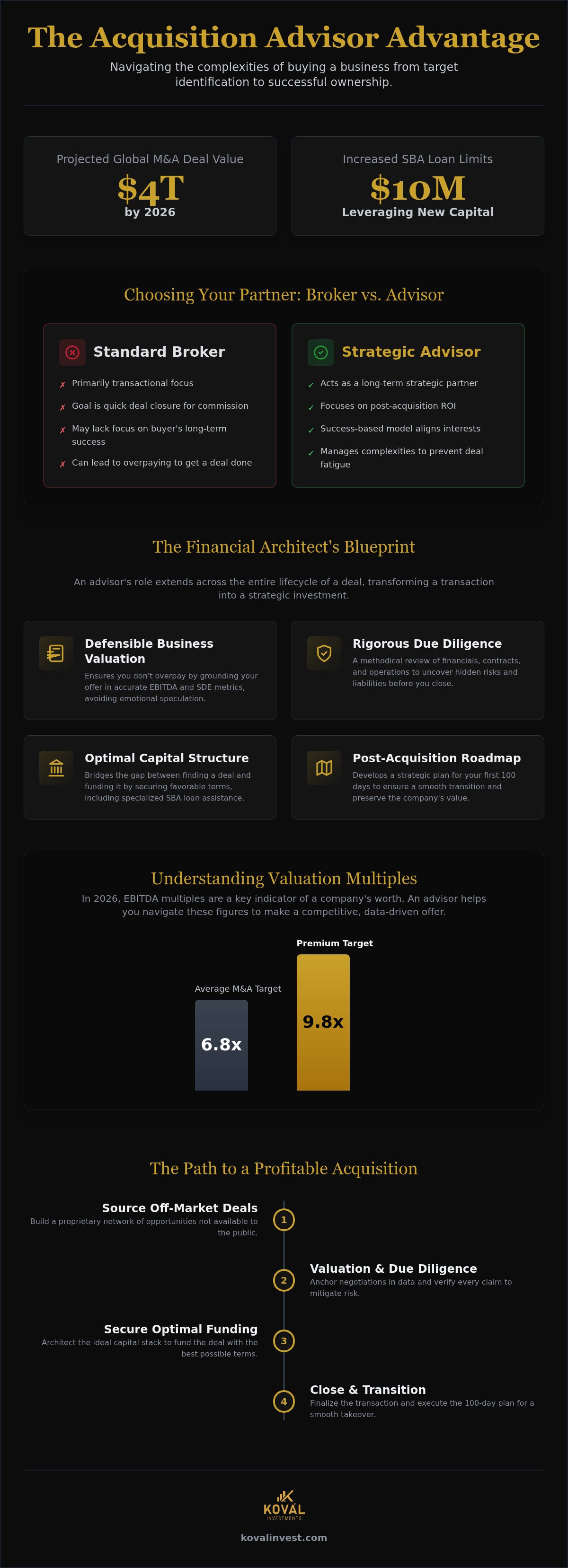
A specialized business acquisition advisor acts as the financial architect of your transaction, ensuring you don't just find a company, but actually own it under the best possible conditions. This article explores how a dedicated advisor bridges the critical gap between identifying a target and securing the optimal capital structure to close the deal. We will preview the strategic synergy between thorough due diligence and capital procurement, including how to leverage the 2026 SBA loan limit increases to $10 million. You'll discover a methodical approach to minimizing risk while optimizing your interest rates, providing a clear, success-based roadmap for your next acquisition.
Key Takeaways
- Distinguish between a standard transaction broker and a strategic partner who manages both the identification and the funding of your target company.
- Master the fundamentals of defensible business valuations to ensure your offer is rooted in accurate EBITDA and SDE metrics rather than emotional speculation.
- Discover how a business acquisition advisor bridges the gap between finding a deal and securing the optimal capital stack through specialized SBA loan assistance.
- Follow a structured roadmap for sourcing off-market deals and building a proprietary network of acquisition opportunities that aren't available to the general public.
- Learn the advantages of a success-based advisory model that aligns your interests with your partner's, ensuring the focus remains on closing a profitable transaction.
What is a Business Acquisition Advisor?
A business acquisition advisor serves as a dedicated partner who guides you through the complex journey of buying a company. Unlike a service provider who handles only one part of the process, these professionals act as financial architects. They look at the entire lifecycle of a deal, from the initial investment thesis to the moment you take over operations. In the broader context of Mergers and acquisitions (M&A), their role is to ensure that the strategic intent of the purchase matches the financial reality of the target. By aligning your long-term goals with the practicalities of capital and operations, they bridge the gap between a simple transaction and a successful investment.
Broker vs. Advisor: Choosing the Right Partner
It's easy to confuse a business broker with a business acquisition advisor, but their objectives are fundamentally different. Most brokers operate on a transactional basis. Their primary goal is to close the deal so they can collect a commission, which sometimes leads to a lack of focus on the buyer's long-term success. An advisor, however, prioritizes your post-acquisition return on investment. They manage the emotional and technical complexities of negotiations, acting as a steady hand when deal fatigue sets in.
Choosing an advisor who operates with a success-based philosophy creates a natural alignment of interests. You aren't just paying for a service; you're entering a collaborative venture. This approach ensures the firm is selective and intentional about the deals they pursue. Instead of high-pressure sales tactics, you get a mentor who is equally invested in your success. They help you avoid the common trap of overpaying for a business simply to get a deal done.
The Core Responsibilities of an Acquisition Consultant
The foundation of any profitable acquisition is a defensible valuation. In 2026, average M&A EBITDA multiples are expected to be 6.8x, but premium targets can reach 9.8x. An advisor conducts professional business valuations to ensure you don't enter at an inflated price. They look beyond the surface numbers to analyze the quality of earnings and the sustainability of cash flow. This precision is vital when you're preparing to secure funding, as lenders require a clear, data-driven rationale for the purchase price.
Beyond valuation, a business acquisition advisor coordinates the heavy lifting of due diligence. This involves a methodical review of financial records, legal contracts, and operational processes to uncover hidden liabilities. Once the risks are identified and mitigated, the advisor helps develop a strategic plan for your first 100 days. This roadmap ensures a smooth transition of leadership and preserves the company's value from day one. This thoroughness transforms a risky purchase into a stable, growth-oriented asset.
The Critical Importance of Business Valuation and Due Diligence
A defensible valuation isn't just a numerical exercise; it's the anchor for your entire negotiation. Without a calculation rooted in market reality, you risk overpaying or being rejected by lenders who see a mismatch between the asking price and the actual cash flow. A seasoned business acquisition advisor typically evaluates a company using Earnings Before Interest, Taxes, Depreciation, and Amortization (EBITDA) for larger entities, or Seller’s Discretionary Earnings (SDE) for smaller, owner-operated firms. These metrics provide a standardized view of profitability. They allow you to compare the target against industry peers with clarity and precision.
Determining the Real Worth of a Target Company
Valuation involves more than just scanning a balance sheet. Advisors use three primary methods to find a fair price: the asset-based approach, the market approach, and the income approach. While the market approach looks at what similar businesses have sold for, the income approach focuses on future cash flow potential. Utilizing professional business valuation services is essential because they account for owner add-backs. These are personal expenses or one-time costs that, when added back to the net income, reveal the true earning power of the business. This transparency gives you the leverage needed to justify your offer to both the seller and your lenders.
The Due Diligence Checklist for Buyers
Once the price is agreed upon, the audit phase begins. This is where you verify every claim made during the initial discussions. A thorough checklist starts with a deep dive into at least three years of tax returns and Profit and Loss (P&L) statements to ensure consistency. You'll also need to assess customer concentration risks. If a single client accounts for a large percentage of the revenue, the deal's risk profile changes significantly. The SBA's guide to buying a business emphasizes that legal and financial scrutiny are your primary tools for risk mitigation.
During this phase, keep a close watch for these specific audit items:
- Verification of accounts receivable aging and collection history.
- Physical inventory counts compared against book value.
- Employee retention rates and the presence of "key-man" dependencies.
- Accuracy of accounts payable and undisclosed liabilities.
Identifying red flags early, such as declining margins or undisclosed legal disputes, allows you to renegotiate terms or walk away before capital is committed. If the audit process reveals complexities you didn't anticipate, a business acquisition advisor can help you pivot your strategy without losing momentum. Ensuring your interests are protected at this stage is vital for long-term profitability. If you're ready to move from searching to auditing, consider how partnering with a strategic expert can streamline your path to a successful closing.
Funding the Deal: Beyond Traditional Bank Loans
Securing the right capital is often the most difficult hurdle in the acquisition journey. Many buyers treat funding as an afterthought, but a seasoned business acquisition advisor views it as a strategic priority from day one. Instead of relying on a single bank loan, modern deals utilize a multi-tiered capital stack. This structure combines senior debt, seller financing, and equity to maximize leverage while preserving cash flow. By engineering this stack early, you can move with confidence when a target meets your criteria.
Leveraging SBA 7(a) and 504 Loans
For most acquisitions, SBA loans provide the foundation of the debt structure. As of July 4, 2026, the cumulative limit for these programs increased to $10 million, allowing borrowers to have up to $5 million in each program concurrently. Choosing between an SBA 7(a) vs 504 loan depends on whether you're acquiring goodwill and working capital or commercial real estate. While variable rates for 7(a) loans currently range from 9.75% to 13.25%, the CDC portion of a 504 loan remains more attractive, hovering between 5.65% and 5.82%.
A consultant provides essential SBA loan assistance by managing the complex documentation and negotiating seller standby notes. These notes can sometimes be used to partially cover the required 10% equity injection, making it easier to secure financing without draining your personal reserves. This methodical approach ensures you don't just get approved, but you do so with terms that support long-term stability.
Non-Dilutive Capital: 0% Interest Solutions
The most innovative part of a modern capital strategy involves non-dilutive funding. You can leverage 0% interest business funding to cover initial down payments or closing costs without giving up equity in your new company. This approach is particularly effective when paired with business credit repair services. Improving your credit profile doesn't just increase your chances of approval; it unlocks lower interest rates across your entire debt stack, including traditional working capital loans.
A business acquisition advisor ensures these pieces work together. This coordination secures the necessary capital while maintaining post-deal liquidity for growth and operations. It's a win-win scenario that protects your personal assets while scaling your business portfolio. By treating the funding process as a collaborative venture, you position yourself as a qualified buyer capable of closing complex transactions quickly and efficiently.
The Business Acquisition Roadmap: A Step-by-Step Guide
Successful acquisitions are built on a methodical framework that begins long before the first meeting with a seller. This roadmap provides a structured path from your initial investment thesis to the successful integration of a new company. A veteran business acquisition advisor ensures each phase is executed with precision, preventing the common mistakes that lead to deal fatigue or financial loss. By following a logical progression, you maintain control over the narrative and the timeline of the transaction.
The journey starts with defining your acquisition criteria. You need a clear investment thesis that outlines the industries, revenue sizes, and operational structures you are targeting. This clarity allows you to filter out distractions and focus your energy on businesses that offer the highest potential for growth. Once your thesis is set, you move into the sourcing phase, where you identify potential targets that align with your strategic goals.
Sourcing and Screening Potential Targets
Relying solely on public listing sites often leads to bidding wars and inflated prices. To find high-quality targets, you should engage in proprietary, off-market outreach. Developing a professional "Buyer Profile" is essential here; it demonstrates to motivated sellers that you have the operational expertise to sustain their legacy. Presenting alternative business funding solutions as your proof of funds signals that you are a serious, qualified buyer. This preparation allows you to move quickly when an off-market opportunity arises, giving you a significant advantage over less prepared competitors.
After sourcing, you enter the negotiation phase. This begins with an initial offer and the drafting of a Letter of Intent (LOI). This document outlines the major terms of the deal, including price and structure, while providing a period of exclusivity for your due diligence. Once the LOI is signed, you move into formal audits and final capital procurement before reaching the closing table.
Negotiating Terms That Protect the Buyer
The LOI sets the stage, but the definitive agreement is where you protect your capital. Your business acquisition advisor will help you structure earn-outs to bridge valuation gaps, ensuring you only pay the full price if the company meets specific performance milestones. It's also vital to include non-compete and transition service agreements. These clauses prevent the seller from launching a competing firm and ensure they remain available to train you during the first few months. Finally, securing adequate working capital for business acquisition ensures you have the liquidity needed for Day 1 success.
The final step is integration planning. A successful close is only the beginning; you must have a strategic plan for the first 100 days to merge cultures and systems effectively. If you're ready to start your journey, partner with Koval Investments to develop your custom acquisition roadmap today.
Why Koval Investments is Your Strategic Acquisition Partner
Choosing a business acquisition advisor is a decision that shapes your financial future for years. At Koval Investments, we don't just facilitate transactions; we act as the financial architect for your entire portfolio. Our approach integrates mergers and acquisitions consulting with direct capital procurement. This ensures you aren't left with a signed letter of intent but no way to fund it. We operate with a national focus, bringing deep expertise to complex credit profiles and high-leverage deals that traditional banks might overlook.
A Success-Based Philosophy for Growth
Our model is fundamentally different from traditional consulting. We operate on a success-based philosophy, which means we win only when you close your deal. This approach minimizes your financial risk and ensures our interests are perfectly aligned with yours from day one. Instead of viewing our services as a traditional expense, you're entering a collaborative venture where we share the objective of securing a profitable company.
We bridge the gap between high-level strategic planning and tangible capital outcomes. By acting as an "insider" mentor, your business acquisition advisor shares the knowledge needed to navigate the nuances of the 2026 market. Whether it's restoring credit to unlock the current 6.75% prime rate or structuring a multi-tiered capital stack, we work alongside you. This relationship is built on integrity and straight-talk, providing a steady hand in complex financial landscapes. We focus on the practicalities of business advancement, moving at a pace that allows for thorough comprehension and long-term success.
Ready to Scale Your Portfolio?
The transition from an aspiring buyer to a successful owner requires a deliberate first step. If you're ready to acquire a company or scale your existing portfolio, the immediate priority is a professional consultation to define your investment thesis. We help you move past the frantic energy of the open market and into a structured, logical progression toward ownership.
Our team is ready to review your goals and evaluate how our suite of services, from business valuations to SBA loan assistance, can accelerate your timeline. We value quality of relationship over high-volume transactions, ensuring every client receives the personalized focus they deserve. Take the next step toward a successful acquisition and Partner with Koval Investments to secure your future.
Strategic Ownership Starts with the Right Foundation
Strategic ownership in 2026 requires a shift from transactional thinking to long-term financial architecture. We've explored how a defensible valuation and rigorous due diligence serve as your primary defense against overpayment and hidden liabilities. By leveraging a multi-tiered capital stack, including SBA loans and 0% interest funding, you can preserve your liquidity while scaling your portfolio with confidence. It's about moving beyond the surface of a deal to ensure the underlying structure supports your growth objectives.
A seasoned business acquisition advisor does more than just find a target; they ensure the deal is structured for sustainable success. Koval Investments provides this steady hand through a success-based philosophy and national strategic advisory. Our team specializes in navigating complex credit profiles and securing the best possible terms, ensuring your interests remain the priority. We win only when you close, creating a collaborative environment where your success is our primary objective.
If you're ready to move from the research phase to active ownership, the right partner makes all the difference. You don't have to navigate the complexities of M&A alone. Secure the Capital for Your Next Acquisition with Koval Investments and turn your strategic vision into a tangible asset. Your next milestone is within reach.
Frequently Asked Questions
What exactly does a business acquisition advisor do?
A business acquisition advisor acts as a strategic partner who manages the entire lifecycle of a purchase, from defining your investment thesis to the final integration. They provide professional business valuations, coordinate legal and financial due diligence, and architect the capital stack needed to close. By bridging the gap between finding a target and securing funding, they ensure the deal is both strategically sound and financially viable for your long-term growth.
How much does it cost to hire an acquisition consultant?
Market rates for advisory services often depend on the enterprise value of the target. For lower middle-market deals, total fees typically range from 4% to 8% of the transaction value. Many firms also utilize monthly retainers for discrete tasks like diligence support. However, it's beneficial to seek a partner with a success-based philosophy. This model aligns the advisor's incentives with your own, ensuring they're committed to closing a profitable deal rather than just collecting upfront fees.
Can I use 0% interest funding for a business acquisition?
You can absolutely utilize 0% interest funding to facilitate an acquisition. This non-dilutive capital is ideal for covering initial down payments, closing costs, or securing working capital without giving up equity in your new company. At Koval Investments, we specialize in these solutions to help buyers maintain post-deal liquidity. When combined with traditional debt, these 0% interest options create a highly efficient capital structure that lowers your overall cost of capital.
How does my personal credit score affect my ability to buy a business?
Your personal credit score is a primary factor in determining your eligibility for high-leverage financing like SBA loans. Lenders view your credit history as a reflection of your financial responsibility, which directly impacts the interest rates you're offered. If your score is currently a hurdle, professional credit repair services can identify and dispute inaccuracies. Improving your profile before applying can unlock lower rates, potentially saving you thousands of dollars over the life of the loan.
What is the difference between an M&A advisor and a business broker?
The primary difference lies in the scope and objective of the relationship. Business brokers are generally transactional, focusing on closing a deal to earn a commission. An M&A advisor acts as a strategic partner who prioritizes your post-acquisition return on investment. They provide deeper analysis into valuation and financial architecture, ensuring the target aligns with your long-term goals rather than just facilitating a one-time exchange of assets between a buyer and seller.
How long does the business acquisition process typically take?
A typical acquisition timeline ranges from six to twelve months. This includes the time needed for sourcing off-market deals, negotiating the letter of intent, and conducting rigorous due diligence. The funding phase can also add time, especially when coordinating SBA loan assistance or complex capital stacks. Working with a dedicated business acquisition advisor can often streamline these stages by managing documentation and lender communications more efficiently to prevent deal fatigue and maintain momentum.
Do I need an SBA loan to buy an existing business?
You don't strictly need an SBA loan, but they're the most common path for acquisitions due to their high leverage and long terms. As of 2026, the cumulative limit for SBA 7(a) and 504 loans is $10 million, providing significant flexibility for buyers. If you prefer to avoid the SBA process, you might consider alternative business funding solutions, seller financing, or 0% interest business credit lines to bridge the gap in your capital stack.
What are the most common red flags in business due diligence?
Critical red flags often include high customer concentration, where a single client accounts for a large portion of revenue, or declining profit margins over several years. You should also watch for discrepancies between tax returns and internal profit and loss statements. Unrecorded liabilities, pending legal disputes, or a high dependency on the current owner's personal relationships can also signal significant risk. Identifying these issues early allows you to renegotiate terms or walk away before committing capital.