
Business Acquisition Financing with Bad Credit: The 2026 Strategic Guide
What if a low credit score wasn't a permanent barrier to business ownership, but simply a signal to refine your capital strategy? Many entrepreneurs believe that seeking business acquisition financing bad credit is a lost cause, or that it forces them into the hands of predatory lenders with crippling interest rates. You've likely felt the frustration of repeated rejections from traditional banks that prioritize a single credit score over your operational expertise. It's a common struggle to feel trapped between high-cost cash advances and the sustainable loans you actually need to build a legacy.
We understand that your financial history shouldn't dictate your future potential as a business owner. This guide demonstrates how to secure the capital required for a successful purchase by leveraging strategic financial optimization and alternative funding structures. You'll learn how to integrate credit repair into your acquisition timeline so you can fix your profile while searching for the right business. We also explore using 0% interest funding for the required 10% equity injection and how to bridge the gap to SBA-level terms. This success-based approach ensures you're treating credit optimization as a high-ROI financial maneuver, transforming your current situation into a platform for long-term growth.
Key Takeaways
- Reframe your credit profile from a risk factor into a manageable strategic asset by understanding the specific criteria lenders use in the 2026 market.
- Navigate the complexities of business acquisition financing bad credit by implementing a "Parallel Path" strategy that repairs your credit during the due diligence phase.
- Compare traditional SBA 7(a) loans against alternative options to ensure you choose a sustainable path rather than high-cost revenue-based debt.
- Utilize creative deal structures, including seller financing and performance-based earn-outs, to reduce the upfront capital requirements for your acquisition.
- Discover how to leverage 0% interest funding solutions to meet the necessary 10% equity injection required for most institutional acquisition loans.
The Reality of Business Acquisition Financing with Bad Credit in 2026
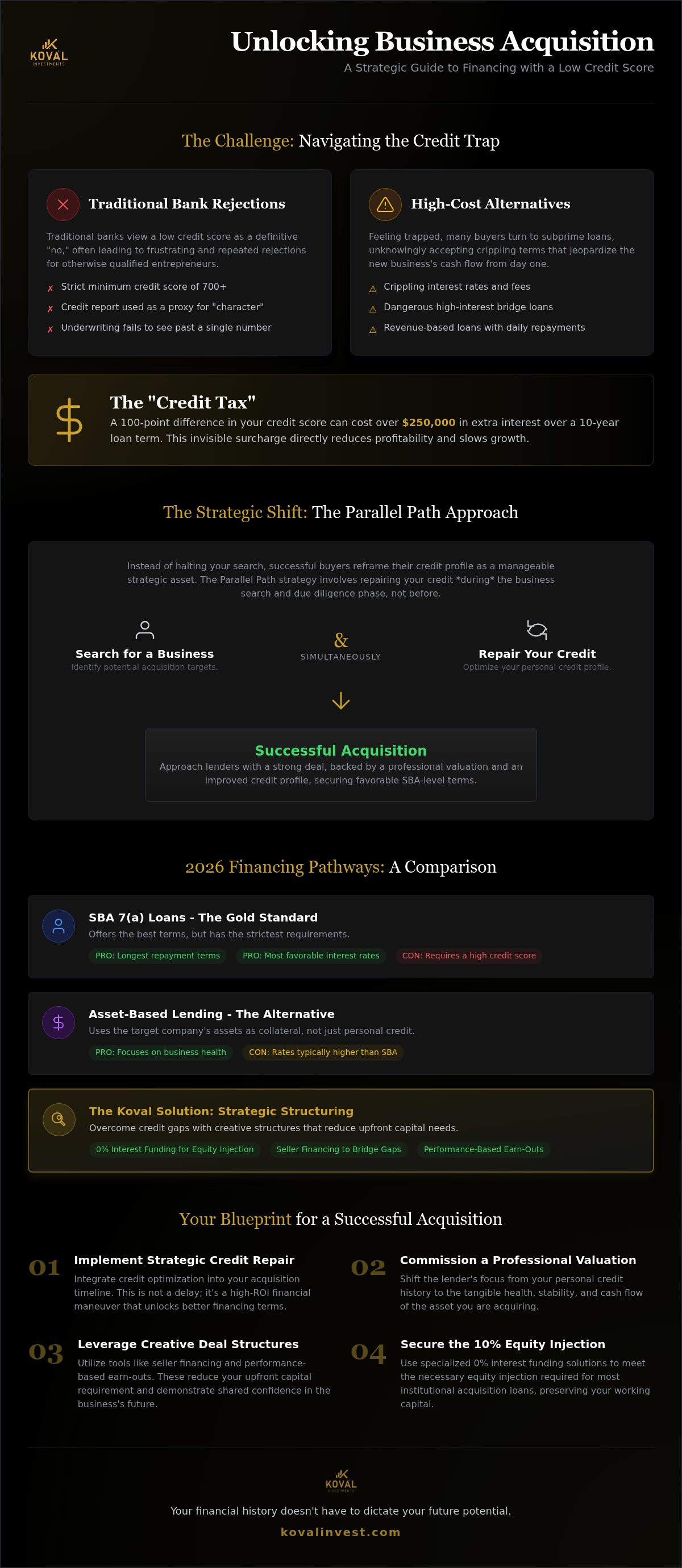
The 2026 capital market is defined by a renewed focus on stability. As interest rates find a new equilibrium, business acquisition financing has evolved into a precision exercise. This type of funding provides the capital necessary to purchase an existing entity, often structured as a leveraged buyout (LBO) where the business's own cash flow secures the debt. However, for those seeking business acquisition financing bad credit remains a significant hurdle. Lenders don't just see a low score as a history of missed payments; they view it as a proxy for operational risk. If a buyer struggles with personal financial obligations, a bank assumes those same habits will translate to the company’s balance sheet.
It's vital to distinguish between "bad credit" and "no credit." Bad credit often involves a history of late payments, defaults, or bankruptcies that require active restoration. No credit simply means a lack of data. Both scenarios trigger lender anxiety, but they require different strategic fixes. One of the most effective ways to counteract this perceived risk is through a professional business valuation. When you present a deal backed by an accurate, expert valuation, you shift the conversation from your personal history to the tangible health and stability of the asset you're buying.
Why Traditional Lenders Say No
Most traditional banks prioritize the debt-service coverage ratio (DSCR), which measures a business's ability to cover its debt payments with its net operating income. While a strong DSCR is essential, it doesn't always override a poor credit score. For SBA loans, "character" is a primary pillar of the underwriting process. Lenders use your credit report as the definitive map of your financial character. In 2026, conventional bank standards have tightened significantly. Many institutions now require a minimum score of 700 just to begin the conversation, leaving those with lower scores searching for alternative paths.
The Cost of "Bad Credit" Loans
Settling for "subprime" business loans carries a heavy long-term price tag. A 100-point difference in your credit score can lead to interest rate hikes that cost $250,000 or more over a typical 10-year loan term. Many buyers mistakenly turn to high-interest bridge loans to close a deal, hoping to refinance later. This strategy is dangerous because it puts immediate, heavy pressure on the business's cash flow during the critical first year of ownership. We define the "Credit Tax" as the invisible surcharge on capital paid by entrepreneurs with low credit scores, which directly reduces the business's net profitability and slows down your growth trajectory.
Comparing Financing Options for Low-Credit Buyers
The lending environment in 2026 offers several distinct paths for entrepreneurs, though each comes with its own set of trade-offs. Finding the right fit for business acquisition financing bad credit requires a clear-eyed look at how different lenders mitigate their risk. While a traditional bank might view a low credit score as a definitive "no," alternative business funding solutions focus more on the cash flow and assets of the target company. SBA 7(a) loans remain the preferred choice for most acquisitions because they offer the longest repayment terms and most favorable interest rates. However, if your personal profile is weak, you may need to pivot toward asset-based lending, which uses the target company’s equipment, inventory, or accounts receivable as collateral rather than relying solely on your personal guarantee.
Revenue-based financing is another option often presented to buyers, yet it's inherently risky for a new owner. These loans require daily or weekly repayments based on a percentage of sales. For a business in transition, this can create a severe liquidity crunch. Instead of looking for the fastest capital, focus on structures that allow the business room to breathe during the first 12 months of your leadership.
SBA Loans with a Consultant
Navigating SBA-guaranteed loans with a "borderline" credit score is a complex process that often requires expert positioning. Utilizing professional SBA loan assistance can help you frame your operational experience as a mitigating factor for past financial setbacks. You'll still need to meet the 10% equity injection requirement, but this can often be sourced through creative means. It's also important to understand the nuance of SBA 7(a) vs 504 loans; while the 7(a) is more flexible for general acquisitions, the 504 may be better if the deal includes significant real estate or heavy machinery.
Alternative Lenders and High-Risk Capital
If institutional debt isn't immediately available, bridge loans can provide a short-term path to closing. These are meant to be refinanced quickly once you've improved your credit or stabilized the business. Some buyers consider using working capital for business acquisition to cover closing costs or small gaps, but be wary of "predatory" terms. In 2026, these often appear as hidden fees or aggressive "confessions of judgment" clauses. A steady, methodical approach to debt will always serve you better than a desperate rush for high-interest capital. If you're unsure which path fits your specific acquisition target, our mergers and acquisitions consulting team can help you evaluate the debt-service capacity of the deal.
Strategic Credit Restoration: The Acquisition Multiplier
Many entrepreneurs view their credit score as a static number that dictates their options. In reality, credit is a dynamic financial asset that can be optimized. If you're currently seeking business acquisition financing bad credit shouldn't force you into a binary choice between waiting years or accepting predatory rates. Instead, we advocate for a proactive restoration period. Investing three to six months in targeted credit repair can yield a massive return on investment by unlocking lower interest rates and better terms. This shift in strategy transforms a "bad credit" loan from a burden into a temporary bridge toward institutional-grade capital.
We utilize a "Parallel Path" strategy to maximize efficiency. This approach involves initiating credit restoration the moment you begin your business search. By the time you reach the due diligence and closing phases, your score has often improved enough to qualify for significantly better programs. Expert advice on getting a business loan with bad credit often emphasizes preparation, and our success-based business credit repair services focus on creating that instant equity in your financial profile. This isn't just about deleting errors; it's about restructuring your profile to meet the specific compliance standards of 2026 lenders.
The Rapid Restoration Process
The first step is a comprehensive audit of both personal and business credit reports. We look for technical inaccuracies that violate current reporting standards. Following the audit, we move into strategic debt restructuring. This involves rebalancing your current obligations to lower credit utilization ratios, which can provide a quick boost to your score. Finally, we initiate aggressive disputes against legacy errors or outdated information. This methodical process ensures that when a lender pulls your report during the acquisition phase, they see a profile that is trending upward and managed with professional precision.
Building a Robust Business Credit Profile
While personal credit is the primary focus for most acquisition lenders, building a separate business credit profile adds a layer of professional legitimacy. We guide you through the process of establishing trade lines with vendors who report to major bureaus like Dun & Bradstreet. This builds your Paydex score, which measures your business's payment reliability. Separating your personal liability from business debt is a long-term play that protects your personal assets while increasing your company's borrowing power. Once your personal score reaches the 700+ threshold, it unlocks access to 0% interest business funding, which is an ideal tool for covering the down payment on your new acquisition.
Structuring the Deal to Overcome Credit Gaps
When traditional lenders hesitate because of a personal credit score, the burden of proof shifts to the deal's architecture. Successful business acquisition financing bad credit often relies on creative structuring rather than institutional approval alone. By reducing the bank's exposure, you make the transaction more palatable for all parties involved. A comprehensive strategic business plan serves as your primary defense. It demonstrates that the business's future cash flow is robust enough to overcome your past personal financial hurdles, effectively shifting the lender's focus from your history to the company's future.
Using "Earn-outs" is another effective way to reduce the upfront capital requirement. This structure ties a portion of the purchase price to the future performance of the company. If the business hits specific revenue targets under your leadership, the seller receives additional payments over time. This aligns your success with the seller's exit strategy and significantly lowers the initial loan amount you need to secure from a bank.
The Power of Seller Financing
Seller financing is often the most flexible tool in your arsenal. In 2026, many retiring business owners are more interested in a steady income stream and a reliable successor than a single lump sum payment. You can structure a "Seller Carry" where the owner finances a portion of the purchase price themselves. This is particularly effective for SBA deals because the SBA allows seller debt to count toward the equity requirement under specific conditions. You can negotiate interest rates and repayment schedules directly with the outgoing owner, often securing terms that a bank wouldn't offer to someone with a lower credit profile.
Creative Equity Injections
If you lack the personal cash for a down payment, consider a 401k rollover (ROBS). This allows you to use your retirement funds to invest in your own business without early withdrawal penalties or tax hits. Another option involves partnering with equity investors who bring strong credit and capital to the table in exchange for a minority stake in the company. If the acquisition includes commercial property, you can leverage funding for real estate investors to secure the real estate portion separately from the business operations. This "Equity Roll" technique helps existing business owners use the value of their current assets to fund new acquisitions. If you're struggling to piece together a complex deal, our mergers and acquisitions consulting team can help you design a structure that bridges the gap.
The Koval Solution: 0% Interest Funding and M&A Advisory
At Koval Investments, we've moved beyond the traditional loan brokerage model to create a success-based ecosystem for entrepreneurs. While most firms focus on a single transaction, we prioritize long-term alignment through a partnership approach. We recognize that securing business acquisition financing bad credit challenges included is a multi-step journey that requires more than just a lender's phone number. Our model is built on the belief that your success is our success, which is why we offer a suite of services designed to bridge the gap between your current financial profile and the requirements of institutional capital. This collaborative stance provides a steady hand in the often volatile 2026 financial landscape, ensuring you aren't just getting a loan, but are building a sustainable foundation for your new company.
Unlocking 0% Interest Capital
One of the most significant hurdles in any acquisition is the 10% equity injection required by most SBA lenders. Our 0% interest funding solution provides a strategic answer to this problem. We help qualified entrepreneurs secure unsecured, zero-interest credit lines that can be used to satisfy these equity requirements. By managing the 0% window effectively, you can maximize your acquisition's cash flow during the critical first year of ownership. This capital isn't just about closing the deal; it's about providing the liquidity needed to implement your growth strategies without the immediate burden of high-interest debt. We guide you through the process of utilizing these funds responsibly to ensure they enhance, rather than complicate, your balance sheet.
Expert M&A Consulting for SMBs
The transition from a "Searcher" to an "Owner" involves complex legal, financial, and operational hurdles. Our professional mergers and acquisitions consulting integrates credit restoration with high-level deal strategy. We don't just fix your score; we help you evaluate the target business to ensure the acquisition price is accurate and the debt-service capacity is realistic. This holistic approach ensures that by the time you're ready to sign the closing documents, your personal credit is optimized and your business plan is airtight. We act as your strategic partner, sharing insider knowledge to navigate challenges alongside you rather than acting as a distant service provider. If you're ready to transform your aspirations into a tangible business asset, we invite you to schedule a consultation with Koval Investments to secure your acquisition capital.
Taking Command of Your Acquisition Strategy
Navigating the complexities of business acquisition financing bad credit doesn't have to be a solo venture marked by rejection. By treating credit restoration as a strategic maneuver rather than a delay, you unlock access to sustainable capital and institutional-grade terms. We've explored how creative deal structures like seller financing and our 0% interest funding solutions can satisfy equity requirements while protecting your future cash flow. This methodical approach ensures that you're prepared for the operational realities of ownership from day one.
At Koval Investments, we provide a comprehensive credit-to-capital pathway backed by national expertise in SBA and alternative capital. Our success-based philosophy ensures that our goals are perfectly aligned with yours; we only succeed when you successfully close your deal. Don't let a temporary credit profile stand in the way of your entrepreneurial ambitions. You have the potential to lead, and we have the tools to help you get there. Secure Your 0% Interest Acquisition Funding Today and take the first step toward a successful transition into business ownership. Your future as a company leader is well within reach when you have a steady partner by your side.
Frequently Asked Questions
Can I buy a business with a 500 credit score?
Buying a business with a 500 credit score is extremely challenging through traditional channels, but it isn't impossible. Most conventional banks require significantly higher scores to mitigate their risk. When seeking business acquisition financing bad credit often forces you to rely on seller financing or asset-based lending structures. We recommend prioritizing credit restoration before applying to avoid predatory interest rates that can cripple your new company's cash flow during its first year of operation.
How much down payment do I need for a business acquisition loan?
Most business acquisition loans require a down payment between 10% and 25%. For SBA 7(a) loans, the 10% equity injection is a standard requirement. You'll need to meet this before closing. If you're struggling with business acquisition financing bad credit, you can utilize 0% interest funding solutions to cover this initial capital. This strategy allows you to preserve your personal liquidity while meeting the strict requirements of institutional lenders.
What is the minimum credit score for an SBA 7(a) loan in 2026?
In the 2026 lending market, most SBA 7(a) lenders look for a minimum personal credit score between 680 and 700. While the SBA itself doesn't set a hard minimum, individual banks use these scores to gauge your financial character. If your score falls below this range, you'll need to provide additional evidence of operational expertise or a higher equity injection. Professional assistance can help you frame your application to highlight the business's strong cash flow instead.
How does seller financing work when I have bad credit?
Seller financing allows you to bypass traditional credit checks by negotiating directly with the outgoing owner. The seller essentially acts as the bank, holding a promissory note for a portion of the purchase price. This is an ideal tool for buyers with lower credit scores because the seller is already confident in the business's ability to generate revenue. You can often secure more flexible interest rates and repayment schedules that align with the company's seasonal performance.
Can I use 0% interest credit cards to buy a business?
You can certainly use unsecured 0% interest credit lines to fund a business purchase, particularly for the required down payment. These funds provide a low-cost alternative to high-interest bridge loans or predatory cash advances. By utilizing our specialized funding solutions, you can access the capital needed to satisfy SBA equity rules without depleting your personal savings. It's a strategic way to manage your debt-to-income ratio while finalizing the acquisition of your new entity.
How long does it take to repair credit for a business loan?
Most entrepreneurs see significant improvement in their credit profile within three to six months of starting a professional restoration program. This timeline fits perfectly into the "Parallel Path" strategy where you fix your credit while simultaneously performing due diligence on potential businesses. By the time you're ready to submit a formal loan application, your improved score can unlock much better interest rates. This saves you thousands of dollars in interest over the life of the loan.
What happens if I default on an acquisition loan with bad credit?
Defaulting on an acquisition loan carries serious consequences, especially since most lenders require a personal guarantee. If the business fails to meet its obligations, the lender can seize the company's assets and eventually pursue your personal property. This risk is why we emphasize professional business valuations and conservative strategic planning before you sign any documents. Ensuring the deal is structured correctly from the start protects both your personal financial future and your professional reputation.
Do I need a business plan to get acquisition financing?
A professional business plan is absolutely essential when seeking acquisition financing, especially if your personal credit is less than perfect. Lenders need to see a detailed roadmap of how you'll maintain or grow the company's cash flow to service the debt. Your plan should include market analysis, operational strategies, and clear financial projections. This document acts as a counterweight to your credit score, proving that you possess the strategic vision necessary to succeed.