
Commercial Real Estate Financing: 2026 Strategic Guide
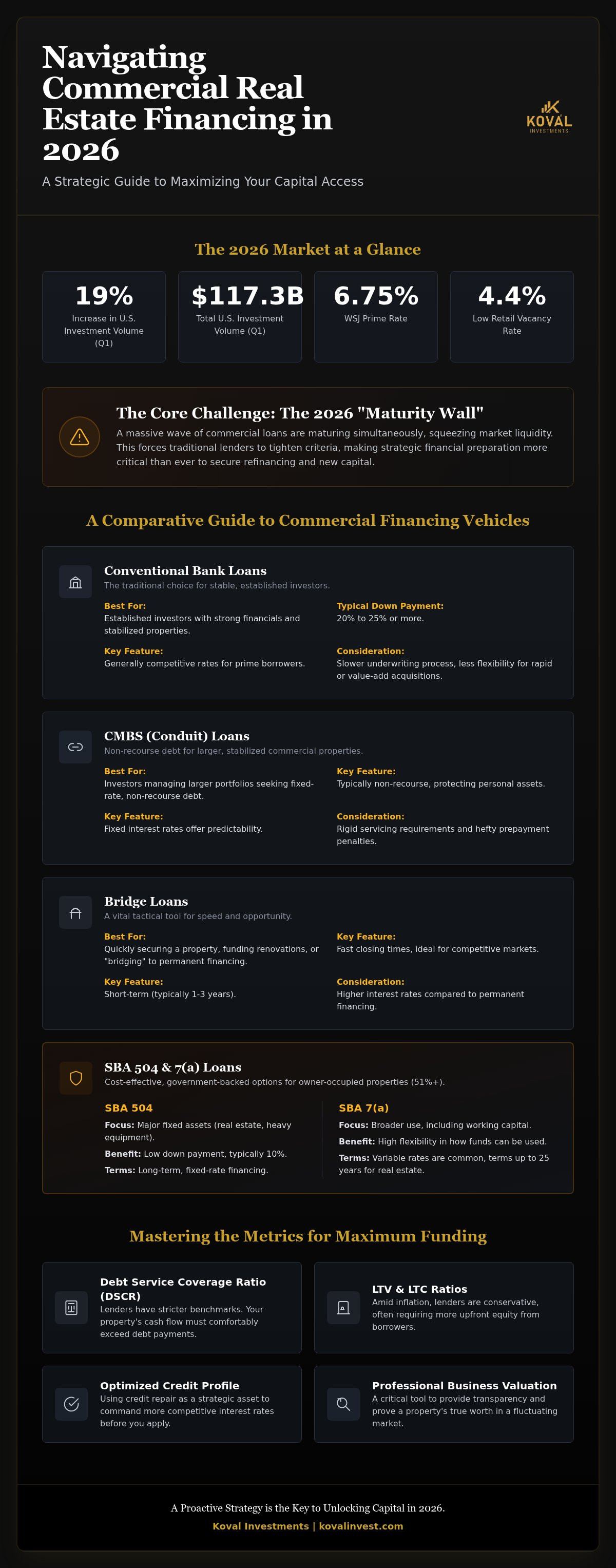
The most competitive commercial loan in 2026 isn't found by simply shopping at different banks. It's built by optimizing your financial profile before you ever explore commercial real estate financing options. You've likely noticed that while U.S. investment volume rose 19% to $117.3 billion in the first quarter, traditional lenders remain cautious. With the WSJ Prime Rate at 6.75% as of August and commercial mortgage rates starting as low as 5.68%, the difference between securing high-leverage funding and facing a rejected application often comes down to the precision of your credit profile.
We understand the frustration of choosing between SBA, CMBS, or bridge loans when every percentage point impacts your cash flow. This guide provides a strategic framework to help you master the capital market and maximize your capital access. You'll learn how to secure high-leverage funding and lower your monthly debt service by using credit repair as a strategic asset. We'll examine 0% interest funding solutions and help you understand how the 21st Century ROAD to Housing Act changes the game for your next project.
Key Takeaways
- Understand how the 2026 maturity wall is shifting market liquidity and why traditional lending criteria have tightened during this fiscal year.
- Evaluate different commercial real estate financing options, including bridge loans and SBA programs, to find the most efficient capital structure for your project.
- Identify the current 2026 benchmarks for Debt Service Coverage Ratio (DSCR) to ensure your property's cash flow meets strict lender requirements.
- Learn how to use credit repair as a strategic tool to optimize your financial profile and command more competitive interest rates before you apply.
- Discover the advantages of a collaborative, success-based funding approach that prioritizes your long-term growth over simple transaction volume.
The 2026 Commercial Real Estate Financing Landscape
The 2026 commercial landscape is defined by the "maturity wall," a surge of loans reaching their end dates simultaneously. This phenomenon is squeezing liquidity as investors scramble to refinance debt originally secured at much lower rates. Because traditional banks have tightened their criteria to mitigate risk, finding viable commercial real estate financing options requires more than just a good property. It requires a deep understanding of how current interest rate cycles, like the Federal Funds rate holding between 3.50% and 3.75%, dictate your loan-to-value (LTV) ratios.
Mid-market investors are increasingly moving toward specialized real estate investment funding. This shift occurs because traditional lenders often prioritize institutional-scale deals, leaving smaller operators to navigate stricter debt-service coverage ratio (DSCR) benchmarks. Real estate investing success in this environment depends on your ability to present a bulletproof financial profile that accounts for these macroeconomic shifts. Inflationary pressures have also forced lenders to be more conservative with LTV and loan-to-cost (LTC) ratios, often requiring more equity upfront.
Market Volatility and the Need for Strategic Planning
A standard bank application isn't enough to secure capital in 2026. Lenders now demand comprehensive data, making professional business valuations a critical component of the procurement process. These valuations provide the transparency necessary to prove a property’s actual worth in a fluctuating market. When regional banks pull back, many investors turn to alternative business funding solutions to bridge the gap. This strategic planning ensures you aren't left stranded when a primary lender changes their risk appetite mid-transaction. Preparation is the only way to maintain momentum when market volatility strikes.
Emerging Trends in Commercial Debt
Private debt funds and non-bank lenders have become dominant players this year. They offer the speed and flexibility that institutional banks often lack. We're also seeing a significant trend where sustainability and energy efficiency ratings directly impact financing terms. Properties with high "green" scores often qualify for better rates or higher leverage due to new regulatory incentives. When evaluating various commercial real estate financing options, modern investors prioritize flexible prepayment terms. While a low initial rate is attractive, the ability to refinance without heavy penalties is more valuable in a market where interest rates might stabilize or drop in the coming years. This flexibility allows you to pivot your strategy as the economic cycle evolves.
Traditional vs. Alternative Commercial Financing Vehicles
Choosing the right capital structure depends on your property type, occupancy status, and long term goals. While conventional bank mortgages remain a primary choice for established investors, they often lack the flexibility required for rapid acquisitions. For those managing larger portfolios, Commercial Mortgage-Backed Securities (CMBS) offer non-recourse debt with fixed rates, though they come with rigid servicing requirements. Exploring diverse commercial real estate financing options is the only way to ensure your debt service doesn't outpace your property’s income potential.
Bridge loans have become a vital tactical tool in 2026. These short term solutions allow you to secure a property quickly, especially when a traditional bank's underwriting process takes too long. Once the asset is stabilized or renovated, you can transition into permanent financing. This approach is particularly effective when competing in high demand sectors like retail, which currently maintains a low vacancy rate of 4.4%.
SBA 7(a) and 504 Programs
If you plan to occupy at least 51% of your commercial property, government-backed programs are often the most cost effective choice. The SBA 504 loans provide long term, fixed rate financing for major fixed assets like real estate. One of the primary benefits is the lower down payment requirement, which is typically 10% compared to the 20% or 25% required by conventional lenders. When deciding between an SBA 7(a) vs 504 loan, consider that the 7(a) offers more flexibility for working capital, while the 504 is specifically designed for real estate and heavy equipment. Our team can help you identify which of these real estate investment funding paths aligns with your specific portfolio goals.
Alternative and Unsecured Options
Alternative commercial real estate financing options often provide the "grease" that keeps a deal moving. An unsecured business line of credit can be used for earnest money deposits, allowing you to keep your liquid cash available for other opportunities. We also see investors successfully using a 0% interest business funding strategy to cover soft costs, such as architectural fees or minor renovations. This preserves your equity for the primary mortgage and reduces your overall debt burden during the critical early stages of a project.
Hard money loans are no longer just a "last resort." In 2026, savvy investors use them as a tactical tool to close deals that traditional banks won't touch due to property condition or distressed financials. While the interest rates are higher, the speed of execution can be the difference between winning a deal and losing it to a cash buyer. The key is having a clear exit strategy to refinance into a lower cost vehicle once the property meets conventional standards.
Key Qualification Metrics: Beyond the Credit Score
Your credit score provides a baseline, but it isn't the final word in 2026. Lenders now view the property itself as the primary source of repayment, which makes Net Operating Income (NOI) the foundation of your entire financing request. If your NOI doesn't demonstrate a clear ability to cover debt, your commercial real estate financing options will quickly narrow, regardless of your personal net worth. This shift toward asset performance means you must be prepared to prove your property's income potential through rigorous documentation.
Understanding the DSCR Threshold
Debt Service Coverage Ratio (DSCR) is the ratio of a property's annual net operating income to its annual mortgage debt service, including principal and interest. In the current fiscal climate, most lenders have moved their benchmarks higher to insulate against market volatility. While some niche programs allow for a DSCR as low as 0.75 for high-risk assets, the "sweet spot" for the most competitive rates in 2026 is between 1.25x and 1.35x. To qualify for higher loan amounts, focus on strategies that bolster NOI, such as auditing operational expenses for inefficiencies or renegotiating service contracts to improve your bottom line.
For development and redevelopment projects, you'll also need to distinguish between Loan-to-Value (LTV) and Loan-to-Cost (LTC). LTC measures the loan amount against the total cost of construction, while LTV compares the loan to the property's appraised value upon completion. Lenders often cap LTC at 75% to 80% to ensure you have sufficient "skin in the game." These standards are heavily influenced by regulatory oversight, such as the guidelines found in OCC Commercial Real Estate Lending, which mandate that banks maintain strict risk management over their commercial portfolios.
The Liquidity and Net Worth Requirements
Lenders don't just look at your down payment; they look at what's left over after the deal closes. Post-closing liquidity requirements usually mandate that you hold enough cash-on-hand to cover six to twelve months of debt service payments. For smaller investors, a "Global Cash Flow" analysis is now standard practice. This involves a comprehensive review of your personal income and all existing business debts to ensure you aren't overleveraged across your entire portfolio. Navigating this level of complex documentation is often easier with professional SBA loan assistance. This type of strategic preparation helps align your financial narrative with what underwriters expect, ultimately reducing the interest rate spreads you're offered.
Strategic Optimization: Preparing Your Business for Maximum Funding
The "Optimization First" approach is a fundamental shift in how successful investors approach the market. Instead of viewing a loan application as a starting point, you should see it as the culmination of months of financial preparation. This proactive stance allows you to identify potential red flags before a lender ever sees them. When you enter a negotiation with a clean, high-limit credit profile, you aren't just asking for a loan. You're presenting a low-risk opportunity to the bank. This leverage is what allows you to negotiate for lower interest rate spreads and higher funding limits that wouldn't be accessible otherwise. Exploring your commercial real estate financing options with a pre-optimized profile ensures you're always operating from a position of strength.
The Role of Business Credit Repair
Auditing your business credit at least six months prior to a transaction is non-negotiable for serious investors. Modern underwriting algorithms are sensitive to even minor discrepancies. Utilizing business credit repair services helps you systematically remove inaccuracies that lead to automatic rejections. These errors often include outdated addresses, closed accounts reported as open, or tax liens that have already been resolved. By scrubbing these from your record, you enhance your fundability. This restoration process is a direct investment in your future cash flow, as a higher score often qualifies you for the top-tier commercial real estate financing options that feature the lowest possible interest rates.
0% Interest as a Strategic Lever
Smart capital procurement uses every available tool to protect property equity. Securing 0% APR business funding provides a unique strategic advantage by allowing you to finance property improvements without incurring immediate interest costs. This is particularly useful for value-add projects where you need to renovate quickly to increase your Net Operating Income. Using interest-free capital to bridge the gap during the closing process keeps your primary liquidity intact. When you integrate these tools into a comprehensive funding for real estate investors strategy, you create a more resilient financial structure. This ensures that your project remains profitable even if market conditions shift during the construction or stabilization phase.
If you want to ensure your business is positioned for the highest possible leverage and the best available terms, reach out to Koval Investments to discuss your strategic planning and credit optimization needs.
Executing Your Capital Strategy with Koval Investments
Securing capital isn't a transactional event; it's a strategic milestone. While a generic bank loan officer is bound by a single institution's rigid policy, a boutique advisory firm acts as your advocate across the entire lending market. At Koval Investments, we operate on a "win-win" philosophy. This success-based approach means our objectives are perfectly aligned with yours. We don't just provide a list of commercial real estate financing options; we build the financial infrastructure necessary for your long-term success. By bridging the gap between high-level financial strategy and your day-to-day operational reality, we ensure that every dollar of debt works toward your growth rather than against your cash flow.
Capital Procurement and Strategic Growth
Our process begins with a deep analysis of your project's specific needs and your current financial profile. We don't believe in one-size-fits-all solutions. Instead, we identify the optimal financing vehicle by evaluating your property type, cash flow, and expansion goals. This might involve facilitating access to specialized SBA loans or our 0% interest funding solutions for upfront project costs. Many of our clients also utilize working capital for business acquisition to expand their footprint alongside their real estate holdings. This integrated approach allows you to scale your operations and your property portfolio simultaneously, creating a more robust business model.
Expert Advisory for Long-Term Expansion
Growth requires looking beyond the immediate loan. We provide comprehensive M&A consulting and strategic planning to help you navigate complex mergers or multiple property acquisitions. Our team uses professional business valuations to help you understand the true worth of your assets. This clarity allows you to leverage existing equity more effectively when negotiating new deals. We act as an "insider" who shares knowledge and navigates challenges alongside you. This partnership ensures you're always prepared for the next stage of your roadmap. When you're ready to move from consultation to capital, we're here to guide the execution. Our expertise in commercial real estate financing options ensures you command the best terms available in the 2026 market.
The first step toward maximizing your capital access is a clear, actionable plan. We invite you to schedule a consultation to build your 2026 funding roadmap and discover how our success-based model can accelerate your growth.
Mastering Your 2026 Capital Strategy
Success in the 2026 market requires more than just identifying a strong property; it demands a proactive approach to financial optimization. By focusing on your credit profile and understanding the nuances of current DSCR benchmarks, you position yourself to command the most competitive terms available. Whether you're utilizing 0% interest funding for upfront costs or exploring long-term SBA structures, your choice of commercial real estate financing options should align with your broader operational goals. A resilient capital stack is the foundation of sustainable growth in this complex landscape.
Our collaborative approach ensures that you have a steady hand guiding you through every transaction. We specialize in 0% interest funding and credit optimization, providing strategic advisory for everything from simple acquisitions to complex mergers and acquisitions. Because we operate on a success-based philosophy, there is no financial risk to you as we work together to achieve your objectives. It's time to move beyond generic banking relationships and partner with a firm that values your progress as much as you do. Secure your commercial real estate capital with Koval Investments and take the first step toward maximizing your property’s potential. Your next project deserves a capital strategy that's as ambitious as your vision.
Frequently Asked Questions
What is the minimum credit score for a commercial real estate loan in 2026?
Most lenders in 2026 look for a minimum credit score between 660 and 680 for standard commercial loans. However, to access the most competitive commercial real estate financing options, a score of 720 or higher is generally required. High-leverage DSCR loans often mandate a 740 FICO to reach an 85% loan-to-value ratio. Maintaining a strong credit profile ensures you avoid automatic rejections and qualify for lower interest rate spreads.
How does the DSCR affect my commercial financing options?
The Debt Service Coverage Ratio (DSCR) is the primary metric lenders use to determine your maximum loan amount. In 2026, a DSCR of 1.25 is the benchmark for securing favorable terms and high leverage. If your property's net operating income is significantly higher than your debt obligations, you'll qualify for lower rates. Conversely, a DSCR below 1.00 may lead to restricted funding or higher equity requirements to offset the lender's risk.
Can I get a commercial real estate loan with no money down?
True "no money down" commercial loans are rare, but you can minimize upfront capital by using a 0% Interest Funding Solution for soft costs. Most 2026 programs require a down payment of 10% to 25%. SBA 504 loans typically offer the lowest entry point at 10% for owner-occupied properties. By strategically layering unsecured business credit with your primary mortgage, you can effectively reduce the amount of liquid cash needed to close.
What are the typical interest rates for commercial property in 2026?
As of August 2026, typical conventional commercial mortgage rates range from 5.60% to 8.99%. The specific rate you receive depends heavily on the property type, your credit score, and the current WSJ Prime Rate, which stands at 6.75%. Government-backed loans and high-quality multifamily assets often sit at the lower end of this spectrum. Investors with optimized financial profiles can often negotiate rates closer to the 5.68% starting point seen in leading markets.
How long does the commercial real estate loan approval process take?
The approval process for commercial financing usually takes between 45 and 90 days. Bridge loans and private debt funds can often close in as little as 14 to 30 days due to their streamlined underwriting. In contrast, SBA loans and complex CMBS structures often require the full 90-day window to complete environmental assessments, appraisals, and legal reviews. Starting your capital procurement process early is essential to meeting strict purchase contract deadlines.
Is 0% interest funding available for real estate investment projects?
Yes, 0% interest funding is available as a strategic tool for real estate investment projects, particularly for covering upfront costs like earnest money or renovations. While these aren't traditional long-term mortgages, they provide interest-free capital during the critical early stages of an acquisition. Integrating these commercial real estate financing options into your capital stack preserves your primary equity. This approach allows you to maintain liquidity while your property undergoes stabilization or value-add improvements.
What is the difference between an SBA 7(a) and an SBA 504 loan for real estate?
The SBA 7(a) loan is a versatile tool used for working capital, debt refinancing, and real estate, while the 504 loan is specifically designed for long-term fixed assets. A 504 structure typically offers a 20-year or 25-year fixed interest rate, which provides more stability for property owners. The 7(a) program is often better for business owners who need to purchase a property while simultaneously funding equipment or inventory for their operations.
How can credit repair help me secure a better commercial mortgage rate?
Credit repair serves as a "secret weapon" to lower your real estate interest rates by removing inaccuracies that artificially depress your score. Even a minor improvement can move you into a better pricing tier, potentially saving thousands of dollars in annual debt service. By optimizing your credit profile before applying, you demonstrate lower risk to underwriters. This allows you to command higher leverage and more flexible terms that are unavailable to borrowers with unoptimized profiles.