
Financing Multiple Investment Properties: The 2026 Strategy for Scaling Your Portfolio
The most successful investors in 2026 aren't necessarily those with the largest cash reserves; they're the ones with the most sophisticated capital stacks. While many are pulling back, the current market presents a unique opportunity for those who understand the nuances of financing multiple investment properties without depleting their personal liquidity. You've likely noticed that interest rates for investment properties are currently squeezed between 7.3% and 7.8%, making traditional growth feel more like a gamble than a strategy. It's a common struggle to see rental margins thin out or to face a loan rejection because of a simple credit report inaccuracy that shouldn't be there.
We view our relationship with investors as a partnership where your growth is the primary metric of success. Scaling your portfolio shouldn't require you to take on disproportionate risk or settle for terms that eat your equity. By focusing on a collaborative approach to credit optimization and strategic capital stacking, you can unlock 0% interest funding that remains invisible to the average buyer. This article provides a clear, logical roadmap for transitioning from single-family units to multi-family assets. You'll learn how to build a capital-ready financial profile and use specialized funding tools to maintain momentum in a shifting market.
Key Takeaways
- Learn why traditional bank loans are no longer the most efficient path for growth and how to transition toward income-based lending models like DSCR.
- Discover the strategic advantage of capital stacking when financing multiple investment properties to maintain liquidity while expanding your portfolio.
- Identify how optimizing your credit profile and removing inaccuracies can reduce your borrowing costs and significantly improve your 30-year return on investment.
- Understand how to leverage 0% interest business funding to cover gap capital needs such as earnest money deposits and renovation expenses.
- Explore how a success-based advisory approach can help you scale from individual acquisitions to a professional, high-valuation real estate business.
Navigating the 2026 Real Estate Investment Lending Landscape
The 2026 market has shifted from the volatility of previous years toward a period of normalization. While interest rates for investment properties have leveled off between 7.3% and 7.8%, the barrier to entry remains high for those relying solely on traditional banking. Successfully financing multiple investment properties in this environment requires a departure from the "one-off" loan mentality. Large institutional lenders are facing new restrictions under the 21st Century ROAD to Housing Act, which limits those with over 350 homes. This creates a strategic opening for mid-sized investors who maintain high liquidity and "dry powder" to move quickly on distressed or undervalued assets.
The Evolution of Investor Financing
Lending standards in 2026 favor the asset over the individual. We've seen a massive rise in private debt funds that prioritize the property's potential rather than just the borrower's W-2 income. Speed is the new currency. If you can't close in 14 to 21 days, you'll likely lose the deal to a capital-ready competitor. Modern Real estate investing strategies now integrate private money and bridge loans to secure the asset before refinancing into long-term debt. This shift allows for rapid scaling that traditional mortgage products simply can't support due to their rigid personal debt-to-income caps.
Key Financial Metrics Lenders Watch in 2026
Your financial profile is a tool, not just a record. Lenders are primarily focused on the Debt Service Coverage Ratio (DSCR). In 2026, most multifamily lenders require a minimum DSCR of 1.20 to 1.25. This means the property must generate 20% to 25% more income than the monthly debt obligation. Mastering the art of financing multiple investment properties also requires a deep understanding of how lenders weigh these metrics against your total portfolio. While the property's performance is central, your personal credit profile still sets the interest rate floor. Even a minor discrepancy on your report can push your rate up by 50 basis points, costing you thousands over the life of the loan. Understanding the balance between Loan-to-Value (LTV) and Loan-to-Cost (LTC) is vital for growth. Most conventional loans for single-family investments still require a 20% down payment, while 2-4 unit properties often demand 25%. Being capital-ready means having the credit and the liquid reserves to meet these requirements without hesitation.
Primary Financing Vehicles for Modern Real Estate Investors
Scaling a portfolio requires a financial toolkit that matches your ambition. In 2026, the legal definition of investment property encompasses a wide range of assets, each requiring a specific debt structure to maximize cash flow. Relying on personal income to qualify for loans eventually hits a ceiling. To break through, you must transition toward lending models that prioritize the performance of the asset itself rather than just your tax returns.
Asset-Based Lending: The Power of DSCR
Debt Service Coverage Ratio (DSCR) loans have become the bedrock of financing multiple investment properties. Lenders calculate this by dividing the property's net operating income by its annual debt service. If your potential acquisition shows a ratio below the 2026 standard of 1.20, don't assume the deal is dead. You can often improve this metric by implementing "Ratio Utility Billing Systems" (RUBS) or reducing operational overhead to boost the bottom line. While these loans carry slightly higher rates than conventional mortgages, they allow for rapid expansion because they don't count against your personal debt-to-income limits. It's a professional way to scale without the constraints of traditional banking.
Short-Term Capital: Bridge and Hard Money
Speed is often more valuable than a low interest rate when you're competing for high-yield assets in a national market. Hard money and bridge loans provide the agility needed to beat out all-cash buyers. These short-term solutions are perfect for "fix-and-flip" projects or "buy-rehab-rent-refinance" (BRRRR) strategies. The key is to have a clear exit strategy. You'll want to transition from high-cost short-term debt into permanent financing as soon as the property's value is stabilized. This ensures you aren't overpaying for capital longer than necessary while still maintaining the "dry powder" needed for your next acquisition.
Utilizing SBA Loans for Real Estate
Many investors overlook the Small Business Administration as a source for real estate capital. If you're targeting mixed-use properties where your own business will occupy at least 51% of the square footage, the SBA offers incredible terms. Specialized SBA loan assistance can help you navigate the complexities of these government-backed programs. When comparing SBA 7(a) vs 504 loans, the 504 program is often the winner for long-term real estate holdings due to its fixed-rate options and lower down payment requirements. This strategy effectively turns your business's rent expense into an equity-building asset.
Choosing the right vehicle is a collaborative process that depends on your specific goals. If you're looking to optimize your capital structure, our real estate investment funding advisory can help you identify which of these tools will best accelerate your portfolio growth.
Overcoming the Credit Barrier: Optimization for Better Terms
Credit is often viewed as a static gatekeeper, but for the sophisticated investor, it's a variable that can be optimized. While asset-based lending focuses on the property's income, your personal credit profile remains the primary factor determining your interest rate floor. When financing multiple investment properties, a difference of just 50 basis points on a mortgage can fundamentally alter your 30-year return on investment. In the 2026 market, where investment rates hover between 7.3% and 7.8%, a "good" score versus an "excellent" one can represent the difference between a deal that barely breaks even and one that provides a healthy monthly surplus.
Real estate investors are frequent targets for credit report inaccuracies. The complexity of having multiple open mortgages, frequent hard inquiries during acquisition phases, and high revolving utilization for renovation costs often leads to reporting errors. These mistakes don't just sit on your report; they act as a tax on your growth. We operate on a success-based philosophy, meaning our interests are directly aligned with yours. If we don't deliver a cleaner, more optimized profile that unlocks capital, there's no financial risk to you. This collaborative approach ensures that your financial foundation is strong enough to support a rapidly expanding portfolio.
Professional Credit Repair for Investors
Inaccuracies on a credit report are more than just clerical errors; they are barriers to entry. In 2026, lenders use increasingly automated systems that trigger immediate rejections for specific red flags, such as misreported late payments or incorrectly categorized business debt. Utilizing professional business credit repair services allows you to dispute these inaccuracies with precision. A clean profile doesn't just lower your interest rates; it expands your access to high-limit unsecured funding, providing the liquid capital necessary for earnest money and closing costs.
The Capital-Ready Credit Profile
Building a capital-ready profile requires more than just removing negatives; it involves strategic management of your existing accounts. You must balance the need for new financing options for multiple investment properties with the necessity of keeping your credit utilization low. This is particularly challenging when you're in an active growth phase. A professional consultation provides a roadmap for which accounts to pay down and which credit lines to expand to maximize your score before a major application. This methodical preparation ensures you're positioned as a low-risk borrower, regardless of how many properties you currently hold.
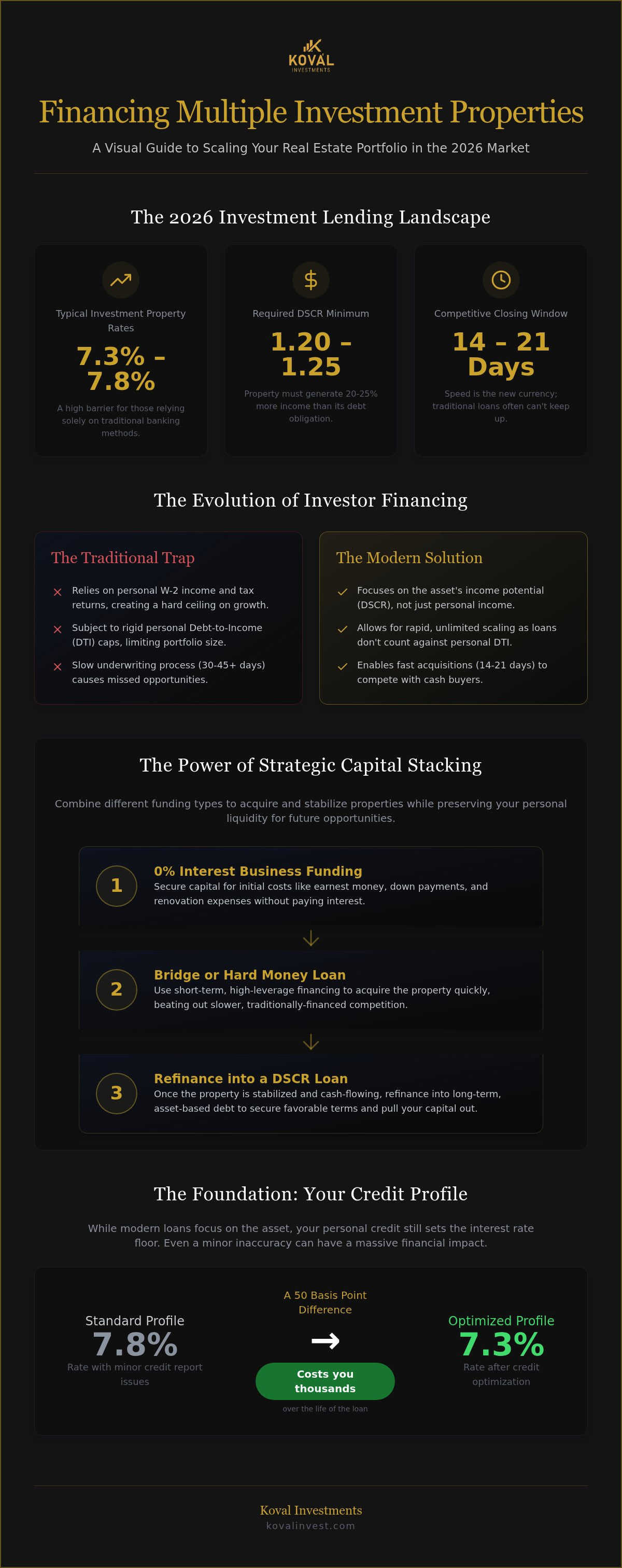
Strategic Capital Stacking: Combining Loans with 0% Interest Funding
Capital stacking is the strategic layering of different debt types to fund a single real estate acquisition. While most investors stop at the first mortgage, high-growth firms in 2026 use a more sophisticated approach. They combine traditional asset-based loans with unsecured capital to minimize their personal cash outlay. This is the most effective way to scale when financing multiple investment properties, as it prevents your liquid reserves from becoming the bottleneck of your growth. By integrating various funding sources, you create a capital structure that is both flexible and resilient.
The centerpiece of this strategy is 0% interest business funding. Unlike traditional construction loans or hard money, this capital is often unsecured. You don't have to put up your existing real estate as collateral to access it. This protection is vital for investors who want to keep their portfolio insulated from cross-collateralization risks. It allows you to move with the speed of a cash buyer while keeping your equity intact.
Leveraging 0% APR for Down Payments and EMD
Securing a property often requires a significant Earnest Money Deposit (EMD) and a 20% to 25% down payment. If you're buying three or four properties a year, that cash requirement adds up quickly. By using 0% interest lines as gap capital, you can cover these upfront costs without draining your bank account. This reduces your weighted average cost of capital and keeps your "dry powder" ready for the next deal. It's about maintaining a constant state of readiness in a competitive market.
Funding the Value-Add Phase
Renovations are where the real equity is built, but construction loans in 2026 can be expensive and administratively heavy. Many of our partners prefer alternative business funding solutions to manage the rehab phase. You can use these 0% APR lines to pay contractors and purchase materials without the burden of monthly interest payments during the construction period. Once the project is stabilized and the value has increased, you can execute a cash-out refinance. This allows you to pay back the credit lines before the introductory period ends, effectively funding your forced appreciation with zero interest costs.
If you're ready to see how these capital layers can fit into your specific portfolio, you can apply for a strategic funding evaluation to explore your stacking options.
Scaling Your Portfolio with Koval Investments Strategic Advisory
Professional real estate growth in 2026 isn't just about the next closing; it's about building a fundable, sellable entity. When you're financing multiple investment properties, you eventually reach a stage where your portfolio is large enough to function as a standalone enterprise. This transition requires moving away from the transactional mindset of a loan shopper and toward a strategic partnership that considers your long-term valuation. Scaling at this level means your financial decisions today must support the mergers, acquisitions, or portfolio exits you plan for the future.
Beyond the Loan: Strategic Growth and Valuation
Strategic growth often involves vertical integration to capture more of the value chain. Many of our clients use working capital for business acquisition to purchase property management companies or specialized maintenance firms that service their own assets. This move doesn't just lower your operational costs; it significantly increases your business's overall valuation. In 2026, lenders and potential buyers look at the synergy of your holdings rather than just individual rent rolls. A professional business valuation provides a baseline for this growth, ensuring you're prepared for portfolio-level expansion or sophisticated M&A activity when the opportunity arises.
Collaborative Partnership vs. Transactional Lending
We don't view ourselves as a traditional bank or a distant institutional lender. Our approach is fundamentally collaborative because we operate on a success-based philosophy. This means our goals are perfectly aligned with your ability to scale. If you don't succeed in securing the capital you need, our model ensures there's no financial risk to you. While others might offer a single product, our funding for real estate investors is part of a broader advisory service that navigates market challenges alongside you. We act as an insider, sharing knowledge on capital procurement and financial optimization to ensure you're always capital-ready.
The path to financing multiple investment properties at scale requires a steady hand and a clear roadmap. It's about more than just securing debt; it's about optimizing your entire financial profile to support a professional real estate business. We're here to help you bridge the gap between high-level strategy and daily operational reality. If you're ready to move beyond one-off deals and build a scalable investment legacy, we invite you to schedule a strategic consultation. We'll work together to audit your current funding structure and identify the most efficient path for your 2026 expansion.
Building Your Capital-Ready Investment Legacy in 2026
Scaling a portfolio in the current market requires a shift from traditional mortgage-seeking to sophisticated capital stacking. By integrating asset-based lending with 0% interest funding, you can maintain the liquidity necessary to move on high-yield opportunities without the constraints of personal debt-to-income ratios. Successfully financing multiple investment properties in 2026 is a matter of financial engineering; it involves optimizing your credit profile to lower your interest rate floor and using unsecured capital to protect your equity.
We believe in a collaborative approach where our success is tied directly to yours. Our success-based philosophy means we're fully invested in your growth, providing the expertise needed for comprehensive credit optimization and 0% interest capital procurement. This model removes the financial risk from your shoulders, allowing you to focus on identifying the right assets while we handle the complexities of your capital structure. The tools for rapid expansion are within reach when you have a strategic partner to navigate the landscape alongside you.
Take the next step in your professional growth. Secure Your 0% Interest Funding Strategy with Koval Investments and start building a more resilient, scalable portfolio today. Your ambition deserves a financial foundation that can keep pace with your vision.
Frequently Asked Questions
What is the minimum credit score for financing multiple investment properties in 2026?
Most lenders require a minimum credit score of 680 for investment loans, though a score of 720 or higher is typically necessary to secure the most competitive interest rates. When financing multiple investment properties, maintaining an elite credit profile is essential to keep borrowing costs low. SBA 7(a) loans generally look for a minimum of 680. We focus on optimizing your score to ensure you aren't overpaying for capital due to avoidable report inaccuracies.
Can I use 0% interest business funding for a real estate down payment?
Yes, you can utilize 0% interest business funding as gap capital for a real estate down payment or earnest money deposit. This strategy allows you to preserve your liquid cash reserves while expanding your portfolio. By stacking these unsecured lines with a primary mortgage, you reduce your initial out-of-pocket expenses. It's a professional way to fund acquisitions and renovations during the introductory period without incurring high-interest debt early in the project.
How do DSCR loans differ from traditional investment property mortgages?
DSCR loans qualify based on the property's rental income potential rather than your personal debt-to-income ratio. Traditional mortgages focus heavily on your W-2 income and personal tax returns, which can limit your ability to scale. In 2026, lenders look for a DSCR of 1.20 to 1.25. This allows you to secure financing for multiple investment properties without being constrained by personal income caps, making it a preferred choice for rapid portfolio growth.
What are the benefits of using an SBA loan for real estate investment?
SBA loans, specifically the 504 and 7(a) programs, offer long-term fixed rates and lower down payment requirements for owner-occupied commercial real estate. If your business occupies at least 51% of the property, you can leverage government-backed terms that are often more favorable than conventional commercial debt. This strategy turns a standard business expense into an equity-building asset while providing the working capital needed for operational growth and strategic planning.
How long does the credit repair process take for real estate investors?
The credit repair process for real estate investors typically takes between 30 and 90 days, depending on the complexity of the inaccuracies. We focus on identifying and disputing errors that specifically trigger lender rejections, such as misreported late payments or utilization issues. This timeline allows you to optimize your profile before your next major acquisition. A cleaner report ensures you're positioned for the interest rate floor rather than settling for sub-optimal terms.
Is it possible to secure real estate funding with no money down using capital stacking?
It is possible to achieve near-zero out-of-pocket acquisitions by strategically stacking 0% interest business funding with asset-based loans. While the primary lender usually requires a down payment, using unsecured credit lines to cover that requirement allows you to acquire property with minimal personal cash. This methodical approach to financing multiple investment properties requires a strong financial profile and a clear exit strategy, such as a cash-out refinance, to retire the short-term debt.
What is the difference between hard money and bridge loans for investors?
Hard money is typically used for short-term "fix-and-flip" projects where the property's current condition prevents traditional financing. Bridge loans are designed to "bridge" the gap until permanent financing is secured, often used for stabilizing a property or quick closings. Both carry higher costs than long-term debt. The choice depends on your speed requirements and the property's stabilization phase. Both serve as vital tools for beating out all-cash buyers in competitive markets.
How does Koval Investments success-based funding model work for real estate?
Our success-based funding model operates on a collaborative, win-win philosophy where we only earn our fee when you successfully secure capital. This eliminates financial risk for the client and aligns our goals with your portfolio growth. We act as a strategic partner, helping you navigate credit optimization and 0% interest procurement. It's a results-oriented approach that moves beyond transactional lending to provide long-term advisory for scaling your real estate business.