
Startup Funding Without Revenue: 2026 Strategic Guide
Your startup's lack of a tax return isn't the barrier to capital you think it is. It's actually an opportunity to build a cleaner, more strategic financial foundation from day one. Most founders believe that without a year of revenue or a stack of financial statements, traditional banks will always say no. It's frustrating to feel like you're stuck in a loop where you need money to make money, but nobody will provide it until you've already proven your concept. Finding startup funding with no revenue often feels like a dead end when you're facing automatic rejections and predatory high-interest offers.
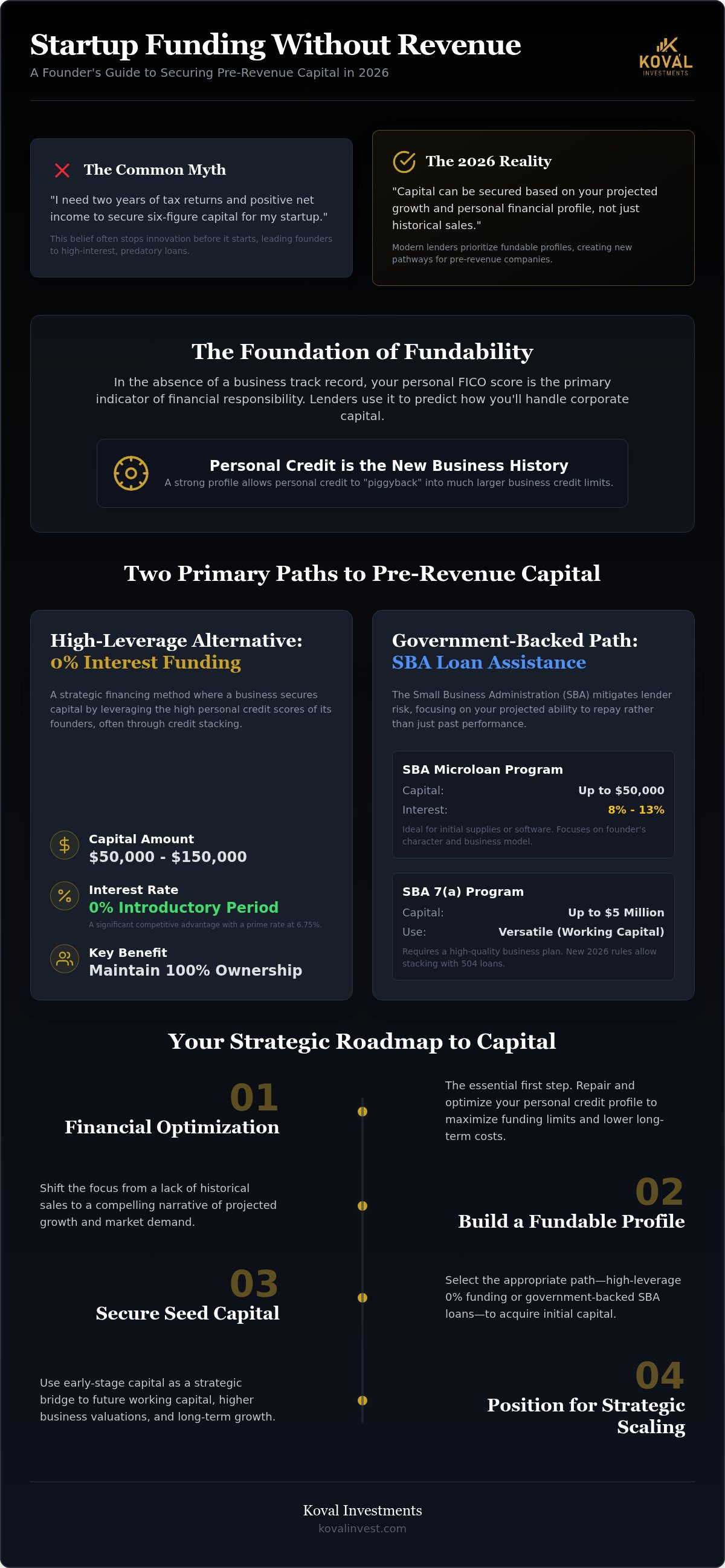
We understand this friction and are here to show you a more professional path forward. You can secure between $50,000 and $150,000 in initial capital while maintaining 100% ownership of your company. In a 2026 landscape where the prime rate sits at 6.75 percent, securing 0 percent interest funding is a significant competitive advantage. This guide provides a clear roadmap to financial fundability. We'll explore how to optimize your credit profile to access high-leverage capital and position your business for long term growth without the burden of immediate debt service.
Key Takeaways
- Understand how to secure startup funding with no revenue by shifting the focus from historical sales to your personal financial profile and projected growth.
- Discover how SBA microloans and the 7(a) program provide a reliable path to capital for new businesses when traditional bank loans are unavailable.
- Learn the mechanics of a 0% interest funding solution and how credit stacking can provide up to $150,000 in seed capital while you maintain full ownership.
- Identify why credit repair and financial optimization are the essential first steps to maximizing your business funding limits and lowering long-term costs.
- See how early-stage capital positioning creates a strategic bridge to future working capital and higher business valuations as your company scales.
The Reality of Startup Funding with No Revenue in 2026
Pre-revenue funding is capital secured based on projected growth and founder credit rather than historical sales. It represents the critical Seed money required to bridge the gap between a business concept and a market-ready product. In 2026, the lending environment has shifted. While traditional institutions still cling to legacy metrics, modern lenders prioritize fundable profiles over immediate cash flow. This means that startup funding with no revenue is more accessible than it was five years ago, provided you understand how to position your financial identity.
Many founders are held back by the revenue myth. They believe they need two years of tax returns and a positive net income to secure six-figure capital. This belief often stops innovation before it starts. The reality is that alternative business funding solutions have filled the void left by rigid commercial banks. These solutions focus on the future potential of the entity and the current reliability of the founder rather than just looking at the previous year's tax filings.
The Challenges of Pre-Revenue Borrowing
Traditional banks view startups as high-risk assets because they lack the safety net of historical performance. This risk aversion often leads entrepreneurs toward high-interest daily-draw startup loans. These products carry hidden costs that can cripple a young company's cash flow before it even scales. It's vital to avoid the trap of personal loan debt for business expenses. Mixing personal and business debt in this way creates a debt-to-income imbalance that often prevents you from securing larger, more professional business lines later.
Why Your Personal Credit is the New Business History
In the absence of a business track record, your personal FICO score acts as the primary indicator of financial responsibility. Lenders use your history of managing personal debt to predict how you'll handle corporate capital. This allows personal credit to piggyback into business credit limits, often resulting in much higher funding amounts than an individual could secure alone. Credit-based funding is a strategic financing method where a business secures capital by leveraging the high personal credit scores and established financial profiles of its founders.
Accessing Capital: SBA Loan Assistance for Startups
Lenders often hesitate when they see a lack of operational history. However, the Small Business Administration (SBA) exists to mitigate this risk. The SBA 7(a) program is particularly effective for pre-revenue ventures because it focuses on your projected ability to repay rather than just past tax returns. To succeed, you need a high-quality business plan that demonstrates market demand and financial feasibility. Because federal guidelines are dense, many founders seek SBA loan assistance to ensure their application meets strict underwriting standards from the start.
Choosing between an SBA 7(a) vs 504 loan depends on your specific growth stage. The 7(a) is versatile, covering working capital and inventory. The 504 program is better suited for fixed assets like real estate or heavy machinery. Effective July 4, 2026, the SBA increased cumulative limits, allowing a borrower to hold up to $5 million in each program simultaneously. This regulatory shift provides a massive opportunity for startups to secure significant leverage early in their lifecycle.
The SBA Microloan Program
For those seeking smaller amounts of startup funding with no revenue, the SBA Microloan program provides up to $50,000. These funds are distributed through community-based, non-profit intermediaries rather than large commercial banks. In 2026, interest rates for these loans typically range between 8% and 13%. While some microloans require collateral, many lenders focus more on the founder's character and the strength of the business model. This makes them an ideal entry point for acquiring initial supplies or specialized software without needing years of revenue data.
Navigating the Application Complexity
The path to SBA-guaranteed loans is notoriously complex. Rejections often stem from incomplete documentation or a failure to articulate how the business will survive the first twelve months. Professional consulting streamlines the Lender Match process by pairing your startup with banks that have a proven appetite for your specific industry. In the 2026 fiscal environment, approval timelines can span from 30 to 90 days. If you're looking to accelerate this process, a professional consultation can help clarify which lenders are currently prioritizing new ventures.
High-Leverage Alternative: The 0% Interest Funding Solution
While government programs offer stability, many founders require more immediate agility. The 0% interest business funding model serves as a high-leverage alternative for those who want to avoid the immediate weight of monthly interest payments. By utilizing introductory 0% APR business lines, startups can access significant capital without sacrificing equity or providing real estate collateral. This approach is particularly effective for securing startup funding with no revenue because it relies on the founder's credit profile rather than the company's historical cash flow.
Our success-based philosophy ensures that our interests are fully aligned with yours. You only pay for the service once the capital is secured, removing the financial risk often associated with traditional consulting. It's a win-win scenario where the focus remains on maximizing your funding limits. By navigating various Startup Funding Options, founders can use these interest-free windows to reach profitability before any debt service begins, effectively using the bank's money to build their operational engine.
0% Interest vs. Traditional Debt
The primary advantage of this model is the reduction in overhead. An SBA loan at a 12.75% variable rate (based on current 2026 prime rates for mid-sized loans) requires immediate monthly payments that can drain a startup's limited reserves. In contrast, 0% APR lines allow you to reinvest every dollar back into growth during the introductory period, which often lasts 12 to 22 months. Revolving lines also offer more flexibility than term loans; you only pay back what you use, and as you pay it down, the capital becomes available again. It's ideal for pre-revenue operations where expenses fluctuate monthly.
The Mechanics of Credit Stacking
Credit stacking is the process of sequencing multiple applications to maximize total funding limits, often reaching between $50,000 and $150,000 in initial capital. Success depends on a few technical factors:
- Strategic Sequencing: Applying for specific lenders in a precise order to prevent multiple inquiries from lowering your score prematurely.
- Stated Income Applications: Leveraging projected revenue and personal income sources rather than requiring years of business tax returns.
- DTI Management: Maintaining a low personal debt-to-income ratio to ensure you remain fundable across multiple banking institutions.
This method allows you to build a robust financial foundation while keeping your personal and business liabilities separate. It's a professional way to secure the runway you need without the predatory terms found in the subprime market.
Financial Optimization: The Prerequisite for Startup Capital
Your financial profile is the engine behind every successful funding round. For founders pursuing startup funding with no revenue, personal credit isn't just a score; it's the primary risk assessment tool for lenders. High-level business credit repair services act as a strategic investment rather than a cost. They ensure that your profile doesn't just meet the minimum requirements but actively commands higher funding limits. While a 680 score might get you in the door, a 750+ score unlocks the 0% interest terms discussed earlier.
Inaccuracies are the silent killers of new ventures. When searching for startup funding with no revenue, you can't afford a single error on your report. Simple data mistakes can trigger automatic rejections from institutional lenders before a human ever reviews your application. A fundable profile requires more than a high number; it needs depth and age. Lenders look for a history of managing diverse account types and significant credit limits. Cleaning up old, stagnant accounts or disputing misreported late payments has an immediate impact on your borrowing power.
The Credit Restoration Process for Founders
Restoring credit isn't an overnight task. It typically takes three to six months to see the full impact of disputes and optimization. DIY repair often fails because it lacks the nuance required by strict 2026 underwriting standards. Professional optimization pays for itself by securing lower interest rates and higher capital amounts. If you're ready to start this process, you can schedule a professional credit evaluation to identify your specific needs.
Leveraging Credit for Long-Term Growth
Optimization isn't just about the first $100,000. It's about the long game. A strong foundation allows you to transition from personal-guarantee funding to true business credit that doesn't report to your personal files. This separation is vital for maintaining your personal debt-to-income ratio as the company grows. Later, when you apply for an SBA 7(a) loan, that same high score gives you the leverage to negotiate better terms and lower down payments. Maintaining fundability is a continuous process of strategic planning. It ensures that as your startup scales, your access to capital remains unrestricted.
Strategic Scaling: From Seed Funding to Acquisition
Initial capital is the catalyst for your long-term trajectory. Securing startup funding with no revenue does more than just pay for early expenses; it establishes the financial credibility needed for every subsequent stage of growth. This early runway allows you to focus on product-market fit without the immediate pressure of diluting your equity. As your operations mature, the focus naturally shifts from seed funding toward optimizing working capital to support daily operations and strategic pivots.
Transitioning from a startup to an enterprise requires a shift in mindset. Professional business valuations become essential tools when preparing for Series A rounds or potential acquisitions. These valuations provide a clear, objective look at your company's worth, ensuring you're positioned to negotiate from a place of strength. The Koval Investments approach is built on a collaborative partnership for the life of your business. Our success-based philosophy means we're as invested in your exit strategy as we are in your initial funding round, creating a true win-win environment.
Funding for Real Estate and Expansion
Once your startup establishes a physical footprint, your capital needs evolve. You might require specialized funding for real estate investors to secure office space or manufacturing facilities. As you scale, acquiring competitors often becomes the fastest path to market dominance. We provide the expertise needed to manage these transitions. By using your established credit and working capital to fund these acquisitions, you can grow your footprint without overextending your cash reserves. Professional M&A consulting ensures these high-stakes deals are structured for long-term stability.
Next Steps for Pre-Revenue Founders
The journey toward a high-valuation exit begins with a single, well-executed funding strategy. Pre-revenue founders can still access over $100,000 in capital by following a precise financial optimization roadmap. Your next step is to prepare your documentation for a professional review. We offer capital procurement consultations with no upfront financial risk. This process allows us to audit your current profile and identify the most efficient path to $100k+ in funding without a single dollar of revenue. By starting with a clear plan, you ensure your startup remains fundable through every stage of its evolution.
Securing Your Venture’s Financial Future
Securing startup funding with no revenue is a matter of strategic positioning rather than just historical data. By optimizing your personal financial profile and leveraging high-leverage solutions like 0% interest business lines, you create a runway that doesn't sacrifice your equity. We’ve explored how a fundable profile acts as the engine for your initial capital, while programs like the SBA 7(a) provide a bridge to long-term scaling. This journey requires a partner who understands the nuances of modern underwriting and success-based procurement.
Koval Investments offers national expertise in credit optimization and SBA assistance to ensure your application isn’t just submitted, but prioritized. We operate on a success-based consulting model with no upfront fees, giving you access to exclusive 0% interest funding networks with zero financial risk. It’s time to move past the revenue myth and start building your enterprise. Secure your startup’s future with Koval Investments’ strategic funding solutions. We look forward to navigating these complex financial landscapes alongside you and celebrating your eventual success.
Frequently Asked Questions
Can I get a business loan for a startup with no revenue?
Yes, you can secure startup funding with no revenue by leveraging alternative funding models and government-backed programs. While traditional banks often require two years of tax returns, pre-revenue founders can access capital based on their personal credit profile and projected growth. This approach shifts the focus from historical cash flow to the founder's financial reliability. It allows new ventures to obtain the necessary runway to reach their first dollar of sales.
What is the minimum credit score for 0% interest business funding?
Most lenders require a personal FICO score of at least 680 to qualify for 0% interest business funding. However, a score of 720 or higher is often the threshold for maximizing your total funding limits. Beyond the numeric score, underwriters look for credit depth, age, and a low debt-to-income ratio. Optimizing your profile before applying ensures you command the most favorable terms and the highest available revolving credit lines for your business.
How much startup capital can I secure without collateral?
Pre-revenue startups can typically secure between $50,000 and $150,000 in unsecured capital through strategic credit stacking. Because this funding doesn't require real estate or equipment as collateral, it's an ideal solution for service-based or tech companies. The specific amount depends on your personal credit history and the number of high-limit banking relationships you can establish. This unsecured approach keeps your personal assets protected while providing significant growth capital for your operations.
Do I need a business plan to get pre-revenue funding?
You don't always need a formal business plan for unsecured credit-based funding, but it's essential for SBA loans. For government-backed programs, a professional plan must demonstrate market demand and repayment capacity through realistic financial projections. Even when it isn't strictly required, having a clear roadmap helps you manage your capital more effectively. It ensures that every dollar of your startup funding with no revenue is allocated toward high-ROI activities that drive growth.
What is credit stacking and how does it help startups?
Credit stacking is the strategic process of sequencing multiple business credit applications to maximize your total available capital. By applying to specific lenders in a precise order, you can secure several revolving lines before inquiries impact your score. This method helps startups by providing a large pool of 0% interest capital that doesn't report to personal credit. It effectively builds a financial wall between your personal liabilities and your business expenses.
How long does the business credit repair process take?
The restoration and optimization process usually takes between three and six months to complete. This timeline allows for the identification of inaccuracies, the filing of formal disputes, and the subsequent update of your credit reports. While some errors are corrected quickly, building credit depth and age requires a methodical approach. Starting this process well before you need capital ensures your profile is fully fundable when you're ready to apply for major lines.
Can I use an SBA loan to start a business from scratch?
Yes, SBA programs like the 7(a) and the Microloan program are specifically designed to help entrepreneurs start businesses from scratch. These loans can be used for working capital, inventory, and equipment. While the application process is more rigorous than alternative funding, the SBA's guarantee reduces the risk for lenders. This makes it possible for founders with strong credit and a solid plan to secure competitive financing without a long history of revenue.
What are the risks of using 0% APR business credit lines?
The primary risk involves the expiration of the introductory period, after which standard interest rates apply. Founders must have a clear strategy to pay down the balance or refinance before the 0% window closes, which usually lasts 12 to 22 months. Overextending your borrowing capacity without a path to profitability can lead to cash flow strain. Managing these lines with discipline is vital to ensure they remain a low-cost growth tool rather than a long-term debt burden.