
Strategic Credit Repair for Real Estate Investors: Unlocking High-Leverage Capital in 2026
What if the credit score you're carefully guarding is actually the primary obstacle standing between you and a seven-figure portfolio? Most real estate investors treat credit repair as a defensive move to fix the past, but in the high-stakes environment of 2026, it's your most important offensive strategy. You've likely seen high interest rates eat into your rental cash flow or felt the frustration of a loan denial on a time-sensitive property deal. We understand that the confusion between personal credit impact and business credit potential can feel like a constant bottleneck to your growth.
This article will teach you how to strategically optimize your profile through credit repair for real estate investors to secure 0% interest funding and high-limit capital. You'll learn how to qualify for SBA and commercial loans with lower down payments while building a robust business credit profile that doesn't rely solely on your personal SSN. We'll walk through the exact steps to transform your credit from a liability into a high-leverage asset that funds your next acquisition with confidence and precision.
Key Takeaways
- Understand how a modest 50-point score increase can significantly lower mortgage interest rates and maximize your rental cash flow.
- Learn why credit repair for real estate investors is the essential first step to meeting strict 2026 SBA loan thresholds and institutional requirements.
- Discover how to establish a "Credit Veil" to separate personal liabilities while leveraging your personal score to secure high-limit business capital.
- Explore the "Funding-to-Repair" cycle; use 0% interest capital to consolidate debt and rapidly boost your profile for future acquisitions.
- Gain insight into a success-based approach that aligns your funding goals with strategic advisory and long-term capital procurement.
The Critical Link Between Credit Optimization and Real Estate ROI
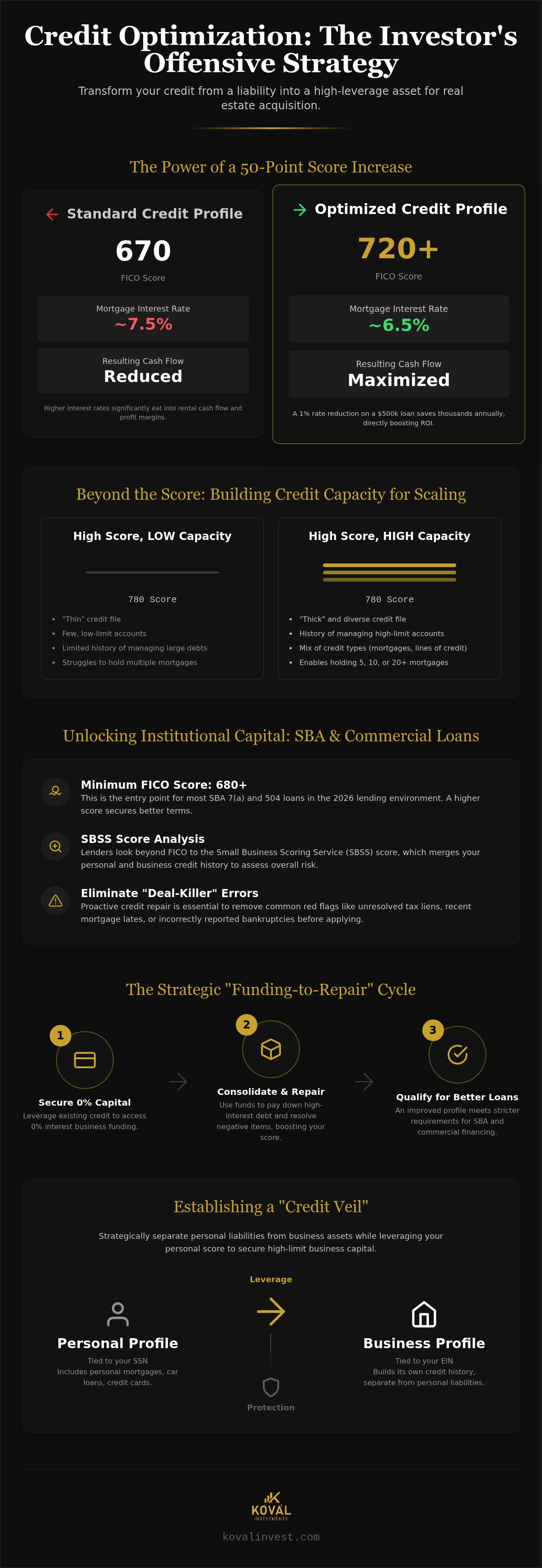
Credit repair for real estate investors isn't just about correcting errors on a report. It's a sophisticated form of financial profile optimization. When you're managing a portfolio, your credit score acts as a multiplier for your returns. A 50-point increase in your FICO score can often reduce your mortgage interest rate by 1% or more. On a $500,000 property, that single percentage point translates to thousands of dollars in annual savings, directly boosting your cash-on-cash return.
This optimization has a profound impact on your Debt Service Coverage Ratio (DSCR). Lenders use this metric to determine if a property's income can comfortably cover its debt obligations. By securing a lower interest rate through better credit, you improve the property's cash flow and, by extension, its DSCR. This makes you a more attractive candidate for institutional capital and allows you to qualify for larger loan amounts. It also positions you to access 0% interest business funding, which can be used strategically for down payments or property improvements without inflating your personal debt load.
Why Investors Cannot Rely on Hard Money Alone
Hard money is a valuable tool for speed and agility, but it's an expensive way to sustain long-term growth. The high interest rates and points associated with private money can quickly erode the profit margins of a deal. Strategic credit repair serves as your essential exit strategy. It provides the path to refinance out of high-cost bridge debt and into stable, low-interest commercial financing. As the 2026 credit market continues to tighten, the "no-doc" loans that once supported investors with lower scores are becoming increasingly rare. Lenders now prioritize borrowers who demonstrate a clean, well-managed financial history.
Credit Scores vs. Credit Capacity for Portfolio Scaling
A high credit score is a great start, but scaling a portfolio requires credit capacity. There's a significant difference between a 780 score with a single credit card and a 780 score backed by a "thick" credit file. Capacity is what determines your ability to hold five, ten, or twenty mortgages simultaneously. Lenders look for a history of managing high-limit accounts and diverse credit types. Building this depth is vital for those seeking alternative business funding solutions. While fix-and-flip investors need high-limit bridge capital for rapid turnover, long-term holders require a robust profile to secure the institutional-grade loans necessary for sustained portfolio expansion.
Navigating Credit Requirements for SBA and Commercial Real Estate Loans
Institutional lenders look beyond the surface. For those seeking credit repair for real estate investors, the process is a prerequisite for accessing the most competitive government-backed programs. In the 2026 lending environment, most banks require a minimum FICO score of 680 for SBA 7(a) and 504 loans. However, the score is only the starting point. Lenders also analyze the Small Business Scoring Service (SBSS) score, which merges your personal credit data with business credit history to assess overall risk.
Lenders view your credit report as a "character" assessment. They look for patterns of financial responsibility that suggest you can manage a complex property portfolio. Common "deal-killer" errors that frequently appear on investor reports include unresolved tax liens, recent mortgage lates, or incorrectly reported bankruptcy discharges. Because these programs are rigid, utilizing professional SBA loan assistance during the restoration process ensures your profile meets these exacting standards before you submit a formal application.
The Impact of Credit on SBA 7(a) vs. 504 Eligibility
Choosing between an SBA 7(a) vs 504 loan depends on whether you need flexible working capital or long-term financing for fixed assets. Both programs rely heavily on your personal credit score to drive the SBSS calculation. If your score is suppressed by high utilization or old inaccuracies, you may face higher interest rates or outright rejection. It's vital to begin the credit optimization process months before reaching the Letter of Intent (LOI) stage. This proactive approach prevents last-minute funding delays that could cause you to lose a time-sensitive acquisition.
Disputing Inaccuracies That Specifically Target Investors
Investors often face unique credit reporting challenges that standard consumers don't encounter. For instance, investment lines of credit may still show as "maxed out" on your report even after they've been paid down through a recent refinance. You must also remain vigilant about removing outdated foreclosure or short sale remarks that have exceeded the legal seven-year reporting window. To handle commercial collections, use the validation of debt process to require agencies to provide documented proof of the legal right to collect the specific debt amount. If you want to ensure your profile is ready for institutional scrutiny, you can partner with us to optimize your credit for high-leverage capital.
Business Credit vs. Personal Credit: The Investor’s Balancing Act
Establishing a clear separation between your personal and business credit is more than a legal formality; it's a strategic necessity. This "Credit Veil" protects your personal score from the high credit utilization that often accompanies property acquisitions and renovations. For those navigating credit repair for real estate investors, the goal is to reach a point where your business entity stands on its own. However, in the early stages of growth, your personal score remains your most valuable leverage. A strong personal FICO allows you to secure high-limit business credit cards that provide the liquidity you need without appearing on your personal credit report.
Your business identity is tracked by specialized bureaus like Dun & Bradstreet, Experian Business, and Equifax Business. These agencies look for a consistent history of trade references and on-time payments. If your business report contains errors or a lack of data, mastering business credit repair services becomes the next logical step. By ensuring these reports are accurate and robust, you build the depth required to move toward institutional-grade capital that doesn't hinder your personal borrowing power.
Building Business Credit Without Personal Guarantees
Moving from personal guarantees (PG) to non-PG funding is the ultimate roadmap for portfolio scaling. In the 2026 market, lenders are increasingly looking for entities that demonstrate independent creditworthiness. This is a critical component of funding for real estate investors, as it limits your personal risk. You can accelerate this process by reporting your rental income to business credit bureaus through specialized reporting services. This turns your existing cash flow into a credit-building asset that proves your entity's reliability.
Optimizing Debt-to-Income (DTI) Ratios Through Credit Separation
The most immediate benefit of credit separation is the improvement of your Debt-to-Income (DTI) ratio. When you move investment-related debt off your personal report, you free up the capacity to qualify for primary residence loans or other personal financial goals. This "hidden" benefit of business credit allows you to maintain a high-growth investment strategy without sacrificing your personal quality of life. Rapid credit profile optimization involves auditing both sides of the veil to ensure every dollar of debt is positioned where it serves your long-term interests best. This methodical approach ensures you're always ready for the next deal, regardless of which credit profile a lender chooses to review.
Bridging the Gap: 0% Interest Funding as a Credit Repair Catalyst
Many property owners view capital as the end goal of a financial cleanup. However, 0% interest funding isn't just a destination; it's a powerful catalyst for credit repair for real estate investors. By securing 0% APR business lines of credit, you can consolidate high-interest investment debt that might be suppressing your scores. This creates a "Funding-to-Repair" cycle. You use the low-cost capital to pay down high-utilization personal accounts, which immediately boosts your FICO score and allows you to qualify for even larger institutional loans later.
You don't always need a perfect score to begin this journey. Many lenders offer 0% APR business lines to investors with "good but not great" profiles, often starting in the 680 to 720 range. This entry-level funding provides the liquidity needed to manage property expenses while you continue the long-term restoration process. Strategically utilizing working capital for business acquisition ensures your portfolio continues to grow even as you refine your underlying credit architecture.
The 0% Interest Funding Solution Strategy
Koval Investments specializes in a 0% Interest Funding Solution that aligns with your specific acquisition timeline. Our team typically moves clients from the initial credit repair phase to funding approval within a matter of weeks, rather than months. We focus on maximizing the 12 to 21 month introductory periods offered by many business lenders. This timeframe is ideal for financing property renovations or stabilizing a new rental unit. It allows you to use the bank's money for free during the most capital-intensive phase of a deal, preserving your cash flow for other opportunities.
Leveraging Unsecured Funding for Real Estate Deposits
Unsecured business funding is a game-changer for investors participating in competitive bidding wars. Because this capital isn't tied to a specific property lien, you can use it for earnest money deposits or "gap" funding between your primary mortgage and the purchase price. Managing this unsecured capital requires professional strategic planning to ensure you don't over-leverage your entity. Liquidation involves converting available credit limits into liquid cash to facilitate acquisitions where sellers demand immediate proof of funds or wire transfers. To see how much 0% interest capital your current profile can unlock, apply for our 0% Interest Funding Solution today and let us help you scale your portfolio with zero financial risk.
Koval Investments: Your Strategic Partner for Capital and Growth
Koval Investments operates as a boutique strategic partner, positioning ourselves as a steady hand in the often turbulent world of property finance. Our firm is built on a success-based philosophy, which means we only succeed when you successfully secure the funding necessary to scale your operations. This creates a collaborative environment where our team is fully invested in your results. We've seen that the most effective credit repair for real estate investors is never a standalone task. It must be an integrated part of a larger capital procurement strategy that includes strategic advisory and capital procurement. By working with us, you gain access to "insider" financial strategies that bridge the gap between high-level strategy and daily operational realities.
Beyond Credit: Strategic Advisory and M&A for Real Estate
Scaling a property portfolio requires more than just capital; it requires a roadmap that prevents future credit pitfalls. Rapid growth can often lead to over-leveraged profiles if not managed with care. Our strategic planning services ensure that your entity's expansion doesn't compromise your borrowing power. We also provide professional business valuations that help you understand the true market value of your holdings. This data is essential when negotiating for higher funding limits or preparing for a portfolio exit. For those looking to dominate their local market, our consulting for real estate mergers and acquisitions offers the tactical support needed to consolidate assets and acquire smaller competitors efficiently.
Getting Started with a Professional Credit and Funding Audit
The first step toward high-leverage capital is a comprehensive audit of your current financial standing. During a consultation with Koval Investments, we perform a deep dive into your personal and business credit profiles. We look for the specific levers that will move the needle for your unique investment strategy. You'll walk away with a customized roadmap designed to unlock our 0% Interest Funding Solution as quickly as possible. This process is designed to be transparent and low-pressure, focusing on the practicalities of business advancement rather than empty promises. If you're an investor ready to move beyond traditional lending constraints, we invite you to begin your audit today. Let's work together to implement the credit repair for real estate investors that your portfolio deserves and secure the capital you need to succeed.
Building a Sustainable Foundation for High-Leverage Growth
Strategic credit repair for real estate investors represents the bridge between managing a few properties and controlling a high-leverage portfolio. You've learned that optimizing your profile isn't just about fixing errors; it's about positioning yourself for the most competitive institutional capital available. By separating personal liabilities from business potential and utilizing 0% interest cycles, you create a sustainable foundation for rapid expansion.
Koval Investments has specialized in investor capital since 2018. We operate on a success-based model that eliminates upfront financial risk for many of our core services, ensuring our goals are perfectly aligned with your own. Our comprehensive suite, including SBA loan assistance and professional business valuations, provides the steady hand you need to navigate complex markets. Secure your 0% interest funding and credit audit with Koval Investments today to begin transforming your credit into your most powerful acquisition asset. Your next major deal is closer than you think.
Frequently Asked Questions
How long does credit repair take for real estate investors?
Credit repair for real estate investors typically requires three to six months for significant results. This timeline depends on the complexity of your report and the responsiveness of credit bureaus. While some errors are corrected within thirty days, building a thick file for institutional capital is a gradual process. We align this restoration with your acquisition schedule to ensure you're ready for funding when the right property deal appears.
Can I qualify for 0% interest business funding with a 650 credit score?
Qualifying for 0% interest business funding generally requires a FICO score of 680 or higher. While a 650 score might lead to approvals for some working capital, the most competitive 0% APR introductory offers are reserved for stronger profiles. If you're currently at 650, our team focuses on rapid optimization to bridge that thirty point gap. This allows you to access high-limit credit lines that don't appear on your personal report.
Does fixing my personal credit automatically improve my business credit?
Fixing your personal credit does not automatically update your business credit profile. Personal scores are tracked by Equifax, Experian, and TransUnion, while business credit relies on Dun & Bradstreet and specialized business divisions. However, most lenders use your personal score as a primary indicator for business funding approvals. Improving your personal profile is the most effective way to jumpstart your ability to secure high-limit business lines without a personal guarantee.
Is it possible to secure real estate investment funding while in the credit repair process?
It's entirely possible to secure funding while your credit is being restored, though your options may be limited to higher-cost bridge loans. We often see investors use hard money to secure a property while simultaneously undergoing credit repair for real estate investors. This creates a clear exit strategy. Once your profile is optimized, you can refinance that expensive debt into a low-interest SBA loan or a conventional commercial mortgage.
What are the most common errors on an investor’s business credit report?
Common errors on an investor's business credit report include incorrectly reported maxed out lines of credit and outdated public records. Many investors also find that their business is listed under the wrong industry classification code, which can trigger automatic denials from certain lenders. We also see trade lines from suppliers that fail to report on-time payments. Auditing these specific data points is a critical part of our comprehensive financial profile optimization process.
How much does professional credit repair for real estate investors cost?
The cost of professional credit repair varies based on the depth of the restoration required and the specific funding goals of the investor. At Koval Investments, we operate with a success-based philosophy for many of our capital procurement services. This means our interests are directly aligned with your ability to secure funding. We provide a transparent breakdown of any service fees during your initial audit so you can make an informed decision.
Can I use SBA loans for residential real estate investment?
SBA loans are generally not used for passive residential real estate investment. These programs are designed for owner-occupied commercial properties or businesses that provide a specific service. However, real estate investors can use SBA 7(a) or 504 loans to acquire properties for their own business operations or to fund the business side of their investment firm. This capital can provide the working capital needed to scale your overall portfolio and operational team.
Why should I choose Koval Investments over a traditional credit repair company?
Koval Investments differs from traditional credit repair firms by integrating restoration with capital procurement. Most companies simply fix scores without understanding the specific requirements of institutional lenders. We've been a specialized strategic partner since 2018, focusing on the win-win nature of our engagements. Our approach combines credit optimization with SBA assistance and business valuations to provide a comprehensive roadmap for your long-term growth and capital access.